

THE REST OF EDUCATION SPENDING WILL THEN GO FARTHER
Gov. Mike Dunleavy has called for accountability in education since before bhe began running for governor in 2018.
As a former teacher and lifelong educator, he pointed out that the State of Alaska spends far more money per student than almost every other state in America, but students in Alaska are at the bottom in terms of standardized test scores. Alaska’s education budget is $1.5 billion per year.
The governor’s Alaska Reads Act is meant to address the one skill that will help students the most: Reading. Currently, fewer than four in ten elementary school children are reading at the expected grade level.
By focusing on reading, including sending reading professionals to schools to work with students and teachers, Dunleavy hopes to make his mark on that accountability problem that schools have.
Must Read Alaska reached Commissioner of Education and Early Childhood Development Dr. Michael Johnson, who said he wasn’t sure what the cost of the program would be, but that “there will be a modest fiscal note.” Some of the aspects of the reading focus can come from using existing resources and redirecting them toward reading.
“They key thing to remember is that whatever the cost, it has a multiplier effect throughout a child’s education. The $1.5 billion we spend on education across the state will be more effective if we address the basic foundation of reading,” Johnson said. “This is true throughout all the grades and even into our university system. The dollars we spend will be worth it when we have children reading at grade level.”
The University of Alaska system has found that 74 percent of high school graduates who attend one of the state universities are having to take at least one remedial class.
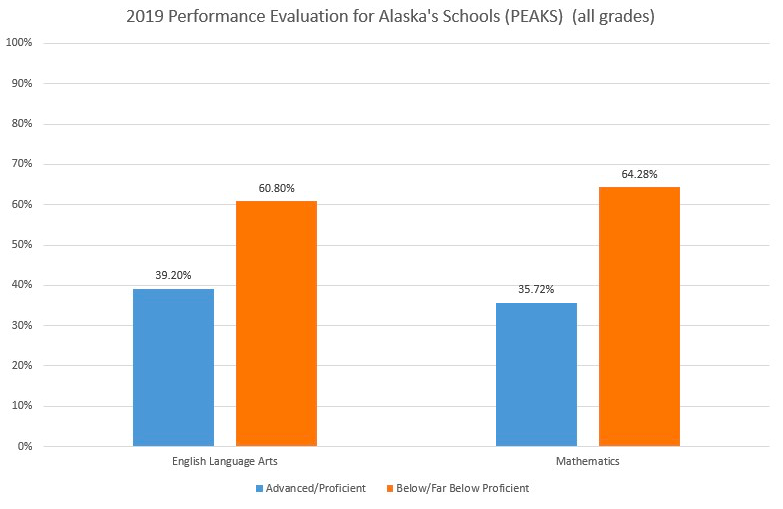
Alaska schools were not always like this. In the 1970s, students graduating from Alaska high schools were among the top in the nation. Today, they wallow at the bottom in terms of those national test scores, such as the SAT, (there are schools in Alaska where that is clearly not the case).
The key points of the Alaska Reads Act are:
- Statewide teacher training on reading instruction and job-embedded training through State Department of Education reading specialists.
- Focusing existing state and federal funds on reading.
- Early literacy screening tool.
- Timely parent notification.
- Individual reading plans.
- Monitored student progress.
- Home reading strategies and/or programs.
- Interventions.
- Appropriate grade-level progression for students severely below grade level.
- Multiple pathways to demonstrate reading proficiency.
- Good cause exemptions.
Details of how the Department of Education plans to achieve these goals include:
- Prioritize early reading in all elementary schools, including K–12 schools.
- Adopt and implement effective reading programs and materials.
- Incentivize districts to adopt and implement effective curriculum and teaching strategies.
- Adopt 60- or 90-minute reading blocks in grades K–3 in all districts.
- Encourage district review of different K–3 models, including movement through individual grades.
- Create and disseminate materials for parents and community members on how they can support the development of their children’s reading skills.
- Provide consistent, ongoing professional development for educators and community members on the effective use of adopted reading curricula.
- Implement effective early screeners in K-3.
- Train teachers on state standards and on how to align instruction to these standards.
- Assist school leaders in using data and classroom walkthroughs to ensure implementation of aligned curricula.
- Use valid and reliable formative assessments to monitor students’ progress.
- Identify and implement effective interventions for struggling readers.
- Inform and train educators, parents, and community members on how to understand reading data and on how it can be used to support students in their reading skills attainment.
- Establish voluntary district reporting to the state on K–3 reading measures.


