The Alaska Department of Fish and Game announced new sport fishing restrictions for Cook Inlet’s summer and winter saltwater king salmon fisheries. The order is in response to declining king salmon populations, the department advised.
Key restrictions for king salmon sport fishing include:
- Cook Inlet Salt Waters north of Bluff Point (59° 40.00′ N. lat.)
- Closure period: May 1 – Aug. 15, 2025
- Regulations: King salmon fishing, including catch-and-release, is strictly prohibited. Any king salmon incidentally caught while fishing for other species must be released immediately without removing the fish from the water.
- Lower Cook Inlet (south of Bluff Point to Cape Douglas and east of Gore Point, including Kachemak Bay)
- Bag and possession limits: One king salmon of any size per day from April 1 – Aug. 31, 2025.
- Winter fishery start: From Sept. 1-15, the bag and possession limit remains at one king salmon of any size.
- Exemptions for terminal fisheries
- The Nick Dudiak Fishing Lagoon on the Homer Spit and the Seldovia Slough and Lagoon Terminal Fisheries are excluded from the reduction in bag limits. These areas will retain the previous two-king salmon bag limit.
Recent monitoring of early-run king salmon escapement in the Kenai, Anchor, and Deshka Rivers indicates that 2025 runs are projected to be below the lower end of escapement goals. This has prompted preseason closures for in-river sport fisheries and an additional closure of Upper Cook Inlet salt waters north of Bluff Point from May 1 – July 15 under the Upper Cook Inlet Summer Salt Water King Salmon Management Plan.

Further, the Kenai River Late-Run King Salmon Stock of Concern Management Plan, adopted by the Alaska Board of Fisheries, mandates an annual closure to sport fishing for king salmon north of Bluff Point from June 20-Aug. 15 until the Kenai River late-run king salmon population meets recovery criteria.
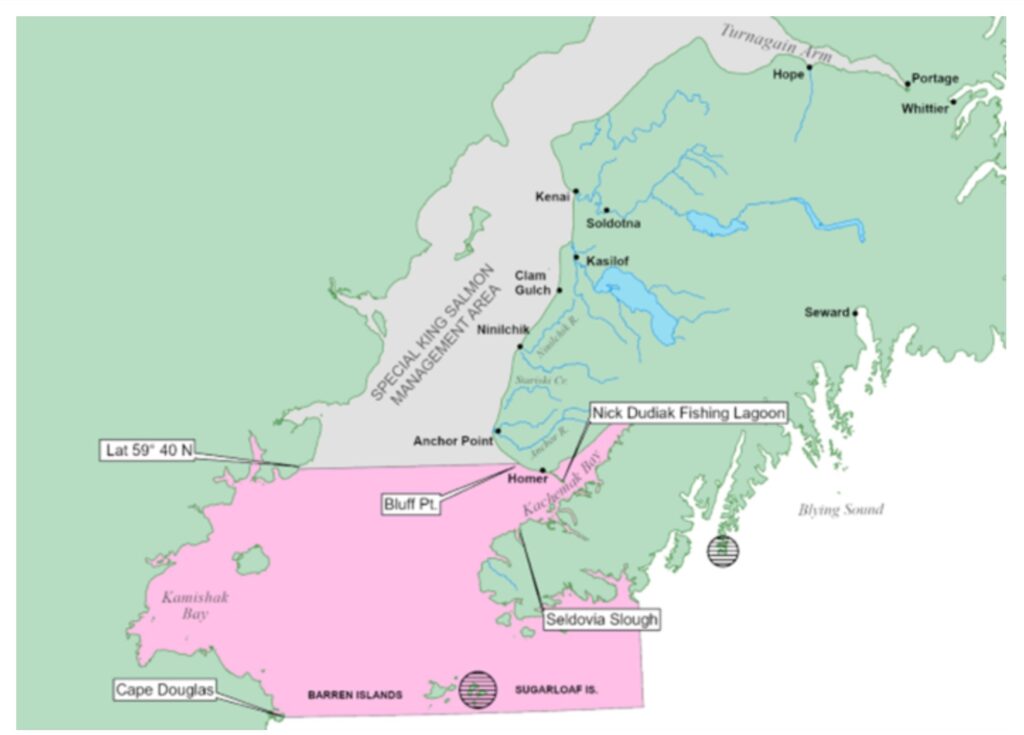
The emergency restrictions apply solely to king salmon sport fishing and do not impact the sport fishing regulations for other species, such as halibut. However, they coincide with similar freshwater sport fishery restrictions throughout Cook Inlet.
“King salmon have continued to decline and were at historic low levels in 2024,” said Mike Booz, Area Management Biologist for ADF&G. “These restrictions aim to maximize escapements while taking a more precautionary approach to sport harvest opportunities in these mixed-stock fisheries.”
Anglers are asked to review the latest Southcentral Sport Fishing Regulation Summary booklet for more details on current regulations. The department said it will continue monitoring salmon populations and may adjust regulations as necessary to support the recovery of king salmon stocks in the region.
These closures follow a pattern of recent years with multiple closures. However, this announcement represents one of the more sweeping closures in recent years.
With so many closures over so many years, overfishing doesn’t appear to be the problem.
It may be that pink salmon being released in hatcheries are dining on king salmon fry in the ocean, which could be dramatically reducing the number of kings returning. Read this report from 2018 on the complicated issue of hatchery pink salmon and their life cycle: