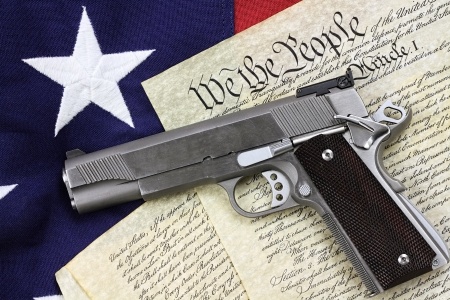
The U.S. Supreme Court has upheld a federal gun law, rejecting the challenge of its constitutionality by a man who was federally banned from possession of a gun due to being subject to a restraining order in a domestic violence case.
The court heard the case of U.S. v. Rahimi in November, delving into the complex issue of what constitutes “dangerousness,” and how it pertains to Second Amendment protections. Its ruling was issued Friday.
The question before the Court revolved around whether a person such as Zackey Rahimi, who is subject to domestic-violence restraining orders, should be barred from possessing firearms under federal law.
The mainstream media, including the New York Times and POLITICO, falsely reported that domestic abusers cannot possess guns, while the ruling clearly applies only to those with restraining orders.
Chief Justice John Roberts, writing the 32-page opinion for the majority, said that the law applies common sense.
“When an individual has been found by a court to pose a credible threat to the physical safety of another, that individual may be temporarily disarmed consistent with the Second Amendment,” he wrote.
“Since the Founding, the Nation’s firearm laws have included regulations to stop individuals who threaten physical harm to others from misusing firearms. As applied to the facts here, Section 922(g)(8) fits within this tradition,” Roberts wrote.
“The right to keep and bear arms is among the ‘fundamental rights necessary to our system of ordered liberty,’” he wrote, citing McDonald v. Chicago, 561 U. S. 742, 778. “That right, however, ‘is not unlimited.” …
In an important aside, Roberts added that the Second Amendment does not jut apply to the muskets that were in use when the Constitution was ratified.
“The reach of the Second Amendment is not limited only to those arms that were in existence at the Founding. Heller, 554 U. S., at 582. Rather, it “extends, prima facie, to all instruments that constitute bearable arms, even those that were not [yet] in existence.” Ibid. By that same logic, the Second Amendment permits more than just regulations identical to those existing in
1791,” Roberts wrote.
Throughout the arguments in November, the Justices showed interest in the history of domestic violence in the United States and the specific terms of the federal gun ban for those under restraining orders.
However, the discussion by the justices had repeatedly circled back to the fundamental query of what specific conduct might cancel a person’s Second Amendment rights to possess firearms. At the time of the discussion, the majority of the court appeared inclined to uphold the federal law in question.
Friday’s decision reverses a lower court ruling that found the law to be in violation of the Second Amendment.
Read the court’s opinion at this Supreme Court link.