
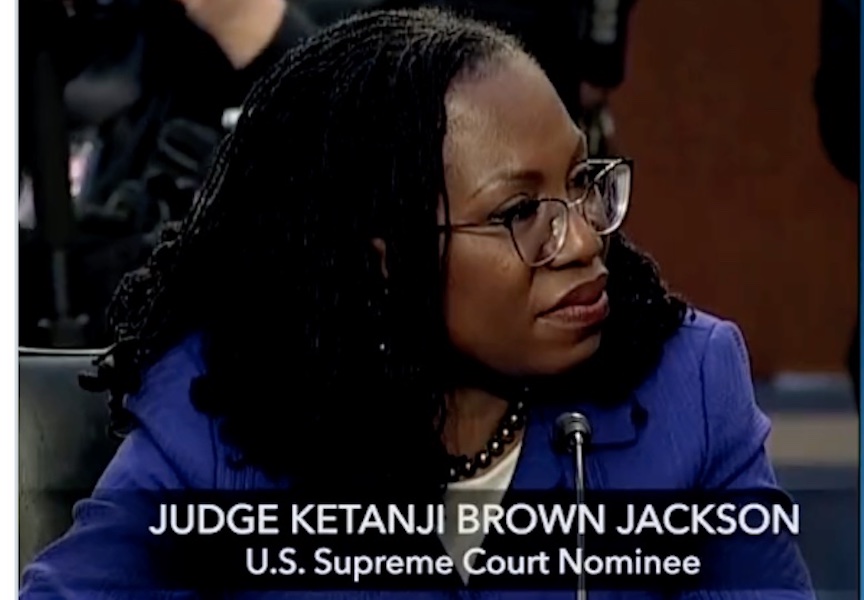
“My biggest concern is that your view has the First Amendment hamstringing the government in significant ways in the most important time periods,” Supreme Court Justice Kentanji Brown Jackson told Louisiana Solicitor General Benjamin Aguiñaga on Monday during Aguiñaga’s presentation defending citizens in the state of Louisiana and Missouri.
Louisiana and Missouri attorneys [and solicitor] general challenged the federal government over how it censored conservative speech and coordinated with social media companies to silence critics during the 2020 election and the Covid-19 pandemic.
The states won in the Fifth Circuit Court of Appeals in Western Louisiana last fall. Appeals Court Judge Terry Doughty, chief judge of the U.S. District Court for the Western District of Louisiana, said the government-directed censorship witnessed was “the most massive attack against free speech in United States’ history” in his 155-page memorandum ruling issued last year.
The appeals court ruled that the Biden Administration had appeared to violate the First Amendment when it worked to persuade social media platforms to remove what the government said was misleading or false content about the Covid-19 pandemic.
The lower court judges wrote that the White House and the Office of the Surgeon General had coerced “platforms to make their moderation decisions by way of intimidating messages and threats of adverse consequences” and “significantly encouraged the platforms’ decisions by commandeering their decision-making processes.”
The Biden Administration appealed the ruling to the Supreme Court and the Supreme Court calendared the case for this session.
During Monday’s oral arguments for Murthy v. Missouri, aka Biden v. Missouri, Justice Brown Jackson had concerns about limiting the government’s role in censoring Americans through its coordination with social media companies like X/Twitter and Meta/Facebook/Instagram because “some might say that the government actually has a duty to take steps to protect the citizens of this country” in ways that are more draconian than just posting the government’s point of view.
“You seem to be suggesting that that duty cannot manifest itself in the government encouraging or even pressuring platforms to take down harmful information,” Jackson said. “So can you help me because I’m really worried about that. Because you’ve got the First Amendment operating in an environment of threatening circumstances, from the government’s perspective, and you’re saying that the government can’t interact with the source of those problems.”
Aguiñaga answered that he was not asking for a restriction on interactions between the government and social media companies, but he said there are constitutional limits to what the government can do in the way of bullying or threatening.
“Our position is not that the government can interact with the platforms there. They can and they should in certain circumstances like that, that present such dangerous issues for society and especially young people,” Aguiñaga said. “But the way they do that has to be in compliance with the First Amendment and I think that means they can give them all the true information that the platform needs and ask to amplify that.”
Despite the abuse of power by the Biden Administration, even more-conservative Justice Amy Coney Barrett raised a concern about how a ban on the cooperation of social media companies with government requests could be too sweeping. It may be the case gets remanded to the Fifth Circuit for further consideration of sideboards on the government, to keep it from being a director of online content and a censor of Americans’ points of view.
Brown Jackson was nominated to the Supreme Court by President Joe Biden and confirmed by the Senate in 2022; she is the first black woman and the first former federal public defender to serve on the Supreme Court. Her confirmation vote in the Senate was 53-47, with three Republicans joining all 50 Democrats in voting yes. Those Republicans were Sens. Lisa Murkowski of Alaska, Susan Collins of Maine, and Mitt Romney of Utah.


