
By WIN GRUENING
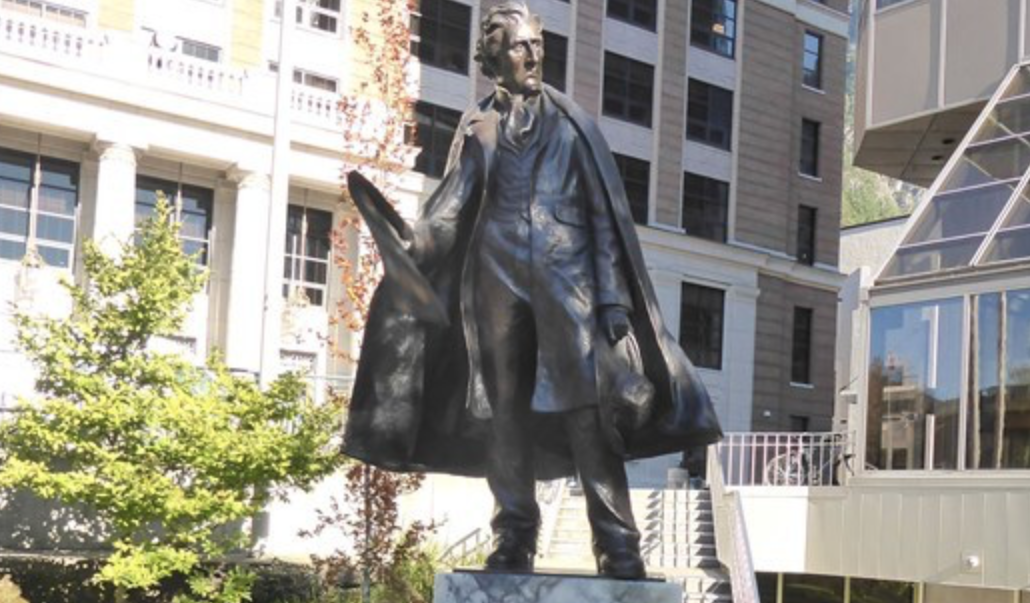
Calls to take down the statue of William Henry Seward from the Court Plaza across from the Capitol in downtown Juneau accelerated after a petition (directed to Juneau state Sen. Jesse Kiehl and Juneau Rep. Sara Hannan) circulated online.
Citing Seward as a symbol of American imperialism and colonialism as reasons to remove his statue they deem offensive, activists accompanied their demands with pleas for unity, reconciliation, and respect for individual differences.

Will removing or replacing Seward’s statue accomplish this or will it just sow more division and feelings of resentment?
The 6-foot bronze sculpture of abolitionist and Secretary of State William Seward, the work of Ketchikan-based sculptor David Rubin, was unveiled on July 3, 2017.
It marked the 150th anniversary of the 1867 purchase transferring Alaska from Imperial Russia to the United States.
As the single most persistent and persuasive voice supporting the purchase, Seward was instrumental in modern-day Alaska’s founding, first as a territory and eventually as our nation’s 49th state. It’s entirely appropriate that he be honored for his role in Alaska’s history and his statue be sited near the state capitol.
There is hardly unanimity of opinion among Native leaders regarding Seward’s legacy.
“Across the Shaman’s River” author Dan Henry wrote that when Seward visited Klukwan two years after the purchase in 1869, he was received with great respect and exchanged gifts with Koh’klux, a fearsome Tlingit leader. Henry writes because of that respect: “…he (Koh’klux} tattooed Seward’s name in his arm…and finally freed his own slaves in 1883, twenty-one years after President Lincoln signed the Emancipation Proclamation.”
Noted Alaskan Native leader, politician, and educator, Willie Hensley, in his 2017 article re-published in Smithsonian Magazine commemorating the Alaska Purchase anniversary, concluded with this quote:
“As the United States celebrates the signing of the Treaty of Cession, we all – Alaskans, Natives and Americans of the lower 48 – should salute Secretary of State William H. Seward, the man who eventually brought democracy and the rule of law to Alaska.”
Nevertheless, it’s appropriate to call attention to the fact that indigenous people were neither consulted on the purchase nor immediately granted citizenship in their new country. After many years, this injustice has been acknowledged in a myriad of ways.
In 1945, the advocacy of Elizabeth Peratrovich, a Petersburg-born Tlingit, resulted in the passage of the territory’s Anti-Discrimination Act, the first such law in the United States. Her impassioned testimony before the territorial legislature was considered decisive in its passage when she stated:
“I would not have expected that I, who am barely out of savagery, would have to remind gentlemen with five thousand years of recorded civilization behind them, of our Bill of Rights.”
In 1971, after the tireless advocacy of Willie Hensley and other Native leaders, Congress passed the Alaska Native Claims Settlement Act (ANCSA). It was the largest land claims settlement in United States history. ANCSA sought to resolve (and provide compensation for) long-standing aboriginal land claims in Alaska.
Speaking at the Seward statue dedication, Alaska’s first Native Lt. Gov, Byron Mallott, expressed hope for Alaska reaching the potential that Seward envisioned. Mallott also speculated Seward would have appreciated the exceptional negotiating skills of Alaska Native tribes when ANCSA was enacted.
“Like the Brooklyn Bridge, Alaska Natives sold Alaska again in 1971 for a bit more than $7.2 million,” Mallott said. “(Our compensation)…was for a billion dollars and 44 million acres of land.”
Even without the land and after adjusting for inflation, ANCSA’s monetary settlement dwarfed Alaska’s original purchase price. Then, under a special tax exemption engineered by Sen. Ted Stevens, between 1986 and 1988, Alaska Native corporations reaped another bonanza by selling an estimated $1.5 billion in net operating losses for $445 million in revenues.
Today, Alaska Natives populate our legislature, corporation boardrooms, social and civic organizations, and wield considerable political power.
The progress made since 1867 doesn’t diminish past injustices inflicted on Native people which must be part of any fair recounting of Alaska’s history. Nor does it mean we shouldn’t continue to recognize the historical rights and contributions of Alaska Natives.
But taking down Seward’s statue won’t make our history more fair, nor will it advance the cause of Alaska Natives.
It’s been suggested that Seward’s statue be replaced by one honoring Elizabeth Peratrovich. Why not commemorate her in an equally visible location – perhaps in front of the Alaska State Museum?
Elizabeth Peratrovich represents a shining example of Alaskans’ determination to eliminate discrimination and establish equal rights in our state.
But elevating Peratrovich over Seward detracts from that message. Each of them occupies a unique place in time in Alaska history.
A balanced view of history demands that both should be preserved.
Win Gruening retired as the senior vice president in charge of business banking for Key Bank in 2012. He was born and raised in Juneau and graduated from the U.S. Air Force Academy in 1970. He is active in community affairs as a 30-plus year member of Juneau Downtown Rotary Club and has been involved in various local and statewide organizations.


