
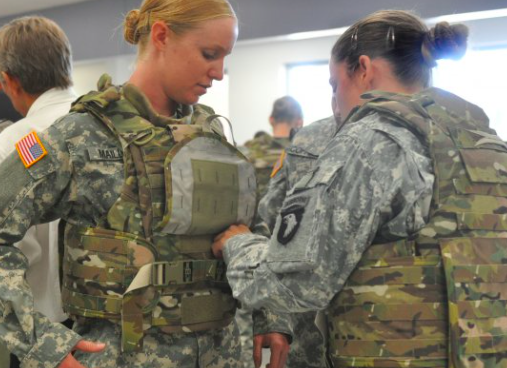
Is this the year when women will be required to sign up for the Selective Service?
Since its creation by Congress in 1917, the United States Selective Service has registered all men ages 18 through 25. But the National Defense Authorization Act that has passed from the Senate Armed Services Committee and is heading to the Senate floor, has what has become a perennial proposal: Adding women to the draft list requirement.
The NDAA authorizes funding levels and provides authorities for the U.S. military and other critical defense priorities. On June 13, the Senate Armed Services Committee voted 22-3 to advance the NDAA for Fiscal Year 2025, a proposal that would award $923.3 billion in taxpayer funds (and national borrowing from countries like Japan and China) for the nation’s defense. The legislation authorizes $878.4 billion for the Department of Defense and $33.4 billion for national security programs within the Department of Energy.
The Pentagon has not drafted anyone since the Vietnam War and there is no current movement to create a draft; the current armed forces for the country is made up of volunteered service members. Repeatedly in past years, attempts have been made to add women to the draft, as recently as in 2022. It’s been championed by Sen. Jack Reed of Rhode Island, a Democrat who is a graduate of West Point.
The executive summary of the bill is here:
In 2017, Congress created a commission to study the matter of adding women to the draft. The commission’s final report, required by the 2017 National Defense Authorization Act, recommended that women be drafted.
“This is a necessary and fair step, making it possible to draw on the talent of a unified Nation in a time of national emergency,” the 11 commissioners wrote in their final report.
The effort has failed in previous years’ versions of the NDAA, but this year, it looks like it may pass.
Although the amendment to sign women up for the draft was offered by Sen. Reed, he ended up voting against the bill because of an amendment to increase overall spending, which was offered by Sen. Roger Wicker, the committee’s top Republican. Sens. Elizabeth Warren, a Massachusetts Democrat, and Tom Cotton, a Republican from Arkansas, also voted against the spending bill.
Read the Selective Service history of legislation, lawsuits, and debate over women and the draft at this link.
The Senate version of the NDAA comes at the same time the House passed its $883.7 billion version of the bill, which has a number of Republican items contained in it, including an amendment that prohibits funds for executive orders on climate change, and defunding the Defense Department’s chief diversity office; eliminating the diversity, equity and inclusion-related offices inside the military; and instituting a hiring freeze on all jobs related to diversity, equity and inclusion.
The House version also has an amendment that bans drag shows and other drag-related events on military bases.
Read more about the details of the Senate’s version of the NDAA at BreakingDefense.com.


