
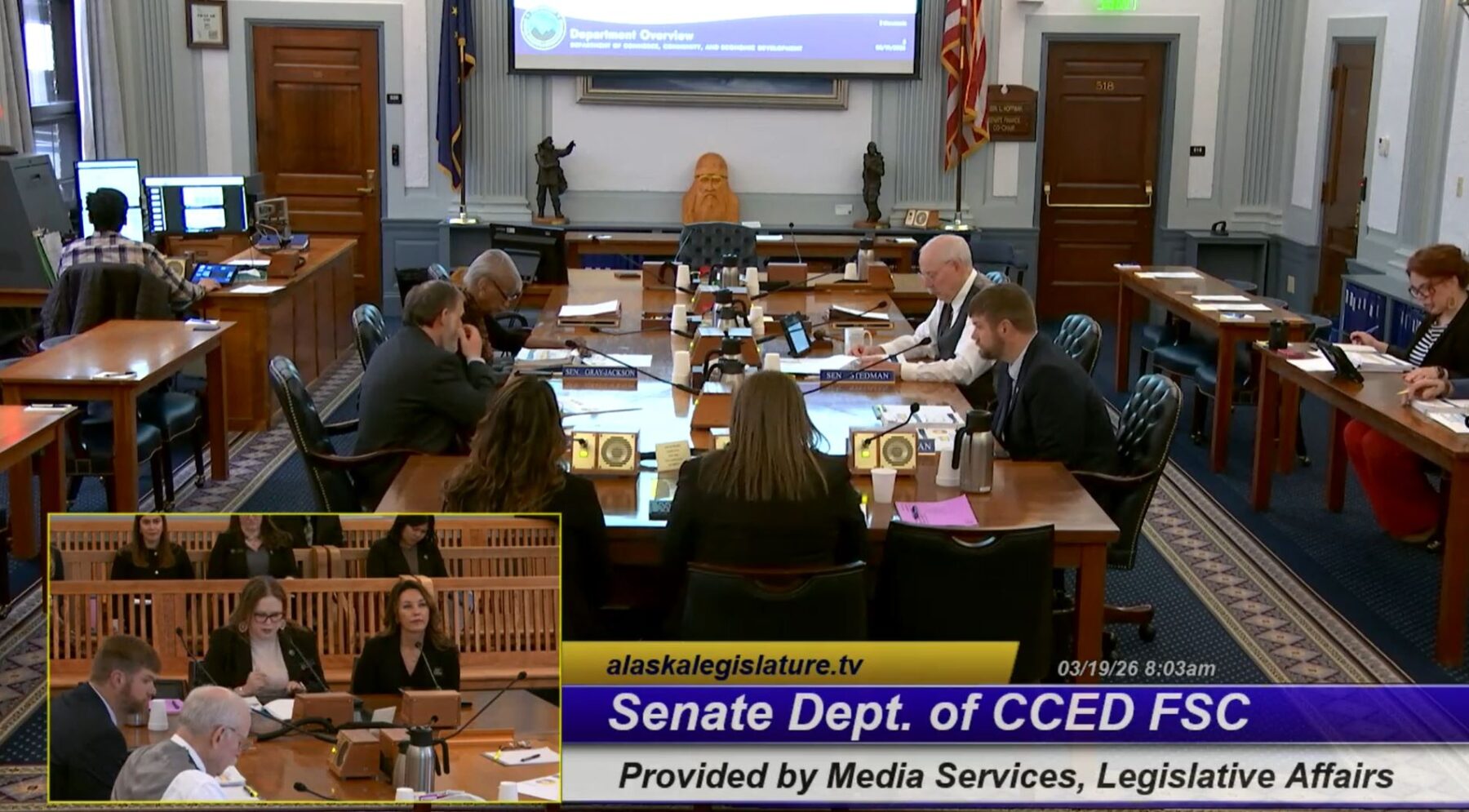
The Senate Finance Committee opened its review of the Governor’s fiscal year 2027 budget for the Department of Commerce, Community, and Economic Development with a clear focus on fiscal discipline and measurable returns. The session featured Commissioner Julie Sande and Administrative Services Director Hannah Lager presenting a $242.8 million request that relies overwhelmingly on designated general funds from licensing receipts, program receipts, and regulatory charges. Unrestricted general funds form only a “small blue sliver,” underscoring the department’s long-standing role as one of the state’s smallest consumers of core taxpayer dollars while remaining a net contributor to the general fund.
Commissioner Sande framed DCCED as “small but mighty,” tasked with promoting a healthy economy, strong communities, and consumer protection across a sprawling portfolio of divisions and corporate entities. She highlighted leadership transitions and program momentum, including new directors in Banking and Securities, Corporations, Business and Professional Licensing, and Investments. Special emphasis fell on the Alaska Broadband Office under Director Thomas Lochner, which has secured an additional $627 million in federal awards—bringing the cumulative total to $1 billion statewide. Sande described this as a landmark achievement that leverages targeted investments to expand access without heavy reliance on state general funds.
Director Lager walked the committee through the numbers, noting that after covering its own operations, DCCED contributed $133 million to the general fund in FY2025. She detailed operational adjustments, including the return of travel and accounts payable positions from Shared Services deconsolidation while retaining centralized payroll for efficiency. In the Division of Community and Regional Affairs, staffing reallocations and federally funded additions address surging disaster recovery grants exceeding $30 million each. The budget maintains $250,000 in base operating support for the Inter-Island Ferry Authority, ensuring continuity for critical transportation links.
A substantial portion of the discussion centered on the Community Assistance Fund. Lager explained its statutory mechanics: one-third of the balance is distributed annually, calculated on June 30 and paid July 1. Recent years have seen distributions of just over $23 million for FY2026, with an expected $20 million payout on July 1, 2026, following prior appropriations. The Governor’s proposal includes a $14 million capitalization from the Power Cost Equalization fund’s earnings waterfall, projecting an approximately $18 million distribution at the start of FY2028. Sen. Jesse Bjorkman (R-Nikiski) sought clarity on fund history and policy goals, while Chair Sen. Bert Stedman (R-Sitka) signaled strong legislative intent: “It’s highly likely the finance committee is going to fill out that community assistance. We’re going to take care of that.” The committee directed Legislative Finance to prepare a detailed layout of historical capitalizations, distributions, and timing mechanics to ensure predictability for small communities where these funds represent a significant revenue share.
The Division of Corporations, Business and Professional Licensing drew focused attention. Director Sylvan Robb and staff outlined sustained growth in business filings and licensing revenues. A proposed FY2027 shift would fund professional investigations through business licensing and corporations receipts rather than individual licensee fee pools. This change aims to prevent fee spikes in small professions—where a single $36,000 investigation can burden just 26 licensees—and eliminate the unfair burden on compliant professionals subsidizing bad actors. Sen. Bjorkman raised concerns about self-policing incentives under the current model and requested a matrix on differential fee structures for pending licensure compacts, including the Nurse Licensure Compact’s proposed doubling of multi-state fees. The department committed to providing analyses on incentive effects, fee stability, and implementation considerations.
Other corporate entities received targeted review. The Alaska Gasline Development Corporation maintains a $2.2 million operational request plus $3.2 million in “hollow authority” from the LNG fund, retained for flexibility should capitalization occur. Chair Stedman requested a detailed justification for the authority level to support continued oversight. The Alaska Energy Authority’s new Railbelt Transmission Organization component includes a one-year $1.3 million bridge from the Railbelt Energy Fund pending tariff approval by the Regulatory Commission of Alaska. Lager noted ongoing work to value Bradley Lake and intertie transmission assets and to pursue substantial federal transmission grants. The Alaska Seafood Marketing Institute’s core operations remain funded, though the Governor’s proposal omits supplemental marketing dollars seen in prior years. Committee leadership expressed interest in evaluating additional support to maintain Alaska’s global competitiveness.
Supplementals and amendments addressed immediate needs: higher-than-expected legal costs for the Railbelt Transmission Organization, a Bulk Fuel Revolving Loan Fund transfer for a Typhoon Halong-impacted community, and carry-forward language for the Broadband Office to align with federal indirect cost negotiations. The committee closed by thanking the department for a focused, data-driven presentation and securing commitments for follow-up materials, including broadband grant recipient lists and compact fee matrices.


