
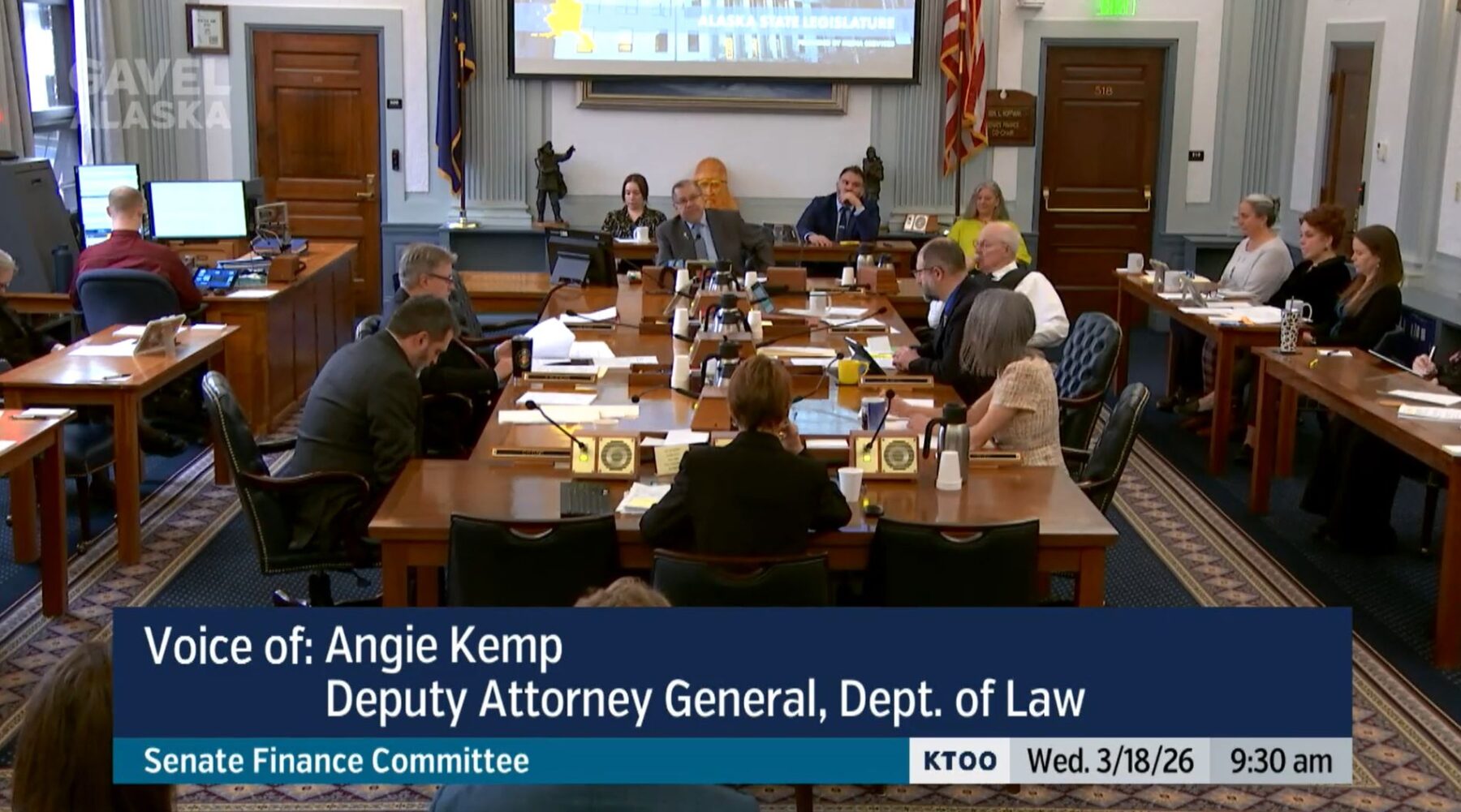
The Senate Finance Committee opened its session with a focused examination of SB 212, legislation to add one superior court judge in the Matanuska-Susitna Valley, before shifting to SB 227, a broad package of potential revenue measures. Testimony highlighted real operational strains in the justice system while raising pointed questions about transparency, fairness, and long-term fiscal sustainability in any revenue strategy.
Nancy Meade, General Counsel for the Alaska Court System, presented SB 212, explaining the procedural origin: introduced by Supreme Court request through the Rules Committee because the number of superior court judges is fixed by statute. The bill would amend AS 22.10.120 to increase the statewide total from 45 to 46 judges and the Third Judicial District allocation from 28 to 29, with the new position assigned to Palmer Superior Court. Meade detailed the pressing need: Palmer handles roughly 2,800 cases annually, with each of its four judges managing an average of 683 cases last year—far exceeding the statewide average of 458 and Anchorage’s 544. “The crux of the matter why we need a new judge in Palmer is because those judges carry the highest caseloads of any judge in the state,” she stated.
Meade traced the growth: Mat-Su Valley population up 58 percent and filings up 56 percent since the last judge was added in 2007. Complexity has compounded the burden—electronic evidence, victims’ rights expansions, self-represented litigants, and the “one family, one judge” model now bundling related cases. Temporary fixes—reassigning Anchorage or district judges, using pro tem retirees—have created unsustainable ripple effects across the system. Importantly, no new capital funding is required; existing remodeling of the Palmer Courthouse (using previously appropriated funds) will accommodate the position. Fiscal notes reflect court system costs of $775,500 in FY 2027 (four positions: judge, assistant, clerk, law clerk), stabilizing at $680,000 thereafter, plus Public Defender Agency ($268,000) and Department of Law ($305,500) requests for supporting attorneys.
Committee members probed practical impacts. Sen. Bert Stedman (R-Sitka) noted the volume of serious cases and inquired about courthouse space. Meade confirmed basement conversion to a grand jury room freed main-floor capacity. Sen. James Kaufman (R-Anchorage) sought assurance that support staff and bailiff costs were fully captured to avoid future overtime surprises. Sen. Jesse Kiehl (D-Juneau) questioned pay disparities between prosecutor and defender positions and overlap with a separate $2 million Department of Law supplemental. Deputy Attorney General Angie Kemp clarified the supplemental addressed statewide rising costs (e.g., witness travel up 122 percent since 2019) and emphasized that a new judge would stretch existing attorneys thinner in Palmer, where caseloads already average 230 per attorney. The bill was set aside for later consideration, with members requesting OMB clarification on attorney costs.
The committee then turned to SB 227, introduced as a “menu of revenue measures” to pair with spending-cap legislation. Sen. Cathy Giessel (R-Anchorage) presented three components: a modernized education tax (tiered, applied to third and fourth paychecks, ranging from $20 for under $30,000 income upward), an S-corporation tax mirroring C-corp brackets (5 percent at $1–2 million net income, scaling to 9.4 percent above $5 million), and a 15-cent-per-barrel oil infrastructure surcharge on TAPS throughput for Dalton Highway maintenance, projected at $28.5 million annually.
Sen. Bill Wielechowski (D-Anchorage) addressed the remaining elements: a proposed shift to a 17.5% gross production tax (from current net-profit system) and market-based sourcing for corporate income taxes on highly digitized/internet sales. He argued Alaska’s current structure—credits, gross-value reductions, carry-forwards—allows effective rates as low as 3.3% on $9.5 billion in gross value, yielding only $323.5 million in production taxes per the fall forecast. A 17.5% gross tax on $8.494 billion projected value would generate roughly $1.48 billion, an increase of about $1.2 billion. Citing historical benchmarks (Hammond’s “one-third” principle, past 28–37 percent state shares under prior regimes), he framed the change as simplifying an overly complex system while aligning Alaska closer to peer states like Texas and North Dakota. The internet-sales provision, adopted by 36 other states, would not raise taxes but shift existing corporate payments to Alaska, leveling the field for local brick-and-mortar businesses.
Sen. Stedman agreed on complexity but noted self-imposed statutory limits prevent full disclosure of company-level data, forcing reliance on aggregated forecasts. He cautioned that production increases paired with revenue declines would be difficult to explain publicly. Sen. Kaufman questioned the “education tax” label, noting its progressive structure and lack of dedicated funding—revenue flows to the general fund despite intent language. He observed it resembles a framework for progressive income taxation rather than a true flat head tax. Giessel clarified the tiered approach aims at fairness and capturing non-resident worker revenue (approximately 25% of Alaska’s workforce). Sen. Kiehl emphasized the capped, variable-rate nature, distinguishing it from a full progressive income tax.
Wielechowski countered that lowering taxes previously failed to deliver promised production or jobs (peaking at 15,300 in 2014, now near 9,000 with 40% non-resident). He cited ConocoPhillips data showing Alaska consistently its most profitable jurisdiction. Chairman Sen. Lyman Hoffman (D-Bethal) framed the broader context: FY 2026 includes roughly $400 million in underlying deficits despite conservative budgeting, with supplements and borrowing masking shortfalls. “We are being bailed out on a short-term basis by higher oil prices,” he warned, urging action on long-term solutions. Both bills were set aside pending further review.


