
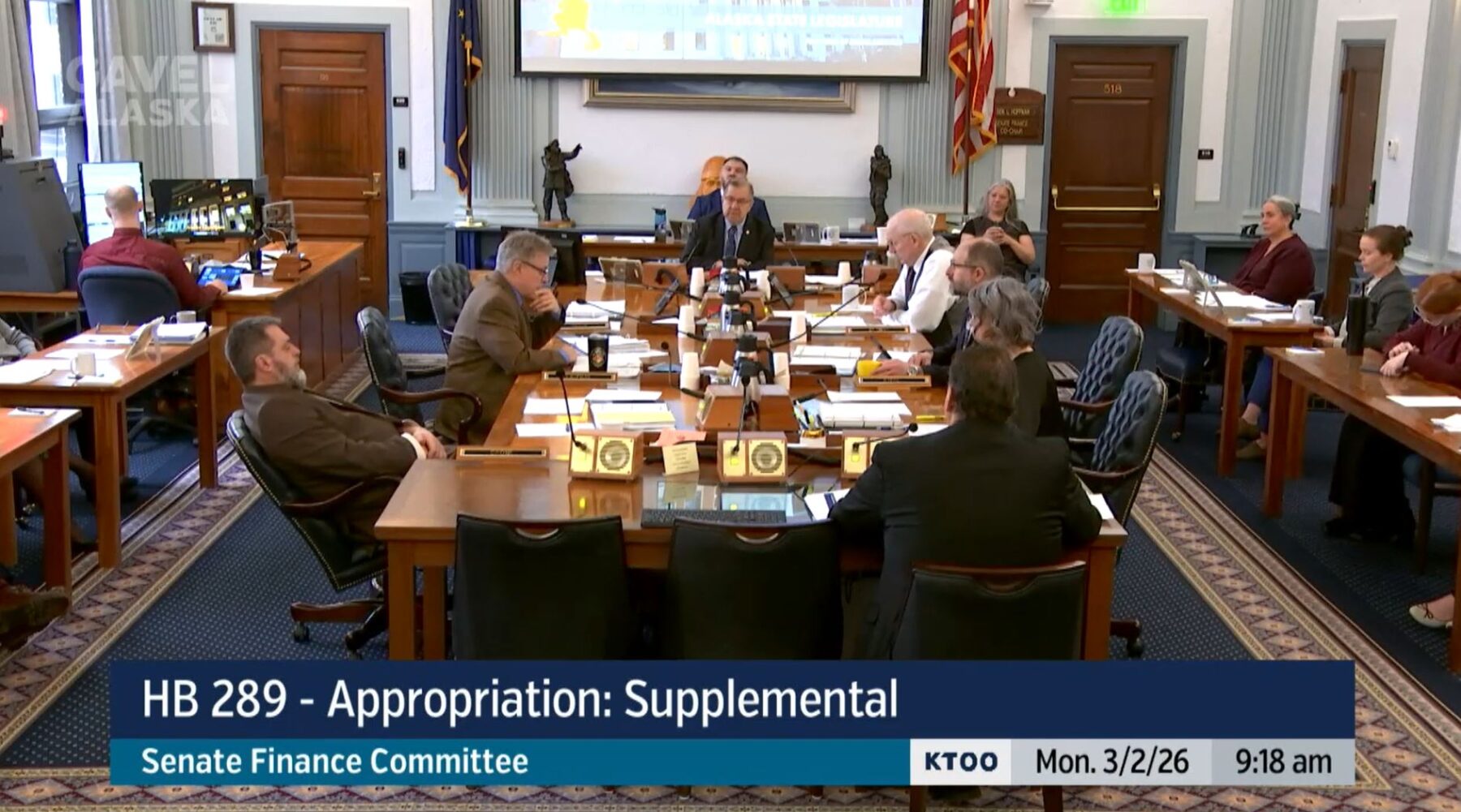
The Alaska Senate Finance Committee unanimously adopted its committee substitute (CS) for HB 289, advancing a $320 million supplemental budget that addresses Medicaid shortfalls, wildfire suppression, disaster relief, and critical transfers to sustain state operations through the end of the fiscal year. Co-Chair Senator Lyman Hoffman (D – Bethel) presided over the brisk session, emphasizing the measure’s role in preventing service disruptions while incorporating legislative adjustments to the governor’s original request.
Staff analyst Pete Eklund briefed members on key changes incorporated into the committee substitute. These included a $2 million reduction in Medicaid projections, $1.25 million for Village Public Safety Officers, $43.7 million for fire suppression, and $35 million in conditional disaster relief tied to the outcome of a FEMA appeal on the Halong incident match rate. The substitute also restored constitutional budget reserve language and added $30 million in “headroom” to cover unforeseen needs.
Eklund walked through the comprehensive spreadsheet, outlining $78.6 million in operating needs, $171 million in statewide and disaster items, and $70.2 million for federal transportation matching funds. Total potential Constitutional Budget Reserve (CBR) impact reached $530.8 million when including the $129.6 million transfer to the Higher Education Investment Fund (HEIF) and the current $51.2 million shortfall projection.
Discussion centered on the Higher Education Investment Fund transfer and revenue optimism. Senator Bert Stedman (R – Sitka) highlighted improving oil prices: “I am optimistic that line 16 is going to dissipate… I’m not so sure line 17… wouldn’t also disappear or get substantially impacted.” He projected the March 13 forecast update could reduce the draw by $100–200 million. Senator Jesse Kiehl (D – Juneau) stressed program continuity: “With $130 million or so absent from the fund, it’s not earning anything… Use fewer Alaskans dollars and more Wall Street dollars.”
Chair Hoffman reinforced the transfer’s necessity: “This not a spend. This a transfer… Everything that they’ve requested has been included… with the exception of the two items.” He noted replenishment signals commitment to education across UA campuses statewide.
Chair Hoffman clarified the headroom’s purpose: “Will not necessitate us coming back here to approve those expenditures,” ensuring operational stability regardless of oil volatility. The $30 million cushion covers potential judgments, settlements, or minor supplementals through session’s end.
Senator James Kaufman (R – Anchorage) raised pacing concerns: “It’s not spending in a classical sense; it is fund transfer, but if we just think like kitchen table economics, where we have a checking account and a savings account, maybe we just slow down the rate of transfer… I am just thinking it might be an opportunity to pull back from this record, big number we have here.”
Hoffman acknowledged the dialogue but prioritized alignment with the governor’s request and continuity: “To get the three-quarter vote is to keep our doors open… Something has to happen.”
Senator Stedman praised the spreadsheet as “a really good summary sheet” and requested footnotes for acronyms to aid non-finance members. The committee adopted the CS without objection after Eklund confirmed only two legislative additions beyond the governor’s ask: the $30 million headroom and conditional disaster language.
The amendment deadline was set for 4:30 p.m. The committee will reconvene at 1:30 p.m. for public testimony on HB 78, the retirement system defined benefits option. With oil prices trending higher than the fall forecast, members expressed cautious optimism that the final CBR draw could shrink, though structural spending pressures remain.
As Hoffman noted, the measure ensures “providing the necessary services and paying back the funds that we borrowed are on the table.”


