
Nine U.S. senators, including Ted Cruz (R-Texas), Rick Scott (R-Fla.), Mike Lee (R-Utah), Jim Inhofe (R-Okla.), James Lankford (R-Okla.), Steve Daines (R-Mont.), Roger Wicker (R-Miss.), Mike Braun (R-Ind.), and Roger Marshall (R-Kan.), along with 38 members of the House of Representatives, filed an amicus brief in U.S. Navy Seals v. Biden.
The 38 House Republicans were led by Mike Johnson of Louisiana, the House Republican Conference chair.
The lawsuit originated from 26 Navy SEALs and other Navy service members with sincere religious objections to receiving the Covid-19 vaccine are challenging the president’s vaccine mandate for the Navy.
The service members argue that both the Religious Freedom Restoration Act and the First Amendment require the federal government to allow exemptions for their sincerely held religious beliefs, especially since they are willing to take other precautionary measures to prevent the spread of Covid-19 in lieu of vaccination and the Navy is already allowing medical exemptions.

Rep. Laddie Shaw, a member of the Alaska House of Representatives is a retired Navy SEAL, the only one in elected office in Alaska. He supports the lawsuit.
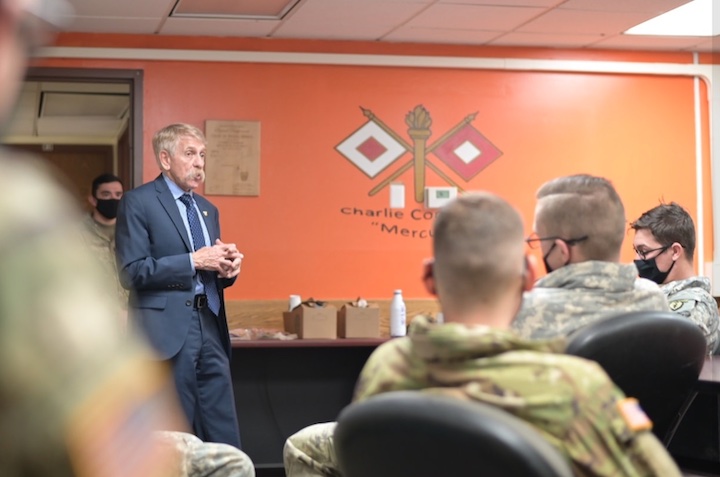
“I’m absolutely on board with that,” Shaw said. “I’m so against mandates. It costs a quarter million to put a Navy SEAL through a year of training. To go through all that hell, then get told they have to get a jab for something that has a 99 plus percent survival rate?”
The SEALs are some of the most fit people on the planet, with high cardiovascular capacity and low body mass index. They would not typically be in the “comorbidity” group.
“My class started with 112 and ended up with 18 because not enough people can do push-ups all day,” Shaw said.
In the amicus brief, the lawmakers wrote:
“Plaintiffs’ religious liberty and the government’s asserted interest in protecting our service members from COVID-19 need not be in conflict, especially where, as here, the individuals seeking an exemption are willing to adopt non-vaccination measures to protect themselves and others from the spread of COVID-19. They are only in conflict here because Defendants refuse to accommodate Plaintiffs’ religious objections even as they accommodate those who will not receive the vaccine for non-religious reasons. This violates RFRA by substantially burdening Plaintiffs’ religious beliefs without a compelling reason, and violates the First Amendment’s guarantee that government not discriminate against religion.”
“Defendants’ policies mandating that Plaintiffs be vaccinated in violation of their sincerely held religious beliefs does not come close to satisfying the strictest scrutiny Congress demands in RFRA. Defendants’ vaccine mandate forces Plaintiffs—individuals who have devoted their lives to the protection of the country—to choose between following their sincerely held religious convictions and effectively being discharged, losing their calling, and destroying their financial well-being.”
“Religious freedom is fundamental to every American’s liberty, but we have seen in recent years increasing hostility among elected and appointed government officials towards those who seek to exercise that freedom. . . . That same hostility to religion is on display with Defendants’ mandate. Defendants could easily accommodate Plaintiffs and similarly situated religious individuals given that Defendants are already accommodating individuals with medical issues or who received placebos in clinical trials. They have simply chosen not to do so.”
“[T]he impact on the military and our national security strongly counsels in favor of granting a preliminary injunction. The mandate is sidelining the deployment of soldiers on whose service our country relies. If this mandate (as currently being applied or threatened) is not enjoined, these Plaintiffs cannot fulfill their pledge to serve and defend our country, even though, based upon their training and experience, these Plaintiffs, as well as others similarly situated, are some of our most qualified, equipped, and fearless soldiers. Our men and women in uniform have fought to protect the freedoms that every American, regardless of belief, enjoys. Now they ask this Court to protect their religious freedom from encroachment by the very government they have sworn to protect with their lives.”
Established by President John F. Kennedy in 1962, the Navy SEALs are a nimble, elite maritime military force suited for all aspects of unconventional warfare. They:
- Conduct insertions and extractions by sea, air or land to accomplish covert, Special Warfare/Special Operations missions
- Capture high-value enemy personnel and terrorists around the world
- Collect information and intelligence through special reconnaissance missions
- Carry out small-unit, direct-action missions against military targets
- Perform underwater reconnaissance and the demolition of natural or man-made obstacles prior to amphibious landings