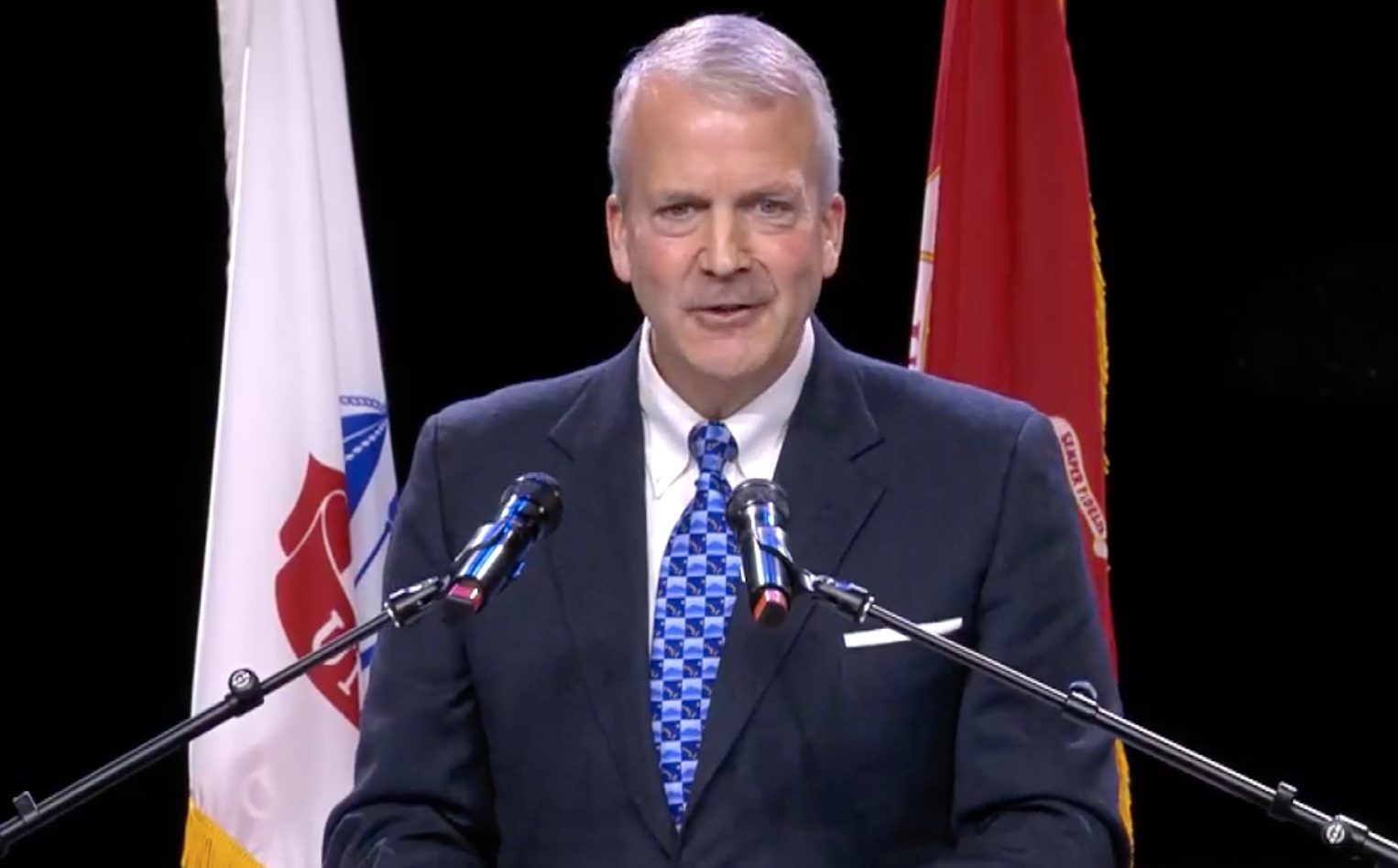
Sen. Dan Sullivan, who was under pressure from faith leaders and conservatives in Alaska to vote against the mislabeled “Respect for Marriage Act,” sent a several-page letter to ministers. In it, he says the vote to affirm the act on Tuesday was one of the most challenging votes of his career, but he feels the act protects religious liberties.
The text of his letter to faith leaders is presented below:
I am writing to provide context on the Respect for Marriage Act (the bill or RMA), whichpassed in the U.S. Senate by a vote of 61 to 36 and is currently being considered in the House. I appreciate the calls, letters, and emails many of you sent. This has been one of the most challenging votes I have taken since I took office eight years ago and your input has been critical throughout the last several weeks. My team and I have spent countless hours researching this bill, listening to your ideas on how to improve it, and working with my colleagues to do just that. As a result, unlike the House bill, the Senate bill is fundamentally more about promoting and expanding religious liberty protections than same-sex marriage.

Out of respect for you and the issues you have raised, my team and I have put together a detailed document to provide context to my vote and many provisions of this bill, particularly as they relate to religious liberties and legal protections for religious institutions that hold traditional views of marriage.
- The RMA Includes Strong Additional Religious Liberty and Conscience Protections for Religious Organizations and the Millions of Americans who Believe in Traditional Marriage.While I’ve long held that marriage should be an issue left up to the states, the Supreme Court nationalized the issue in the 2015 Obergefell vs. Hodges decision. Although I disagreed with Obergefell, I said then that I would respect the Court’s decision, but would also continue to fight for, respect, and defend the religious liberty of all Americans. Since that time, I’ve worked hard to keep this commitment. In the last several weeks, I have worked relentlessly to include in this bill considerable advances in much stronger religious liberty protections for millions of Americans. Additionally, I continued this fight for religious liberty protections on the Senate floor, where I was ultimately successful in forcing votes on three additional religious liberty amendments from Senators Lee, Lankford, and Rubio during debate on this bill. This was a commitment I made to several Alaskans.Because of Obergefell, same-sex marriage is taking place in every state in the country, which would continue whether this bill passed or not. This bill, as amended in the Senate, codifies and maintains the status quo under the Obergefell decision, but importantly enshrines additional religious liberty protections and racial equality protections that previously were not in federal statute and were not included in the Obergefell decision—particularly for organizations that support traditional marriage.As amended in the Senate, the bill includes statutory changes that significantly extend religious liberty and conscience protections, including:
- Affirming explicit Congressional support for traditional marriage supporters that they and their beliefs are decent and honorable, which can be cited as national policy in any future litigation cases where plaintiffs might try to wrongly equate traditional beliefs about marriage as akin to racism (See below in Section IV for further explanation of this important issue);(2)(2) “Diverse beliefs about the role of gender in marriage are held by reasonable and sincere people based on decent and honorable religious or philosophical premises. Therefore, Congress affirms that such people and their diverse beliefs are due proper respect.”
- Directing courts that nothing in the bill diminishes current statutory religious liberties or conscience protections, including, of course, under the First Amendment and the important protections in the Religious Freedom Restoration Act (RFRA) and the Religious Land Use and Institutionalized Persons Act (RLUIPA);(6)(a) “Nothing in this Act, or any amendment made by this Act, shall be construed to diminish or abrogate a religious liberty or conscience protection otherwise available to an individual or organization under the Constitution of the United States or Federal law.”
- Protecting the rights of religious and social services organizations who believe in traditional marriage, including educational institutions, and their employees from being required to host, participate in, or accommodate in any way same-sex wedding ceremonies;(6)(b) “Consistent with the First Amendment to the Constitution, nonprofit religious organizations, including churches, mosques, synagogues, temples, nondenominational ministries, interdenominational and ecumenical organizations, mission organizations, faith-based social agencies, religious educational institutions, and nonprofit entities whose principal purpose is the study, practice, or advancement of religion, and any employee of such an organization, shall not be required to provide services, accommodations, advantages, facilities, goods, or privileges for the solemnization or celebration of a marriage.”
- Protecting nonprofit religious organizations—including churches, mosques, synagogues, temples, nondenominational ministries, interdenominational and ecumenical organizations, mission organizations, faith-based social agencies, religious educational institutions, and nonprofit entities whose principal purpose is the study, practice, or advancement of religion—and any employee of such an organization, from being sued for choosing not to accommodate or participate in same-sex wedding ceremonies; and“Any refusal under this subsection [(6)(b) above] to provide such services, accommodations, advantages, facilities, goods, or privileges shall not create any civil claim or cause of action.”
- Preventing the federal government from discriminating or retaliating against religious organizations that hold a traditional view of marriage by taking away any benefit, right, or status—including tax-exempt status, grants, loans, or educational accreditation, among others. (7)(a) “No Impact on Status and Benefits Not Arising From a Marriage — Nothing in this Act, or any amendment made by this Act, shall be construed to deny or alter any benefit, status, or right of an otherwise eligible entity or person which does not arise from a marriage, including tax-exempt status, tax treatment, educational funding, or a grant, contract, agreement, guarantee, loan scholarship, license or certification, accreditation, claim or defense.”
- Major Faith Groups and Religious Liberty Advocates that Believe in Traditional Marriage Strongly Support the Religious Liberty and Conscience Protections in the RMA.A number of prominent religious groups that strongly support, practice, and teach traditional marriage as one of their core beliefs also strongly support the religious liberty protections in the RMA, and view such protections as significant advancements in federal law for their churches, synagogues, and members. For example, the President of the National Association of Evangelicals, Walter Kim, states that this bill “will produce the first significant bipartisan legislation in many years advancing religious freedom for all, including for those who hold traditional views on marriage.”Additionally, leadership from the Seventh Day Adventist Church, The Church of Jesus Christ of Latter-day Saints, Union of Orthodox Jewish Congregations of America, Council for Christian Colleges and Universities, AND Campaign, Institutional Religious Freedom Alliance, Center for Public Justice, and 1st Amendment Partnership, jointly wrote that the Senate version of the RMA “adequately protects the core religious freedom concerns raised by the [House version of the] bill, including tax-exempt status, educational funding, government grants and contracts, and eligibility for licenses, certification, and accreditation. If passed, it would continue to build on the congressional wisdom represented by the Religious Freedom Restoration Act of 1993 (RFRA).”The Council for Christian Colleges and Universities (CCCU) also favors this bill because of the religious liberty protections it includes. CCCU institutions are sincere Christian educational institutions that adhere to Biblical values and teach that the Biblical understanding of marriage, between one man and one woman, is an essential foundation for a thriving society. CCCU President Shirley V. Hoogstra writes, “[T]his carefully crafted [bill] includes both strong religious liberty language … and non-retaliation language that ensures this legislation cannot be used by state and federal agencies to punish religious organizations for their sincerely held beliefs.” Stanley Carlson-Thies, Founder of the Institutional Religious Freedom Alliance, and Stephanie Summers, CEO of the Center for Public Justice, wrote, “We regard adoption of the Act as the best opportunity since the passage of the Religious Freedom Restoration Act (1993) and the Religious Land Use and Institutionalized Persons Act (2000) for Congress to safeguard religious freedom with Democratic support. The amended RMA . . . add[s] to the U.S. Code new protections for religious freedom in the context of marriage equality.”Additionally, prominent religious liberty advocates also support the religious liberty protections in this bill. This includes Douglas Laycock, a prominent professor of law and religion at the University of Virginia, who has testified frequently before Congress and has argued many cases in the courts, including serving as lead counsel in six cases before the U.S. Supreme Court. Laycock, along with three other First Amendment professors stated that they “believe the religious liberty protections in RMA are meaningful and important even if not comprehensive.” They emphasize that religious liberty protections have failed to become law regardless of which political party is in the majority. Their observation is correct—even under the Trump Administration, with a Republican House and Republican Senate, legislation I cosponsored similar to the Lee amendment could not get enacted into law.
- Progress is Being Made on Important Religious Liberty Issues Not Addressed in the Bill.Despite support from the religious groups mentioned above, not all prominent religious organizations and faith groups support this bill—some prominent examples are the Conference of Catholic Bishops, Family Research Council, and Alliance Defending Freedom. These organizations and others raise a number of criticisms about the bill, the most common of which is that it does not go far enough to protect all important religious liberty issues currently under debate in our nation. This is a legitimate and understandable concern. For that reason, I pressed my Senate colleagues to ensure that amendments offered by Senators Lee, Lankford, and Rubio each received a vote on the Senate floor. I have cosponsored bills that mirror the religious liberty and conscience protections offered in these amendments. As I committed in 2015 when the Supreme Court issued the Obergefell decision, I will continue to fight for, defend, and attempt to broaden the religious liberty and conscience protections of all Americans.At the same time, this bill does not do anything to undermine religious liberty issues where there has been recent progress due to the significant number of federal judges, including Supreme Court Justices, added to the federal judiciary who have a principled view of the importance of First Amendment religious liberty protections in our constitutional order. While the bill is silent, for example, as to religious protections for for-profit wedding vendors, existing law protecting wedding vendors under the First Amendment Free Exercise clause continues to be the law of the land. A prominent example of this protection is the Masterpiece Cake Shop case, in which the U.S. Supreme Court held in 2018 in a 7-2 decision that the Colorado Civil Rights Commission’s conduct in evaluating a cake shop owner’s reasons for declining to make a wedding cake for a same-sex couple violated the Free Exercise Clause.Likewise, this bill does nothing to undermine the U.S. Supreme Court decision in Fulton vs. City of Philadelphia, which interpreted the First Amendment Free Exercise Clause in favor of religious liberty for foster care agencies. In 2021, the U.S. Supreme Court held in a unanimous decision (9-0) that the refusal of Philadelphia to contract with Catholic Social Services (CSS) for the provision of foster care services unless CSS agrees to certify same-sex couples as foster parents violates the Free Exercise Clause of the First Amendment.
- The RMA Also Addresses Interracial Marriage and the Bob Jones University vs. United States Precedent that had the Potential to Threaten Religious Institutions.The bill also codifies the federal legality of interracial marriages,[1] while expressly protecting the views of religious organizations and individuals who believe in traditional marriage from being wrongly labeled as akin to racists. This is an extremely important aspect of this bill. In the aftermath of Obergefell, one of the biggest risks to religious liberties for all organizations and institutions that believe in traditional marriage is that the federal government might go after them and specifically after their tax-exempt status for their beliefs on traditional marriage.In my view, this is a very significant concern because of the precedent of the 1982 Supreme Court decision in Bob Jones University vs. United States.[2] That was a case in which Bob Jones University lost its tax-exempt status due to its policy of prohibiting interracial marriages and interracial dating. While very few argued that the decision was incorrect, it has been feared that that case would be used as precedent to remove tax-exempt status from educational and other religious institutions that do not support same-sex marriage. Indeed, during the Supreme Court oral argument on Obergefell in 2015, President Obama’s Solicitor General stated that a religious institution losing its tax-exempt status because of its belief in traditional marriage was “going to be an issue.” This comment made seven years ago has been cause for alarm for religious institutions that believe in traditional marriage, especially because there have not been protections for religious organizations’ tax-exempt status in statute. Chief Justice Roberts also highlighted this very real concern in his dissent in Obergefell: “Indeed, the Solicitor General candidly acknowledged that the tax exemptions of some religious institutions would be in question if they opposed same-sex marriage.”[3]This bill directly addresses this problem. The RMA shuts the door to any group wrongly trying to use the Bob Jones precedent to take away the tax-exempt status of religious organizations that believe and practice traditional marriage. First, this bill includes an express provision prohibiting the federal government from discriminating or retaliating against religious organizations that hold a traditional view of marriage by denying eligibility for or right to federal benefits, rights, accreditation, legal claims or defenses, or tax-exempt status.(7)(a) “No Impact on Status and Benefits Not Arising From a Marriage.—Nothing in this Act, or any amendment made by this Act, shall be construed to deny or alter any benefit, status, or right of an otherwise eligible entity or person which does not arise from a marriage, including tax-exempt status, tax treatment, educational funding, or a grant, contract, agreement, guarantee, loan scholarship, license or certification, accreditation, claim or defense.”Second and importantly, this bill also expressly affirms that traditional marriage supporters and their beliefs are decent and honorable. This establishes a clear, congressionally explicit national policy that can be cited in all future cases where an opponent wrongly alleges that traditional beliefs about marriage are as unacceptable in the United States as racism or bigotry. Instead, the United States’ official statement on traditional beliefs (and other beliefs) about marriage is provided in the RMA, which states: (2)(2) “Diverse beliefs about the role of gender in marriage are held by reasonable and sincere people based on decent and honorable religious or philosophical premises. Therefore, Congress affirms that such people and their diverse beliefs are due proper respect.”
- The RMA Expressly Prohibits Federal Recognition of Polygamy.There have been some concerns that the original House version of the RMA, which was flawed in many ways, would open the door for polygamy. While polygamy is illegal in every jurisdiction of the United States, the Senate version expressly addresses this issue by stating that the federal definition of marriage is between two individuals and valid in the State where lawfully entered. (5)(a) “For the purposes of any Federal law, rule, or regulation in which marital status is a factor, an individual shall be considered married if that individual’s marriage is between 2 individuals and is valid in the State where the marriage was entered into.”Further, the bill includes an express provision that the language of the RMA cannot be used to require or authorize federal recognition of a polygamous marriage. (7)(b) “No Federal Recognition of Polygamous Marriages.—Nothing in this Act, or any amendment made by this Act, shall be construed to require or authorize Federal recognition of marriages between more than 2 individuals.”
- State Law Sovereignty over the Definition of Marriage Remains and is Respected.As noted above, because of Obergefell, same-sex marriage is taking place in every state in the country, which would continue whether this bill passed or not. Obergefell also ensured that regardless of the definition of marriage one state may have, that state must give full faith and credit to same-sex marriages entered in other states. In the very unlikely event that Obergefell is overturned in the future, this bill would not mandate that Alaska must undertake same-sex marriages or enact a new federal right to same-sex marriage. Instead, this bill would respect state laws, like Alaska’s constitutional provision defining marriage as between one man and one woman, and leave states the traditional sovereignty to set their own definition of marriage. If states have traditional marriage definitions, like Alaska, they would no longer be required to issue marriage licenses to same-sex couples. If Obergefell were ever overturned, this bill would only require same-sex and interracial marriages lawfully entered in one state to be provided full faith and credit in the other states.[4]
- Conclusion.
I sincerely appreciate your engagement on this and other issues of concern. As many of you know, I have been fighting to strengthen religious liberty protections in statute since I arrived in Washington, D.C. This bill has the strongest religious liberty protections for religious organizations that believe in traditional marriage since the passage of the Religious Freedom Restoration Act (RFRA) in 1993. I would have liked more, but sincerely believe that the protections afforded in this bill are much better for America’s faith community than if the bill had not passed—especially as it relates to the Bob Jones University concern explained above.
As noted above, in the last several weeks, my team and I have spent dozens of hours researching, listening to and meeting with Alaskans, and pressing my Senate colleagues for improvements to this bill that was received from the House completely devoid of religious liberty protections. I have fully considered and taken to heart your input, questions, concerns, and admonitions. The Alaska faith community, of which I consider myself a part, was especially gracious in speaking with me about the importance of a Biblical view of marriage. In response, I committed to ensuring the bill included the strongest religious liberty protections that could be agreed upon in order to protect the right to teach and practice these sincere religious views. That commitment included my insisting that the Lee, Lankford, and Rubio amendments received a vote when they would otherwise have not made it to the Senate floor for consideration.
Nevertheless, I realize that many in Alaska’s faith community were not supportive of this bill and my vote in support, including many from my own Catholic faith community. This is personally an uncomfortable place to be and is one of several reasons why this has been one of the most challenging and difficult votes of my Senate career. I recognize that people of good intentions can and do disagree strongly on this issue. But, in the final analysis, as a practicing Catholic and conservative, I agreed with the important conclusion of Walter Kim, the President of the National Association of Evangelicals, regarding the religious liberty protections included in this bill: “These are important, commonsense provisions that represent a significant contribution to strengthening the legal protections for those who [] believe that God designed marriage as an exclusive covenantal relationship between a man and a woman for the purpose of creating strong families that in turn bless their community and nation. We cherish the freedom to preach, teach, and practice these core convictions, while respecting our fellow citizens who do not share these beliefs.”
[1] In Loving vs. Virginia, 388 U.S. 1 (1967), the U.S. Supreme Court held as unconstitutional under the Fourteenth Amendment Equal Protection clause Virginia’s state prohibition of interracial marriage. If Loving were somehow overturned, which is unimaginable, this bill would mandate that states recognize interracial marriage lawfully entered in other states.
[2] Bob Jones University vs United States, 461 U.S. 574 (1983).
[3] Obergefell vs. Hodges, 576 U.S. 644, 711 (2015) (Roberts, C.J., dissenting).
[4] This requirement mirrors the Full Faith and Credit provision in Article IV of the United States Constitution which reads: “Full Faith and Credit shall be given in each State to the public Acts, Records, and judicial Proceedings of every other State. And the Congress may by general Laws prescribe the Manner in which such Acts, Records and Proceedings shall be proved, and the Effect thereof.”
Sincerely,
Dan Sullivan
United States Senator
Senator Sullivan’s letter to faith leaders: