URBAN REP. SAYS IT’S A ‘FALSE CHOICE’ BETWEEN SERVICES NEEDED AND REVENUES TO PAY
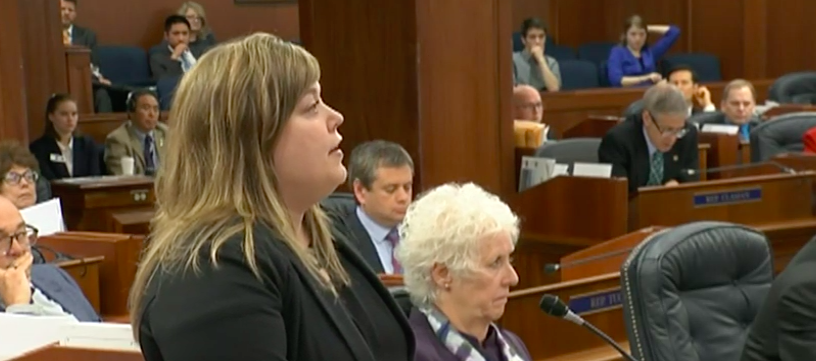
Rep. Geran Tarr, co-chair of House Resources, gave a detailed explanation on the House floor today of why she does not support drilling in the Arctic National Wildlife Refuge’s coastal plain: Melting permafrost is already causing existing wells to “spew” oil everywhere.
“Here we are in 2019 and because of the thawing permafrost, the wells are literally popping out of the ground and spewing oil and gas across the surface of the North Slope,” Tarr said. “I don’t know what will be happening in 2024 (when the North Slope 1002 Area is planned for drilling), but this is not a comprehensive energy strategy. This is not doing the right thing, in my opinion, for the next generation.”
In fact, a couple of old wells from decades ago have eased out of the thawing permafrost and small amounts of petroleum have come to the surface, mostly gas, but also some oil, all of which was contained in the well housing; none has escaped onto the tundra. Those with that old well design are being capped.

Tarr also objected to the resolution due to climate change, and said she was unhappy that Gov. Michael Dunleavy had shelved Gov. Bill Walker’s climate change task force: “Unfortunately both at our state and federal government, our highest leaders have abandoned the work on climate change.”
She then delivered a lecture directly to rural residents in the state, saying there is a false choice between getting new revenue from the oil fields and providing services to poor areas of the state.
That’s when Speaker Bryce Edgmon interrupted her and cautioned, “Rep. Tarr, I have rural residents in my district. Please continue.” She continued to assert that those services should still be provided to rural residents, who had testified in her committee that they support responsible oil development in their region.
“I would caution any member from making statements that are sweeping in nature. Please continue,” Speaker Edgmon interrupted her again.
“What we heard in committee was that the development was needed because of the services that would come from the revenue,” Tarr argued, evidently taking her disagreement with rural testifiers in her committee to the House floor.
“To me that’s a false choice because I believe the services are needed regardless of whether the revenue comes from the resource development,” she said. However, she was silent on where the revenue would come from in the absence of resource development.
The resolution, which is simply a statement of support, is nearly identical to one that has passed both the House and Senate every two years for decades, but specifically refers to the draft environmental impact statement that is now in the public comment period, which ends March 13.
Senate Joint Resolution 7 says “the Alaska State Legislature requests that the United States Department of the Interior, Bureau of Land Management, implement an oil and gas leasing program in the coastal plain of the Arctic National Wildlife Refuge as outlined in the December 2018 Coastal Plain Oil and Gas Leasing Program Draft Environmental Impact Statement.”
Rep. John Lincoln, who serves the people of District 40 where the 1002 Area is located, had a different perspective than Tarr, who represents urban East Anchorage. As the other co-chair of House Resources, he rose to support the resolution, saying oil wealth has paid for state and local government services for decades. Many of his community leaders had testified in favor of the development.
Rep. Adam Wool, who represents a portion of Fairbanks, voted against the resolution, as did Rep. Sara Hannan, who represents Juneau. Both are Democrats, like Tarr, and both are from communities that benefit greatly from oil revenues.
The only votes against the resolution in the Senate were from Democrat Sen. Elvi Gray-Jackson and Sen. Tom Begich.