
POLLSTER IS WEAPONIZING OUR FIREARMS…
A poll released by Alaska poll-driver Ivan Moore last week asked some of us if we want to ban “assault weapons” in Alaska.
48 percent of his 761 survey sample said yes.
The media took the bit and ran with the story, never questioning why Moore used the term “assault weapon” to describe a semi-automatic rifle that is widely used in Alaska.
There’s no real news in that number, other than the fact that shootings at schools and night clubs over the past year did not alter the opinion of gun-toting Alaskans.
Why? Moore’s poll result is the same as the last one he conducted for the Alaska Dispatch News in late 2016, when he asked nearly the same question, but called the rifle something else: “Do you support or oppose a ban on the sale of semi-automatic weapons in Alaska?”
47.2 percent supported a ban in 2017. The polls have a margin of error of about 3.6 percent, he says.

(Note to Moore: Almost all handguns sold today are semi-automatic, and they are firearms, not weapons, unless used as weapons.)
A recent CNN poll reveals 53 percent of Americans want a ban on AR-15 semi-automatic rifles, and Moore’s poll shows that only five percent fewer Alaskans share that sentiment.
WHO WAS THE CLIENT FOR THOSE GUN QUESTIONS?
Ivan Moore’s current business model is to do a grab-bag poll that sells clients questions, because there are so few clients left in Alaska who can afford a $50,000 poll.
Those gun questions did not end up on the Moore poll by accident, nor would Moore simply throw a series of questions in for his own amusement.
Someone in Alaska paid for gun-related questions to be tested. There was money changing hands to get some information for someone to make a decision.
[Read: The Ivan Moore poll on gun attitudes, 2018: tony181gunfrq ivan moore gun survey]
The person who wants that information is in Anchorage, Must Read Alaska has learned. He’s a well-heeled Democrat with an interest in funding the current “youth movement” in Anchorage to restrict guns. Those youthful gun restricters will also reliably vote Democrat, so this is a two-for-one political action committee in the making.
But Moore’s poll will not give his client much comfort: Alaskans are not changing their minds on the Second Amendment, even after the tragedy in Parkland, Florida.
And then, there’s this:
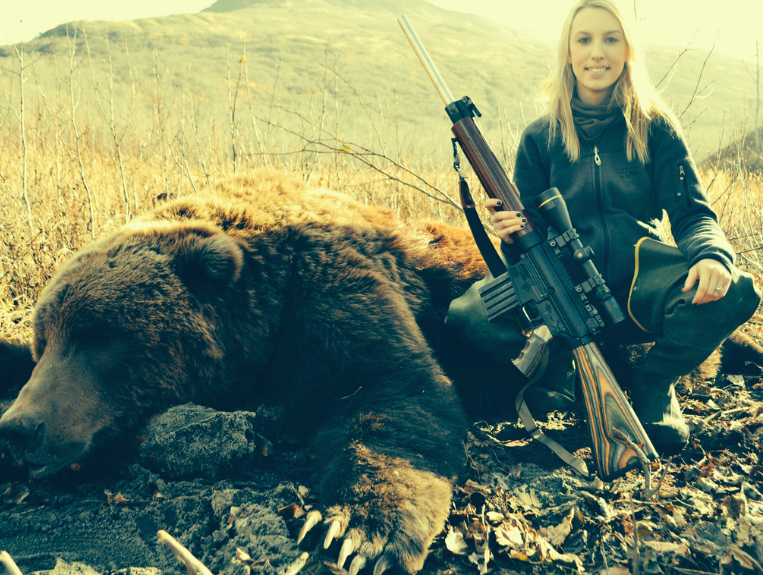
SEMI-AUTOMATIC RIFLES — THE SUBSISTENCE HUNTER’S CHOICE
The use of modern sporting rifles — semi-automatics with detachable magazines — has grown in popularity in recent years. The National Rifle Association says 25 percent of the rifles produced in the United States are AR-15s or similar semiautomatic styles.
In Alaska, that number is higher, with some firearm experts estimating that between 50-80 percent of Alaska rifle owners own a semi-automatic, some of which are AR-style in shape. The actual numbers are hard to come by, because gun owners keep this information private.
The semi-automatic users are primarily rural Alaskans, where these firearms are the rifle of choice for subsistence hunters who are hunting caribou, an animal where there is a multiple bag limit of five a day — or no limit, in some game management units. They also hunt marine mammals, like seals, with them.
In other words, Moore’s poll asked the urban telephone respondents if they want to ban semi-automatics.
He didn’t tell them that the ban would lead to the confiscation of guns that hunters use to feed their families.
It’s another indication that the poll is skewed on this question. How many of respondents knew that the AR-15 is simply a semi-automatic rifle — i.e., a subsistence rifle in Alaska — not an “assault weapon?” Do 48 percent of Alaskans want to take away the hunting rifles of Alaska’s indigenous people?
WHAT ELSE IS IN THAT POLL?
Alaskans are not seeing the whole poll, but Moore’s poll also revealed some other intelligence:
- 49 percent support a ban on high-capacity magazines. Nationally, CNN says 63 percent favor the ban.
- 67 percent support setting a mandatory age of 21 or older to own a gun. Nationally, CNN pegs it at 71 percent favoring an age-related ban. In Alaska, you must currently be 18 to buy a gun.
- 45 percent say the laws about firearms sales should be stricter, while 53 percent say they should be less strict or left alone.
- 45 percent of Alaskans support teacher’s carrying guns on campus.
- 84 percent support a petition for judges to be able to confiscate guns.
- 19 percent of Alaskans live in a household with a National Rifle Association member.
- 67 percent of respondents say their household has a firearm. The number is likely higher, as people typically are reluctant to say.
- 16.6 percent of respondents said they own a semi-automatic “assault weapon” like an AK-47 or AR-15. Again, the number is likely higher, but privacy weighs heavy on owners of guns.
- 81 percent of respondents said they do not read the print edition of the Anchorage Daily News ever. Less than 7 percent read it every day.
- 65 percent said they don’t read the online edition of the Anchorage Daily News — ever.
- 70 percent of respondent do use the internet for news.
- 27 percent of respondents claimed to be Republican, 14 percent Democrat, and 59 percent something else.
- 37 percent said they are conservative, 46 percent moderate, and 17 percent progressive.
Of course, the real poll on guns in Alaska is the one taken at the cash register: 67 percent of Alaskans have a gun in the house, and many have more than one.
MOORE: NOT ALWAYS ON TARGET
The question for critical thinkers is whether that new Moore poll is accurate. Moore’s polls are not well-regarded due to their wildly inaccurate results.
For example, in 2014, just two weeks before the General Election, Moore said candidate Forrest Dunbar trailed Rep. Don Young by one point, 43-44. In a smaller sample, Moore had Dunbar winning handily.
Young won 52-41, nearly 11 points ahead.
Moore also sampled the race between Mark Begich and Dan Sullivan for Senate in late October, 2014, just days before the election. He predicted that Begich would win, 48-42 against Sullivan.
Even the New York Times got a tingle up its leg on that one, writing hopefully: “The state fell off the radar over the last few weeks because just about every unsponsored survey was showing Dan Sullivan, the Republican, in the lead …Then, on Monday evening, Ivan Moore Research showed Mr. Begich ahead by a modest margin.”
“Unsponsored” was the key word. Likely, Moore had a sponsor for his poll.
The final result was 48-46, with Sullivan winning over Begich and Ivan Moore ending up with an 8-point miss.
The only way people can judge whether a poll is any good is by looking at the pollster’s track record.
FiveThirtyEight.com looked at that track record and gave Ivan Moore a “C” grade, with 40 percent of races called correctly.



