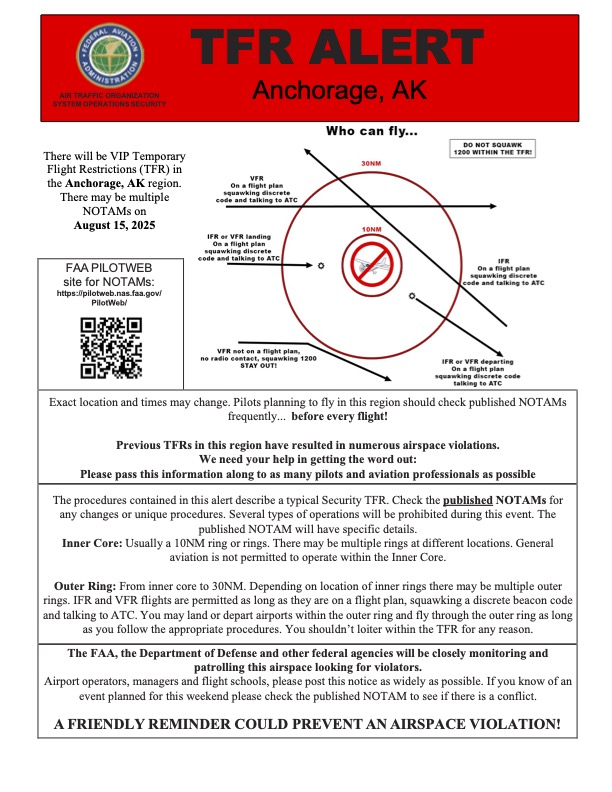
The Federal Aviation Administration has declared a Temporary Flight Restriction (TFR) for Anchorage on Friday, coinciding with the expected arrival of President Donald Trump and Russian President Vladimir Putin.
In an alert issued this week, the FAA advised that pilots should anticipate multiple Notices to Air Missions (NOTAMs) on the day of the visit. The agency cautioned aviators not to transmit transponder codes — or “squawk” — within the restricted airspace during the TFR’s active period.
While exact details of the restriction have not been released publicly, such airspace closures are standard protocol for presidential travel and high-security events. The TFR is expected to cover key approach and departure corridors for Ted Stevens Anchorage International Airport and surrounding airspace, including Merrill Field and Lake Hood.
Security preparations have been intensifying in Anchorage this week, with law enforcement, federal agencies, and aviation authorities coordinating ahead of the high-profile meeting between the two world leaders.
The notification from the FAA advised that in the past in Anchorage, there have been multiple violations of TFRs. Pilots planning to fly in the region should check the latest notifications with FAA.
Pilots are urged to check for updated NOTAMs before operating in or near Anchorage airspace on Friday.
Last Wednesday, the Anchorage Economic Development Corporation hosted its annual economic summit. Downtown denizens of Los Anchorage watched more than a thousand attendees navigate convention center chicken as number-crunchers told the tale of Alaska’s largest city and its economic fortunes.
And right on cue, the city’s newspaper of record was there — not to capture the real story, but to run its usual filtered version, where every chart and forecast is bent just enough to fit the preferred “Trump bad, tariffs worse” storyline.
This gathering is the closest most residents will get to a Federal Reserve meeting on interest rates, complete with politicians of every stripe in the audience, eager to divine their next-year talking points from whatever wisdom is dispensed in that hour and a half.
Amid the packed agenda, economists from McKinley Research walked through the key elements of the local economy and offered a two-year outlook. The local daily newspaper’s coverage was predictable: a headline focus on the impact of tariffs (bad!), framed as an impending cascade of doom because … Trump bad.
That narrative had two problems. First, the economists didn’t say that. They acknowledged that an America-first trade policy could ripple through various sectors, but they weren’t wringing their hands. Second, and far more important, the newspaper entirely missed the economists’ loudest point: oil remains a pillar of Anchorage’s economy.
Payrolls tied to large-scale projects like Santos’ Pikka development and ConocoPhillips’ Willow project are delivering meaningful, positive impacts in Southcentral Alaska. And that’s just the visible part. McKinley’s economists admitted there are data gaps—the spending power of slope workers, including the many Alaska-based Hilcorp employees at Prudhoe Bay, doesn’t even show up in Anchorage job counts.
Omitting that story is unsurprising, but still disappointing. These projects, and the thousands of Anchorage jobs they support, wouldn’t exist without a pivotal choice made more than a decade ago. Then-Gov. Sean Parnell and a Republican majority — back when they acted like a team — overhauled Alaska’s Soviet-style oil tax system, paving the way for new investment. The goal was simple but strategic: Don’t punish producers when prices are high; instead, incentivize more production.
To their credit, McKinley’s economists brought the data showing the results: Production increases over the past decade, achieved despite oil price collapses, hostile federal administrations on both sides of Trump’s tenure, and endless environmental lawsuits designed to stall development. Against those headwinds, Alaska’s private sector has delivered engineering marvels on the Arctic coast.
Every new American barrel of oil forces Russia, Iran, and other adversaries to compete harder. This kind of economic competition, which makes critical supplies available to the free world, is a direct result of the pro-growth vision embraced by Republicans when they still believed in markets, business, and workers.
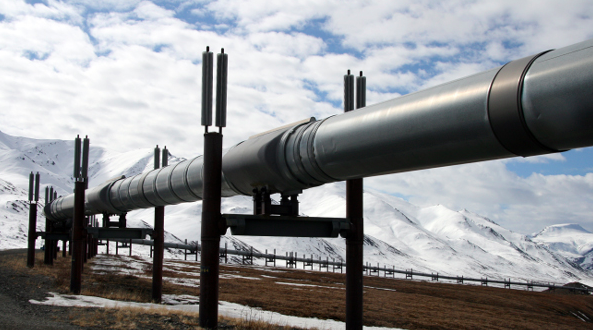
As our president prepares to meet his Russian counterpart in Alaska this week, it’s worth remembering that much of our state’s viability flows through a 48-inch steel pipeline, built and maintained by people scorned by the very groups who never hesitate to cash the checks its revenues fund.
Suzanne Downing is the founder of Must Read Alaska and serves as editor.
It’s “Go” time for hundreds of residents in the Mendenhall Valley in Juneau. The Mendenhall River is about to spill over its banks, as the ice and water held behind an ice dam at Suicide Basin has broken.
Already, the river was elevated and was currently in “Minor Flood Stage,” due to heavy rainfall from the previous three days. The Mendenhall River was expected to crest through Tuesday morning, before falling out of Flood Stage through Tuesday afternoon and into Wednesday, but now that the ice dam has broken, residents are being advised to take immediate measures if they live in the historic flood zone. A crest is expected around Wednesday afternoon near record levels of somewhere between 16.3 and 16.8 feet, according to the National Weather Service.
The non-emergency public flood information hotline will be staffed by trained volunteers, and will provide the latest information about sheltering, transportation, current conditions, and other questions residents may have as they prepare for an evacuation alert.
On Monday, City and Borough of Juneau staff and volunteers began distributing evacuation preparation notices to all homes in the potential flood inundation area. The notice includes shelter information, basic steps for protecting property, the flood information hotline number, and a link to Juneau’s flood readiness website at bit.ly/JuneauFloodReady.
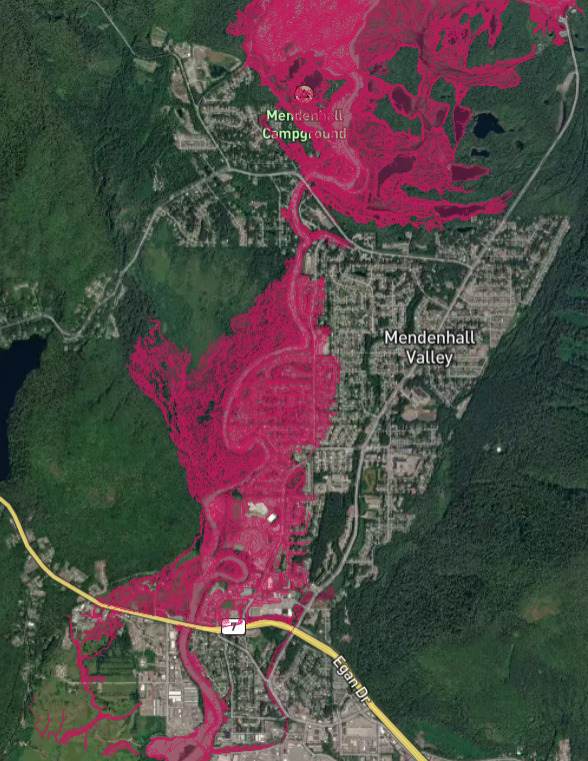
Flood areas of the Mendenhall Valley.
Flooding expected late Tuesday through Wednesday. Officials are urging residents in the 17-foot lake level inundation zone to evacuate immediately and remain out of the area until an official “All Clear” is issued.
Officials warn that the flood threat is significant, at the “warning” level, and residents should check whether their homes or businesses are in the inundation zone using the 17-foot Mendenhall Lake map at JuneauFlood.com.
A Red Cross emergency shelter is open at Floyd Dryden Gymnasium, 3800 Mendenhall Loop Road. Pets cannot be housed there, but evacuees can contact Juneau Animal Rescue at (907) 789-6997 for pet sheltering assistance.
North of Division Street: Travel north on Riverside Drive toward Mendenhall Loop Road and out of the inundation area.
South of Division Street: Travel south on Riverside Drive, turn left on Stephen Richards Memorial Drive toward Mendenhall Loop Road.
Rivercourt Way: Travel south on Riverside Drive toward Egan Drive.
West side of Mendenhall River: Travel west on Mendenhall Loop Road toward Auke Bay, avoiding Back Loop Bridge.
West of Brotherhood Bridge: Travel west on Glacier Highway toward Auke Bay.
Residents are being urged to avoid the Mendenhall River entirely during the flood warning. Approaching the river can endanger lives and interfere with evacuation and emergency operations, the city advised.
Live camera feeds of the river and updated safety information can be found at bit.ly/JuneauFloodReady.
For non-emergency questions, call the Flood Information Hotline at (907) 500-0890. For emergencies, dial 911.
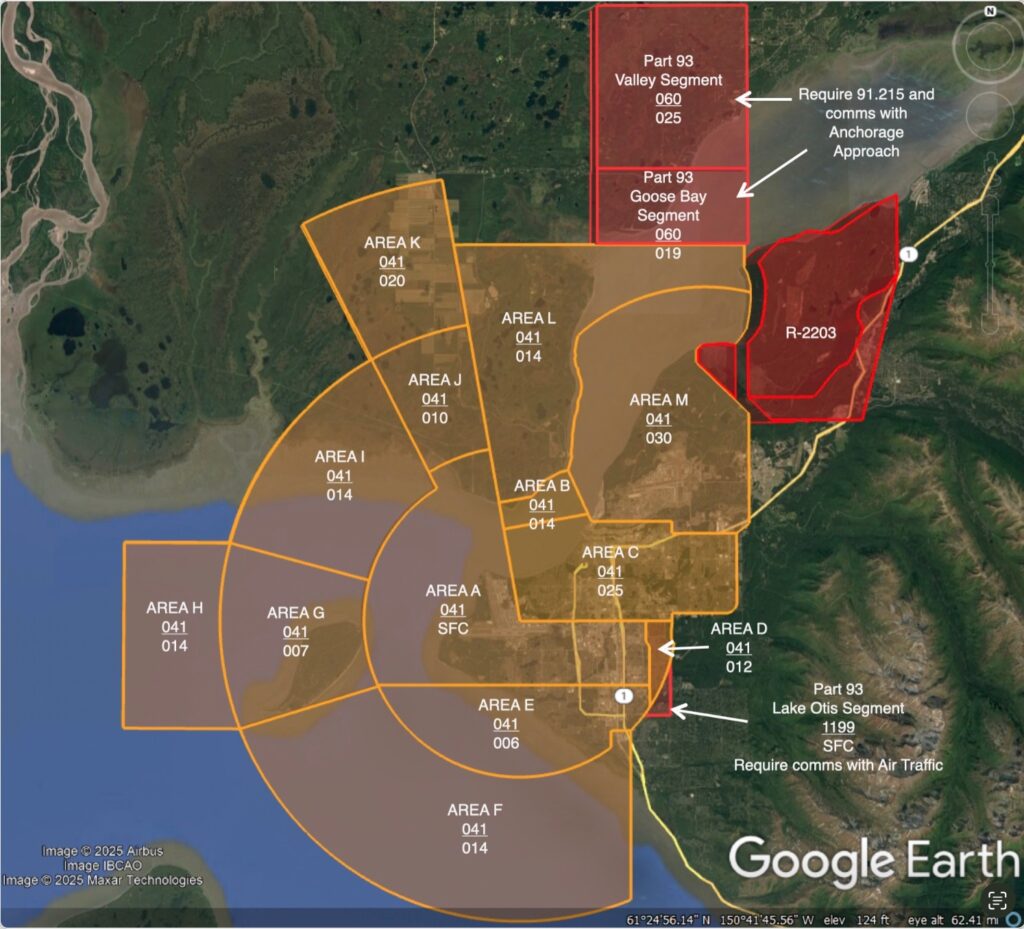
Changes could be on the horizon for pilots flying in and out of Ted Stevens Anchorage International Airport, as the Federal Aviation Administration begins taking public input on a proposal to redraw Class C airspace in the Anchorage area. The changes are expected to be significant in the Anchorage bowl. Pilots will need to do their homework because the patterns will change.
The Federal Aviation Administration will hold two virtual public meetings in September to gather feedback on a proposal to amend Class C airspace at Ted Stevens.
The meetings, set for Sept. 23-24, will air the traffic challenges that may come when the Air Force’s 3rd Wing at Joint Base Elmendorf-Richardson extends runway 16/34 by 2,500 feet and installs an Instrument Landing System, with plans to make it the primary arrival runway.
FAA studies have found that while the upgrades would enhance safety and operational efficiency, they could also cause delays across the region’s airports, including Ted Stevens International, Merrill Field, and Elmendorf.
To mitigate potential impacts, the FAA is reviewing possible redesigns of local airspace and flight procedures. This includes evaluating instrument approaches, air traffic flows, and classifications for Class C and D airspace, as well as special Anchorage Terminal Area flight rules.
Class C airspace is a type of controlled airspace established around airports with moderate traffic levels, such as Ted Stevens Anchorage International Airport, to manage air traffic and ensure safety. It is designed to handle a mix of commercial, general aviation, and sometimes military operations, with specific rules to regulate aircraft movement.
Class D airspace is a type of controlled airspace surrounding airports with an operational control tower but typically lower traffic volume than those with Class B or Class C airspace, such as smaller regional or general aviation airports. It is designed to manage air traffic and ensure safety in the vicinity of these airports. Merrill Field is considered Class D. Lake Hood, the world’s busiest seaplane base, shares a control tower with ANC but operates its own Class D airspace for seaplane and general aviation operations. Its airspace extends from the surface to a similar altitude as Merrill Field’s, with a radius tailored to its operations.
An Ad Hoc Committee led by the Alaska Department of Transportation has helped shape proposed redesigns. Those designs have been shared first through the committee process, with the public’s initial opportunity for feedback coming at the airspace meetings.
Proposed changes to air space in Anchorage.
Meeting attendees will be able to present comments, ask questions, and submit written materials. Both sessions will be recorded and made available on the FAA’s YouTube channel.
Comments can be sent to: Byron G. Chew, FAA Western Service Center, 2200 S. 216th St., Des Moines, WA 98198, or by email to [email protected] (subject line: “ANC Class C”).
A pair of men resembling Secret Service agents were spotted Monday surveying rooftops, cameras, and vantage points in downtown Anchorage, likely scoping out sniper stations and security hazards ahead of this Friday’s historic meeting between President Donald Trump and Russian President Vladimir Putin.
The summit, expected to take place Friday, aims to chart a potential path toward peace in Ukraine. Security preparations are intensifying, with federal teams expected to occupy strategic positions on buildings and parking garages in the days ahead.
But as the security operation ramps up, Mayor Suzanne LaFrance’s administration appears to have made no visible headway in clearing downtown streets of homeless encampments, which present their own hazards.
On Tuesday morning, as on countless mornings before, vagrants could be seen sleeping on sidewalks throughout the city’s core, along the same routes where international journalists, dignitaries, and diplomats will walk this week. Not to mention the Alaska protesters who don’t want peace, as well as protest organizers who will be flown in from out of state.
In advance of a presidential visit, it’s normal for the Secret Service to have meetings with state and municipal officials. Thus, it’s likely that LaFrance has been contacted by the president’s security detail and that requests have been made to secure the downtown area. The Secret Service will also have been working with the Anchorage Police, Alaska State Troopers, and the Governor’s Office.
One particularly stark scene was seen early Tuesday morning by the the Dena’ina Civic and Convention Center, where a man sat on an orange mat beside a charred patch of pavement, evidence of a fire set directly on the sidewalk. Behind him, shopping carts piled with personal belongings stood parked near flower planters. The street people of Anchorage are using the planters for mattresses and toilets.
Must Read Alaska’s Tuesday morning photo tour shows that Anchorage has not figured out where to put all the bodies:
Egan Center entryway.
Visitors center.
Hotels are filling up fast — one night at the Hilton Garden Inn in midtown will set you back $783 on Friday — but there’ just one room left. Friday night at the Home2 Suites by Hilton in midtown is going for $987.
The high-level summit, which is presumed to be in Anchorage and not at some other location in Alaska, is expected to draw global attention, but for now, the most visible reality on the streets is not the arrival of world leaders, it’s the entrenched human crisis that greets visitors at every corner every hour of the day.
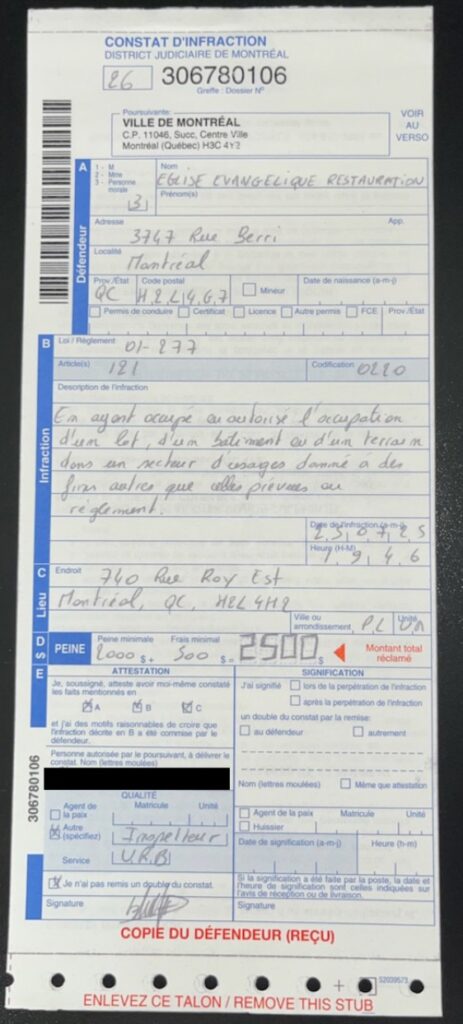
A church is facing a $2,500 fine from the City of Montreal for hosting a July 25 worship service without a permit, an event that turned chaotic when anti-Christian protesters threw smoke bombs into the sanctuary.
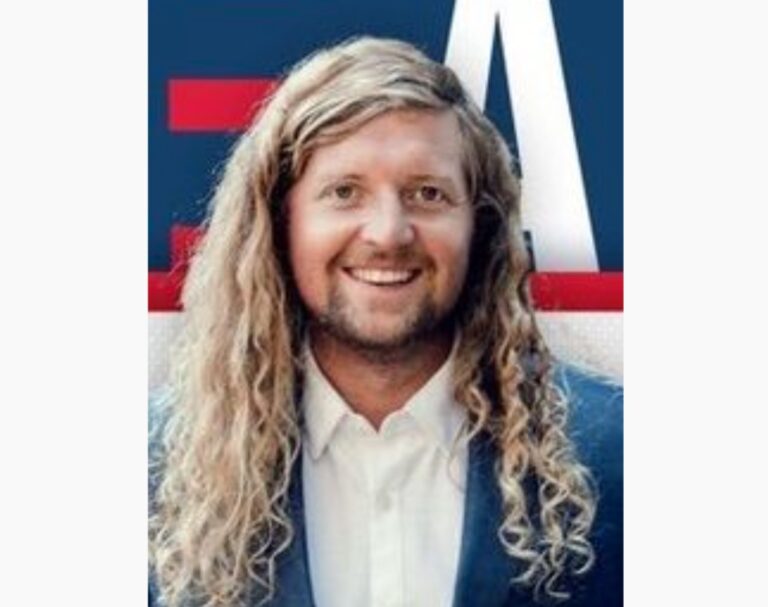
Ministerios Restauración Church had invited American Christian musician and activist Sean Feucht as part of his “Revive in 25” tour. Revival tours are classic Christian events that always include worship music. City officials classified the gathering as a “concert,” requiring a special event permit, which they say the church failed to obtain.
City spokesperson Catherine Cadotte said the fine was issued for violating municipal bylaws regulating use of buildings and land for certain activities. The ticket cites “occupation of a lot, building, or land in a sector of use other than those provided for in the regulations.”
The citation by Montreal police.
While the scene inside the church during the service was peaceful, with a few dozen worshippers singing and praying under the watch of a row of police officers, protests grew outside. According to Rebel News reporter Alexandra Lavoie, Feucht was met by protesters when arriving at the church, and one individual, now identified through video footage as a large man, threw two smoke bombs in at Feucht as he entered. One was detonated inside the building.
“Despite a police presence, the suspect was not detained,” Lavoie reported, adding that security video of the incident has now been made public. There appeared to be little interest in tracking down the suspect, as police seemed more focused on stopping Feucht from speaking.
The Democracy Fund, a Canadian constitutional rights charity, has taken up the church’s legal defense, arguing the fine is an infringement of religious freedom under both the Canadian Charter of Rights and Freedoms and the Quebec Charter of Human Rights and Freedoms.
Mark Joseph, litigation director for the Democracy Fund, accused the city of acting in bad faith. “The state has apparently prejudged this matter, suggesting, improperly and without evidence, that peaceful Christian worshippers were engaged in hate speech. This is highly inappropriate,” Joseph said.
A spokesperson for Montreal’s mayor’s office defended the city’s stance, saying: “This show runs counter to the values of inclusion, solidarity, and respect that are championed in Montreal. Freedom of expression is one of our fundamental values, but hateful and discriminatory speech is not acceptable in Montreal.”
No arrest has been made of the person who threw the smoke bomb inside the church.
Feucht is the founder of the Let Us Worship movement. He ran as a Republican in California’s 3rd congressional district primary in 2020, losing in the primary to Tamika Hamilton.
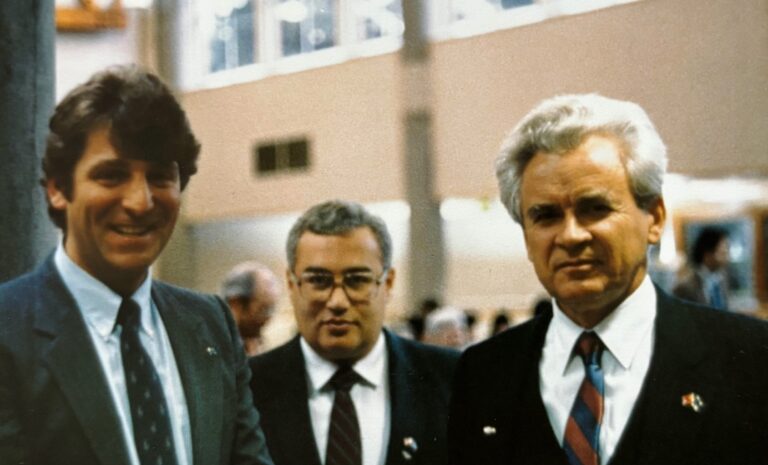
Thirty-five years ago, Mikhail Gorbachev, then president of the Soviet Socialist Republic, was awarded an Honorary Doctorate in Humanities from the University of Alaska Southeast. Then-UAS Chancellor Marshall Lind invited Soviet Ambassador Yuri Dubinin to accept this award on Gorbachev’s behalf.
Dubinin arrived at Juneau with an entourage of six Soviet officials. Back then, I taught Russian Studies and archaeology at UAS and was assigned to accompany the delegation. In fact, Dubinin was the first Soviet ambassador to visit Alaska, post-World War II.
Dubinin was the Soviet ambassador to the United States during much of the turbulent 1980s’ perestroika period. In a Washington post piece, he described himself as a “popularizer of perestroika”— the radical reform efforts of Gorbachev.
In Alaska, the mid-1980s through 1990s was an enthusiastic period of the Soviet/Russian–Alaska relationships in nearly all cultural, educational and governmental spheres. I was a busy person, translating, almost daily, for all involved in the Russian-Alaska affairs; the enrollment in my Russian language classes at UAS was over the limit, with a long waiting list. Indeed, it was a promising hope to end Cold War tensions and begin a new era of mutually productive and friendly relationship between two great nations.
Nevertheless, whether under Soviet/Russian leadership of Khrushchev, Brezhnev, Chernenko, Andropov, Gorbachev, Yeltsin or Putin, the West never stopped its Cold War policies of undermining USSR/Russia. In the late 1970s, President Jimmy Carter provided military and logistical support to the Afghan Mujahideen, the precursor to the Taliban, thereby provoking Soviet invasion of Afghanistan in 1979.
In fact, every successive U.S. president continued covert and overt interference in countries on Russia’s southern borders, including former Soviet Central Asian republics, Georgia and Ukraine.
The ideological architect of the strategy to contain the Soviet Union during Carter presidency was Zbigniew Brzezinski, national security advisor and antagonist of the Soviet regime. Indeed, Ukraine played a pivotal role in the so-called Brzezinski Doctrine, which identifies the country as key to preventing Russian–European economic and political integration. Still today, the U.S. foreign establishment is rife with Brzezinski proteges and anti-Russian Cold War ideology.
With Ukraine, because of Brzezinski’s anti-Russian ideology, the West made a major strategic bet that eventually failed. The crippling sanctions against Russia since 2014 were expected to crater the Russian economy, resulting in a popular uprising and leading to the replacement of Vladimir Putin with a pro-Western leader. The hope was that this wishful dream would lead to a pro-Western globalist taking control of the Kremlin, resulting in a boon for Wall Street, as Russia is the richest country in the world in terms of natural resources.
With the growing demand for natural resources, Russia represents a rich investment opportunity in the unforeseen future. However, these Western sanctions against Russia completely failed. In 2024, European Union’s GDP grew 1.7%, while Russia’s grew 4.2%.
Soon after the dissolution of the Soviet Union—as early as 1993—President Bill Clinton started pushing for NATO expansion in Europe, including Ukraine, to which many strategically thinking American sociologists and historians strongly objected. This is how the slippery road to the current crisis might escalate into potential nuclear conflicts.
After gaining its independence in 1991, Ukraine could expect a bright future. At that time, Ukraine (with exception of Russia) was the largest country (territory) in Europe, with a population of 52 million citizens, and sixth largest GDP in Europe. Today, population of Ukraine is under 30 million citizens, and it is the poorest country in Europe by GDP per capita.
Having vital industrial and agricultural sectors, a favorable climate, and fertile land, the country needed effective anti-corruption reforms, a certain level of autonomy for its regions with large Russian ethnic populations, and, most importantly, neutral status with no membership in any military blocs to become one of the most prosperous European states within its 1991 borders.
Instead, billions of dollars from the Western countries, and George Soros poured into Ukraine—not to boost its economy but to reformat public opinion, which overwhelmingly favored neutral status and opposed joining NATO. This influence from the West helped to instigate the “Orange” revolution regime change in 2004, and then “Maidan” in 2014, which was directly coordinated by then-Vice President Joe Biden with Victoria Nuland from the White House in the Ukrainian capital Kyiv.
The new Ukrainian government, selected by Washington and the West, immediately declared its intention to join NATO. In fact, if not for this 2014 coup, there would be no annexation of the Crimean Peninsula by Russia in 2014, no war today in East Ukraine, and no risk of potential nuclear World War III.
In short, the Western policies of using Ukrainians as cannon fodder to inflict a strategic defeat on Russia denigrates and contradicts the fundamental spirit and soul of America itself. While claiming to adhere to Western/Judeo-Christian values, the West provoked and continues to fund a prolonged war between two nations that have lived together for over three centuries and are bound together by close historical, linguistic, religious, economic, cultural, and family ties.
No one can predict how the Russian-Ukrainian/West conflict will end, but as the drums of World War III keep banging, those who are not among decision-makers or on the battlefields should at least try to clear the smog of this war.
Forthcoming meeting between President Trump and President Putin in Alaska on August 15 is a step in the right direction to achieve peace in the Russian-Ukraine conflict. Certainly, both presidents may have different views on this matter, and they may not succeed to their goal and expectations. However, if they won’t try, then they definitely will not succeed to end this conflict.
Alexander Dolitsky was born and raised in Kiev in the former Soviet Union. He received an M.A. in history from Kiev Pedagogical Institute, Ukraine in 1976; an M.A. in anthropology and archaeology from Brown University in 1983; and enrolled in the Ph.D. program in anthropology at Bryn Mawr College from 1983 to 1985, where he was also lecturer in the Russian Center. In the USSR, he was a social studies teacher for three years and an archaeologist for five years for the Ukrainian Academy of Sciences. In 1978, he settled in the United States. Dolitsky visited Alaska for the first time in 1981, while conducting field research for graduate school at Brown. He then settled first in Sitka in 1985 and then in Juneau in 1986. From 1985 to 1987, he was U.S. Forest Service archaeologist and social scientist. He was an Adjunct Assistant Professor of Russian Studies at the University of Alaska Southeast from 1985 to 1999; Social Studies Instructor at the Alyeska Central School, Alaska Department of Education and Yukon-Koyukuk School District from 1988 to 2006; and Director of the Alaska-Siberia Research Center from 1990 to 2022. From 2006 to 2010, Alexander Dolitsky served as a Delegate of the Russian Federation in the United States for the Russian Compatriots program. He has done 30 field studies in various areas of the former Soviet Union (including Siberia), Central Asia, South America, Eastern Europe and the United States (including Alaska). Dolitsky was a lecturer on the World Discoverer, Spirit of Oceanus, and Clipper Odyssey vessels in the Arctic and Sub-Arctic regions. He was a Project Manager for the WWII Alaska-Siberia Lend Lease Memorial, which was erected in Fairbanks in 2006. Dolitsky has published extensively in the fields of anthropology, history, archaeology and ethnography. His more recent publications include Fairy Tales and Myths of the Bering Strait Chukchi, Ancient Tales of Kamchatka, Tales and Legends of the Yupik Eskimos of Siberia, Old Russia in Modern America: Living Traditions of the Russian Old Believers in Alaska, Allies in Wartime: The Alaska-Siberia Airway During World War II, Spirit of the Siberian Tiger: Folktales of the Russian Far East, Living Wisdom of the Russian Far East: Tales and Legends from Chukotka and Alaska, and Pipeline to Russia: The Alaska-Siberia Air Route in World War II.
Dr. Vinay Prasad, a nationally known hematologist-oncologist, took the helm of the FDA’s powerful Center for Biologics Evaluation and Research in early May. It was a position with vast influence over vaccines and other biologics.
Just two months later, he abruptly resigned amid a coordinated smear campaign involving Big Pharma, right-wing firebrand Laura Loomer, and critical Wall Street Journal editorials.
Behind the scenes, whispers claimed President Donald Trump wanted him gone, even though Health and Human Services Secretary Robert F. Kennedy Jr. and FDA Commissioner Dr. Marti Makary urged him to stay.
Prasad, unwilling to let political drama eclipse the FDA’s mission, stepped aside “to avoid being a distraction,” saying he planned to return to California and spend more time with his family. In doing so, he put the institution and the nation ahead of himself.
But less than two weeks later, he’s back. At Makary’s urging, the White House reinstated Prasad after reviewing the comments Loomer had branded as “disloyal” to Trump. The verdict? There was no “there” there, as Gertrude Stein might put it.
The official announcement by HHS spokesperson Andrew Nixon was, “Dr. Vinay Prasad is resuming leadership of the Center for Biologics Evaluation and Research. Neither the White House nor HHS will allow the fake news media to distract from the critical work the FDA is carrying out under the Trump Administration.”
Of course, Loomer had to respond with a post on X (formerly Twitter) which said this was an “egregious personnel decision” and then went on to say she plans to “(ramp) up my exposures of officials within HHS and FDA” in the coming weeks.
Big Pharma is watching Prasad’s return closely. It’s uncertain how this will impact Sarepta Therapeutics, which recently had strong disagreements with the FDA over its Duchenne Muscular Dystrophy drug Elevidys before Prasad resigned last month. Interestingly, two days after Prasad resigned, the FDA approved Elevidys for ambulatory DMD patients. Sarepta was allowed to resume shipments, which caused its stock to soar.
And Big Pharma doesn’t know the effect on Pfizer and Moderna, now that the Covid boosters are being restricted to those at risk and those over 65 years old.
Yes, you can still get the jab if you don’t meet those criteria, but will your health insurance company pay for it? You may have to pay in more than one way.
Now let’s get to what’s most important-our children and vaccines. How do we ensure that our children’s vaccines are safe and effective? Why is it we give more vaccines to our children than any other country? Why do we vaccinate our children with vaccines that other countries won’t give due to safety concerns?
It always goes back to follow the money. Somehow the Hippocratic Oath that says “First do no Harm” is not as important as the bottom line.
Linda Boyle, RN, MSN, DM, was formerly the chief nurse for the 3rd Medical Group, JBER, and was the interim director of the Alaska VA. Most recently, she served as Director for Central Alabama VA Healthcare System. She is the director of the Alaska Covid Alliance/Alaskans 4 Personal Freedom.
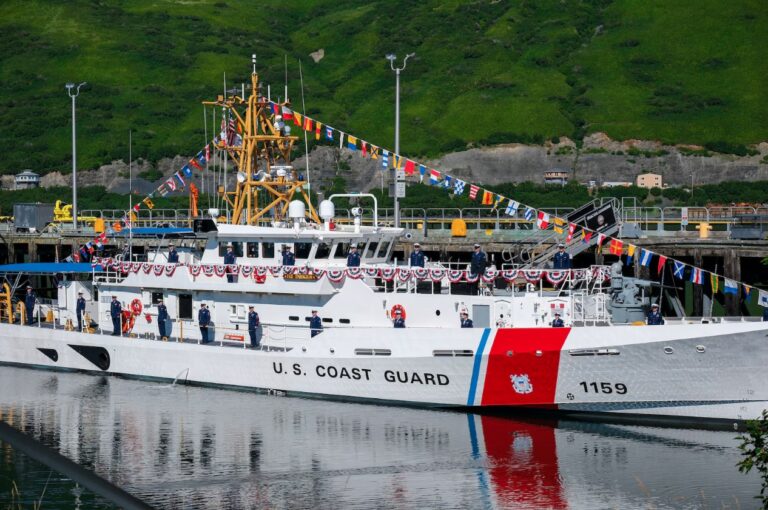
Just one day after the ceremonial commissioning of the icebreaker Storis in Juneau, the US Coast Guard welcomed another vessel into its Alaska fleet, officially commissioning the Coast Guard Cutter Earl Cunningham during a ceremony Monday at Coast Guard Base Kodiak.
Acting Coast Guard Commandant Adm. Kevin Lunday presided over the ceremony, which was attended by members of the Cunningham family, including the ship’s sponsor, Penney Helmer, granddaughter of the cutter’s namesake.
“Commissioning the USCGC Earl Cunningham strengthens our ability to control, secure, and defend Alaska’s U.S. border and maritime approaches, protect resources vital to our economic prosperity, and respond to crises throughout the Aleutian Islands,” Lunday said. “This crew will honor the heroic legacy and selfless devotion to duty exemplified by Petty Officer Cunningham in the years ahead.”
The Earl Cunningham is the 59th Fast Response Cutter in the service and the second of three slated to be home-ported in Kodiak. Its crew will operate primarily in the Aleutian Islands, Bering Sea, Gulf of Alaska, and North Pacific Ocean, carrying out missions such as search and rescue, fishery patrols, drug and migrant interdiction, national defense, and ports, waterways, and coastal security.
The cutter honors Petty Officer 2nd Class Earl Cunningham, who enlisted in the Coast Guard in 1928 after serving in World War I. On Feb. 8, 1936, Cunningham volunteered to rescue two ice fishermen trapped in the frigid waters of Lake Michigan. He reached them in a skiff and pulled them aboard, but severe weather stranded the group on the ice. Three days later, one fisherman made it to shore alive; the other died trying. Cunningham was found frozen in place at the oars of the skiff.
For his sacrifice, Cunningham was posthumously awarded the Gold Lifesaving Medal. He left behind his wife, Helen, and three sons.
The new cutter is part of the Coast Guard’s modernization effort to replace its aging 1980s-era Island-class patrol boats. Backed by the largest single funding commitment in Coast Guard history, nearly $25 billion through President Donald Trump’s One Big Beautiful Bill Act, including $1 billion for additional Fast Response Cutters, the vessels boast advanced communications, surveillance, and over-the-horizon deployment capabilities. They are a key component of Force Design 2028, an initiative launched by Secretary of Homeland Security Kristi Noem to build a more agile and responsive Coast Guard.
The commissioning marks the Earl Cunningham’s joining active service, with a mission ranging from saving lives to defending America’s maritime borders.