Tuesday, August 4, 2026
Home Blog Page 374

David Boyle: Anchorage schools, how low can you set your goals and still claim victory?

By DAVID BOYLE

At its recent mid-June retreat, the Anchorage School Board worked hard to set low goals for teaching students how to read and do math.  

Watch the retreat session and listen to the discussion on YouTube:

It is encouraging that the school board has set achievement goals for its staff and students. Goals for math and reading should be basic for any school district.

The retreat recording was not initially posted, but at my request Board President Andy Holleman did work to ensure the recordings were posted on YouTube for the public to hear. You can fast-forward through it and hear different parts of the discussion and presentation, which is revealing. Listening to the discussion is helpful to understand why they set such low, yet achievable, goals. 

Here are the reading, math and graduation goals set by the board:

What percentage of students do you believe should be able to read at grade level and what percentage of students should be proficient in math? 

Shouldn’t at least 50% of our students be able to read by 3rd grade?  Shouldn’t at least 50% of our students be able to do math by 8th grade?

From the goal graphic above, it doesn’t look like the district believes that.

The district’s goal is that only 46.4% of third-grade students should be able to read at grade level by 2028. That’s not aspirational. It would seem they looked for a low number they might be able to achieve so they could be successful.  

Goals should be aspirational. When one challenges a child to meet a high goal, many students will reach that goal and excel.  That leads to self-worth, pride, and further student encouragement.

So, if you enroll your child in the district’s kindergarten this year, chances are less than 50/50 that your child will be able to read at grade level by the time your child is ready for fourth grade.

What parent would take a less than 50% chance that their child could read by third grade?  

That child will have a very difficult time succeeding in other subjects such as math, science and social studies if he/she/they/them cannot read.  

The saying goes, “A child learns to read by 4th grade so she can read to learn thereafter.”

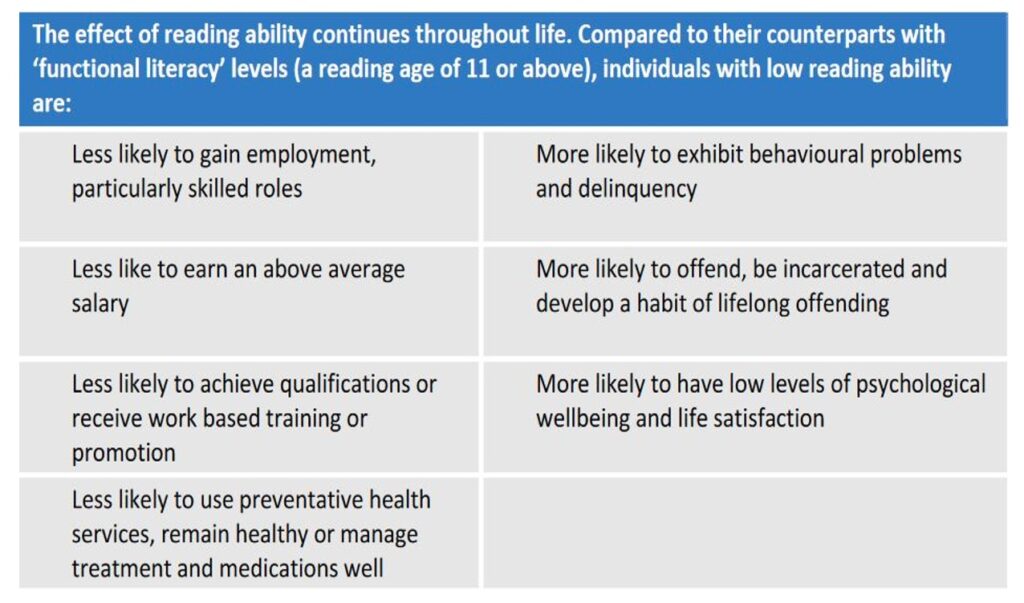
Here is a chart from The Centre for Education and Youth that shows the relationship between reading and success in life:

As you can see, the future does not bode well for those students who are less literate.

An even greater question is, “If a school district cannot teach a child to read, what is it teaching?”

But there is some good news. In the current 2023 AK STAR test less than one-third (32.4%) of ASD current 3rd grade students read at grade level. So, it is an improvement if 46.4% read at grade level by 2028.

But how many of these 3rd grade students will read at grade level in later grades?  

The board also set math proficiency goals at its retreat. It believes that only 41.5% of its 2028 8th grade students should be proficient at math. That’s not aspirational either.

This spells doom for many students who like STEM (science, technology, engineering and math) classes.  

Those 2028 8th grade students are today in the 5th grade. That student cohort scored 40% in math proficiency in 2023 in the AK STAR. This is just slightly below the goal set for them by the time they reach 8th grade.   

But, once again, there is good news — sort of. In the 2023 AK STAR tests less than 35% of 8th graders were proficient in math.  So, the district is hoping that the 2028 8th grade students will at least improve by six and a half percentage points.

Again, the question is, “If a school district cannot teach a child to do math, what is it teaching?”.

Finally, the Anchorage School District sets a graduation goal of 90% by 2028.

This presents a real contradiction: How can the graduation rate be so high if students cannot read at grade level and do math at grade level?

Maybe, just maybe, some of these students will not be able to read their diplomas.

It is clear that the district will probably achieve its very low goals.  And it will declare success. But will students be able to achieve their goals? And will they be successful in life? 

These reading and math goals were on the Aug. 20th agenda for the ASD School Board.  Here is a link to the agenda.

You can listen to the school board here.

Hastily called meeting: Mayor LaFrance apologizes to police for disparaging them last week at press conference

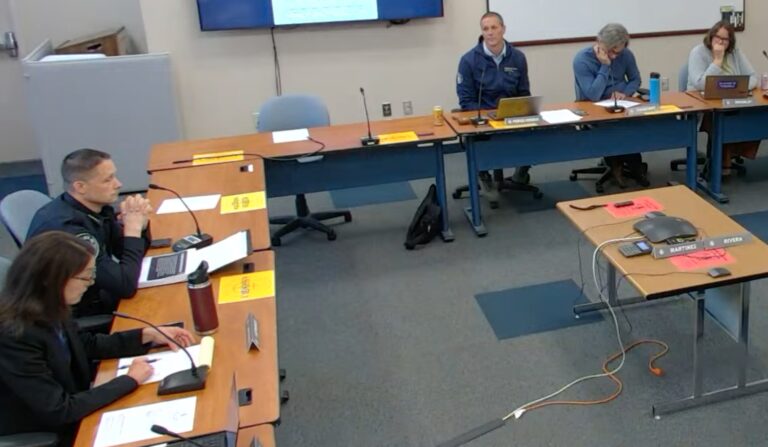
After a meeting with the head of the police union in Anchorage and the chief of police earlier this week, Mayor Suzanne LaFrance asked her allies on the Anchorage Assembly to hold a “special meeting” of the Assembly’s Public Health and Safety Committee. That way, she could get an apology she had promised to police on the record for her prior comments, which were made at a press conference last week and appeared to disparage uniformed officers.

LaFrance went on at length describing how devastated she was upon learning of the loss of the life of a 16-year-old earlier this month, who was shot dead by police after she came at them with a knife. Her comments last week poured all of her sympathy into the family of the victim, and made no recognition of the difficulty police have not knowing if they will see their families again after each shift. She had poured gas on the fire that liberals have created which has made police into the bad guys.

LaFrance admitted on Wednesday that she needs to listen more and hear the concerns of officers.

Evidently her newfound understanding of police came after a meeting in which many members of the uniformed officer staff attended and expressed their dismay at her public comments.

“Multiple things can be true at once,” LaFrance said Wednesday, adding that her grief for the family of the teen, who was going through a homicidal phase, does not undermine support for sworn officers, and vice versa.

She and Police Chief Sean Case, who was also at the Wednesday meeting, laid out the basic plan that she has for the investigation into the shooting. Last week, she had indicated she was taking away the power of the internal affairs officials and getting an outside third party to do an investigation.

While last week she referred to the routine investigation that is done by the State Office of Special Prosecutions, today LaFrance acknowledged that the state investigation will have to come before the third-party investigation, and it all may take weeks or months.

Assembly members Felix Rivera, Daniel Volland, and Meg Zaletel are working on creating a citizens accountability group that will oversee the police. Surprisingly Assemblyman Chris Constant counseled the Assembly to slow down and wait until the facts come in about the shooting and other shootings this year involving officers.

Much of the meeting focused on the need for an expansion of the Mobile Intervention Team, which is a combination of mental health clinicians and paramedics who can respond to behavioral health calls. There is currently not enough staff or funding or staff to support the unit on a 24-hour, 7-day-a-week basis. Part of the funding for the unit comes from the alcohol tax passed by voters.

LaFrance did not issue a written apology or press release regarding her statements on Wednesday. She spoke her words into a meeting that was not advertised to the public and which had no agenda that had been released.

Watch the meeting here:

Nearly half the states, including Alaska, call on U.S. Supreme Court to uphold state voting security

17

Alaska’s Attorney General Treg Taylor has joined a group of 24 states in calling on the U.S. Supreme Court to ensure that noncitizens don’t vote in federal elections, in accordance with federal law.

The brief was filed in the case known as Republican National Committee v. Mi Familia Vota, asking the high court to hear the case and allow states to require that voters show proof of citizenship when they vote.

The law recently passed in Arizona is at the heart of the case. The law requires proof of citizenship in order to vote, but a federal district court judge has issued an injunction, which this coalition is attempting to have set aside.

The States “bear many of the consequences of unlawful immigration.” and for too long, “‘federal policies’
of nonenforcement” have left “the States helpless before those evil effects,” the amicus brief states in its introduction. “One of those effects is voter fraud” which “drives honest citizens out of the democratic process and breeds distrust of our government.”

There is every reason to believe “this problem of non-citizen voting has gotten worse, as the number of illegal immigrants in the United States has undeniably grown… Each of those illegal aliens represents another possible opening for voter fraud, for each represents a probability – no matter how small – that they will vote illegally,” the attorneys general state.

The brief was filed by Texas Attorney General Ken Paxton, who argues the Biden-Harris Administration “intentionally flooded our country with illegal aliens. Without proper safeguards, foreign nationals can and will illegally influence elections at the local, state, and national level. States have a constitutional right and responsibility to ensure that only legal votes from American citizens are counted.”

Attorneys general signing onto the brief include Alabama, Alaska, Arkansas, Florida, Georgia, Idaho, Iowa, Indiana, Kansas, Kentucky, Louisiana, Missouri, Montana, Nebraska, New Hampshire, North Dakota, Ohio, Oklahoma, South Carolina, South Dakota, Texas, Utah, Virginia, and West Virginia.

Wolf bites motorists on the Dalton Highway

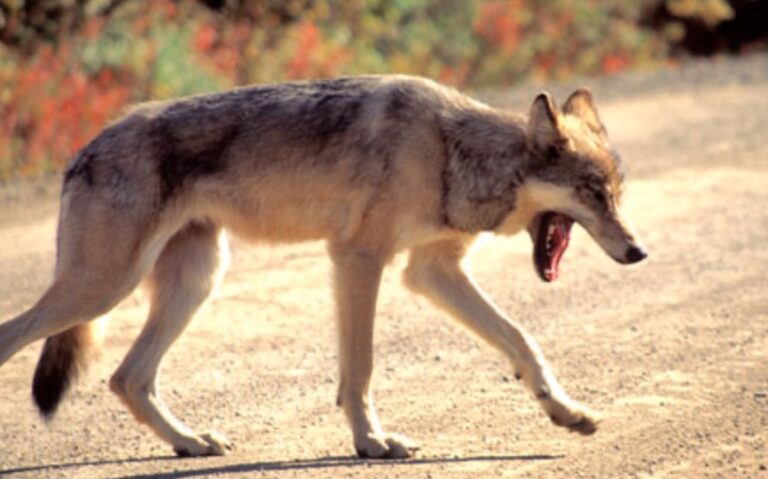
A wolf attacked two motorists at mile 37 of the Dalton Highway on Aug. 19, as the two people were stopped in a construction zone and had stepped out of their vehicle while waiting for the pilot car. They were bit on their lower extremities, before the wolf fled to the nearby woods after being shot at by another motorist. The wolf was not believed to have been struck.

Both people had puncture wounds and returned to Fairbanks for medical care. The Alaska Wildlife Troopers were unable to locate the wolf and notified Alaska Department of Fish and Game.

There was no indication that the people were feeding the wolf and the Troopers made no statement about whether the wolf exhibited signs of rabies.

The gray wolf has the strongest bite pressure of any canid, reaching up to 1200 lbs/square inch (PSI), according to Seacrest Wolf Preserve’s website: “Muscles that control a wolf’s jaw are enough to bite through bones.”

Craig Campbell: How Jared Goecker will win Eagle River/Chugiak Senate District L

By CRAIG CAMPBELL

Elections have consequences.  Ranked Choice Voting (RCV) created an election process designed to reduce political party influence, but it also has taken away the premise of “one person, one vote.”  That was intentional, as RCV is intended to elect “consensus” candidates, not necessarily the voter majority preferred candidate.

In Alaska, Democrats have been slick at reducing the number of Democrats running against each other, while Republicans often have multiple Republicans in any race. That was clearly seen in yesterday’s elections.  Even more challenging is having multiple Republicans in a race where one is actually favored and supported by Democrats.  

Incumbents have a higher probability of winning re-election due to name recognition and support from special interest groups. Thus, for a challenger to beat an incumbent, there must be a unified campaign with a consistent message that informs the voters of the stark differences between the incumbent and the challenger. RCV also gives the incumbent a tremendous advantage when there are multiple challengers from the same political party. 

Such is the case in Senate District L, where incumbent Kelly Merrick may face two other Republicans.  

While registered as a Republican, Merrick has gained most of her support from labor unions, special interest groups, and Democrats. In her elected career, she has consistently joined coalitions with Democrats. She is one of eight Senate Republicans who organized with all nine Democrats this past 33rd legislative session to form a coalition despite the fact that the Senate had a Republican numerical majority of eleven.  

In doing so, those eight Republicans turned their backs on three Republicans to give significant control of the Senate to Democrats. This is a pattern she learned while serving in the State House, where she joined Democrat controlled coalitions, despite telling voters she would not.

Senate District L is one of the most conservative districts in Anchorage. It should be represented by a Republican who will stand with Republicans to form Republican controlled majorities. If Eagle River/Chugiak wants to see a Republican Senate majority next year, we must elect an actual Republican to replace Merrick.

Based on yesterday’s preliminary results the only Republican who can defeat Merrick in November is Jared Goecker.  But to do this, Ken McCarty must withdraw from the race and endorse Jared Goecker.  I know Ken, he is a solid Republican who served our area well in the State House.  

I also know Sharon Jackson, who is a proud military veteran and also served us well in the State House.  If both Ken and Sharon join the Goecker team, Jared can beat Merrick in November.  Jared is a solid Republican who is committed to only joining a Republican majority, led by Republicans. He will not coop his principles by joining with a coalition numerically controlled by Democrats, unlike our current senator.

Let’s take back control of the Senate. Let’s replace Merrick with Jared Goecker.  

Ken, Sharon, this is the time for statesmanship and a consolidated effort to secure Senate District L with a Senator who represents our conservative political principles.  Now is the time for them to withdraw and publicly endorse Jared. We can do this, but only with a united Republican campaign supporting the strongest challenger, and that candidate is Jared Goecker.

Craig E. Campbell served on the Anchorage Assembly between 1986 and 1995 and later as Alaska’s Tenth Lieutenant Governor.  He was the previous Chief Executive Officer and President for Alaska Aerospace Corporation.  He retired from the Alaska National Guard as Lieutenant General (AKNG) and holds the concurrent retired Federal rank of Major General (USAF).

Listicle: Which districts in Alaska had highest voter turnout on Tuesday?

The top districts for voting in Alaska in the Aug. 20 primary were:

House District 9, South Anchorage: 4,176 / 16,361, 25.52%

House District 35, Fairbanks: 3,762 / 15,791, 23.82%

House District 6, South Kenai: 4,296 / 18,310, 23.46%

House District 4, North Juneau: 3,621 / 16,947, 21.37%

House District 3, Downtown Juneau: 3,255 / 15,281, 21.30%

House District 16, Anchorage: 3,356 / 15,935, 21.06%

House District 34, Fairbanks: 3,263 / 16,099, 20.27%

House District 8, Kenai: 3,501 / 17,375, 20.15%

House District 36, Interior: 3,254 / 16,234, 20.04%

House District 11, Anchorage: 2,988 / 15,350, 19.47%

The lowest turnout of those reporting all their precincts was:

House District 18, Government Hill and military area of Anchorage: 603 / 12,183, 4.95%

The state total was 92,690 of 605,482 (15.31%), however, three rural districts have not reported in most of their ballots, and so the voter turnout may inch higher.

The Division of Elections, under the direction of Lt. Gov. Nancy Dahlstrom, failed to get three village voting centers open — all in very rural areas. They were Kaktovik, Wales, and Anaktuvuk Pass, where a few hundred votes for Rep. Mary Peltola may have been sacrificed. It remains unclear if those votes would have changed a state House outcome.

Results roll in: Peltola, Begich, Dahlstrom, Salisbury are top four

Editor’s note: Numbers are being updated at 9 a.m. Aug. 21. Expect changes.

Polls closed at 8 p.m. in Alaska, and the first results of the 2024 primary are rolling in. These numbers are dynamic and will change. Some seats are uncontested, while others have fewer than four candidates. This is a “final four” primary, so the top four candidates in any race will proceed to the November election. Turnout appears to have been light across the state.

Here’s what we know (for now we are not reporting the uncontested races): 318 of 403 (78.91%) have reported. Voters Cast: 96,539 ballots of 605,482 registered voters (15.94%). With absentee ballots still coming in, turnout may be about 17% by the time the final tally is certified.

Congress

Mary Peltola DEM 48,418, 50.38%

Nick Begich REP, 25,930, 26.98%

Nancy Dahlstrom REP, 19,234, 20.01%

Matthew Salisbury REP, 599, 0.62%

Others under 1/2%

Total Votes 96,100

Dahlstrom had a press release prepared that went out immediately. She said she will not drop out of the race and that she is the only one who can beat Peltola. Earlier in the race, she said she would sit down with Gov. Mike Dunleavy and Nick Begich and have a discussion, but tonight she canceled those plans. She was spotted casually shopping at Nordstrom rack on Election Day afternoon, while three towns in Alaska did not open their voting centers; as lieutenant governor, elections are her primary responsibility.

Earlier in the race, Begich said many times that if he was not the leading Republican, he would drop. Tuesday, he’s the leading Republican by nearly 7 points, while Dahlstrom trails the leader, Peltola, by 30 points.

Nick Begich posted a statement saying he has surged as the “decisive Republican nominee in Tuesday’s primary.
Conservative voters across Alaska issued a mandate for their choice of nominee.”

“Tonight’s votes demonstrate incontrovertibly two key results:
● First, Nick Begich has been identified by Alaskan voters as the candidate they feel confident can defeat
Mary Peltola in November.
● Second, despite her cash advantage and relentless advertising barrages, Mary Peltola remains
vulnerable in the November general election.”

Peltola has had millions of dollars at her disposal from national fundraising efforts through Act Blue. Begich has raised almost all of his money from in state.

“I am deeply grateful to Alaskans for delivering our campaign a resounding victory in today’s primary,” said
Begich. “The voters sent a clear message: I am the best Republican candidate to beat Mary Peltola in
November. To get that done we must unite as conservatives. I congratulate Nancy Dahlstrom on a well-run
race. Unified, it is clear that Republicans can defeat both Mary Peltola and the ranked choice system that only
benefits the Democrats.”

In its statement, the National Republican Congressional Committee made no mention of Dahlstrom, who the organization had backed with massive funding: “Extreme Democrat Mary Peltola talks a good game in Alaska, but her voting record enabled Joe Biden, Kamala Harris and the Squad’s liberal agenda destroying Alaska’s future. Actions speak louder than words. Peltola’s failed record made Alaskans poorer and less safe, which is why we are confident Alaskans will flip the seat red again as it was under Don Young,” said NRCC spokesman Ben Petersen.

Senate District D (North Kenai)

Carpenter, Ben REP, 2,445, 41.23%

Cizek, Andy AIP, 156, 2.63%

Bjorkman, Jesse J. REP, 2,605, 43.93%

Wegener, Tina DEM, 724, 12.21%

Total Votes, 5,930

Senate District F (South Anchorage)

Kaufman, James D. REP, 2,298, 45.83%

Borbridge, Harold REP, 287, 5.72%

Park, Janice L. DEM, 2,429, 48.44%

Total Votes, 5,014

Senate District H (SW Anchorage)

Claman, Matt DEM, 3,644, 59.64%

Vazquez, Liz REP, 1,186, 19.41%

McKay, Thomas “Tom” REP, 1,280, 20.95%

Total Votes, 6,110

Senate District J (East Anchorage)

Dunbar, Forrest DEM, 1,982, 71.50%

Smith, Cheronda L. UND, 790, 28.50%

Total Votes, 2,772

Senate District L (Eagle River)

Goecker, Jared D. REP, 2,054, 33.14%

Hammermeister, Lee E. DEM, 881, 14.23%

McCarty, Ken REP, 699, 11.29%

Merrick, Kelly R. REP, 2,095, 33.83%

Jackson, Sharon D. REP, 465, 7.51%

Total Votes, 6,192

Senate District N (Wasilla)

Wilson, David S. REP, 1,604, 41.21%

Wright, Stephen REP, 1,009, 25.92%

Yundt, Robert REP, 1,279, 32.86%

Total Votes, 3,892

Senate District P (Fairbanks)

Kawasaki, Scott DEM, 1,583, 48.92%

Hajdukovich, Leslie W. REP, 1,653, 51.08%

Total Votes, 3,236

Senate District R (Interior)

Cronk, Mike REP, 3,041, 43.39%

Fletcher, Savannah UND, 2,996, 42.75%

Squyres, James A. REP, 524, 7.48%

Williams, Robert “Bert” AIP, 448, 6.39%

Total Votes, 7,009

House District 1 (Ketchikan)

EchoHawk, Grant NON, 669, 26.69%

Bynum, Jeremy T. REP, 1,253, 49.98%

Moran, Agnes C. NON, 585, 23.33%

Total Votes, 2,507

House District 5 (Kodiak)

Stutes, Louise B. REP, 1,324, 80.15%

Radner, Leighton LIB, 328, 19.85%

Total Votes, 1,652

House District 6 (South Kenai-Homer)

Vance, Sarah L. REP, 1,829, 42.90%

Greear, Alana L. NON, 718, 16.84%

Slaughter, Dawson R. REP, 245, 5.75%

Johnson, Brent NON, 1,471, 34.51%

Total Votes, 4,263

House District 7 (Soldotna)

Gillham, Ronald D. “Ron” REP, 960, 39.83%

Ruffridge, Justin M. REP, 1,450, 60.17%

Total Votes, 2,410

House District 8 (Kenai)

Elam, Bill REP, 1,474, 49.22%

Hillyer, John REP, 1,521, 50.78%

Total Votes, 2,995

House District 9 (South Anchorage-Girdwood)

Ellis, Lee E. REP, 771, 19.32%

Holland, Ky NON, 1,609, 40.33%

Bauer, Lucy REP, 866, 21.70%

Pennington, Brandy REP, 744, 18.65%

Total Votes, 3,990

House District 10 (South Anchorage)

Kopp, Charles M. “Chuck” REP, 1,327, 60.79%

Johnson, Craig W. REP, 856, 39.21%

Total Votes, 2,183

House District 11 (South Anchorage)

Coulombe, Julie REP, 1,549, 52.96%

Featherly, Walter T. NON, 1,376, 47.04%

Total Votes, 2,925

House District 12 (Anchorage)

Lurtsema, Joseph M. “Joe” REP, 750, 35.05%

Schrage, Calvin R. NON, 1,390, 64.95%

Total Votes, 2,140

House District 13 (Anchorage)

Gottshall, Heather REP, 777, 43.97%

Josephson, Andrew L. “Andy” DEM, 990, 56.03%

Total Votes, 1,767

House District 14 (Anchorage)

Kamdem, Harry Winner DEM, 315, 16.26%

Galvin, Alyse S. NON, 1,622, 83.74%

Total Votes, 1,937

House District 15 (Anchorage)

Costello, Mia REP, 1,423, 51.41%

Darden, Dustin T. DEM, 120, 4.34%

Wells, Denny DEM, 1,225, 44.26%

Total Votes, 2,768

House District 16 (Anchorage)

Hall, Carolyn DEM, 2,023,

Moe, Nick NON, 1,214, 62.50%

Total Votes, 3,237, 37.50%

House District 18 (North Anchorage)

Groh, Cliff DEM, 379, 64.24%

Nelson, David REP, 211, 35.76%

Total Votes, 590

House District 19 (Downtown Anchorage)

Anderson, Kaylee M. REP, 284, 25.43%

Mina, Genevieve G. DEM, 775, 69.38%

Wyatt, Russell O. UND, 58, 5.19%

Total Votes, 1,117

House District 20 (Anchorage)

Kohlhaas, Scott A. LIB, 540, 32.49%

Gray, Andrew T. DEM, 1,122, 67.51%

Total Votes, 1,662

House District 21 (Anchorage)

Sims, Aimée REP, 1,067, 43.22%

Mears, Donna C. DEM, 1,402, 56.78%

Total Votes, 2,469

House District 22 (East Anchorage)

Eischeid, Ted J. DEM, 557, 50.87%

Wright, Stanley A. REP, 538, 49.13%

Total Votes, 1,095

House District 23 (Eagle River)

Allard, Jamie REP, 1,837, 59.20%

Arlington, Jim DEM, 1,266, 40.80%

Total Votes, 3,103

House District 27 (Wasilla)

Eastman, David REP, 1,148, 61.75%

Underwood, Jubilee L. REP, 711, 38.25%

Total Votes, 1,859

House District 28 (Wasilla)

Sumner, Jesse M. REP, 674, 32.67%

Menard, Steve REP, 564, 27.34%

Moore, Elexie REP, 483, 23.41%

Wright, Jessica REP, 342, 16.58%

Total Votes, 2,063

House District 30 (Big Lake)

Holmes, Doyle E. REP, 1,106, 45.40%

McCabe, Kevin J. REP, 1,330, 54.60%

Total Votes, 2,436

House District 31 (Fairbanks)

Dibert, Maxine L. DEM, 1,058, 51.94%

LeBon, Bart REP, 979, 48.06%

Total Votes, 2,037

House District 32 (Fairbanks)

Damron, Gary K. DEM, 402, 34.04%

Stapp, Will REP, 779, 65.96%

Total Votes, 1,181

House District 34 (Fairbanks)

Cottle, Joy “Joy Beth” REP, 1,379, 46.17%

Tomaszewski, Frank REP, 1,608, 53.83%

Total Votes, 2,987

House District 35 (Fairbanks)

Carrick, Ashley E. DEM, 2,235, 60.45%

McNeill, Ruben A. Jr. REP, 1,462, 39.55%

Total Votes, 3,697

House District 36 (Interior)

Fields, James LIB, 223, 6.59%

Kowalski, Brandon P. “Putuuqti” DEM, 1,163, 34.36%

Goode, Pamela REP, 475, 14.03%

Schwanke, Rebecca A. REP, 656, 19.38%

Snodgress, Cole REP, 479, 14.15%

Mock, Dana S. REP, 389, 11.49%

Total Votes, 3,385

Remainder of districts, rural Alaska, have too few precincts reporting to provide any good data:

House District 37 (Western Alaska)

Deacon, Darren M. NON, 329, 32.57%

Edgmon, Bryce UND, 266, 67.43%

Total Votes, 1,010

House District 38 (Bethel area)

Keppel, Willy VET, 244, 20.94%

Sosa, Victoria B. DEM, 82, 7.04%

McCormick, C.J. DEM, 345, 29.61%

Jimmie, Nellie D. “Unangiq” DEM, 494, 42.40%

Total Votes, 1,165

House District 39 (Nome)

Foster, Neal W. DEM, 993, 63.61%

Ivanoff, Tyler AIP, 112, 36.39%

Total Votes, 1,561

House District 40 (Barrow)

Chase, Saima “Ikrik” DEM, 215, 34.91%

Baker, Thomas C. “Ikaaq” UND, 190, 26.43%

Burke, Robyn “Niayuq” DEM, 278, 38.66%

Total Votes, 719

Kentucky Democrat Gov. Beshear says JD Vance’s family needs to be r*ped so he will understand it

It’s campaign season and leading politicians are saying some things they might regret. Case in point, on MSNBC, Kentucky Democrat Gov. Andy Beshear, while trying to make a point about abortion exceptions, said a member of vice presidential candidate JD Vance’s family needs to be raped so Vance will understand the need for abortions.

“Make him go through this,” Beshear said.

Later, when asked about the remark, Beshear refused to apologize.

“What the hell is this? Why is @AndyBeshearKY wishing that a member of my family would get raped?!? What a disgusting person,” Vance wrote in response.

Rep. Thomas Massie of Kentucky said, “Please don’t judge Kentucky based on our Democrat Governor’s disgusting remarks.”

It’s game time, Alaska: Where will you vote today?

It’s primary Election Day in Alaska, the day Alaskans decide which candidates have the best judgment, character, energy, and talent to represent them in the state House, state Senate, and U.S. House of Representatives.

The polls are now open and will close at 8 p.m. Tuesday. On Tuesday morning, sign-wavers for congressional candidate Nick Begich gathered in the parking lot of Carrs/Safeway at the corner of New Seward Highway and Northern Lights Blvd. Other candidates will have their sign-waving crews out as well along the major intersections, an Alaska election-day tradition to catch the attention of the going-to-work crowd and the going-home crowd of potential voters.

Sign wavers were also out in Fairbanks this morning under cloudy skies.

Fairbanks sign-wavers were out in force on Tuesday morning.

Given the problems with the elections already by Division of Elections, with late ballots getting out to villages and lack of information available to the media and candidates, at least the division won’t be overwhelmed by a huge turnout, or so it appears.

Turnout so far in early voting and absentee has been up over 2018 and 2020’s turnout, but down from 2022. Early votes received from Aug. 5 through Aug. 18 totaled 12,534, down from 18,296 in the same time period in 2022, but that year there was a “special general” and regular primary after the unexpected death of Congressman Don Young.

This year, there are 9,715 outstanding absentee ballots that were sent out to voters at their request but have not been returned to the Division of Elections.

To find out where you can vote, check this link at the Division of Elections.

This ballot is an open ballot, with all candidates appearing, regardless of party. Democrats have remained disciplined in not running more than one credible Democrat in any race. Republicans have not done the same, but only a few races will have decisions made in the primary.

In races with fewer than four candidates, all four will proceed to the November ballot.

Only the congressional seat, the state Senate seat L for Eagle River, and House District 36 for Interior will have a winnowing of candidates in this election to get to a final four. The congressional seat is the one with the most candidates — 12, with four of them registered Republicans.

If all goes according to past history, most races will have results known by 10 p.m. Tuesday. The Division will then not release the late-arriving absentee numbers for seven days, and then another release on Day 10 after the election, Aug. 30.

Candidates who are chosen to proceed to the Nov. 5 general election ballot will have until Sept. 2 to drop.