The Alaska Division of Elections finished the recount of Ballot Measure 2, and just six votes were changed, not nearly enough to alter the overall outcome. The attempt to repeal ranked-choice voting has failed by a margin of 743 votes.
Part of the recount, which was done by sending the ballots through the Dominion scanners again, included a hand count of a random precinct from every district.
The citizens trying to get Alaska to return to regular primaries and general elections were up against $15 million in dark money from outside Alaska, money that was used to convince Alaskans that ranked-choice voting is somehow more fair, and money that was used to chase absentee ballots and deliver the win for the liberals who designed the system for Sen. Lisa Murkowski, so that she will not have to face Republican voters in a normal primary.
Phil Izon, who was a leader of the ballot initiative to undo the ranked-choice system, says he is prepared to try again, because it’s apparent that many voters were not coerced by the millions of dollars of dark-money ads don’t agree with the system that is designed by and for leftists. He will be filing a petition application with the Division of Elections soon with what he hopes will be a more successful campaign.
In another recount that is now complete, winner Elexie Moore for the House District 28 seat made vacant by Rep. Jesse Sumner, has retained her win, after second-place finisher Steve Menard had requested a recount. Menard was behind by 12 votes, and after the recount he still trailed, but by 9 votes.
It’s better to be lucky than good. It’s best to be both. Our new congressman got elected on merit, and he’s lucky to be a member of the 119th Congress. The next two years will be the most exciting time of his life, and the most productive. I admit I’m a little jealous.
He’ll be treated well by the Republican leadership. He took a seat away from the Democrats, and they want to see him to keep it. And they know that developing Alaska’s resource wealth is a key not only to energy dominance, but to the overall health of the American economy. Prosperity is good politics.
It’s true, I believe, that he has yet to develop any rapport with President Donald Trump. He lost to Mary Peltola two years ago only because of the vainglorious Sarah Palin, who was a Trump candidate.
Trump only endorsed him this year after he beat the candidate Trump did want, Lt. Gov. Nancy Dahlstrom. But it is in the mutual interest of both men that the other succeed, and self-interest will be enough for a good working relationship.
Talk about an interesting time to be a member of the House Majority! For a while, at least, it looks like a 217 to 215 split, which means any one Republican defection can deny the Speaker a majority. It’s hard to imagine any Republican Congressman actually doing such a foolish thing, but any collection of 217 politicians will contain a few odd ducks. Actually, more than a few. For an old pol like me, this is great entertainment.
Every day seems to bring something new to get excited about. Take NASA, for instance, the organization that got us to the moon. If you’re old enough, you vividly remember where you were and who you were with when Neil Armstrong first set foot on the moon. I was in a tiny apartment on West 27th in Spenard, watching a little black and white TV with the original Fritz Pettyjohn and his wife. It was one of the most memorable moments of my life.
Those were the glory years of NASA, but it’s been more or less a boondoggle ever since. It’s been captured by Boeing, the company that builds planes with exploding doors.
But it’s got a new boss, Jared Isaacman, a big customer of Elon Musk. He paid Musk for a ride on a SpaceX rocket and got to do a spacewalk. What a guy! He’s going to have a $20 billion budget to play with, and I think he’s going to use it to help Elon get to Mars.
Aside from seeing an Article V Convention, and walking my granddaughter down the aisle, my dearest wish is to see a man land on Mars. I like pointing out Mars in the night sky and telling my grandsons that it is not a star, it’s a planet, like Earth, and some day they will see a man walk on it.
That’s one day, and one announcement, about one federal agency.
What a brave new world it may be!
Nick will be in the middle of all of this. What’s curious is that his grandfather, Nick Begich I, was in the same position 54 years ago. He was as good as Nick III, but he didn’t have any luck. He died with the House Majority Leader, and Speaker-to-be, Hale Boggs in a tragic airplane crash somewhere in the Chugach range/Prince William Sound area. What a waste!
If you’re a Christian, you might just believe that Nick I is in heaven watching all this, and he’s very proud.
Fritz Pettyjohn was a prosecuting attorney for the City of Ketchikan, Alaska in 1973 and served in the Alaska Legislature in the 1980s. He blogs at ReaganProject.com
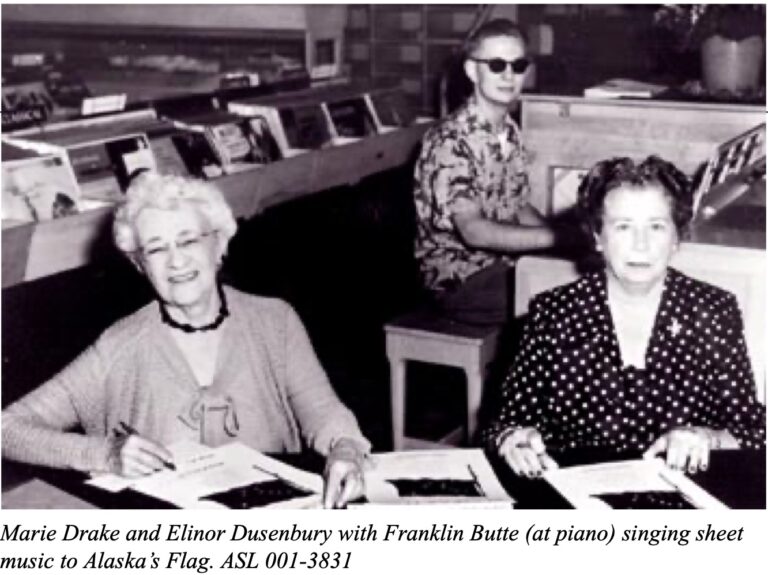
I recently wrote an additional version of Alaska’s Flag song, in consideration of the recently failed legislative attempt to add an additional verse to our traditional State song.
It seems that when attempting to alter historical icons, there is always the potential to create controversy and division from those who love and want to keep them just the way they are.
So it was, with the proposed second verse of Alaska’s Flag song. It was controversial and a legislative attempt to officially add it to the song ultimately failed.
I have performed our State song hundreds of times over the years with guitar or piano, and wherever in the world that was, people said it was one of the most beautiful state songs they had ever heard. Simple and strong. A true masterpiece.
However, those calling for a second verse had a point: The only reference to any people in the song was to “sourdough” miners, invariably mostly white and newcomers, the only requirement for the designation at that time was having survived one Alaska winter. There was no reference to Alaska’s first people, our Native population. So, a writer penned a verse to correct this omission. The problem was, while more inclusive, it was almost completely unsingable. Many people tried but it just didn’t work.
While referencing our Native population and the design of our flag by a “Native boy” it is actually a bit more complex than that. While Benny Benson was an Alaska Native, his mother, Tatiana, was Aleut/Russian and his father was a Swedish fisherman, more reflective of the diversity of our Alaska population of today. And the state song also had no recognition of all the other wonderful people that make up our state.
So, rather than try to suggest a change to our iconic Alaska’s Flag song, I have written a completely new song, not to replace but to complement it; to capture the natural beauty of our state, but also to pay respect to all of our people, especially when we stand united together.
So many forces today try to divide us by race, politics and seemingly just about everything else. These forces see some short-term advantage to this approach, but overall it is destructive to Alaska and someone needs to say something about it. I have done so here and I hope you enjoy it.
Verse 1
Alaska’s flag, long may it mean to me
Our rivers strong, our mountains, the deep blue sea
But when I see our people
Standing together proud and free….
As can be
That’s when I feel, those 8 gold stars
Shining down on me (refrain: shine on)
Verse 2
We work the sea and land
Kids and parents hand in hand
No matter your race
I only see your smiling face
And when they try to divide us
We reach deep down inside us and see
What can be
When we stand as one, under the midnight sun
That great North star will always shine on me. (refrain: shine on)
4/4 time, moderate Latin tempo and feel
Intro: E G#m7 F#m7 Am7
Verse: E G#m7 F#m7 B X2
Bridge: A Am E C# F#m B
Outro: E G#m7 F#m7 Am7
A fitting tribute to Benny Benson
He was a wonderful man. He spent his early years as an orphan in the Jesse Lee home in Unalaska. While I lived there in the 1980’s and was mayor, I visited the home, which is now a private residence.
There, upstairs, I saw Benny’s locker with his name still engraved on it, just as he left it. The Jesse Lee home moved to Seward and so did Benny, where he received an education and learned many life skills. He designed Alaska’s flag there and graduated from high school in 1932.
Benny returned to the Aleutians, trapping and selling furs on the international market, and worked as a diesel mechanic in Seattle before returning to Kodiak where he raised his two daughters as a single father, using the skills of cooking and sewing he learned at Jesse Lee. He later used those sewing skills to sew and autograph Alaska flags presented to every newly crowned Miss Alaska.
Benny broke racial barriers as well, being the first Alaska Native to be initiated into the Kodiak Elks Club, despite strenuous objections by the Elks regional headquarters in Seattle due to race. He died, at 58 years old of a heart attack.
Benny stated the reasons and meaning behind his design of the Alaska Flag:
The deep blue background representing the sea.
The Dipper’s constellation, Ursa Major, the Great Bear because of its strength.
The Great North Star to guide the future of Alaska. The North Star is particularly symbolic since it was an actual guide for travelers for centuries, ‘O’er land and sea, a beacon bright’ in the words of the song. Since the North Star stands directly over the North Pole and the other stars appear to revolve around it, you readily know where North is. And its distance over the horizon indicates your latitude. It was many years later that a double mirrored sextant and accurate timepiece allowed for the calculation of longitude. And even much later for Loran stations and the satellite GPS systems we now take for granted. Yet, even to this day, the North Star remains a powerful symbol for all Arctic people as we look North to the Future.
Paul Fuhs grew up in Anchorage, attending Denali Elementary, Central Junior High and graduated from West High in 1967. He was enlisted in US Army Military Intelligence, MOS 97 Delta, and a North Vietnamese linguist during the Vietnam War era, 1969-1971.
While the Anchorage Assembly prepares a ballot question for April to get voters to approve a 3% sales tax, it’s already flush with money.
Among the jobs it is seeking to fill is a “marketing assistant,” range 10, for the Anchorage Public Libraries.
The job pays up to $26 an hour and is open to the general public and any current municipal employee.
And it’s covered by the public employee union: “This position is represented by the Anchorage Municipal Employee Association (AMEA) and is subject to the provisions of the current agreement between the Municipality of Anchorage and the AMEA,” the job listing says.
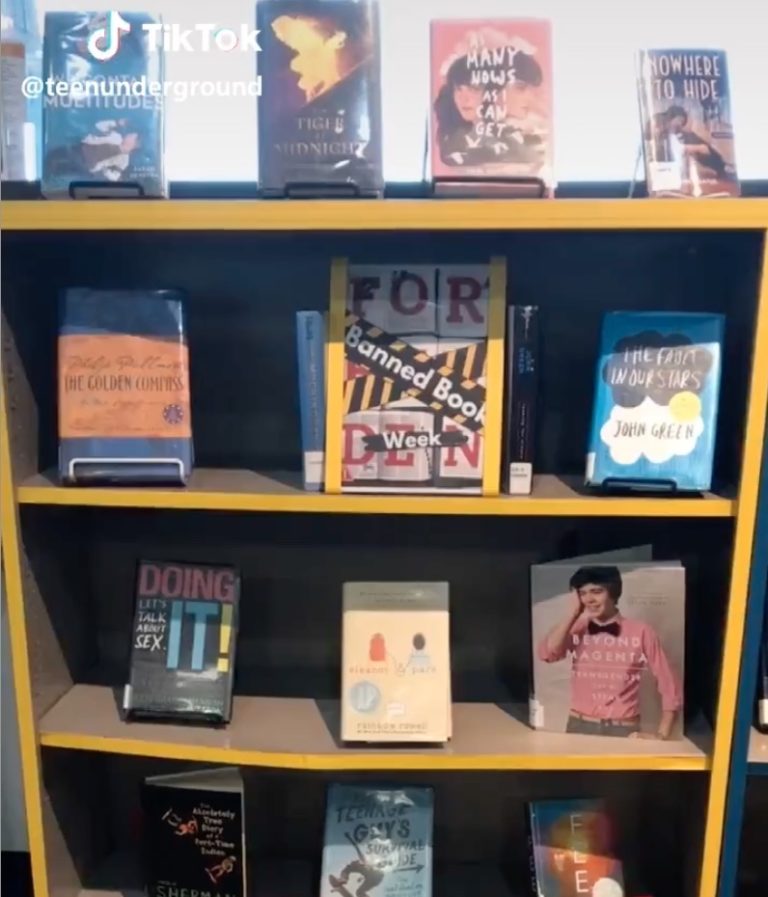
There is no library director at this time, although Elizabeth Nicolai, the assistant director, is serving as acting director of a library system that has been the subject of much public criticism for pushing gender ideology on children through Drag Queen Story Hour and books about gay sex placed prominently at a child’s eye level.
Anchorage libraries, as with those in some places in the Lower 48, have become homeless shelters and drug-use sanctuaries during the day, and some traditional users of the libraries no longer feel safe.
In 2022, a woman was stabbed in the back at the main Loussac Library and permanently injured in her spine by a man who was later released by a judge because he was found to be not competent to stand trial.
In other cities, surface tests have been conducted in public libraries and have shown that many surfaces are contaminated with drugs like methamphetamines and fentanyl. In Colorado, the Boulder Public Library suddenly closed in 2022 after meth had been detected in public areas. Denver metro libraries are spending tens of thousands of dollars to clean up meth residue in their bathrooms, according to the Colorado Sun.
With Anchorage libraries being used by drug abusers, there may be actual health hazards associated with going to the library. But instead of testing surfaces to ensure safety of patrons, Anchorage is going to focus on marketing the libraries as places for the public to take their kids.
Here is the general job description:
“The Marketing Assistant supports the development of marketing materials, social media content, short form videos, and participates in public engagement opportunities, that help grow library usage and develop a positive relationship between the Anchorage Public Library (APL) and the community. Under the direction of the Marketing Supervisor, the Marketing Assistant is responsible for: developing original content for both print and digital projects using Adobe programs and web-based services; producing engaging creative content for all APL’s social media platforms, representing the department at various outreach events virtually and/or in-person; contributing ideas for future marketing campaigns; other duties as assigned.”
Find this and other Anchorage city jobs at this link.
The Marine Corps veteran who put a chokehold on a violent subway druggie has been found not guilty of criminally negligent homicide.
Daniel Penny had already on Friday been found not guilty of manslaughter. But the judge instructed the jury to deliberate the second count, which was criminally negligent homicide. The Monday verdict means he is not guilty in the eyes of the law.
The issue has electrified the nation, as some felt it was a racial issue. Penny is white and the perpetrator, Jordan Neely, was black.
Outside the courtroom, protesters shouted that there will be violence as a result of the verdict: “If we don’t get no justice, they don’t get no peace,” which some saw as a threat against jurors. As with George Floyd, who died in 2020 during an encounter with police, some have made Neely into a type of martyr, and painted Penny as a racist vigilante.
According to body cam footage from a New York Police officer, Neely had a pulse when medics and officers responded, but they didn’t give him mouth-to-mouth resuscitation out of fears of contracting hepatitis from him, a known drug abuser.
A group of Juneau residents, including geologists, energy specialists, engineers, and concerned homeowners, have formed in the past few weeks to try to get the government to act on the seemingly annual disaster that is happening to neighborhoods near Juneau’s Mendenhall River, where catastrophic flooding is becoming the norm.
After a flood from an ice dam lake at the Mendenhall Glacier washed away homes in 2023, the city Assembly sat on its hands and did essentially nothing. The Assembly was too busy spending $50,0000 to lobby voters to approve a new city hall during that October’s election, instead of addressing the crisis along the river. The voters said no to the city hall, and the city did not act on the flood crisis.
The flooding was even worse in 2024, when the ice dam once again burst and hundreds of homes were inundated, impacting thousands of Juneau residents.
Juneau Flood Solution Advocates was born to tackle the issue head on. Studies don’t require federal permits, they say. The studies should already be done by now.
One of the group’s first public projects is an explanatory documentary film produced by Noah Tether that was just launched on YouTube, “Frozen Waters Unleashed.” In it, solutions are explored that have contained the flooding on the Chena River in Fairbanks, with a look at how the same solutions could be applied to the Mendenhall River.
Juneau Flood Solution Advocates is also calling for a town hall meeting in advance of the Juneau Assembly’s regular meeting on Dec. 16, which may be a decision-making meeting about more actions to protect homes and lives. The group wants the city to schedule the town hall meeting first to get the information out to the public about the decisions that may be made on Dec. 16.
“The purpose is to allow for a conversation including questions and answers about the upcoming ordinance. We are waiting for the city’s response. You can email the city, and your assembly and ask for the Juneau FSA Townhall. Many requests give power to our voice, so please consider writing to the city this weekend. We are also preparing for the public comment time at the assembly meeting on Monday, December 16th. We are looking for volunteers to speak. Can we count on you? Please let us know. Respond to [email protected] and tell us you will help,” the group advised on its website, where more information and resources can be found.
“I’m really looking to make our country successful. I’m not looking to go back into the past,” Trump said during his first major mainstream media interview since being elected president for the second time. “I’m looking to make our country successful. Retribution will be through success.”
In an interview on NBC’s Meet the Press, he said he would act quickly to pardon J-6ers, the Jan. 6, 2021 protesters who entered (and some who did not enter) the Capitol in an effort to halt the certification of the 2020 election of Joe Biden.
“I’m going to be acting very quickly. First day,” Trump told Kristen Welker, and he called the criminal justice system corrupt.
“I know the system. The system’s a very corrupt system. They say to a guy, ‘You’re going to go to jail for two years or for 30 years.’ And these guys are looking, their whole lives have been destroyed. For two years, they’ve been destroyed. But the system is a very nasty system.”
But it won’t be a blanket pardon, he said, saying he’d make exceptions, “If somebody was radical, crazy.”
He described the J-6ers as “living in hell. They’ve been in there for years, and they’re in a filthy, disgusting place that shouldn’t even be allowed to be open.” About 645 defendants have been sentenced to varying levels of incarceration, from a few days to as long as 22 years.
As for the highly controversial House committee members like former Rep. Liz Cheney and Rep. Bennie Thompson, who investigated the Jan. 6 surge on the Capitol, Trump said some of them “should go to jail,” but he added it would be up to Attorney General nominee Pam Bondi to decide whether to pursue people like Cheney or the Department of Justice special counsel Jack Smith, who has recently dropped all of his charges against Trump, post-election.
Trump also said that his nominee for FBI director, Kash Patel, would have an obligation to pursue corruption, but said that as president he will not direct such actions.
Kristen Welker throwing dagger eyes at Donald Trump. Photo credit: Screenshot from NBC.
From the outset and throughout the interview, Welker took an unfriendly and at times hostile stance toward the incoming president, but Trump remained his plainspoken self the entire interview.
Trump says he plans to END birthright citizenship on day one.
"We're the only country that has it. We're going to end that because it's ridiculous." pic.twitter.com/M6Yc0q9swN
The Moose A’La Mode cafe on 4th and K Streets has closed, with the owners saying that downtown Anchorage’s “changing dynamics have created challenges that we can no longer navigate safely or effectively.”
The owners posted on Facebook that they bought the cafe just when the Covid pandemic lockdowns hit, and they somehow survived as a business through that two-year challenge. But downtown has deteriorated in the four years they have been owners of the cafe.
“After surviving the challenges of the pandemic and dedicating every ounce of our energy, time, and resources into rehabilitating a staple of Downtown, we have ultimately decided that it is time to close our doors,” they said on social media. “We want to express our heartfelt gratitude to all of you for your unwavering support and loyalty throughout the years. Your presence, energy, and enthusiasm have been the heartbeat of our café, and we’ve cherished every meal shared, every coffee brewed, and every story exchanged within these walls. It has truly been an honor to be part of such a vibrant and welcoming community, serving local patrons and those who have traveled from around the world to experience a once beautiful and thriving Downtown Anchorage scene.”
The owners will still have their food truck, Tiki Pete’s Alaskan Grill, “and we’ll also be bringing our signature dishes at the concession stands at the various events occurring at the Sullivan Arena. We’re not going anywhere!”
Downtown is suffering from a cultural collapse. Earlier this year, longtime Ghost Tours of Anchorage owner Rick Goodfellow closed his business of touring visitors around the downtown area and teaching them history, along with some ghost stories. He said downtown conditions were not safe anymore.
Iconic downtown restaurant Marx Bros. also closed this year and Kaladi Brothers closed its downtown location in 2023. The downturn began before Covid closures, when Nordstrom closed its downtown store in 2019, after being poorly treated by the Mayor Ethan Berkowitz administration, which tried to manhandle the company over the lease of the property. Meanwhile, Berkowitz’s downtown czar Andrew Halcro said that building a basketball court on top of one of the parking garages was a sure bet to revitalizing the downtown. The basketball economy in downtown Anchorage has been a complete failure.
The Mayor Suzanne LaFrance effort has been focused on choking off vehicles by converting lanes to bicycle-only spaces, further making downtown unattractive to shoppers and diners.
The Alaska House Republican Caucus finished organizing on Saturday. With 19 members, it elected Rep.-elect Mia Costello as minority leader, Rep. Cathy Tilton as minority whip, and the following members to serve on the Finance Committee: Reps. Will Stapp of Fairbanks, Frank Tomaszewski of Fairbanks, Jamie Allard of Eagle River, DeLena Johnson of Palmer, and Rep.-elect Jeremy Bynum of Ketchikan.
Although 21 Republicans were elected in Alaska to the House — enough for a majority — two Republican members betrayed their fellow Republicans and organized with the Democrats — Louise Stutes of Kodiak and Chuck Kopp of Anchorage.
It’s the same situation as in the Senate this year, with a majority of Republicans elected, but Democrats put in charge due to duplicity of certain Republicans — Gary Stevens, Cathy Giessel, Bert Stedman, Jesse Bjorkman and Kelly Merrick, who organized with the Democrats.
But it leaves a strong Republican minority that is not without power. Nineteen in the House is enough to help block an override of a governor’s veto, along with the six-member Senate Republican minority.
“I am honored to lead this dedicated group of legislators as we represent the interests and values of Alaskans,” Costello said. “I deeply appreciate the confidence my colleagues have placed in me and pledge to guide our efforts with focus, integrity, and resolve.”
Other Committee Assignments made Saturday
Resources – Dan Saddler, George Rauscher, Julie Coulombe and Bill Elam
Judiciary – Sarah Vance, Costello, and Jubilee Underwood
Labor & Commerce – Saddler, Coulombe, and David Nelson
Education – Underwood, Rebecca Schwanke, and Elam
Health & Social Services – Mike Prax, Coulombe, and Schwanke
State Affairs – Vance, Kevin McCabe, and Elexie Moore
Transportation – McCabe, Tilton, and Moore
Community and Regional Affairs – Prax and Justin Ruffridge
Energy – Tilton, Rauscher and Costello
Fisheries – McCabe, Vance, and Elam
Military & Veteran Affairs – Saddler, Rauscher, and Nelson
Tribal Affairs – Schwanke
The Alaska House Republican Caucus said it will prioritize:
Delivering affordable, reliable Alaska-sourced energy to secure a stable future.
Ensuring accountability in education with stable funding, school choice, and measurable outcomes for families.
Advocating for responsible budgets that protect the Permanent Fund dividend and safeguard Alaska’s economic future.