The Alaska Republican Party District 29 committee has passed three resolutions, sanctioning Sen. Lisa Murkowski and Republican elected leaders for defying the will of the members and the platform of the party.
The first resolution calls for the party as a whole to sanction U.S. Sen. Lisa Murkowski. She has worked against the Republican Party by encouraging voters to vote no on the repeal of ranked-choice voting, and she has worked against President Donald Trump and the Alaska Republican Party platform for years. The resolution says she has a long history of working against the Alaska Republican Party and thus deserves a permanent sanction and censure, making her forever ineligible for support or endorsement by the party or its affiliates.
The U.S. senator has already been sanctioned twice in the past by the state Republican Party, but those sanctions had expiration dates that coincided with elections.
Regardless of whether Murkowski remains a Republican, the district, which covers portions of Wasilla and the Eastern Matanuska-Susitna Valley, asks the Alaska Republican Party recruit a challenger for Murkowski in 2028 and bar her from participating in any formal Republican events.
The Valley Republican Women of Alaska, a subdivision of the Alaska Republican Party, last week issued a similar resolution.
A second resolution passed by the district members calls for sanctioning and censuring Sens. Gary Stevens, Bert Stedman, Cathy Giessel, Kelly Merrick, and Jesse Bjorkman, because they have joined with Democrats to form a majority in the Senate in violation of Alaska Republican Party rules passed in 2024, which says Republicans will not join a majority where more than one-third of the members are not Republicans. (Article VII, Section 1(e)).
“Senators Stevens, Stedman, Giessel, and Merrick have a consistent record of flipping Alaska’s legislative bodies from Republican to Democrat majorities,” the resolution says.
The district is calling upon the party to permanently sanction these elected legislators and find qualified candidates to challenge them, “declaring these elected officials permanently ineligible for endorsement or support by the ARP or its affiliates, and permanently prohibiting participation in ARP events, and any other appropriate sanction not disallowed by ARP or RNC Rules.”
A third resolution calls for the party as a whole to sanction turncoat members of the Alaska House of Representatives.
“Representatives Chuck Kopp and Louise Stutes have joined a Majority Caucus where more than 1/3 of its members are non-Republicans, in violation of ARP 2024 Republican Party Rules, Article VII, Section 1(e),” the resolution says.
As with the resolution on the senators,”District 29 calls for permanent Sanctioning of both Representatives Chuck Kopp and Louise Stutes, to include permanent censure, declaring both elected officials permanently ineligible for endorsement or support by the ARP or its affiliates, recruiting a challenger, and permanently prohibiting participation in ARP events, and any other appropriate sanction not disallowed by ARP or RNC Rules.”
Not everything is spelled out specifically in the U.S. Constitution. When it was written, there were certain understandings in common law already in place. It takes good historians and lawyers to know exactly what those understandings were.
Perhaps the most important one was “natural-born” citizen, especially as it applied to qualifications for the presidency. As such, natural-born citizen in 1787 meant that both your parents were already citizens. However, some have argued that only the father needed to be, but there is no question it required at least your Dear Old Dad.
It was World Net Daily that actually brought this up regarding Barack Obama being properly natural born in order to qualify for the presidency. If you are old enough to recall, the whole squeal was whether or not he was born in Kenya or Hawaii.
WND called it a “wrong premise,” but it was a bridge-too-far for most conservatives in Congress and in conservative media. The point was buried soon afterwards.
You also might recall that there was a typical red herring brought out at the same time about John McCain, since he was born to a military family that was stationed in the Canal Zone.
How absurd this question becomes can be seen right away: It is all right for the media to question the natural-born citizenship of the son and grandson of naval admirals while on duty serving their country, but is not politically correct to question the natural-born status of Obama, Harris, or so-called “anchor babies”?
But it served its purpose in deflecting attention from the true problem of Obama. Since he escaped authentic scrutiny, the new precedent changed, all to the benefit of Kamala Harris, neither of whose parents were citizens when she was born.
If Obama’s true father was Barack Obama, Sr., then he would not have been eligible, according to the 1787 common law. However, I believe his real father was ultra-Marxist pornographer and leftist Frank Marshall Davis, an American citizen. Look up his image, as well as Obama, Sr., and place them alongside Barry Soetoro (another alias for our former president) and come to your own conclusions.
But that would have been more damaging to Obama, Jr., for it would have opened up the allegation of a fraudulent biography, and no accusations of “racism” would have helped his cause.
So, what is birthright citizenship? One must first study the operative element of the post-Civil War 14th Amendment. I have previously written articles on its fraudulent approval, which violated Article V of the Constitution, but since few people want to go there, this article will take it on its face value. Here is the appropriate clause:
All persons born or naturalized in the United States, and subject to the jurisdiction thereof, are citizens of the United States and of the State wherein they reside.
This was meant to apply to the freed slaves. Period.
Thus, if we accept “original intent,” the 14th Amendment does not apply to criminals who sneak across our borders, deliver a baby, and use them to be “anchored” as U.S. citizens.
But, of course, “original intent” is one side of a contentious coin, the other being “current interpretation”, which means that the Constitution is a “living document”, and can mean whatever the majority of justices on the Supreme Court say it means.
Thus, like so many propaganda slogans, such as “People’s Democratic Republic” or “Women’s Clinic for Reproductive Health,” they mean the exact opposite of what the superficial title indicates. Ergo, a “living constitution,” if it can mean anything you want, is not living at all, but dead. Quite dead.
There are statutes that intend to take care of the nuances of constitutional directives. Constitutions are not meant to be legislation, but merely guidelines. However, of all our amendments, the 14th is so tiresomely long that it amounts to virtual legislation, an indication that its application was troublesome to many at the time of its adoption … which it certainly was throughout the North (the South was being illegally prevented any representation during the 14th Amendment’s tour through Congress.)
Here are some hypotheticals which I once posed before an INS bureaucrat who agreed to talk via speaker phone to one of my constitutional law classes, sometime in the 1990s. It is no guarantee that he was speaking accurately, or that his answers are still relevant (due to court cases or legislation), and neither is my own memory a guarantee.
Question: A woman sneaks across the U.S. border, delivers a baby, is caught and deported with her son. Does this child possess U.S. citizenship?
Answer: Yes, but he would need to have documents proving his citizenship, and he would not be accepted into the U.S. until his 21st birthday, or unless his mother was subsequently legally admitted sometime before his 21st birthday.
Question: Would this person be eligible to someday run for president?
Answer: Yes. (As might be expected, the agent did not understand “original intent”.)
Question: If a tourist is vacationing in the U.S. and delivers a baby, is that baby entitled to U.S. citizenship?
Answer: No.
Confirmed here: The State Department’s 2020 rule change made it more difficult for birth tourism companies to continue operations. The amended rule confirmed “that travel to the United States with the primary purpose of obtaining U.S. citizenship for a child by giving birth in the United States is an impermissible basis for the issuance of a B nonimmigrant visa.”
Question: A diplomat and his family enter the U.S. and a baby is born, outside of the embassy grounds of the diplomat. Is this child entitled to U.S. citizenship?
Question: So, apparently there are exceptions to the claim that merely being born in the U.S. is sufficiently adequate for “birthright citizenship.” How, then, are these exceptions determined: by statute, bureaucracy or court cases? And why would a person who entered the country legally, as in a tourist or a diplomat, be denied, while a criminal would not?
Answer: I’m afraid I cannot answer that question until I research it myself (and this was in the days before the internet.)
It should be obvious, then, that the usual dogpile on President Donald Trump’s policy regarding birthright citizenship is merely another example of Trump Derangement Syndrome by the Democratic Party’s mouthpiece, the legacy media.
Whatever the judiciary might rule, the fact is that, for too long, the U.S. has been a total chump regarding the 14th Amendment’s application. President Trump deserves to be supported in this effort of cleansing our government from leftist policies whose ultimate goal is to destroy our sovereignty.
Bob Bird is former chair of the Alaskan Independence Party and the host of a talk show on KSRM radio, Kenai.
Urgent weather reports from large aircraft pilots in the Anchorage airspace said there was a possible funnel cloud and thunderstorms on Sunday afternoon, but the weather was too cloudy to see either the base or the top of the phenomenon. The exact place unknown but was southwest of Anchorage.
High winds in Anchorage have made for tough flying and power outages across the area.
A Pilot Report or PIREP is a report of the real-time weather encountered by an aircraft in flight. This is the report:
Urgent PIREP report of funnel cloud in Anchorage.The B39M refers to a Boeing 737 aircraft.
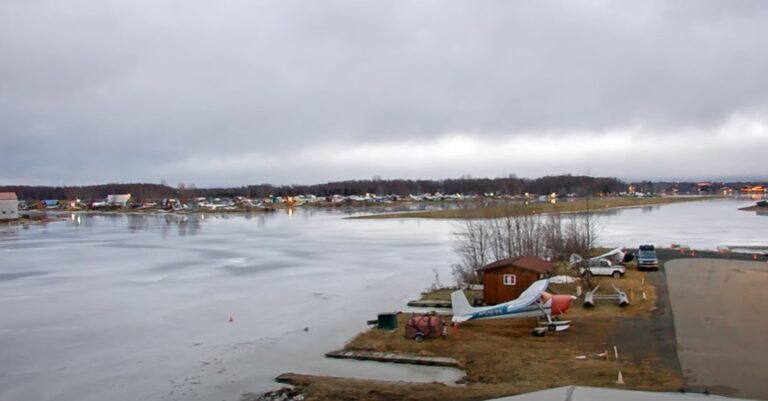
Several of the “heavies,” the cargo jets that come through Anchorage, were forced to do “go arounds” because of the wind and on approach many jets could be seen fighting the wind on Sunday afternoon on the web cam mounted on top of the Alaska Aviation Museum.
Hours after President Donald Trump enacted tariffs on goods from Colombia in response to the president of Colombia refusing to repatriate his own citizens, the government of Colombia agreed to all of Trump’s terms. Those terms include the use of U.S. military aircraft to fly illegal immigrants from the United States back to Colombia.
The statement from the White House reads:
“The Government of Colombia has agreed to all of President Trump’s terms, including the unrestricted acceptance of all illegal aliens from Colombia returned from the United States, including on U.S. military aircraft, without limitation or delay. Based on this agreement, the fully drafted IEEPA tariffs and sanctions will be held in reserve, and not signed, unless Colombia fails to honor this agreement. The visa sanctions issued by the State Department, and enhanced inspections from Customs and Border Protection, will remain in effect until the first planeload of Colombian deportees is successfully returned. Today’s events make clear to the world that America is respected again. President Trump will continue to fiercely protect our nation’s sovereignty, and he expects all other nations of the world to fully cooperate in accepting the deportation of their citizens illegally present in the United States.”
Earlier in the day, after Colombian President Gustavo Petro turned away the U.S. flights that had about 160 illegal Colombian immigrants on them, Trump set forth a punishing series of sanctions, including huge tariffs.
Petro quickly backed down and at first said he would fly his own jet up to get the immigrants. Later, it appears he conceded fully.
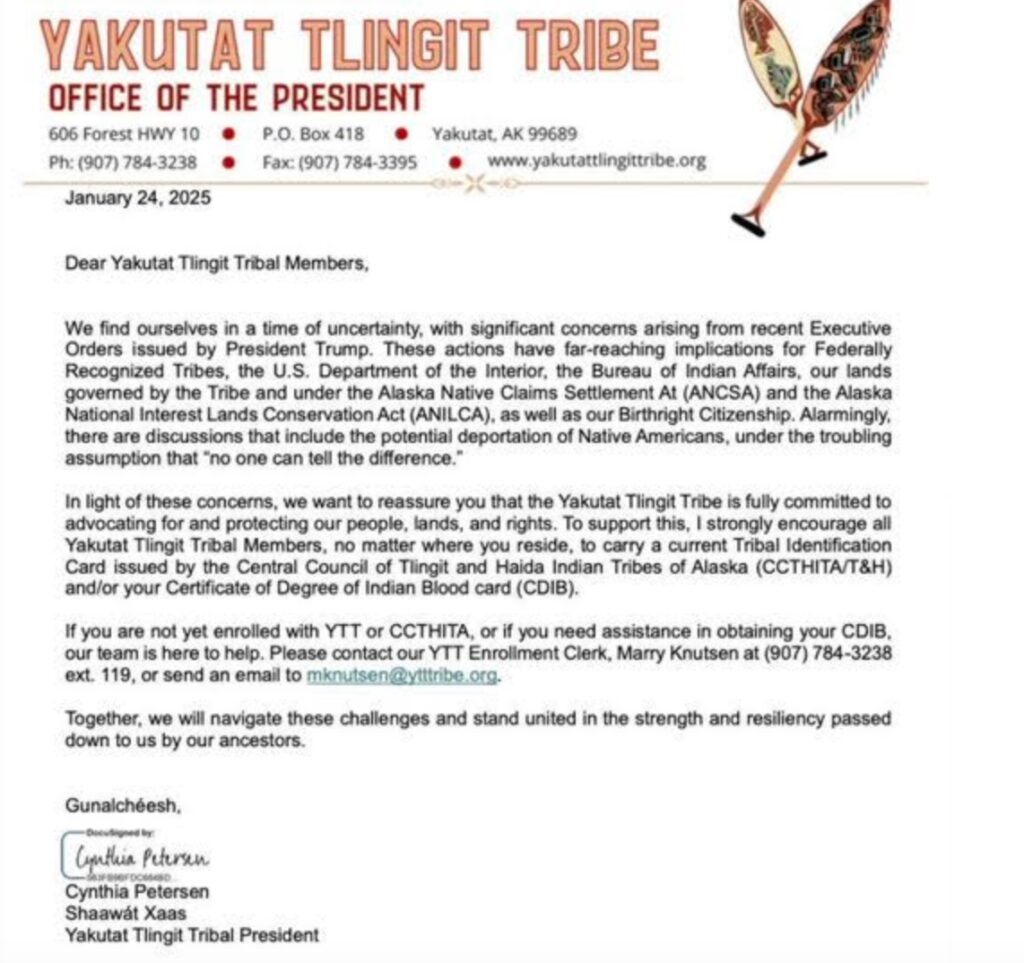
The president of the Yakutat Tlingit Tribe has sent a letter to members warning of possible arrest and deportation due to President Donald Trump’s recent executive orders.
Cynthia Petersen said that tribal members should carry tribal identification cards issued by the Central Council of Tlingit and Haida Indian Tribes of Alaska, or their “certificate of degree of Indian Blood card (CDIB). They should keep this ID on them at all times.
She said “there are discussions that include the potential deportation of Native Americans,” under the “troubling assumption that no one can tell the difference.”
The executive order she is referring to pertains to the immediate deportation of illegal immigrants, who flooded into the country by the millions during the term of President Joe Biden. She presumes tribal members do not have any other form of legal identification.
Navajo Nation Deputy Attorney General Kris Beecher preached the same fear message last week, saying that tribal membersshould carry their state and tribal IDs at all times, since the Trump Administration is acting quickly to deport illegals and mistakes could be made.
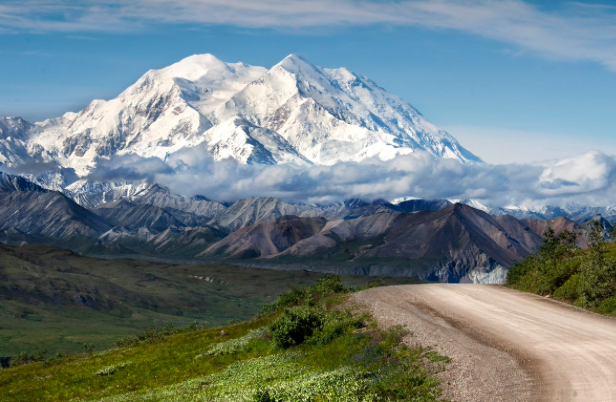
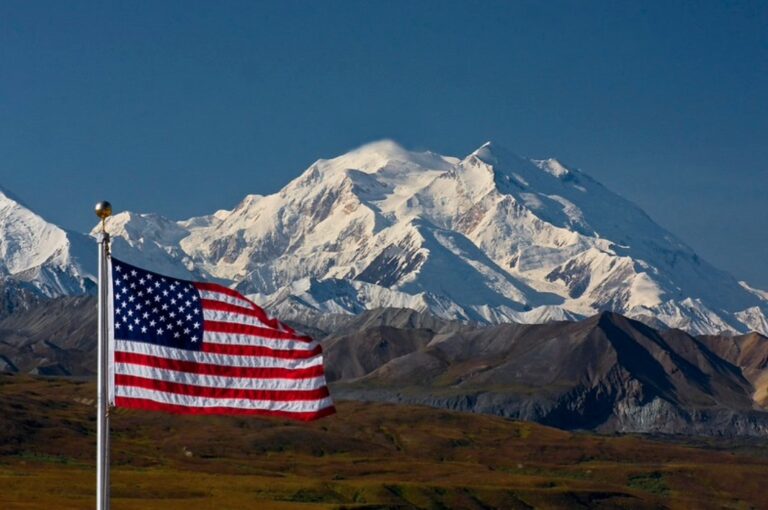
Democrat Rep. Maxine Dibert has offered a bill that is being fast-tracked through the House Rules Committee, asking President Donald Trump to change his mind on the restoration of the name of Alaska’s tallest mountain.
In his first week in office, Trump reversed the name change that had been one of Democrat President Barack Obama’s executive actions in 2015.
According to Dibert, it should be up to Alaskans and not the federal government or the president what the name of the geographic features are in the state, even if those features are on federal land.
“Denali is the traditional Koyukon Athabaskan name for the tallest mountain in North America; and … the name Denali is deeply ingrained in the state’s culture and identity,” she says in her resolution.
In addition, “President McKinley, after whom the mountain was previously named, never visited the mountain and has no significant historical connection to the mountain or to the state,” her resolution says.
President Trump’s order is already signed and even the Associated Press, a liberal news organization, has acknowledged the name change is now law. Thus, the effort by the Democrat from Fairbanks is largely symbolic and intended to force legislators to take a vote on something that has little to do with the state’s economy, budget, infrastructure, or educational outcomes.
The Alaska House and Senate, although they have more Republicans than Democrats, are ruled by Democrats with the help of turncoat Republicans who abandoned their party to join with the Democrats and form a majority. The resolution requires no action from the governor and would be sent to the Trump Administration and the Alaska congressional delegation, if it passes.
The filing for the April 1 Anchorage municipal election closed Friday. Ballots will be mailed to qualified (and unqualified) Anchorage voters at least 21 days before Election Day. Anchorage executes its elections with mail-in ballots, which can also be dropped off at any of the 18 ballot drop-boxes around the city. More information is available at the Municipal Election Office website.
Our newly inaugurated President Donald Trump signed an executive order last week to change the name of North America’s highest mountain back from Denali to Mount McKinley.
He did this by issuing an executive order to his minions at the Bureau of Place Names, which lives in the executive branch of government.
The nature of executive orders is that the chief of the executive branch of government (the president) can tell the folks who work there what to do. Usually, upper government functionaries are there because they are politically or philosophically aligned with the president, so they do what the boss wants.
For example, President Joe Biden thought the government’s paying college loan debt was a great idea. He issued an executive order to his executive branch underlings to “get that done.”
President Biden’s minions started to get it done. However, somebody’ said, “Wait a minute! He can’t do that.”and the U.S. Supreme Court agreed. Biden simply lacked the authority to arbitrarily spend money (paying universities for the debts of students) without congressional appropriation. That starts in the House of Representatives.
President Biden and his sympathizers didn’t get away with that one, so Biden tried another executive work around to do it anyway. That may still exceed presidential prerogative. We’ll see.
The president, as chief executive, has the authority to tell the folks who work in the executive branch what he wants done. They can either do it, fake doing it while doing what they’ve always done (a common tactic of agency ideologues), quit, or be fired. Where executive orders have gotten off track has been that Congress has failed to keep executive branch agencies on the rails. Congress has typically left it to the next administration to sustain or make corrections to previous presidential overreaches.
President Barack Obama famously said that if Congress didn’t act as he wanted he had a pen. That was clearly a threat to Congress because the president can simply make laws by executive order, unless Congress is negligent (or is insufficiently attentive to hold the executive branch within its appropriate bounds). It seems Obama thought he could bully Congress. When Congress is either partisan or passive, power creep inevitably results.
There are numerous examples, including the failure of Congress to protect the authority of law it doesn’t like, but doesn’t change. Congress was largely responsible for the unchecked immigration bonanza. That crisis was enabled when Biden told his executive branch functionaries to stop enforcing existing immigration law. He said the immigration system was broken and decided to alter it to the liking of special interests by executive action. Congress didn’t protect its law-making turf. Now, President Trump is telling those same executive branch folks to get back to work protecting the border as present law requires.
Trump seems to be a big fan of President William McKinley, primarily because McKinley’s use of tariffs on imports made the country prosperous enough it could afford luxuries like Teddy Roosevelt’s National Parks. Based, at least partly on Trump’s understanding that McKinley (whose assassination probably resulted in naming the mountain in his honor) was great on tariffs, we might understand Trump’s procedural directive to the Bureau of Place Names to change the present name of North America’s highest mountain back to McKinley. If the name change were done by executive order, Trump may succeed.
Many present-day Alaskans won’t like it. We’ve grown accustomed to Denali over the last 40-50 years, and that Alaska Native name colloquially pre-dates Mount McKinley. I suppose whether the name gets changed depends on administrative history, authority, and public sentiment. Not everyone in Alaska loved the change from McKinley to simply Denali years ago. The mountain will remain the same.
Calling the Gulf of Mexico after Mexico might have seemed sensible to early Spanish colonizers. Renaming it the “Gulf of NORTH America” seems more reasonable. After all, it about equally bounded by Mexico and the United States (both presently North American nations). Calling it the Gulf of Mexico seems to neglect the United States, and simply calling it the Gulf of America (a name often applied to the United States) seems just as nationalistic as attributing it exclusively to Mexico. The Gulf is not owned by either. It will remain the same no matter what it is called.
If there’s a value to these renaming exercises, it may be to point out that executive orders only apply to the government agencies in the executive branch of government. How today’s executive branch name games affect the rest of us is really a function of vigilant congressional representation, and whether we choose to get personally excited over them.
Wayne E. Heimer has lived in Alaska for almost 60 years and is well aware of how executive orders can affect Alaska.
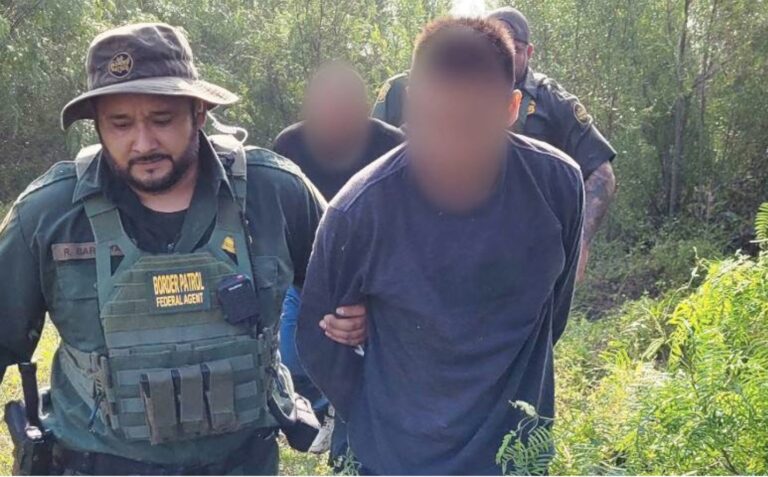
Two military flights from the United States that were filled with about 80 illegal Colombian immigrants who had detained and deported by U.S. authorities were refused landing in Colombia, after the Socialist President Gustavo Petro turned the flights away.
In retribution, President Donald Trump announced retaliatory measures, including several that may impact the flow of illegal drugs into the United States:
– Emergency 25% tariffs on all goods coming into the United States. In one week, the 25% tariffs will be raised to 50%.
– A travel ban and immediate visa revocations on the Colombian government officials, and all allies and supporters.
– Visa sanctions on all party members, family members, and supporters of the Colombian government.
– Enhanced customs and border protection inspections of all Colombian nationals and cargo on national security grounds.
“These measures are just the beginning,” Trump said. “We will not allow the Colombian Government to violate its legal obligations with regard to the acceptance and return of the Criminals they forced into the United States!”
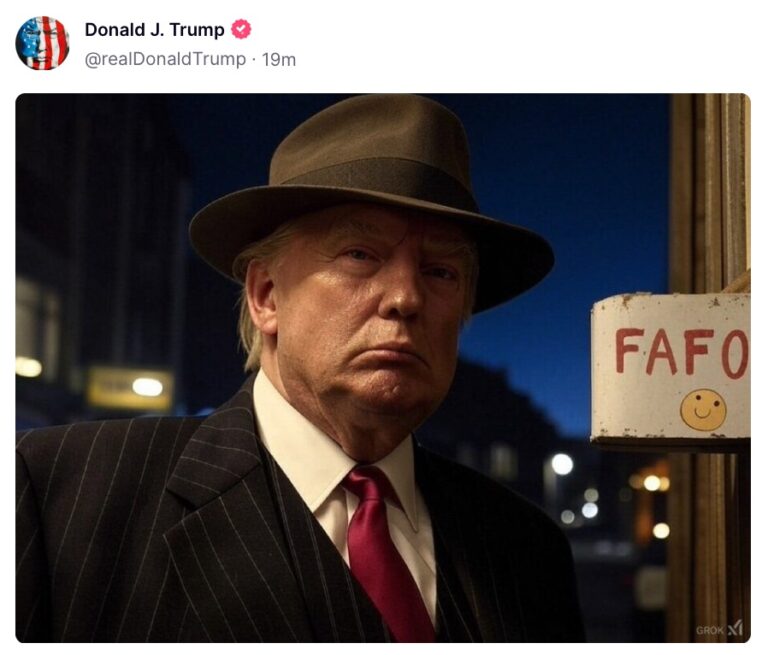
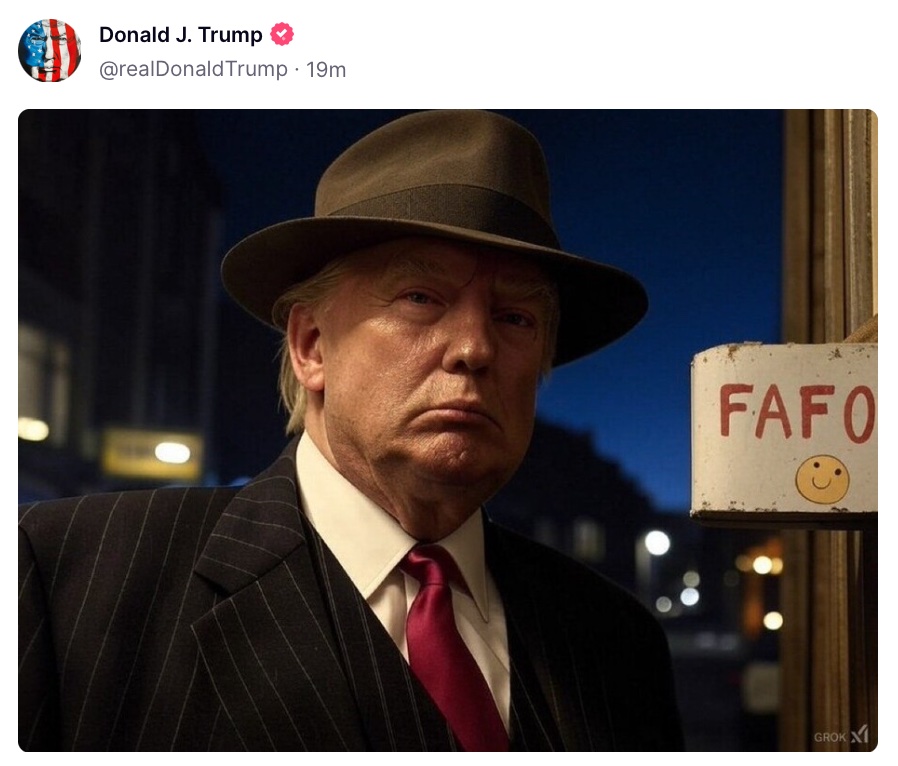
After he imposed the sanctions, Trump posted this graphic on his TruthSocial page:
Screenshot from Trump’s TruthSocial account.
Alaska’s congressional representative responded.
“America’s prior leadership vacuum has led to a sense of entitlement among some heads of state that their citizens have a right to reside in our nation at will and without legal admittance. America’s national sovereignty is being reasserted, and those who fail to recognize that sovereignty will find the economic price to be substantial,” said Congressman Nick Begich.
Update: Within hours, Petro has offered his own presidential plane to help repatriate the illegals being deported from the United States, but it’s unclear how future deportations will be handled, since there are well over 130,000 illegal Colombian immigrants in the country, up from the 65,000 believed to be in the USA in 1996.