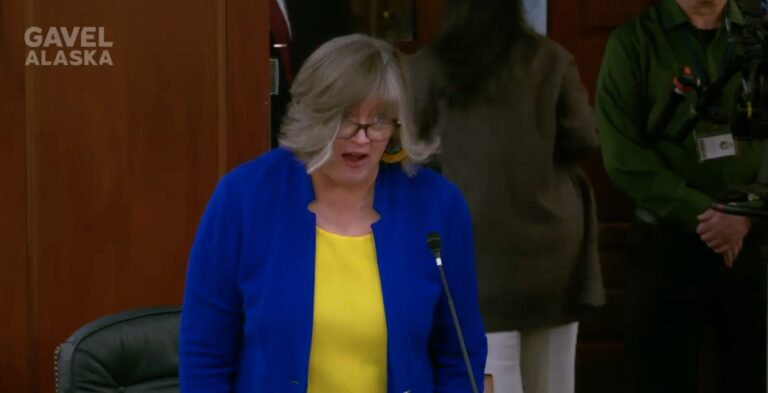
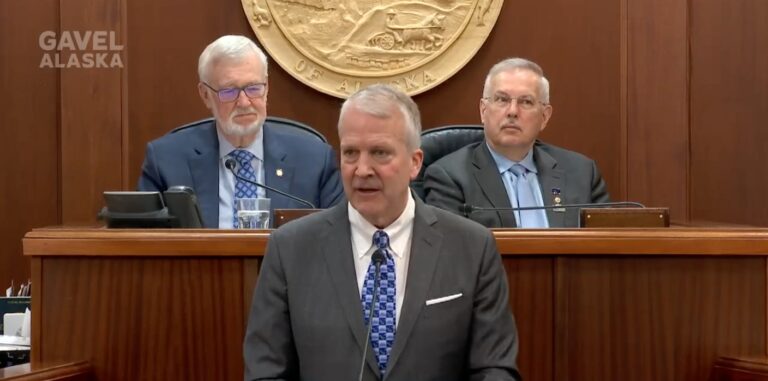
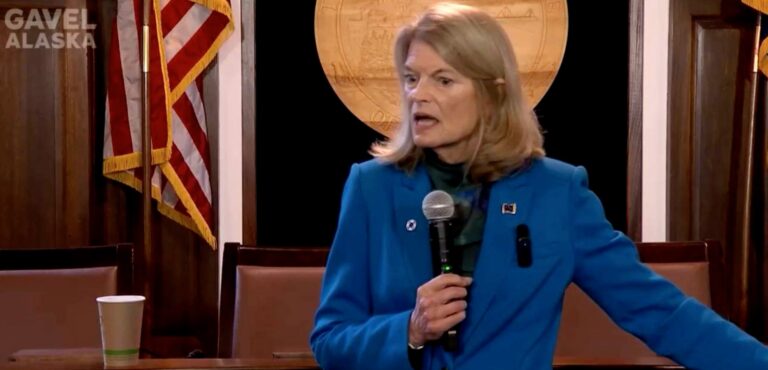
House Republicans in Juneau were appalled at the behavior of the House Democrats in the question-and-answer portion of US Sen. Dan Sullivan’s speech to a joint session of the Legislature on Thursday.
Democrats rudely addressed the senator in a display that appeared to be coordinated attack with Speaker Bryce Edgmon. The Democrats did not treat Sen. Lisa Murkowski in the same way when she spoke to the body on Tuesday. They mainly gave her a pass, clapping softly, while Republicans sat quiet during Murkowski’s speech.
For Sullivan, the Democrats all took a card from the deck of ever-shrill US Rep. Alexandria Ocasio-Cortez, making wild claims filled with misinformation as they peppered Sullivan, who took it all in stride. They did not faze the senator, who was once the attorney general for Alaska and is a subject expert on every question they lobbed his way.
But so dismayed were the Republicans in the House about the attack on Sullivan that they quickly wrote a letter of apology to the senator for their colleagues’ misbehavior.
The letter started out by thanking Sullivan for coming to the Legislature and addressing the joint session.
“On behalf of the House Republican Caucus of the Alaska State Legislature, we wish to extend our heartfelt gratitude for your compelling and insightful speech delivered to our body today. Your address was both impactful and informative, shining a much-needed spotlight on the pressing issues facing Alaska. We deeply appreciate the dedication you and your staff have shown in tackling these challenges head-on—crashing through that proverbial brick wall, as it were. Thanks to your efforts, we are finally witnessing tangible progress for Alaska, and we join together in celebrating this momentum. It is nothing short of fantastic,” the letter stated.
Indeed, the speech Sullivan delivered got rave reviews. He brought ample good news for Alaska, from oil and gas production to military and national security improvements. But the Democrats came loaded for bear.
“Beyond our appreciation, however, we feel compelled to address a matter of significant concern and disappointment. It is with sincere regret that we write to apologize for the discourteous treatment you endured from some of our colleagues during the question-and-answer session following your remarks. The tone and manner of certain inquiries—preceded by what can only be described as unnecessary grilling and regrettable rhetoric — fell far short of the respect and decorum you deserve as a United States Senator who graciously accepted our invitation to speak. To say we were merely disappointed would understate the depth of our dismay. Alaska’s legislative body is better than this, and most of us recognize that such conduct does not reflect our values or the esteem in which we hold you,” the lawmakers said.
Some House members noted privately that when Rep. Mary Peltola spoke to the Legislature last year, the Republicans treated her with respect — unlike what happened on Thursday with the coordinated attack that Democrats staged, with the consent of the two Republicans who have joined the Democrat-led caucus, Rep. Louise Stutes and Rep. Chuck Kopp.
“Please accept our sincere apologies for this lapse. Know that we have the utmost respect for your leadership, your service, your Alaska centric focus, and the dignity you bring to your office. While we would fully understand if this experience left you hesitant to return, we earnestly hope it will not deter you from gracing us with your presence and wisdom in the future. We look forward to welcoming you back with the courtesy and appreciation you so richly merit,” the Republican lawmakers wrote.
The letter was signed by Republican Minority Leader Mia Costello, Republican Minority Whip Cathy Tilton, and Representatives Jamie Allard, Julie Coulombe, Jeremy Bynum, Bill Elam, DeLena Johnson, Kevin McCabe, Elexie Moore, David Nelson, Mike Prax, George Rauscher, Justin Ruffridge, Dan Saddler, Rebecca Schwanke, Will Stapp, Frank Tomaszewski, Jubilee Underwood, and Sarah Vance.
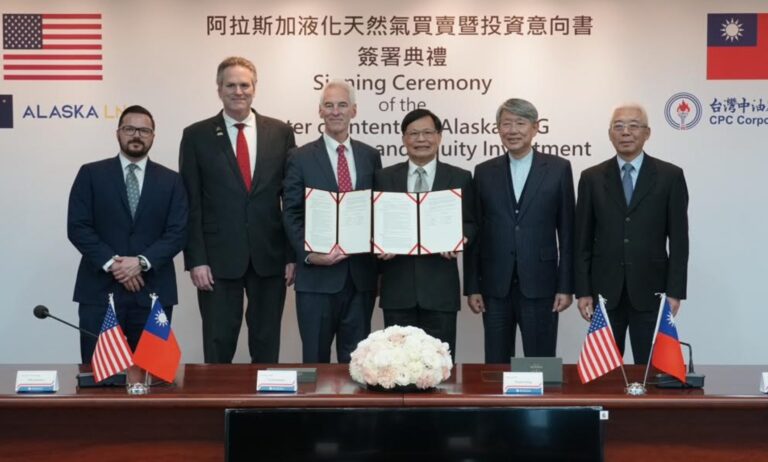
In front of Alaska Gov. Mike Dunleavy, Taiwan’s state-owned oil and gas company CPC has signed a letter of intent to invest in the Alaska LNG export project and purchase liquefied natural gas from it.
The agreement reached on Thursday was signed by CPC and the Alaska Gasline Development Corporation, the state agency in charge of getting a gasline built. The Taiwanese Ministry of Economic Affairs announced the deal in a statement.
“Alaska LNG offers our allies in Asia a unique energy opportunity with competitively priced, abundant LNG via short, secure shipping routes and unlocks the numerous benefits of North Slope natural gas for Alaskans. The Letter of Intent is the latest reflection of growing market interest in and an important commercial step forward for Alaska LNG. AGDC and CPC will now turn to negotiating binding procurement and investment agreements,” Dunleavy said.
Taiwan is a democratically governed island that China claims as its property, but which claims itself to be independent. The deal aligns with broader US efforts to enhance economic and strategic cooperation with its allies in Asia, particularly through energy partnerships and particularly not with China.
With strong support of the Trump Administration, Gov. Dunleavy and Sen. Dan Sullivan have been actively promoting investments in the Alaska LNG project. Dunleavy and Sullivan are also encouraging Japan and South Korea to increase their LNG imports as a means of balancing trade deficits with these nations.
Dunleavy and key AGDC officials are currently on a tour across Asia, seeking additional investors for the $44-billion Alaska LNG project. They are visiting non-communist countries, in contrast with former Gov. Bill Walker, who went to China four times to get communist China’s investment and purchase rights to Alaska LNG. That agreement was canceled by Dunleavy as soon as he took office in 2018.
Should the LNG project come to fruition, Alaska LNG would be Taiwan’s closest LNG supplier among US export facilities. Unlike shipments from the Gulf of America, LNG from Alaska would not require passage through the Panama Canal, and that significantly reduced shipping time is a big advantage.
The letter of intent comes directly after Sen. Dan Sullivan gave a rousing speech to the Alaska Legislature, saying that the project is moving forward apace.
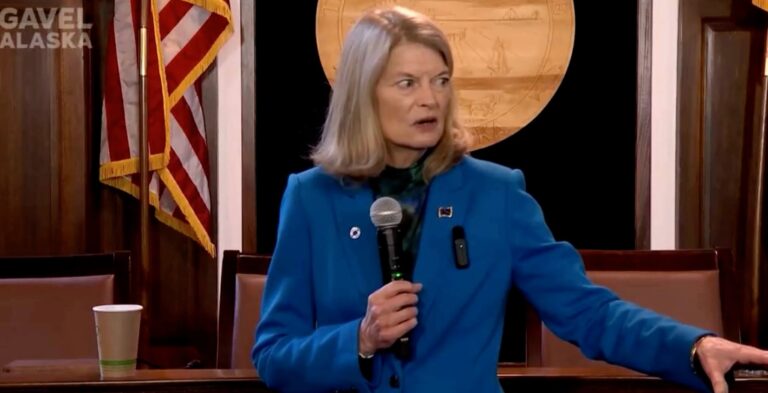
Sen. Mike Lee of Utah didn’t agree at all with Sen. Lisa Murkowski’s statement made this week to reporters in Alaska, when she said Republicans are afraid of Elon Musk and his Department of Government Efficiency.
“I don’t know a single Republican senator who feels that way. Not even one,” Sen. Lee wrote on X.
Well, he does know one: Murkowski had told reporters that no one but her is speaking up because they’re all afraid of Musk.
“I get criticized for what I say, and then everybody else is like, ‘How come nobody else is saying anything?’ Well, figure it out, because they’re looking at how many things are being thrown at me, and it’s like, ‘maybe I should just duck and cover,’” Murkowski said. It’s why you’ve got everybody zip-lipped, not saying a word. Because they’re afraid they’re gonna be taken down, they’re gonna be primaried, they’re gonna be given names in the media. You know, we cannot be cowed into not speaking up,” she said.
Sen. Lee’s response to Murkowski’s statement was noticed by Elon Musk, who amplified the post by reposting it, and added two American flag emojis in his response to Lee, a signal that he aligned with Lee, not with Murkowski.
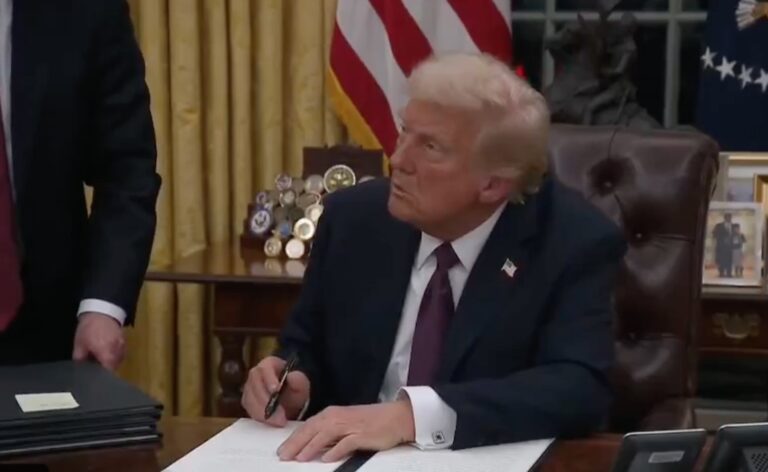
President Donald Trump today signed an executive order that begins the reduction of the Department of Education, returning the authority over education to states and local communities.
The Department of Education was created by President Jimmy Carter. Since its creation, educational outcomes have plummeted across the country.
The order argues that the federal government’s control over education through the Department of Education has failed students, teachers, and families, despite significant federal spending on schools.
Gov. Mike Dunleavy applauded the move: “While the original intent of the US Department of Education was noble, it failed in its primary mission, to ensure that every child has access to a quality education. Like all large, centralized departments and programs, it pilfered tax dollars to support a large bureaucracy, which became increasingly inefficient. As it metastasized, the Department took billions of dollars out of state and local economies to create regulations and pay employees, and the financial resources that it provided to the states, was a fraction of what was taken.”
Key points of the executive order are:
The Department of Education has not improved educational outcomes, with reading and math scores near historical lows.
The department manages a $1.6 trillion student loan debt portfolio with insufficient staff, a function better suited for banks.
Making the Department of Education much smaller will allow states and local communities to take control of education and improve program implementation.
The Secretary of Education is being directed to take all necessary steps to facilitate the shrinkage of the department while ensuring uninterrupted delivery of services, programs, and benefits.
Federal education funds must be allocated in compliance with federal law and Administration policy. This includes terminating any programs promoting illegal discrimination under the auspices of “diversity, equity, and inclusion” or gender ideology.
There is little doubt that the National Education Association will sue to stop the president from downsizing what is arguably the most failing agency in the federal government.
Opponents of the action say he cannot remove the department without the approval of Congress. The White House has already answered that by saying he is not going to make it go away entirely.
Education Secretary Linda McMahon has already taken steps to curtail the department’s authority and to reduce its workforce.
It’s been a big day for the Alaska economy. Using wartime powers under the Defense Production Act, President Donald Trump’s latest executive order aims to bolster domestic mineral production to improve national and economic security by reducing reliance on foreign mineral supplies.
His order intends to boost domestic output of such minerals as cobalt and copper, reducing reliance on imports amid tensions with China.
“More great news coming out of the @WhiteHouse,” wrote Gov. Mike Dunleavy in response to the news. “Alaska stands ready to lead the way in revitalizing America’s mineral supply chain. We look forward to working with the administration to accelerate permitting, unleash investment, and make the United States the global leader in critical mineral production.”
Congressman Nick Begich wrote, “Today’s Executive Order to increase mineral production in the United States is yet another major victory for America’s energy and national security. The war on mining that we saw waged under the Biden Administration is over. I was proud to work with the Trump Administration to make domestic mineral production a priority, and this action is going to deliver results for hardworking Americans. By streamlining permitting, we are unleashing the vast mineral wealth of the United States and reducing our reliance on China for critical minerals while also strengthening our own supply chains.”
As Vice Chair of the House Subcommittee on Energy and Mineral Resources, Begich said he will continue the work to expand responsible resource development that fuels economic growth for Alaska and supports the American worker.
“This executive order is a win for America, a win for Alaska, and a win for every American who relies on affordable, reliable energy for every American,” he said.
Trump had directed the Secretary of the Interior to prioritize mineral-rich federal lands for mining, amending land use plans accordingly. The order eases restrictions that hamper private investment and public-private partnerships by leveraging federal land leases, waiving certain regulatory requirements under the Defense Production Act, and delegating authority to the Secretary of Defense and the CEO of the U.S. International Development Finance Corporation to expedite mineral projects.
It further encourages capital investment through various federal programs and seeks legislative recommendations to clarify mining waste management under the Mining Act of 1872, aiming to swiftly enhance the domestic mineral supply chain.
The order comes with a series of deadlines to ensure accountability:
Priority Projects (Sec. 3): By March 30, the heads of executive departments and agencies involved in permitting mineral production must submit lists of all mineral production projects with pending plans, permit applications, or approvals to the Chair of the National Energy Dominance Council. These agencies, in coordination with the NEDC, will then identify “priority projects” that can be immediately approved or permitted. The focus is on projects that can quickly enhance domestic mineral output, though specific examples aren’t named—criteria include readiness for approval and potential impact on supply chains.
Transparency Projects (Sec. 3(b)): By April 4, the NEDC Chairman Doug Burgum, in consultation with agency heads, will propose projects for the permitting dashboard under the Fixing America’s Surface Transportation Act.
These “transparency projects” will be expedited for review.
Federal Land-Based Projects (Sec. 5): Secretary of the Interior Burgum must identify federal lands with known mineral deposits by March 30, prioritizing them for mining. By April 19, multiple secretaries (Defense, Interior, Agriculture, Energy) will pinpoint sites suitable for leasing or development for commercial mineral production.
These projects target rapid operational status and supply chain robustness, focusing on minerals like critical minerals, uranium, copper, potash, and gold.
Earlier today Trump reversed the Biden lockdown of Alaska’s oil and gas reserves in the National Petroleum Reserve-Alaska and the Arctic National Wildlife Refuge’s 1002 coastal plain area.
There are two competing visions for Alaska’s future: One is the dependence on a distant federal government that restricts development and treats Alaska as a “beautiful snow-globe.”
Another vision is one of self-reliance, opportunity, and economic growth driven by unlocking the state’s natural resources and private sector potential.
Sen. Dan Sullivan implored the Alaska Legislature to embrace the self-reliant Alaska model. In his annual address on Thursday, he spoke about economic development, job creation and natural resources, and he addressed the many successes he and the Legislature have accomplished by working together. And he said Alaska is fortunate right now because “We have a president who listens to us.”
Anti-Trump protestors swarmed the halls and lined the corridor leading to the House Chamber, before Sullivan’s planned remarks. They did not create the same hostile welcome to Sen. Lisa Murkowski, who spoke on Tuesday to the joint session. The group held signs opposing President Trump and they created congestion in the access way to the Chamber, but they did not disrupt the official proceedings.
Instead, the joint meeting of the House and Senate gave Sullivan numerous ovations and even a couple of standing ovations, in stark contrast to the tepid response that Sen. Lisa Murkowski received during her remarks earlier this week, when the entire Republican minority sat silent.
The theme of Sullivan’s speech cited the difference between what happened to Alaska during the Carter, Obama, and Biden Administrations, and how Trump is turning that around — and quickly, through executive orders.
“With the stroke of a pen, on his first day in office, President Trump sent Alaska, America, and the world an unmistakable message that unleashing Alaska’s extraordinary resources and jobs in a growing economy will be a top priority of his administration. Whatever you think of President Trump, this document reflects a President who actually listens to us. I encourage you all to read it, understand it, and most importantly, use it for the betterment of the people we represent. This EO could help bring so many of the long-sought ambitions in our state and thousands of good-paying jobs with it,” Sullivan said, holding up a summary of the Trump executive order restoring Alaska energy potential.
He critiqued the difficulty the state has had as an eco-colonial province that the environmental NGOs and their lawmakers and regulators want to keep in the snow-globe category.
“We’re so used to the ‘mother-may-I’ federal permitting slog and the use of delay tactics to kill projects, that we’ve come to accept it. Ten years to permit a hydro project … Twenty years for the Kensington Mine. Forty years for the Cooper Landing Bypass. The Willow Project has been in the works since 1999. It will have spanned six administrations before first oil,” he reminded legislators.
On the Alaska LNG project, Sullivan spend a lot of time. He noted that he has been advocating for the Alaska LNG Project for over 15 years, emphasizing its transformative potential for Alaska and its strategic importance for the US.
Despite skepticism and obstacles, including four years of resistance from the Biden Administration, Sullivan and his team have persistently pushed forward.
Recent progress includes securing federal permits, loan guarantees, and growing interest from foreign governments and stakeholders. Sullivan has actively pitched the project to President Trump and his administration, gaining significant support, as evidenced by its mention in an executive order and during Trump’s meeting with Japan’s Prime Minister. In his State of the Union address, Trump highlighted the project as a top priority, noting its massive scale and international investment potential.
Sullivan credited this momentum to relentless collaboration with Gov. Mike Dunleavy and Trump’s team.
While the gasline project isn’t imminent, Sullivan said, he did seem hopeful it is nearing realization, promising affordable energy, economic growth, jobs, and a manufacturing boom for Alaska. The potential makes it a goal too critical to abandon.
“The Trump Administration, from the president on down, has made Alaska LNG a top priority … and I respectfully ask that all of you do, too,” he said to the Alaska Legislature.
In speaking about the military in Alaska, Sullivan highlighting the incursions from Russia in airspace close to Alaska.
“Alaska, I am happy to report that, after five years of dogged persistence from me and my team — countless hearings, meetings, and NDAA amendments — the NorthCom and IndoPacom commanders have agreed with me that it is time to re-open the Naval base at Adak,” he said, earning a long ovation from the Legislature.
“And right here in Juneau, we’re finally making history. The Coast Guard Cutter Storis — the first polar icebreaker in a generation—is being retrofitted as we speak, has a fresh coat of Coast Guard colored paint, and should achieve initial operating capability in August 2025. After years of work, the Coast Guard will homeport this icebreaker where the ice is! Imagine that. In Alaska!” Sullivan said.
In his remarks about the fisheries issue, he targeted Russia: “And we continue to keenly focus on leveling the playing field against Russia on unfair seafood trade, where they could export fish into our market, but we couldn’t export into theirs, for over 10 years. We fixed this unfair situation that was devastating our fishermen and then we closed the Communist China loophole that Russia tried to use to circumvent the U.S. ban on importing their fish into our market.”
“The end result of my team’s years of relentless advocacy on this — and it was relentless — is that more Americans are now buying Alaska “freedom fish” because we’ve shut down ‘communist fish’ from Russia and China! That’s great news for Alaska and our fishermen,” he said, again getting another ovation.
Sullivan also talked about the fentanyl crisis and Biden’s open-border policy.
“Last year I raised an issue that hits close to home for so many Alaskans, and that’s fentanyl. Overdose deaths in our state are up a staggering 45%. It is mostly our young people, our future, being poisoned and dying. That’s unacceptable. And a large part of this was the result of Biden’s open border policies, with fentanyl pouring in from drug Mexican cartels, made with Chinese chemicals. Well, not anymore. Mexican drug cartels have rightly been designated terrorist organizations and illegal border crossings are down 93%,” he said. He has launched a “one pill can kill” campaign to warn Alaskans about how one fentanyl pill has enough poison to kill a person.
Sullivan touched on the importance of the work of the Trump’s Department of Government Efficiency — DOGE.
“Our national debt of over $36 trillion has reached dangerous, unsustainable levels. Last year, we paid out more in interest on this debt — $882 billion — than we did to fund our military! When you look at history, great powers begin to fail when they hit this precarious inflection point,” he said. It is the inflection point that crumbles empires historically.
There is plenty of bipartisan blame to go around for this dangerous debt situation, he acknowledged.
“So I think most in this room understand that we have to root out wasteful spending, more responsibly spend the American people’s hard-earned dollars, and have a federal government that finally lives within its means. Otherwise, we’ll just pass this mess onto our kids and grandkids,” he said.
“That’s what DOGE is doing, and they are making some notable progress. Do I like every decision that they’re making? No. These are difficult decisions. Job losses are always difficult on families and communities, especially in a tight-knit state like ours. They certainly shouldn’t be celebrated. And they need to be done humanely and less randomly. But is the end goal of a smaller, more efficient federal government that lives within its means is necessary?” Sullivan said.
He reminded the room that President Bill Clinton first launched the original DOGE — the National Partnership for Reinventing Government during his first year in office. Its goal was to dramatically shrink government and make it more efficient, which it did during his presidency, saving $108 billion and balancing the budget by 1998, the last time the US had a budget surplus.
“I’ve spoken directly with DOGE leaders and Trump administration leaders regularly. They have emphasized that, during this process, there will be mistakes made, and they want to work with us to correct them. We have had some successes on getting decisions that have been made or going to be made,” he said, and then asked legislators to reach out to his office with specific instances of federal jobs or leases that, if canceled, would harm the economy of the state.
Secretary of the Interior Doug Burgum on Thursday announced immediate steps to unlock Alaska’s vast untapped natural resources. His actions support President Donald Trump’s vision of American energy dominance and aim to revitalize energy exploration and infrastructure in the state.
The Bureau of Land Management will take immediate steps to expand oil and gas development in the National Petroleum Reserve in Alaska and the 1002 Coastal Plain of the Arctic National Wildlife Refuge. Also, the BLM will work toward partially revoking public land withdrawals by the Biden Administration to advance critical infrastructure projects such as the Ambler Road and the Alaska Liquefied Natural Gas (LNG) Pipeline.
Gov. Mike Dunleavy issued an immediate response to the announcement, which came just before Sen. Dan Sullivan’s address to the Alaska Legislature:
“The announcement today from the Department of Interior is more great news for Alaska. I want to thank President Trump and Interior Secretary Burgum for their commitment to work on behalf of Alaska to ensure that our great state and its resources can continue to be a solution for many of America’s challenges. The news today will provide more investment opportunities, more jobs, and a better future for Alaskans. We look forward to our continued work with President Trump and his administration to move Alaska and our country forward,” Dunleavy said.
The actions outlined by Secretary Burgum are part of the implementation of Executive Order 14153 and Secretary’s Order 3422, both titled “Unleashing Alaska’s Extraordinary Resource Potential.” Key elements of the plan include:
Reopening up to 82% of the National Petroleum Reserve in Alaska (NPR-A) for leasing, expanding opportunities in the 23-million-acre reserve while ensuring environmental protections.
Reinstating a leasing program for the entire 1.56-million-acre Coastal Plain of ANWR, fulfilling the intent of the 2017 Tax Cuts and Jobs Act and strengthening U.S. energy security.
Revoking land withdrawals along the Trans-Alaska Pipeline Corridor and Dalton Highway north of the Yukon River, allowing these lands to be conveyed to the State of Alaska. This move facilitates the development of the Ambler Road and Alaska LNG Pipeline projects, which could create significant job opportunities and spur economic growth in the region.
“It’s time for the U.S. to embrace Alaska’s abundant and largely untapped resources as a pathway to prosperity for the nation, including Alaskans,” Burgum said. “For far too long, the federal government has created too many barriers to capitalizing on the state’s energy potential. Interior is committed to recognizing the central role the State of Alaska plays in meeting our nation’s energy needs while providing tremendous economic opportunity for Alaskans.”
President Trump has long championed the development of Alaska’s vast energy resources as a means of securing national economic stability. As one of his first act upon becoming president this year, he reaffirmed his commitment to unlocking Alaska’s resource potential for the benefit of both Alaskans and the broader U.S. economy.
“Today marks a new day for Alaska and American energy security. Thank you, President @realDonaldTrump and @SecretaryBurgum for taking critical steps to unlock Alaska. My office has engaged with the Administration early on to make these projects a priority, and I will continue to lead efforts in Congress to codify these actions – ensuring that future Administrations cannot stand in the way of Alaska’s energy future and prosperity. President Trump understands that Alaska is the KEY to restoring American energy dominance, and I stand ready to work with his Administration to continue fighting for Alaska,” wrote Congressman Nick Begich.
My commentary on Nov. 15, 2024, “Work on sensible legislation this next session — with solutions, not band aids” was obviously not read by the majority legislators in the Alaska House and Senate. They are not even picking the right bandages.
My recommendation was: “ One of the most important objects for Alaska to work on at this time is to get increased oil flow in the Trans Alaska Pipeline, with a goal of a million barrels a day or more so that we can have assured revenue sufficient to fund the necessary items of the annual budget well into the future. The way to ensure a balanced budget with the least hassle is to ensure future revenues. Oil and gas are the best revenue sources we have.”
With that guidance, a smart legislator who is experienced in Alaska would have gone to the oil producers in the state and asked them: “What projects do you have that are shovel ready, or at least almost shovel ready, with a design and a plan ready to go, and what do you need Alaska to do that would encourage you to get those projects going so we can get increase flow of crude oil to the pipeline?”
We know that the ESG (environmental, social, governance) influence on investors and financial institutions has put a block on financing of “fossil fuel” (hydrocarbon) projects. The Alaska Legislature could have proposed legislation that would instruct the Permanent Fund Corporation to not invest with any company not willing to finance oil and gas exploration and development in Alaska. Once they get moving on solutions like this they will undoubtedly come up some more incentivizing solutions.
The price of crude oil is going to drop, so we need to increase the quantity crude oil flowing down the pipeline to market. This would help increase the flow of crude and would likely get people behind John Hendix and Furie/HEX to ensure easy financing for drilling new gas wells to help ensure there is not a reduction in Cook Inlet gas.
We have demonstrated that the Kitchen Lights Unit has a large gas capacity, that accessible financing would be able to unleash to drill more wells and add more platforms to Kitchen Lights. I’m sure that some of the potential investors in the AKLNG project would be better encouraged to step forward to invest immediately, once the curse of hydrocarbon fuel is removed.
I’ve been surprised that after all the commentaries that have been written about the amount of Cook Inlet gas that is readily available, and that no one is shouting “Drill, John (Hendrix), Drill!” The basic idea is to keep our energy cost as low as possible. Going to LNG imports immediately increases our energy cost considerably, and immediately.
Hilcorp or S Corp tax will not get engineering and construction projects going, but when oil and gas production projects are encouraged to get a jump start, the engineering and construction efforts begin quickly and money flows in the economy. Then, move immediately to encouraging mineral extraction and timber extraction. Then, encourage the increase in energy production so that mines that are developed might be encouraged to refine their ore in Alaska.
It is time to chase dollars — billions of dollars and not pennies, nickels and dimes — so that we can finally get to where we can actually develop a meaningful budget that can be fully funded.
Then the legislators can properly attach the Alaska school system issues, and it sure isn’t lack of funding of the system. There is no point in paying more money into a broken system.
The 23,000 homeschool students exist because their parents did not want their children to be indoctrinated to America- hating ideologies being pushed in Alaska schools these days. No group (union) should have more control than Alaska parents in any school district.
With a Republican majority in both houses we should not be having some of these discussions, but with the few who abandoned their party affiliation with the misrepresentation of “looking for a balanced budget,” the legislative efforts are not directed to real solutions for real problems.
I see a few abandon the party platform just to torpedo the PFD payments to the deserving citizens of Alaska.
There is still time to see what can be done to get some crude produced and in the pipeline to get some real money flowing. And there is still time to get some policy changes into the Alaska education system. And now is the time to say “Drill, John, Drill”!
Robert Seitz is a licensed professional electrical engineer and lifelong concerned Alaskan.
In a half hour spent with the Capitol press corps this week, Sen. Lisa Murkowski brought up her own electability, which may be in question even for her, a senator who has served since being appointed by her father, Gov. Frank Murkowski, in 2002.
Murkowski brought up election politics in a government building — the Alaska Capitol — straying close to the line of improper use of a government facility for partisan elections.
In remarks that were more animated than her usual pace, Murkowski responded to a reporter’s question about how anyone should believe her when she says things will be OK. She said she has no choice but to try to work with President Donald Trump, and that she expects Elon Musk will try to take her out in the next election cycle.
Here are her remarks:
“I’m not going to compromise my own integrity by hiding from my words when I feel they need to be spoken. I’m going to take the criticism that comes,” Murkowski said.
“It may be, it may be that Elon Musk has decided he’s going to take the next billion dollars that he makes off of Starlink and put it directly against Lisa Murkowski. And you know what? That may happen,” she said, foreshadowing 2028’s election.
Murkowski has been a supporter of fiber optic broadband solutions for Alaska, and has not championed the small, low-orbit satellites that Starlink has provided for Alaskan customers, a solution that has been cheaper and much-preferred by many in the 49th state.
Although there is a viable alternative, Murkowski has pushed for hundreds of millions of dollars in grants for companies that are part of the Alaska Broadband Initiative, the fiber optic cable solution; these companies also donate to her campaigns for reelection. Starlink has been cut out of that grant process by the fiber optic cable companies winning the awards and the federal government that is picking winners and losers in broadband.