For the curious, here are the plans that the new head of the Alaska Gasline Development Corporation has in mind for the restructuring of the Alaska AK-LNG project, where the State moves into the lead role as the developer of the gasline. A more complete story is here.
Lincoln’s Gettysburg Address is on parallel with the Declaration of Independence and the U.S. Constitution in its stature.
As the most famous speech in American History and just 271 words long, it implied so much and in such lofty terms, without actually stating uncomfortable truths directly.
On that cold November day in 1863, when the graves of thousands were still fresh in the ground, Lincoln only sought to give his seal of approval to the battlefield cemetery, which contained the mortal remains of both Union and Confederate fighters. But he gave our nation reason to believe in fighting on for the cause of free people.
If you like Garry Wills’ Lincoln at Gettysburg, you will also appreciate the vivid writing in The Gettysburg Gospel, which deepens our understanding of the content and the context of this remarkable speech, and the promise of the nation that inspired it.
Earlier that year, in the heat of summer, ten thousand soldiers’ bodies were dusted over with dirt and lime, while swarms of flies and human and animal excrement covered the field, and the carcasses of three thousand or more horses and mules were rigor mortis on the land around Gettysburg. Twenty-one thousand were wounded. “War had come to them. And then it had gone and left the horror behind.”
It’s difficult to imagine what that scene looked like and smelled like, but we know from this description that it was hell on earth for the 2,400 sturdy Scotch-Irish and German people who inhabited Gettysburg. They became coffin-makers overnight. The white powder of lime covered everything “like snow in July,” as the town coped with the stench, the fear of disease, and the throngs of strangers — some to find their loved ones, some to loot, and others just war tourists, there to witness, to “gawk.” Gettysburg, for a time, ceased to be a town, but became a collection of hospitals, one person observed.
The Gettysburg Gospel transports the reader back to the day and sets the scene into which President Lincoln would offer his words of hope, solace, and healing for a nation so divided.
The Alaska Gasline Development Corporation may not want to call its new plan a “go-it-alone” strategy, but it definitely has the feel of a project takeover.
Keith Meyer, AGDC photo
We are told the new draft plan by AGDC is floating around in the Senate, and it indicates the agency would form a new sub-entity to own, commercialize, finance, design, build and operate a gasline system. The agency would move full-steam-ahead without further market analysis.
The new company owned by AGDC would do all the work that three other partners are now doing.
That work would include the $65 billion in financing to make the gasline a reality, with a final State of Alaska investment decision deadline of July, 2018, and start-up by 2023.
Companies that actually own the gas would be marketing their gas through the gasline, which may explain in part why Gov. Bill Walker has insisted in seeing the companies’ marketing plans.
AGDC has been reluctant to release the draft plan because, according to a memo from Keith Meyer:
“Unfortunately, the apparent willingness of some authors in the public domain to take certain terms out of context or make a story where no story exists, has led to a request by one of the parties to not release a draft concept and instead wait for a more definitive agreement; we are sympathetic to that argument and have decided to comply with that request for now while a more definitive agreement is in the works.”
That same letter bristled at the characterization by some that the agency/state was going to “go it alone” in this new plan of attack.
HOUSTON WILL BE A CENTER OF AGDC ACTIVITY
At the board meeting of AGDC on Thursday, new President Keith Meyer told the board that the agency will open up a new office in Houston, Texas, which will become the center — or at least the brain trust — of operations. He plans to hire three new people, one of which is his daughter, who he said has expertise in Quickbooks and Excel spreadsheets.
No one at the meeting said anything about Alaska hire or nepotism, and there was no board action taken — or requested — on the matter of AGDC essentially shifting some of its operations to Texas. How much in salary the three employees will make is murky, but Meyer said the two that were not his daughter would be in travel status regularly. The individuals to be hired are people with whom Meyer worked in a previous capacity in Houston.
Update: The Alaska Dispatch is reporting that the AGDC Board Chair Dave Cruz will not allow the daughter to be hired.
AGDC is exempt from procurement laws and is supposed to operate independent of the Governor’s Office, but close observers say the two have become intertwined to the point that they are in constant deliberative communication, operating as one.
AGDC has a history of creating subsidiaries since last fall’s attempt to focus on an in-state gasline. The AGDC communications effort back then was headed by Luke Hopkins, who then filed to run against a member of the Senate who had a large part in creating AGDC — John Coghill.
WALKER’S DEMANDS FOR MARKETING PLANS
Background: The state Division of Oil and Gas on June 30 rejected BP’s 2016 plan of operation for Prudhoe Bay. The letter by Oil and Gas Director Corri Feige, allows the company to operate until Nov. 1, but demands critical gas marketing information that BP says it cannot give.
BP, ConocoPhillips and ExxonMobil have repeatedly said that giving over marketing information would be an anti-trust violation and also run afoul of Securities and Exchange Commission laws.
Feige wrote that major gas sales, in the relatively near future, are required. But the letter does not specify why there is such urgency for marketing gas for a gasline that AGDC now says won’t be ready to deliver product until after 2023, at the earliest.
In a quickly issued apology, Gov. Bill Walker yesterday walked back his threats against lawmakers and candidates, in which he had stated that he would be interviewing each of them to determine which of three plans they supported, and then, in veiled terms threatened to work against them as candidates if they chose wrong.
Without admitting to wrongdoing, he stated:
“While it has been determined that the statement I made about the upcoming election was not a viol
ation of the ethics act, I want to clarify that I am not trying to influence an election. I am trying to inform the public about what the legislature’s own analyst has called the ‘gravest fiscal crisis in state history.‘ I want Alaskans to know the consequences of action and inaction. I regret any misunderstanding this may have created.” –Governor Bill Walker
COMPLAINTS MOVE FORWARD
Meanwhile, two other ethics complaints were in the queue against the governor today. Representative Tammie Wilson of North Pole filed this one:
Government transparency activist Andree McLeod was preparing to file another. An exerpt from the McLeod complaint draft:
Alaska Gov. Bill Walker today issued a press release threatening both sitting legislators and candidates if they do not answer his questions about which fiscal plan they support.
From the look of it, unless they give him the answer he wants, he’ll work to make sure they are not elected.
In his press release, Walker said:
“There are currently three fiscal plans in play. There’s the Governor’s New Sustainable Alaska Plan, which will continue to force government efficiency while maintaining most current state services. But there are also two alternate plans: The No Action Plan (NAP) and the SB128-Only (Permanent Fund Restructure) Plan.
I will ask every legislator and every candidate for the legislature to choose which of these three plans they support. Failure to choose a plan will constitute support for the No Action Plan (NAP). After Alaskans become familiar with the type of Alaska each of these three plans represents, voters will be much better informed about who should represent them in Juneau.”
The governor may have violated ethics laws that cover the use of state resources for campaigning. His threats against legislators would have been fair play, but threats against candidates is electioneering on government time and worthy of an ethics complaint.
“I will ask every legislator and every candidate…” is code language for using the governor’s bully pulpit as a campaign stump to fight the very citizens who have stepped up to run for office.
The Alaska Legislature is engaged in its fifth special session over two years. One of those sessions involved the governor’s request purchase of TransCanada’s interest in the Alaska Gas Line, AK-LNG. The others involved fiscal decisions needed to patch the state’s budget.
The specific section of the Executive Ethics Act that the governor is in violation is:
(6) use or authorize the use of state funds, facilities, equipment, services, or another government asset or resource for partisan political purposes; this paragraph does not prohibit use of the governor’s residence for meetings to discuss political strategy and does not prohibit use of state aircraft or the communications equipment in the governor’s residence so long as there is no charge to the state for the use; in this paragraph, “for partisan political purposes”
(A) means having the intent to differentially benefit or harm a
(i) candidate or potential candidate for elective office; or
(ii) political party or group;
UPDATE: LEGISLATORS NOW REPORTING THREATS
The governor has a hit list and is vetting candidates, supporting those who are with him and working against those who oppose him. Darwin Peterson, the governor’s legislative director, has strongly implied to at least one legislator that that person was on the governor’s hit list. The governor is particularly angry with one conservative Republican legislator, but others report the same conversation has been had with them.
The governor, through his legislative director, has also told legislators he will not do bill signings with legislators who are not being helpful to him.
If it’s Wednesday of this week, and you’re in the Mat-Su Valley, you’ll want to pop into Wasilla.
The action happens at the Legislative Information Offices at 1 pm and 5:30 pm (public testimony) with the Senate State Affairs Committee.
The committee, chaired by Sen. Bill Stoltze, will be hearing SB 5001, the restructuring of the Alaska Permanent Fund.
SB 5001 is a zombie apocalypse bill. It’s a new version of SB 128 which was the governor’s bill during regular session. Before the governor’s bill, there was SB 114, offered by Sen. Lesil McGuire.
It’s a bill that won’t stay dead.
In all the years since statehood, has there ever been an official committee hearing in Wasilla? Since the Valley is the second-most populated area in the state, it probably seems only fair to Sen. Stoltze.
But the Administration is going to sit this one out. Commissioner Randy Hoffbeck sent a “thanks no thanks” letter to Committee Chairman Stoltze, and won’t even show up by telephone.
The Department of Law is without its top gun, former Attorney General Craig Richards, but Assistant AG Emma Pokon will lay out the particulars for the committee. She’s been the workhorse on this bill anyway, even under Richards. Also from Law will be Bill Milks, and Angela Rodell, Permanent Fund Executive Director, will phone in as well.
The Permanent Fund restructuring plan has proponents and opponents on all parts of the political spectrum, but the Mat-Su Valley would not be Woodstock for this legislation.
Stoltze, who has been an advocate for a capital move, might be having a bit of “last laugh” during the waning weeks of his tenure as an Alaska legislator, by bringing hearings on “messing with the Permanent Fund” to his own opinionated home turf. He’s never been a fan of Juneau.
And it did not help that just this week Sen. Dennis Egan, D-Juneau, was caught in one of his classic moments of candor calling voters outside of Juneau idiots who don’t care, or that’s how it came across.
BILL WALKER THREATENS MUNI-TAX HIKES
Governor’s tweet of July 12, threatening property tax increases.
Governor Bill Walker called into the Anchorage Assembly meeting this evening (July 12). Then he did a live shoot with a KTVA reporter.
After that, he summarized what he said to the Twitter Universe: “Due to legislative inaction, property taxes will go up and Alaskans will have to pay more for services,” he threatened.
“In the social service world, we call this the perpetrator blaming the victim,” said one legislative aide.
ALREADY TAXED TO THE MAX
“Someone needs to tell the governor that the Anchorage mayor is taxing people at the cap already,” according to an Anchorage resident who attended. “The only thing left to use is the $5 million that Berkowitz and the Assembly promised to rebate to property taxpayers, since we’re already at the cap.”
The voters, with “Yes on 8”, reaffirmed the formula for property taxes in April, which prevents exactly the kind of scenario the governor is threatening.
The mill rate was also set in April, which takes care of this year. In the future, the State could take away municipal assistance and revenue sharing, and the muni have to make up that difference with property taxes, at least in Anchorage.
GOVERNOR HAS UNTIL NEXT FRIDAY; WILL HE USHER IN INDIAN COUNTRY?
Using his veto authority,Governor Bill Walker last week pulled the plug on Citizens’ Advisory Commission on Federal Areas in Alaska. That’s the group that advises on state land policy as it pertains to access to federal lands.
Walker simply defunded it and by doing so made a policy call: He will not fight the federal government on overreach.
Citizens can thank or blame Lt. Gov. Byron Mallott for the death of CACFA, depending on where they stand on the issues.
But make no mistake, the dismantling of CACFA is a signal about what’s just ahead: Indian Country in Alaska, also known as Indian reservations. It’s happening this month and it’s historic, if Walker doesn’t act this week.
WHAT IS CACFA?
The Citizens’ Advisory Commission on Federal Areas in Alaska (CACFA) is made up of Alaskans with an interest in protecting land access granted by the Statehood Compact and other acts, such as the Alaska Native Claims Settlement Act (ANCSA).
Members of the commission stay keenly informed about federal laws that pertain to land rights among the different entities — Native, State, and Federal.
The commission’s job is to be Alaska’s watchdog for federal laws pertaining to federal lands in Alaska.
They study. They deliberate. They inquire. Ultimately, they write letters advising on policy. CACFA is a policy-advising body.
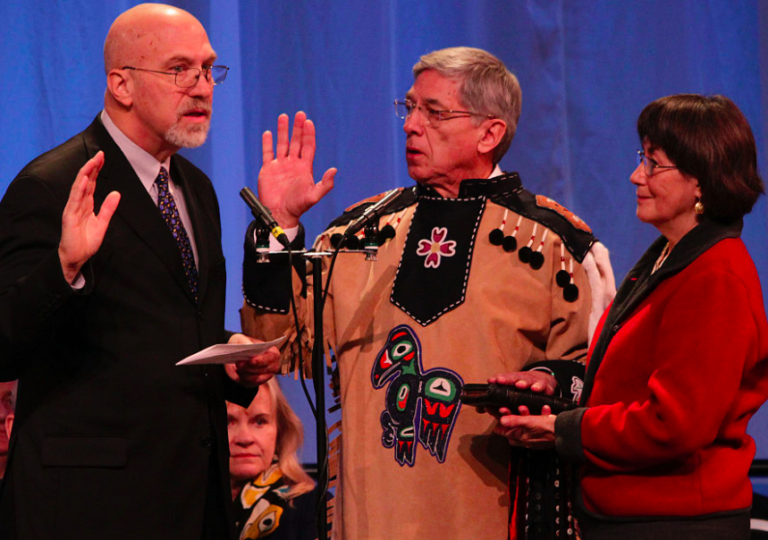
Byron Mallott being sworn in as lieutenant governor. James Brooks photo, Wikipedia
SEALASKA AND LIEUTENANT GOVERNOR
In 2011, CACFA wrote a letter of concern about land selections being made by the Sealaska Corporation that were outside of the original ANCSA areas designated for such. The group had a problem with how the selected lands would affect certain communities on Prince of Wales Island.
“After much thought the Commission has concluded that the corporation’s land entitlement can be adequately met with lands from the ANCSA withdrawals areas added by Congress in 1976. Therefore, for the following reasons we cannot support passage of S. 730 or H.R. 1408,” the group wrote to Sen. Lisa Murkowski.
That stance sat poorly with the Sealaska Corporation, with which the Lt, Gov. Byron Mallott is closely aligned. A shareholder, Mallott was a board member until 2014, when he ran for governor. His son is the president and CEO of Sealaska. Mallott has been upset with CACFA over that and other stances the group has taken because Mallott advocates for Native rights, whereas CACFA advocates for all Alaska rights.
CACFA has been an expression of Alaska’s need to exert its interests and influence in land use decisions made by federal agencies. Mallott holds the opposite view. And according to the Walker Administration, Walker and Mallott are one and the same, a two-for-one governor. And Mallott loathes CACFA.
JULY 22 DEADLINE FOR TRIBAL RESERVATIONS
Fast forward to this week and the “Akiachak Case.” This case relates to the termination of CACFA as a policy advising panel of experts, and the diminishment of Alaska sovereignty in the eyes of federal law.
The Akiachak Case is the first step to tribal reservation systems known in the Lower 48 as “Indian Country.” Alaska has, since 1971, had an ANCSA exception to Indian Country, with no reservation land left except Metlakatla. The complete inventory of Alaska’s prior reservation status is here.
Four tribes and an individual asked Interior Secretary of State Sally Jewel to eliminate the “Alaska exemption” to reservation land. They want the ability of Alaska Natives to have lands put into federal trust, a Balkanization that ANCSA sought to prevent.
With reservation status, management of fish and game resources would become an unholy nightmare. That’s just one of the problems with creating reservations in Alaska. The land also becomes self-governed and free of state taxes and regulations. Tribal members and business entities would become exempt from state rules on marijuana, gaming, and anything else that is regulated. The State of Alaska will lose access to historic trails still being contested with the federal government.
Mary Bishop of the Alaska Outdoor Council explained the challenges more fully last year in an opinion that appeared in the Fairbanks NewsMiner. But here are the Cliff Notes on this complex case from teh 1990s to present day:
In the 1990s, well over two decades after ANCSA became law, three tribes contended that the Indian Country exemption in the law is wrong. Litigation was next, and a series of legal actions on each side, which we won’t detail here.
In 2014, the DC district court judge agreed with the complainants and the Department of Interior began the process of accepting applications from tribes, while the State of Alaska’s appeal went forward.
On July 1, 2016 the DC Circuit Court also ruled that ANCSA was wrong in disallowing reservations in Alaska.
The State of Alaska has until July 22 — next Friday — to ask for a stay. After that, tribes and individual Alaska Natives can ask for their lands to be put into federal trust, aka reservation status.
Before appealing to the US Supreme Court, the State could ask for a second opinion from the same court. The request has to be filed within 14 days.
If Walker does not file a request for rehearing, the Department of the Interior can start taking lands into trust next week. If the State does request rehearing, that date is to be determined, but would certainly be later.
MALLOTT PREVAILED? WE’LL KNOW THIS WEEK
In his campaign for lieutenant governor, Byron Mallott told a group in Bethel that he fully supported tribal sovereignty.
“By not recognizing tribes, it also continues to keep a divide between us as Alaskans that needs to be done away with,” he told them, according to KYUK radio.
But after he joined forces with Bill Walker, Mallott just said that he hoped Walker would change his mind on that issue.
In 2014, Lt. Gov. Mallott said he supported Walker’s decision to appeal the federal court ruling, but he also supported putting lands into federal trust and again, he hoped Walker would drop the case.
Today, in 2016, Gov. Walker may walk away from the Akiachak challenge, in which case he will have made a decision to not fight for state sovereignty.
His decision will change Alaska forever. It’s a win for some, a loss for others, and a blow against the State of Alaska.
GASLINE AGENCY IS NOW THE SAME AS GOVERNOR’S OFFICE
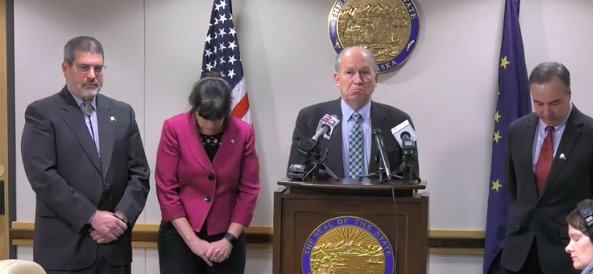
Governor Walker made an announcement in March that things were not going that well on the gasline. The partners stood by stoically. Dave Cruz, chairman of AGDC, is at left.
Governor Bill Walker has established a shadow government: the Alaska Gasline Development Corporation.
AGDC, created to carry the State of Alaska’s interest in a full-scale gasline from the North Slope to tidewater and markets beyond, is no longer the trusted agency it was set up to be.
The website description for AGDC describes it as, “an independent, public corporation of the State of Alaska, with a legal existence separate and distinct from the state.”
In charge of the largest capital project in North American history, AGDC is now murky in its goals and mysterious in its operations. One thing we know: The governor is running the show.
The melding of the two entities happened in stages, starting nearly as soon as Walker was sworn in back in 2014.
First, Walker fired almost everyone on the board, including Chairman John Burns, and replaced them with cronies associated with Walker’s old Alaska Gasline Port Authority, the failed Valdez project.
He said AGDC would be a “lay” board of Alaskans, but they’re Alaskans with a specific portfolio that links back to Walker and his top hot-dog lawyer, Craig Richards.
Walker then got rid of AGDC president Dan Fauske, an Alaskan with a long history of successes in the state, who was trusted by the public through his work at the Alaska Housing Finance Corporation, another public corporation. The governor brought in a brash Texan, Keith Meyer, who made the mistake of insulting a few legislators right out of the gate. It was a rocky start for Meyer last month.
The governor drove off one commissioner after another at the Department of Natural Resources, and put a malleable Andy Mack in that slot. Mack will do as he is told, since he is clearly out of his league as commissioner.
With Mack in place, Walker then took the first step to default the Prudhoe Bay oil fields, as he tries to force confidential marketing information out of the gasline partners, Exxon, BP and ConocoPhillips.
When the governor’s attorney general, Craig Richards, left state employment suddenly in June, he was replaced by a person with no experience in oil and gas.
Richards will evidently contract with the Alaska Gasline Development Corp. to do some kind of work for some kind of price. No one knows and no one is telling at this point. The governor’s communication director, Grace Jang, says the deal isn’t final. The good money says he’ll be suing over the leases in Prudhoe in what will be the litigation of a lifetime.
BRIGHT LINE ERASED
There was always a separation between AGDC and the Governor’s Office and other state agencies. AGDC has a separate board and the ability to bond. The structure wasn’t created to be run by a Walker or a Begich; it was built when Sean Parnell was governor, and Parnell was a stickler for rules.
The key mistake may have been that the board “serves as the will” of the governor. That worked out when the governor respected the bright-line role of board members and kept it at arm’s length, as Parnell did.
But now, there is no distinguishing between the Governor’s Office — with Jim Whittaker, chief of staff, and Marcia Davis, deputy chief of staff — and AGDC.
It’s one and the same, except that AGDC is not subject to public records requests.
There’s the rub. The public has no idea what’s going on over at the agency that spends millions of dollars of public money, and has no apparent accountability.
AGDC’s board will have its next meeting on July 14. In addition to an expected executive session, they may discuss that they are opening an office in Houston, Texas, and they’ve hired a marketing coordinator to market “their” gas to Asia.
And all this full-speed-ahead activity can proceed until the next fiscal year, which starts July 1, 2017.
By then, the only recourse for the people of Alaska is for the Alaska Legislature to pull the funding plug. This is being suggested by observers who say that until the Governor proves he has a viable option, every dime except bare maintenance needs to be locked down.
That solution is only possible if Republicans who are true fiscal conservatives hold their majorities in both the House and Senate. Walker is planning to change the calculus on that as well, so that along with malleable commissioners in charge of Alaska’s economy and law, he has a cooperative Legislature.
All eyes are on November.
SUMMER FILM SERIES
The Walkerville Plan is outlined in videos that have surfaced from 2012.
Here, his law partner Craig Richards says what he thinks is best for Alaska — state control of the gas line:
“The one [option] I am suggesting might be in Alaska’s best interests and that we should start seriously talking about is state control, that is we take control away from the producers, and [for the] state to step into that development role.”
The video sets the stage for how and why the Walker Administration took the first step last month to default the Prudhoe Bay fields: Take control. Is he baiting the producers into filing a lawsuit against the state for unfair treatment? Quite possibly, so he can counter-sue them for failure to market their gas.
During the same 2012 conference, Walker described his “my-goodness-owner-state-control.”
“As a comparison with Qatar, which owns all the infrastructure…You need gas and you need a market. The infrastructure in between is what you put together when you have those two pieces…It will never make sense to the leaseholders…It’s time for Alaska to step up and take control of this process.
The governor’s million-dollar consultant, Radoslav Shipkoff, also is on YouTube, arguing Alaska needed to start “right now” to take advantage of the window of opportunity.
First Territorial Legislature, 1913. Alaska legislators were paid $15 a day while in session plus 15 cents per mile traveled.
VETO OVERRIDES?
The Alaska Legislature gavels in for special session No. 5 today. The Senate convenes at 11 am, and the House at 1 pm.
House Finance Committee is set to take up the governor’s tax legislation on Tuesday, Wednesday, Thursday, and Friday at 9 am. Governor Bill Walker insists he’ll get his revenues, says Lieutenant Gov. Byron Mallott, who told the Kenai Chamber of Commerce, “This governor is dedicated to the proposition that he will keep dealing with the Legislature until that is done.”
Today is about caucusing. The Senate is staying in Anchorage for now.
LAST WEEK’S MESS: We didn’t have the heart to dig into the steaming pile last week, but here goes: Governor Walker dumped CACFA, the Citizens’ Advisory Commission on Federal Areas in Alaska. He simply defunded it.
The commission’s job? To be Alaska’s watchdog for ANILCA and other laws pertaining to Alaska lands. The commission was due to sunset in 2021 if for some reason the federal government went back in its constitutional cage.
It was a double whammy for the State. Also last week, a federal court ruled in favor of tribes placing their lands into federal trust, a leap forward for Indian Country, a leap backward for the actual law — the Alaska Native Claims Settlement Act sought to prevent Balkanization.
The Citizen’s Advisory Commission on Federal Areas opposes Indian Country because it will likely lead to reservations in Alaska. And we all know how well those worked out.
Here’s your Xanax. Breathe into this brown paper bag for a moment. Now read the story on the federal ruling as brought to you by the Fairbanks NewsMiner.
CACFA is established by statute (AS 41.37.160) and its official function is to “consider, research and hold hearings on the consistency with federal law and congressional intent on management, operation, planning, development, and additions to federal management areas in the state. The commission shall report annually to the governor and the legislature within the first 10 days of a regular legislative session.”
SPECIAL SESSION, HO!
Senate and House will need to reconsider elements of the criminal reform legislation, SB 91, which Governor Bill Walker signed today. There’s evidently a loophole for pimps that needs to be patched.
PLAN OF DEVELOPMENT REVEAL?
Senate Natural Resources Committee is scheduled to meet next Tuesday at 1 pm at the Anchorage Legislative Information Office to discuss the governor’s cancellation of the Plan of Development for the Prudhoe Bay Unit. It will be teleconferenced, audio only. And testimony is by invitation.



 Lincoln’s Gettysburg Address is on parallel with the Declaration of Independence and the U.S. Constitution in its stature.
 Without admitting to wrongdoing, he stated:



 AGDC, created to carry the State of Alaska’s interest in a full-scale gasline from the North Slope to tidewater and markets beyond, is no longer the trusted agency it was set up to be.
 The melding of the two entities happened in stages, starting nearly as soon as Walker was sworn in back in 2014.