Screenshot of the Save My Care ad aimed at Sen. Lisa Murkowski, and paid for by healthcare workers’ union SEIU. It’s saturating television in Alaska this week.
HERE COME THE UNION-BACKED ADS: Save My Care, the union-backed group fighting changes to Obamacare, is launching a “seven-figure TV ad buy” targeting Alaska, Nevada, Maine and West Virginia to target Sens. Lisa Murkowski, Dean Heller, Susan Collins and Shelley Moore Capito.
Save My Care hasn’t seen how devastating Obamacare has been in Alaska. The Alaska ad makes no mention of Alaska’s insurance rates going up over 200 percent under Obamacare for people who have to buy it on the market.
Save My Care is funded largely by SEIU,the union that organizes healthcare workers, including hospital, home care and nursing home workers, as well as local and state government employees. None of these people have to buy their care on the Obamacare exchange.
In addition to Save My Care, the airwaves are being inundated by advertising from at least four other groups, according to Alaska political consultant Art Hackney, who monitors such things. They are:
– Planned Parenthood Action Fund
– Coalition to Protect America’s Healthcare
– AARP, formerly known as American Association of Retired Persons
– CommunityCatalyst.org
The Planned Parenthood Action Fund spent $1.4 million during the 2016 election cycle, most of it on independent expenditures allowed by the United United lawsuit. The fund’s affiliates spent well over $15 million during the election cycle.
Planned Parenthood Action Fund’s PAC, which is registered with the Federal Election Commission, contributed nearly $700,000 directly to congressional candidates in the 2016 cycle, 98 percent of which went to Democratic candidates, according to the Center for Responsive Politics.
The Coalition to Protect America’s Healthcare is another Obamacare protectionist group, and it turned to BlueDigital.com to run its campaign to protect the federal funding for hospitals. BlueDigital works exclusively for Democrats and their associated causes.
CommunityCatalyst.org is funded by George Soros and other like-minded philanthropists.
Hackney said the ads are squarely aimed at Republicans, as many of them are showing up on Fox.
“There is no counterpoint,” Hackney said. No group has stood up any message to contradict the claims being made by these groupss pouring millions of dollars into ads they hope will pressure on Sen. Lisa Murkowski, who appears most likely to cave and leave Obamacare in place.
CONGRESSIONAL BUDGET OFFICE REPORT OUT
Adding fuel to the Resistance fire, the Congressional Budget Office published a report saying that 22 million people will lack coverage under the replacement bill for Obamacare, knows as the Better Care Reconciliation Act.
The CBO estimates that the BCRA would reduce federal deficits by $321 billion over 10 years but increase the number of people who are uninsured by 22 million in 2026.
No one knows for sure how either Obamacare or BCRA will play out in 2026, but the Congressional Budget Office record is spotty. Before Obamacare was enacted, the CBO greatly overestimated the number who would get government-subsidized coverage through the new insurance exchanges.
At the same time, the office vastly underestimated the cost of Medicaid expansion by under-predicting the number who would get coverage through expanding Medicaid.
CBO said 10 million more would be added by 2016, but the real number was 14.4, over 40 percent greater than it predicted.
It has been an interesting 15 months in Alaska and America from a political standpoint. I think that period of time deserves a bit of musing.
But first, let’s examine the emotional response called schadenfreude. Originating in Germany, the word means to take pleasure in the misfortune of others.
I think it is fair to say that the feeling would be intensified in the case of the misfortune of an adversary. In general, this emotion is seen in a negative way, grouped with its sister emotions of envy, greed, and jealousy.
I would posit, however, that there is a form of good schadenfreude and that is when your adversary suffers misfortune because of his own doing.
So it is that I am enjoying a feeling of good schadenfreude when contemplating the misery of Hillary Clinton and her adherents here in Alaska.
Fifteen months ago, Alaska Republicans gathered to conduct our Presidential Preference Poll, which is the beginning of the process used to select delegates that are sent to the national convention. (Cruz won, remember? Trump came in a strong second.)
I helped staff the Juneau polling station. My role was crowd management but there were others performing very careful election functions, the most crucial of which was registering non-Republicans who wanted to vote.
The only people allowed to vote in this poll were registered Republicans. Anyone could register Republican on the spot and then participate in the poll. Nearly 1,000 Juneau residents voted that night and many of them were not registered Republicans when they walked into the building. But they all were when they walked out.
I knew a lot of these people, and I knew that some of them were flag-burning Democrats who were there to vote for Trump, and that they would re-register as Democrats the next day.
I discussed this with others working that day, and in the days that followed it was our collective conclusion from the whispering, our knowledge of our neighbors, and some outright sarcastic comments we overheard from people waiting in line — these were Democrats trying to throw the election.
I wondered if this was a uniquely Alaska-based Democrat behavior or if there was more to it. If you are looking for character differences between the two major political parties, the willingness to mess around in the other party’s business is decidedly un-Republican and very much in the Democrat Party’s toolbox.
The most lamentable example was in 1982 when there was no restriction on who could vote in the Republican Primary. The Democrats had picked their man, Bill Sheffield and his victory at the primary phase was well-enough assured that hundreds of Democrats voted on the Republican ticket rather than their own and caused nomination of Tom Fink rather than the more moderate sitting Lt. Governor, Terry Miller.
It is widely believed that this was a deliberate tactic that was conceived and directed by the Democrat Party leadership. Fink was seen by most political observers as too far right to win and sure enough, we know the outcome. That event is why the Alaska Republican Primary is closed to just registered Republicans, nonpartisan, and undeclared voters.
I watched the 2016 campaign unfold and I started some research to see if there was evidence of a national Democratic Party tactic to encourage the Republicans to pick Trump. The Democratic leadership would never admit it now, but it sure does look like they wanted Hillary to face Trump and they were giddy when he got the nomination.
That is basically the conclusion in a Politico article by Gabriel Debenedetti published on November 07, 2016, a day before the general election.
Titled They Always Wanted Trump, it is a pretty interesting review of the Clinton campaign effort over the preceding year. The subtitle is “Inside Team Clinton’s year-long struggle to find a strategy against the opponent they were most eager to face.”
What is not so clear is whether there were plans made, money spent, aides dispatched to interfere in the individual state Republican convention delegate selection procedures, but the fact that the Clinton campaign wanted Trump is enough, I believe, to enjoy a warm feeling of schadenfreude without any guilt at all.
All are welcome to join me. It’s more fun to bask as a group.
Murray Walsh owns a government permitting consulting company and has been involved in land use management and planning for more than 40 years. He lives in Juneau.
Gov. Bill Walker poses with AFL-CIO President Vince Beltrami, who worked tirelessly to get him elected. Walker calls himself a non-partisan.
The campaign season has begun for Gov. Bill Walker, and it looks like he’s leaning toward a Party-of-One candidate again.
No one really know about Walker’s re-election plans, but he’ll appear at a public event in Washington, D.C. this week to extoll the benefits to society when there are no political parties, just individuals running as themselves. Like he did, when the only path forward was to drop his party affiliation.
According to a report in the Alaska Dispatch News, Walker and Rep. Jason Grenn, another union-made politician, will be star witnesses at the press event organized by the Centrist Project.
Except that their “independence” is not. Both Walker and Grenn had the fully pledged support and resources of the Alaska Democratic Party and its backers at the AFL-CIO. They had no such support from Republicans.
In Walker’s case, in 2014 the Democrats convinced their own front-runner to step back and run for lieutenant governor, which meant they offered no Democrat candidate on the ticket in 2014, thus clearing the field for Walker. It was the only way they could win.
Walker promised his prior running mate, Craig Fleener, that he’d have his pick of jobs in the Walker Administration. Fleener now runs the Washington, D.C. Office of the Governor, a position previously held by Kip Knudson.
Walker had decided, after losing the 2010 Republican primary, the only way he could win was to throw in his lot with the Left, erase his Republican past, and sweep in the voters who are in the middle; so many in Alaska are undeclared, that in a two-way race he could grab the Democrats and a chunk of the middle.
In the meantime, the Democrats’ machine worked overtime behind the scenes and through the pages of the Anchorage Daily News (now the Dispatch) to destroy the reputation of the incumbent, Republican Sean Parnell.
Byron Mallott had actually won the August Democratic gubernatorial primary, but the party’s central committee rejected him as the party’s nominee, and assigned him to the lieutenant governor role on the “fusion ticket” with Walker at the top.
It worked, and Walker ascended to power. Mallott is his lieutenant governor.
LONE WOLF WALKER
It’s no secret among politicos that the governor’s Chief of Staff Scott Kendall has been shopping The Boss around to leading Republicans across the state, incuding those who write checks. He’s seeing if Walker could run in the Republican primary. The concern Walker has is if Mark Begich throws his hat in the ring as a Democrat, it’s going to be tough for this shape-shifting governor, as he and Begich would split the left-of-center vote.
So far, the track record for the Party-of-One Governor has been spotty. Gov. Walker’s first budget in 2015 was woefully late, he has been unable to balance the budget in 2015 and 2016, nor make effective cuts. He was unable to work well with either side of the aisle, but he particularly struggled with Republicans.
In 2017, he submitted an unfunded budget and asked the Legislature to figure it out. Now, he is at odds with some Democrats just as he’s going into a re-election cycle.
Gov. Bill Walker follows President Barack Obama off of Air Force One on the president’s trip to Alaska in 2015.
In the two and a half years he’s been in office, the Legislature has had seven special sessions. The state came perilously close to government shutting down in 2016 and 2017.
Walker has alienated the largest industry in Alaska. The oil and gas industry paid over $1.6 billion in taxes and royalties in fiscal year 2016 to the State and another $447 million to local governments, but have been downsizing their operations. It’s bad enough to have low prices and a high cost environment. Add looming taxes on top of that, and companies just cannot make it work. Gov. Walker has threatened them with higher taxes and has withheld payment of tax credits, driving some companies to the edge of bankruptcy and some out of the state altogether.
More than one third of Alaska jobs are tied to the oil industry, but the drop in employment in the oil patch has been 20 percent or higher under Walker. Currently, the state has the highest unemployment in the nation, and the worst educational outcomes. There has never been such a drop in gross domestic production as there has been under lone-wolf Walker. Alaska’s GDP in 2016 fell 5 percent.
Although he was an outspoken opponent of SB 21, the oil tax reform of 2013, Walker stated as a candidate he would not offer changes to the legislation that voters ratified in 2014: “I will begin to monitor North Slope activity immediately to ensure those promises are kept and make that information available to the public. It is my hope those promises are kept.”
Instead of using his bully pulpit to talk about the successes of SB 21 — increased oil throughput — he quickly reneged on his campaign promise and sought tax increases even when prices are low and industry operators are struggling.
When asked during his campaign if he would implement taxes or trim the Permanent Fund dividend, candidate Walker said: “I have no intention to implement a statewide tax or paying for state government by reducing Permanent Fund dividend checks. If we properly develop our natural resources and put in place a sustainable budget that should not be necessary.”
Yet he pushed for an income tax since the month he took office. And he did in fact cut dividends, rather deeply.
Walker has no party, and he has no platform.
He has demonstrated a willingness to do and say just about anything if it will get him elected, then once elected he quickly drops his promises and advances the agenda of his funders.
Jason Grenn gazes off into space during committee hearing. He served on the Finance Committee in his freshman year in the Alaska Legislature.
THE NEW JASON GRENN
Jason Grenn did the same thing: He dropped his Republican party affiliation and ran as a non-aligned candidate against Rep. Liz Vazquez, a Republican. The Democrats withdrew their candidate (he became ill, he said), and Democrats and unions threw their cash to Grenn. Otherwise, they had no hope of winning the conservative district.
The AFL-CIO brought out the big guns for Grenn, who immediately caucused with the Democrats. Not surprisingly, he has represented them well — more taxes and more government spending on everything.
Grenn, who promised his conservative supporters that he would represent their values, turned against Republicans the moment he was elected. He embraced his union sponsors, and is now suffering from a form of Stockholm Syndrome, identifying with his captors, who keep a close eye on him, as he is a flight risk.
The Centrist Project, which is sponsoring Grenn and Walker’s trip to D.C., espouses the ideals of nonpartisanship, a world where political parties don’t matter and “independents” rise above the partisan fray to enact sensible policies.
But as Alaskans have found, this too is a bait-and-switch. Candidates still need financing for their campaigns. It has to come from somewhere. The “Independent” label ends up being a stalking horse for the special interests on the Left.
To prove this, one need look no further than Grenn’s track record in his first year, where he voted with Democrats on nearly everything. The only time he broke partisan ranks was voting against the House version of the oil tax increase bill (HB 111) on a floor vote, but that appears to have been orchestrated to appease his business supporters and because it would have killed his re-election hopes. It didn’t matter — the required votes were there without Grenn’s.
Altogether, Grenn’s voting record is anything but nonpartisan. The same goes for the other “Independent” in the House, Rep. Daniel Ortiz of Ketchikan. He has voted 100 percent Democrat since being elected three years ago. Both are fully entrenched in the caucus system they ran against.
There is another curious thing about the July 12 press conference in Washington DC: July 15 is the last day of the current special session of the Legislature. If the House cannot find a way to end oil tax credits, it will cost the State $1 million a day.
We’re in the last days of the seventh special session in three years.
Are neither Walker nor Grenn needed in Juneau? And how would they know that in advance?
WRANGELL LABOR DISPUTE LABORS ON: Wrangell officials have pulled out of contact talks with the IBEW, the union representing municipal workers. Twenty-four utility and other workers had gone on strike on June 22, saying progress was not being made on a contract.
Interim Borough Manager Carol Rushmore posted a long letter on the Wrangell municipal website Wednesday saying she was not accepting the latest offer by IBEW and she wasn’t making any counter offers, either. The letter says, in part, “I feel the Union’s additional demands are not financially feasible for the residents of Wrangell, nor consistent with what the Union has stated publicly that it wanted. Therefore today, July 5, 2017, I have made the choice to not accept the Union’s last proposal to the Borough and to not make any further offers to the Union. I cannot in good conscience submit the Union’s demands for Assembly review when I feel it threatens the financial future and the sustainability of the Community.”
YOUR TAX DOLLARS AT WORK: Spending on Medicaid-covered prescriptions for the treatment of opioid abuse (now known as opioid use disorder) and opioid overdose increased dramatically between 2011 and 2016, according to a report from the Urban Insitute.
Between 2011 and 2016, Medicaid spending on OUD treatment prescriptions for buprenorphine, naltrexone, and naloxone more than doubled, from $394.2 million to $929.9 million. Most of the taxpayer money went to buprenorphine, for which spending increased from $380.9 million to $753.9 million.
Medicaid spending on naltrexone increased over 1,000 percent, from $13.3 million in 2011 to 156.3 million in 2016. Overall spending on naloxone increased 90,205 percent— from just $0.02 million in 2011 to $19.7 million in 2016.
Read the January, 2017 recommendations of the Alaska Opioid Policy Task Force here.
PARADE OF SUPERINTENDENTS: That was fast. Haines School Board just accepted the resignation of its school superintendent, Tony Habra, who moved from Michigan last year to take the job. He is the fourth in four years, following Michael Byers, Ginger Jewell, and Rich Carlson.
GABBY LEDOUX, A STUDY IN CONTRADICTIONS: The House Democrat-led leadership held a press conference yesterday, during which it doubled down on its insistence for higher oil taxes along with ending the cash credits paid to small explorers on the North Slope. But Rep. Gabrielle LeDoux, in answering reporters’ questions, contradicted the party line: “Eliminate credits – simply eliminate the credits – that’s what we can all agree on.” “Simply eliminate the credits.” “Repeal the credits, one doesn’t have to go with the other.” But that is not where House Resource Committee co-chair, Rep. Geran Tarr, is taking the House majority. The rumor is, LeDoux is not the only one in the majority caucus who is unhappy with the majority’s direction right now and, specifically, House Resource Committee leadership.
The credits cost Alaska $1 million a day, and the Senate wants to end them. Their plan is to backdate the effective date to July 1 to save precious cash this fiscal year.
OUR SITE HAS NO PAYWALL: But we do have a place to donate. It’s up at the top of the page on the right. We sincerely appreciate the help keeping Must Read Alaska up and running, a voice for conservatives (and open-minded others). Thank you for contributing what you can!
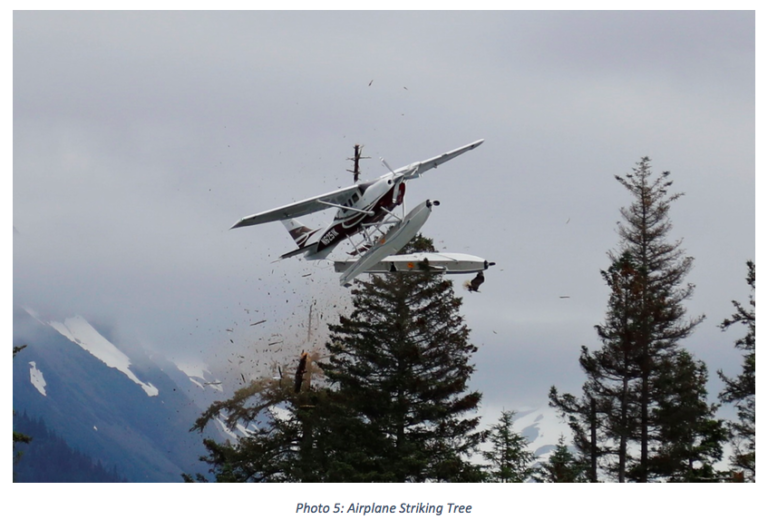
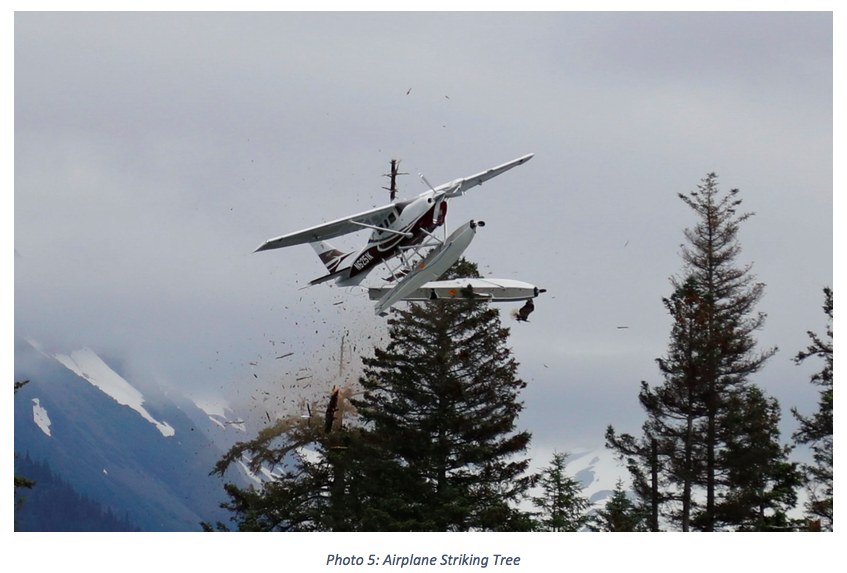
Piloted by Alaska Dispatch News owner Alice Rogoff, a Cessna 206 floatplane crashes into a tree, before crash landing in the waters of Halibut Cove on July 3, 2016.
Alice Rogoff, owner of the Alaska Dispatch News, had just completed a trip to the Nushagak River on July 3, 2016. She had dropped off her daughter for a fishing excursion. She flew as a co-pilot, meaning she had another pilot with her, doing the actual flying.
As she told it to the National Transportation Safety Board, “Afterwards, we flew back to Homer airport to drop off the pilot and take on additional fuel. I followed my pre-flight check list and checked Homer A TIS for weather for the flight back to Halibut Cove.
“I departed runway 22 and conducted a standard rate 180 degree turn climbing to approximately 1000′ for the flight to my destination. Very familiar with this 10 minute flight, having landed on water at Halibut Cove many times,” she reported in her statement.
She radioed her intentions to land from the west, and then flew over the landing area at approximately 600 feet to confirm there was no traffic and check the wind direction and water conditions. Then she circled back to land downwind.
“I followed my approach to landing checklist {FFCARS-Fuel, Flaps and Gear, Clear Area, Rudder, Radio and Speed) setting full flaps and descending at approximately 70 mph on final,” she reported.
But she came in hot from the east and touched down faster than she expected to, and sooner than where she’d intended the floats to contact the water. The aircraft began to bounce.
Rogoff decided to not try to complete the landing, but to attempt a go-around. So she gunned the engines, and on her steep climb out of the cove, she could not see where she was headed, nor could she see the tree that her left float then crashed into.
The NTSB report says “the airplane subsequently made a slight turn towards the vessel before passing off the right side and impacting trees. The airplane then descended into the water, about 100 feet from the tour boat.”
But that’s not quite how bystanders described it and photographs taken at the time don’t reflect an immediate descent. The plane continued to fly, although not far.
Photo taken by Delores Wilbur from the Danny J motor vessel, shows that the plane continued to fly, rather than simply crash to the water.Alice Rogoff’s plane continues to fly long after losing one of its pontoons (now in the water), on July 3, 2016, in Halibut Cove. It crashed not far from the stern of the Danny J. – Delores Wilbur photo.
Rogoff landed near the Narrows, which is the entrance to the cove which is located on an island. The community of Halibut Cove is located on Ismailof Island and the south shore across the Narrows.
“The pilot stated there were no mechanical failures that would have precluded normal operation,” the NTSB investigator wrote. Her last biennial flight review was three years prior, in September of 2013, in the same make and model as the plane she crashed.
The weather was mild, with light winds, broken clouds, 10 miles of visibility, about 61 degrees, and a barometer reading of 29.92. The water was described by the NTSB as glassy, although the photos tell a slightly different story: There appears to be a ripple on the surface on all photos observed from that day.
Glassy water can be a problem for floatplane pilots, as it is notoriously difficult to judge altitude when touching down. But the water was arguably not all that glassy, merely calm.
As she climbed, Rogoff banked the plane at about 40 feet altitude, and then struck the tree and crash landed in the water. A tour boat nearby was full of visitors who witnessed the crash.
“Thereafter, I have little recollection other than realizing that water was coming into the cabin and I needed to get out,” according to Rogoff. “I kicked out the pilot window and pulled myself from the cockpit.”
She was rescued by people nearby, who jumped into skiffs and went to her aid, but by the time the Alaska State Troopers arrived at 10 pm, she was long gone.
Her attorney says she left because she needed to get warm and dry and be medically evaluated. If she has little recollection of the crash, but only remembers she was kicking out the pilot window to escape, she may have been in shock.
After the crash, however, Rogoff issued a different kind of statement:
“Fortunately she was not hurt and wants to thank all the people in Halibut Cove for their generosity and good spirits,” she said last July through her attorney. “Clem Tillion’s 91st birthday party went on as planned and Ms. Rogoff was delighted to attend.”
NTSB never interviewed Rogoff at the scene, and troopers also passed on the opportunity, saying they were unable to locate her. This too is questionable since most people in Halibut Cove would have been aware that Rogoff was at the Tillion house. Roughly 75 people live around the cove and many are related to the Tillions in some way. No toxicology report was ever done.
Rogoff no longer has her FAA floatplane rating but is still a licensed pilot for land. Experienced Alaska pilots say she is fortunate indeed for having lived through the ordeal, and so are the people aboard the Danny J, who came close to being casualties of a crash landing on the way to a birthday bash, one that will go down in the family histories of all concerned.
***
SINCE YOU’RE HERE, BE A DEAR: We don’t have a “subscribers only” paywall at Must Read Alaska. That means everything we do is for you, free of charge, or you may help us out with contributions — as you wish.
We ask for donations so we can be sure to be here next year … and the year after … a conservative voice and news source for Alaska.
Check out the Donate button to the right of the page — near the top — and please consider making a contribution. As you wish. Thank you!
Some of the members of the current House leadership in their negotiating stance this spring, from left: Reps. Geran Tarr, Sam Kito, David Guttenberg, Jason Grenn, Les Gara, Paul Seaton, Ivy Spohnholz, Bryce Edgmon, Louise Stutes, Chis Tuck, Daniel Ortiz, Justin Parish, Andy Josephson.
By SCOTT HAWKINS SENIOR CONTRIBUTOR
Scott Hawkins
As lawmakers return irritably to Juneau next week, a fascinating dynamic has emerged: Gov. Bill Walker and Senate Republicans, who have vast differences in their policy leanings, found some common ground on the most pressing issues facing the state this year.
House leadership – normally aligned with the Governor on most issues – now finds itself the odd man out.
How did this happen?
Quite simply, it is a case of grown-ups in the Governor’s Office and the Senate knowing how and when to negotiate – and find common ground – while House leaders seem to utterly lack those skills. Indeed, our current House leadership appears composed of perhaps the worst negotiators in modern Alaska history.
WALKER SAVES HOUSE LEADERSHIP FROM ITSELF
The regular legislative session and the first special session adjourned with no action on the operating budget, mainly because the House tried to link all fiscal issues together and come away with a grand bargain on budgets, personal income taxes, oil tax hikes and Permanent Fund restructuring that favored their position on everything.
It was all or nothing. Predictably, the result was nothing.
With state government facing a July 1 shutdown in the absence of a budget, Gov. Walker stepped in to save his allies in the House from themselves – i.e., he called a second special session, but this time he limited the call to the operating budget only. This deprived House leaders of their ability to link a hodge-podge of fiscal issues together into one big, unwieldy hairball.
It worked. House budget negotiators had very little choice but to sit down and hammer out an operating budget in just a few short days. Gov. Walker signed it before July 1. Voila, shutdown averted.
With an operating budget now in place, Gov. Walker amended the special session agenda to add House Bill 111, the House’s oil tax bill. That, and only that, for now. The Senate version of the bill has been narrowed to deal only with eliminating cash payments to small oil companies, a subject on which all three bodies – Senate, House and Administration – more or less agree.
Since everyone agrees, why not just get that done? Simple, right? Well, except that the House really, really wants to re-broaden the bill to jack up base taxes on an oil industry that is already struggling with low prices.
The governor agrees in principle with the House position, but the Senate is not having it. To his credit, Walker has gotten the memo that oil tax hikes are not in the cards this year.
In keeping with standard negotiating principles, Walker and the Senate sat down and identified those high-priority HB 111 elements they can agree on, then they compromised on some key details.
This required the Senate to back down on things like “ring-fencing,” a restriction that Walker wants on how tax deductions can be applied to individual oilfields.
By the way, eliminating the cash incentives is not something pro-growth Republicans are all that keen on doing. After all, the incentives have been wildly successful, more so than even their most ardent supporters expected.
However, with the state running a massive deficit, funding them straight out of the general fund is no longer feasible. There are other ways to fund them, and we should, but that sort of creativity is in short supply just now. So eliminating them is the only thing the three bodies can agree upon.
However, in spite of their enthusiasm for eliminating the cash payments, the House has not yet come to the table. Unless they come to their senses, they appear ready to sink the whole bill unless they get their way on jacking up tax rates.
Here’s the rub: Failure to end the program means cash payment liabilities continue to accumulate on the order of $300-400 million per year. This adds substantially to an already huge, unfunded liability of over $700 million.
Bear in mind, these cash payment liabilities are very real legal obligations incurred under state law, not funny money. Failure to make good on them would sink the state’s credit rating even further, while branding Alaska as a political banana republic and putting development of several newly discovered oilfields at grave risk. They cannot be ignored indefinitely.
INCOMPETENT NEGOTIATING OR CYNICAL MOVE?
That House leadership would even contemplate letting the cash payments program remain in place for another year or two seems counter to their usual, revenue-hungry ways.
Each and every member of the House majority caucus would far rather spend that quarter billion on their friends in government than invest it in the efforts of small, independent oil producers.
Here is where negotiating incompetence gives way to cynical manipulation. Many Juneau observers are increasingly convinced that the House majority actually wants the credits to remain in place in order to stoke public outrage against the oil industry, leading to a ballot initiative — to not only end the credits but jack up taxes, too.
Oh, and they think that gambit would also bring more anti-industry types to the polls in 2018, helping House leaders maintain or increase their majority.
Yes, you read that right. House leaders seem willing to squander nearly a half billion dollars that our cash-strapped State cannot afford in order to launch a destructive ballot initiative they believe would help the Democrats, politically.
That would explain the bizarre spectacle we are seeing now: Republicans attempting to end incentives for small oil companies, while Democrats take steps to keep them in place against the interests of their core constituents.
And yet, here is where tragedy could give way to farce. As you might recall, Democrats have tried this before. In 2014, their public employee union backers gathered enough signatures to force a vote on the 2013 oil tax reform bill, Senate Bill 21.
That gambit backfired spectacularly when voters ratified SB 21 by a fairly good margin. Private sector voters came to the polls in droves, which ended up electing solid Republican majorities in both the House and Senate.
VOTERS USUALLY GET IT RIGHT
A spectacular backfire is just as likely to happen again. Voters generally make good decisions once an issue gets fully aired out and this one would certainly get a fulsome public hearing.
Voters may very well decide that they don’t wish to accelerate the current economic downturn, depress their real estate values even further, and squander the best chance in decades for a sustained increase in oil production, state revenue and high paying jobs.
In fact, I would bet on it.
In that Keystone Cops scenario, the political left in Alaska would be dealt yet another setback in a long string of setbacks to their various anti-business ballot initiatives over the years that have targeted both the mining and oil and gas industries. They would also find themselves saddled with another year or two of accumulated cash payment liabilities, plus a very real chance of losing their newly cobbled majority. What a plan!
It is a strategy akin to someone pointing a loaded gun at their big toe and saying, “give me what I want or I will shoot!”
Here is a better idea for House leaders: Accept the major items on which everyone agrees – ending cash payments to small oil companies, passing a lean capital budget, and enacting Senate Bill 26 to stabilize Permanent Fund earnings in line with the way other large foundations are managed.
That would let House members return home with some real accomplishments and avoid endless, irritable special sessions this summer and fall.
The alternative available to the House is to let cash payment liabilities accumulate irresponsibly, let the battered construction industry sink further this summer for lack of a capital budget, back the State into a very tight financial corner, and drive public approval of the Legislature even lower than it already is.
***
Scott Hawkins is board chairman of AlaskaWins.org, previously known as ProsperityAlaska. He is president and CEO of Advanced Supply Chain International. An economist, Hawkins was the founding president of the Anchorage Economic Development Corp.
PFC Hansen Kirkpatrick and his mom, from her Facebook page.
Somewhere in Wasilla, Alaska, there are a mom and dad whose brave son went off to war in January and will return in a flag-draped casket in July. Tonight, their hearts are broken as they leave Alaska to be present when their son’s remains return to the U.S.
PFC Hansen Kirkpatrick was the seventh U.S. soldier killed in Afghanistan this year, in the war against terrorism that seems to never end. U.S. troops have rotated through the war-torn country for the past 15 years and nearly 1,000 Americans and British military personnel have died in this region.
Kirkpatrick was killed late Monday while fighting the Taliban alongside Afghanistan forces in Helmand Province, Pentagon officials said. Helmand is a particularly restive area of Southern Afghanistan.
Kirkpatrick appears to be the first American soldier to die in the province this year. He was hit by indirect mortar attack; typically that involves exploding shells or rocket rounds.
Two other soldiers were injured in the attack during the operation, said Navy Capt. Jeff Davis, a Pentagon spokesman, who said the injuries were not believed to be life-threatening.
Kirkpatrick was with the Fort Bliss-based 1st Battalion, 36th Infantry Regiment, 1st Stryker Brigade Combat Team, 1st Armored Division. He was a mortarman who joined in June, 2016, according to Army Maj. James C. Bithorn, an officer with the 1st Armored Division’s 1st Brigade. He described Kirkpatrick as “a caring, disciplined, and intelligent young soldier.”
One person he served with wrote on Facebook that Kirkpatrick was a great storyteller who used to regale his fellow soldiers with tales from Alaska. Kirkpatrick had attended a high school named for a master storyteller: Robert Service High School in Anchorage.
After graduation, Kirkpatrick enlisted, and he and 1,500 other soldiers deployed to Afghanistan in January to serve in nine-month rotations. The brigade’s soldiers embed in various regions, some working alongside U.S. Marines and Afghan forces fighting the Taliban and its most strident wing, ISIS, or the Islamic State.
The area has seen heavy fighting in recent weeks as Taliban forces have pushed for control of an area of intense opium poppy production, which is a major source of funding for the Taliban and is a primary supply of opium for the global trade.
“We will keep [Kirkpatrick’s] family in our thoughts and prayers as we reflect on the sacrifice he and others have made to secure our freedoms and help make Afghanistan a better place,” Army Gen. John Nicholson, the top U.S. commander in Afghanistan, said in a prepared statement.
For the parents and siblings of PFC Hansen Kirkpatrick, the Fourth of July will not be the same next year or the years that follow. This family became a Gold Star family on July 3, 2017, a sad designation, a somber honor that reminds us of their sacrifice for our nation.
Our hearts go out to the family, friends, and fellow soldiers of PFC Hansen Kirkpatrick.
A COUP TO REMEMBER: The last time the Alaska Legislature stayed in session this long was back in the 1980s, when Rep. Jim Duncan, a Juneau Democrat, was House Speaker. The session went into June.
Old-timers will remember what happened next. The session went too long, so there on June 12, 1981 some legislators staged a coup, and Duncan was out as speaker, replaced by Joe Hayes.
The coup was staged by Reps. Russ Meekins, Rick Halford, Mitchell Abood, Al Adams, Charles Anderson, Ramona Barnes, Betty Cato, Jack Fuller, Michael Beirne, Robert Bettisworth, Bernard Bylsma, David Cuddy, Kenneth Fanning, E. J. Haugen, Joe Hayes, Vernon Hurlbert, Terry Martin, Ray Metcalfe, Joe Montgomery, Patrick O’Connell, Randy Phillips, and Richard Randolph.
Part of the ousted Duncan camp were Reps. Hugh Malone, Brian Rogers, Fred Brown, Don Clocksin, Sam Cotten (now Fish and Game commissioner), Sally Smith, Mike Miller, Tony Vaska and Fred Zharoff. They sued to have Duncan restored, saying the coup was unconstitutional. Their attorney was Doug Pope. They lost.
The Anchorage Superior Court ruled that while “the procedures used by the majority in accomplishing its will lacked woefully in decorum and the orderly parliamentary process by which the business of a public legislative body should be conducted,” the replacement of Speaker Duncan was lawful. The group also lost on appeal.
As for Duncan, he is the only House Speaker to last but one session, but he is still walking the halls of the Capitol, now as the union representative for State employees (some might suggest that he held that position back then, too).
Thirty six years since the first coup in the House, the Democrats once again are in control and have lost track of time. They are holding the Legislature in session well into July, almost as though this is the best-paying job they’ll ever have.
IF YOU HAVE TO ASK, YOU CAN’T AFFORD IT: To answer all those questions we’re getting about where the founder of Facebook stays when he comes to Alaska, Mark Zuckerberg and his wife Priscilla parked at the Alaska Wilderness Lodge in China Poot Bay in Kachemak Bay, dined at local Homer restaurants, and did not use a guide for fishing, just the lodge staff and equipment.
BEST WILLIAM SEWARD STATUE EVER: The bronze statue of William Seward was dedicated on July 3 in Juneau. It sits in the spot close to where the old much-maligned Nimbus once stood, the most controversial public sculpture in Alaska. By all accounts the dedication ceremony was rainy but the depiction of Secretary of State Seward is being praised for its artistry and its “scars and all” honesty.
APOCALYPSE ISLAND: Juneau Empire reporter James Brooks snapped a photo from the island near the whale sculpture in Juneau, and we think those are fireworks, even though his photo was taken not long after North Korea launched its long-range missile:
NOW THAT YOU’RE HERE, BE A DEAR: We don’t have a “subscribers only” paywall at Must Read Alaska. That means everything we do is for you, free of charge, or you may help us out with contributions — as you wish.
We ask for donations so we can be sure to be here next year … and the year after … a conservative voice and news source for Alaska.
Check out the Donate button to the right of the page, and please consider making a contribution. As you wish. Thank you!
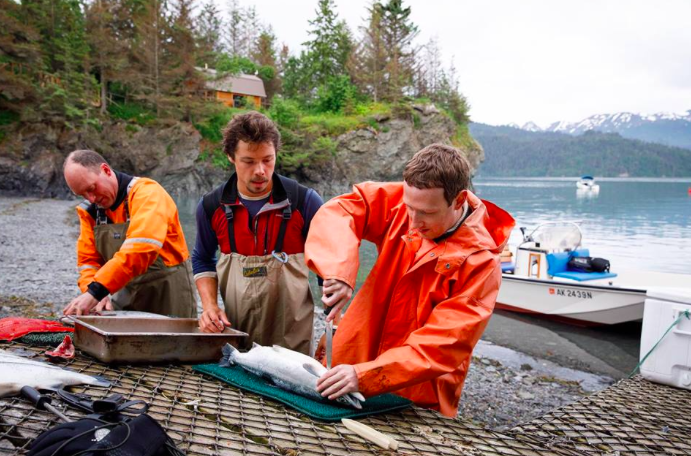
Mark Zuckerberg, founder of Facebook, fillets a salmon in Homer, Alaska. (Photo from his Facebook page.)
WE WADE INTO FACEBOOK FOUNDER’S ‘BASIC INCOME’ CLAIMS
Alaska, the richest state to ever go broke, may not have any money to promote tourism these days, what with our budget crisis and all.
But with Facebook founder Mark Zuckerberg in the state over the weekend, that may be all the promotion our state can stand. Except he’s sending us the wrong type of people to our state — people who want free money.
Zuckerberg, in his exploratory essay about the Alaska Permanent Fund, may be sending Alaska the kind of person who thinks that our “basic income” is the social safety net.
Zuckerberg spent time in Homer, kayaking, fishing, and observing dip netters gather salmon for their freezers.
He visited Seward for the Fourth of July and watched runners muddy and bloody themselves on Mount Marathon.
And he wrote about it on Facebook, where millions of people will read his words and take them to heart.
“One thing that stood out to us is how different Alaska’s social safety net programs are in a way that provides some good lessons for the rest of our country.
“Alaska has a form of basic income called the Permanent Fund Dividend. Every year, a portion of the oil revenue the state makes is put into a fund. Rather than having the government spend that money, it is returned to Alaskan residents through a yearly dividend that is normally $1000 or more per person. That can be especially meaningful if your family has five or six people.
“This is a novel approach to basic income in a few ways. First, it’s funded by natural resources rather than raising taxes. Second, it comes from conservative principles of smaller government, rather than progressive principles of a larger safety net. This shows basic income is a bipartisan idea.
“Seeing how Alaska put this dividend in place reminded me of a lesson I learned early at Facebook: organizations think profoundly differently when they’re profitable than when they’re in debt. When you’re losing money, your mentality is largely about survival. But when you’re profitable, you’re confident about your future and you look for opportunities to invest and grow further. Alaska’s economy has historically created this winning mentality, which has led to this basic income. That may be a lesson for the rest of the country as well.”
Basic income is a cause that Zuckerberg has adopted as his own, speaking about it at length at his recent speech at Harvard University. This resonates with a certain subset of people. He’s calling it a bipartisan idea that everyone can get behind.
However, it is not an idea everyone embraces. Conservatives and free-market types have issues with the basic-income movement that Zuckerberg is championing.
America already does have a type of basic income program: Entitlements. The government, through taxation, pays for people’s housing, food, medical care, phone service. Taxpayers pay for elder care, disabled care, special needs care, day care. Taxpayers pay for abortions and fertility treatments. Taxpayers pay for sex change operations and tattoo removal. We pay for fresh needles so addicts can stay “healthy.” We shoulder the cost for opioid and heroin overdose prevention.
We even have an earned income tax credit, which means instead of paying taxes, the government gives you money.
The average taxpayer in America pays for government handsomely. In 2016, federal, state and local governments collected $4.9 trillion in taxes, which is:
$15,202 for each person living in the U.S.
$39,074 for each household in the U.S.
26.5% of the U.S. economy
And yet, we are a nation with $20 trillion in national debt.
Only in a country sliding toward socialism would the government take $15,202 per year from one hand and at the same time give every person a basic income in the other hand and keep running up the credit cards.
Zuckerberg doesn’t explore how such a program as the Alaska Permanent Fund would work in the rest of America. Every state doesn’t have a Trans Alaska Pipeline to tap into in order to create a large sovereign wealth fund to support state government needs and annual cash payments to residents.
How would other states raise that kind of cash? And is Alaska’s dividend program really the model for the rest of the country?
In fact, the average $1,022 dividend that Alaskans have received since 1982 barely pays for the increased cost of fuel, food, and housing in our high-cost part of the world. But millions of people who hang on Zuckerberg’s every word don’t know that. And at least a few of them are packing their cars today, and painting “Alaska or bust!” on their back windows.
A word to the wise: Alaska has the highest unemployment rate in the nation. So $1,000 is not a safety net. It’s a plane ticket out of a land that is, in fact, very unforgiving.



 But Rep. Gabrielle LeDoux, in answering reporters’ questions, contradicted the party line: “Eliminate credits – simply eliminate the credits – that’s what we can all agree on.” “Simply eliminate the credits.” “Repeal the credits, one doesn’t have to go with the other.” But that is not where House Resource Committee co-chair, Rep. Geran Tarr, is taking the House majority. The rumor is, LeDoux is not the only one in the majority caucus who is unhappy with the majority’s direction right now and, specifically, House Resource Committee leadership.