Thursday, December 18, 2025
Home Blog Page 1644

Salary commission takes bite out of legislators’ pay

3

A state salary commission on Wednesday recommended a 10 percent cut to legislators’ pay, taking it from $50,400 per year to $45,360.

The State Officers Compensation Commission also reduced the per diem of legislators, who normally get about $200 per day for meals and lodging while in session. Now, they’ll see those payments cut by more than half.

Glenn Clary, who took over as chairman of the commission this week, said the Legislature must approve or reject those salary and per diem schedules by passing a bill within the first 60 days of regular session, and aren’t able to adjust the recommendations. It’s all or nothing.

Clary said the salary cuts are not retaliatory but that Alaskans have seen half of their Permanent Fund dividends taken from them by the Legislature this year, and “I’d like to hear from legislators about why they should not allow these recommendations to go forward.”

Commission member Duane Bannock wrote: “If the new salary (90% of $50,400) is considered, the total compensation package is now $52,380 ($3,780 x12 months + $2,340 x 3 months). It’s hard for me to think anyone can complain about a job that pays $52,380 + benefits for only being a part-time legislator, especially considering the fiscal position of the state.”

The commission did not touch the salaries of the governor, lieutenant governor or commissioners.

While Juneau is an expensive place to set up temporary residence for lawmakers, Juneau legislators Sen. Dennis Egan and Reps. Sam Kito Jr. and Justin Parish receive 75 percent of the per diem of other legislators, although they are not out of town on assignment.  The Compensation Commission did not alter that arrangement.

Quote of the Day: Wielechowski says oil tax reform a failure

1


FROM THE WAY-BACK MACHINE

“We were told by the Governor [Parnell] and his consultants that the last year’s Oil Wealth Giveaway would increase production within a matter of years … Today’s announcement by the Administration confirms that this approach is an utter failure, a flop of epic proportions.”

– Sen. Bill Wielechowski on April 7, 2014, in a press release criticizing SB 21, his legislative colleagues who voted for it, and the governor who signed it. SB 21 had passed one year earlier and had yet to face a Democrat-led referendum to repeal it on the August 2014 primary ballot. Oil production in 2014 totalled 530,000 barrels per day, and today it has edged up to 533,000 barrels per day.


Production forecast is out: SB 21 is working

3

ADMINSTRATION FINALLY ADMITS OIL PRODUCTION IS INCREASING

For three years in a row, Alaska’s oil fields have been producing more each year. That hasn’t happened since the 1980s.

Since Alaskans voted by referendum to support Senate Bill 21, the oil tax reform bill of 2013, energy companies felt they could invest and get a fair shake from the State, and oil production began increasing as a result.

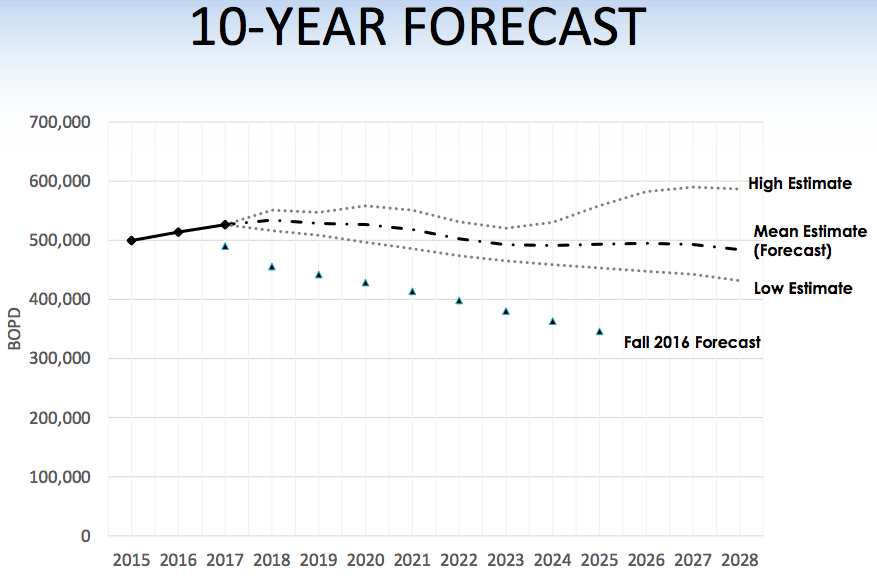
But last spring, the Walker Administration’s production forecast predicted a catastrophic 12 percent decline for FY 2018 — that’s the current fiscal year. The administration had to walk back its forecast, blaming it on “stale numbers.”

The Department of Revenue also predicted that within 10 years, the pipeline would be carrying less than 350,000 barrels a day, a level at which many experts say the pipeline would struggle to operate.

Instead, there’s been a 2 percent increase, year over year — for three consecutive years. Today, the pipeline is carrying an average of 533,000 barrels a day, some 6,000 barrels more per day than last year.
A 14 PERCENT MISS AND THE ORIGINS OF FAKE NEWS

The 12 percent drop predicted by Walker, and the 2 percent increase in actual production — for a whopping 14 percent swing in projected output — shows that the Departments of Natural Resources and Revenue are still struggling to produce their own forecasts, which used to be done by a third party contractor.

It also may show that the Administration is willing to present fake numbers to lawmakers and the public in order to create a fake fiscal crisis that would convince legislators to enact one or more of the governor’s tax proposals.

“You can’t ask for taxes if the people don’t believe you. Once people figure it out, you have a hard time restoring crediblity.” – Tuckerman Babcock, chair of the Alaska Republican Party.

Under the old ACES tax regime, implemented during the Palin Administration, production was dropping more than 7 percent per year.

Today, the long-term declines have given way to actual increases. Much of the increased production this year is coming from Caelus, Hilcorp, ConocoPhillips, BP, and Exxon.

Hilcorp and Caelus came into the state, in part, to take part in the tax credit program. Hilcorp started in Alaska with the Cook Inlet Recovery Act, and did well enough that it purchased several fields on the North Slope and is now the poster child for how tax credits worked to increase production.

Caelus is still waiting for its credits to be paid.

MORE OIL ON THE WAY — IF ALASKA REMAINS STABLE

Armstrong Oil and Gas earlier this year predicted it has found 1.2 billion barrels of light crude, which may be the largest onshore discovery in America for the past 30 years.

The field is located in a prospect called Horseshoe, near the North Slope village of Nuiqsut and production could start in 2021 with 120,000 barrels a day, according to Plattes Analytics.

Caelus Energy has a huge find at Smith Bay on the North Slope.

Because of the conservative nature of the oil forecasts, only a fraction of those finds is included in the state’s prediction, which bodes well for production stability on the North Slope.

“The voters got it right with SB 21,” said one oil analyst, who has worked with oil tax legislation for several years. “Now if the state would pay its tax credits and get the hell outta the way, you would see a huge spike in production.”

Berkowitz budget puts Muni property up for collateral

4

 BORROWS $60 MILLION FOR PENSION OBLIGATIONS

The budget proposed by Anchorage Mayor Ethan Berkowitz has a sleeping giant in it — a plan to incur over $68 million in debt in order to pay another debt. The details were revealed at the Tuesday night Municipal Assembly meeting.

As the municipality heads into 2018, Berkowitz has proposed an overall budget of $519 million — the largest in Anchorage history, and the second year in a row the municpality will have pierced the $500 million mark.

Instead of trimming spending, Berkowitz plans to borrow more than $68 million to pay back an amount that is owed by the municipality to the Police and Fire Retirement System. He plans to put city properties up as collateral.

The city is obligated by settlement to pay $10.3 million a year until the pension fund is made whole. The obligation totals $68.6 million.

The budget avoids the $10 million annual obligation to the pension system by borrowing $68 million and paying it in one lump sum, and then paying back the loan over a longer period of time.  In the past years, the $10.3 million minimum payment was included in the operating budget.

Think of refinancing your home loan from a 10-year to a 30-year mortgage. Or paying off one credit card with another one. It’s a similar concept.

The lump payment must be agreed to by the pension board that oversees the fund.

“This ordinance would essentially allow the Municipality to forward-fund several years of contributions by making a lump-sum payment into the System of approximately $68.1 million. That amount would be treated as a ‘credit’ against the Municipality’s annual payment obligation. Following the financing, the Municipality’s payments to the System for at least the next six years would be eliminated,” the proposed ordinance reads.

The financial effect is that borrowing the money and paying off the obligation would reduce the city’s payment flow from $10 million a year for six years, but  would require paying $6.4 million for decades into the future — all the way to 2033, long after Berkowitz is out of office.  And, it would result in millions of dollars in interest costs that are not currently incurred by simply making the minimum annual payment.

The budget trick makes sense for a mayor going into an election cycle. Berkowitz, up for reelection in April, has had a tough year with soaring crime, unkept promises regarding public safety, and excess property taxes that were promised to be returned to taxpayers but were spent instead. And then, his administration and the liberal Anchorage Assembly raised property taxes by another 5.4 percent.

Now comes more borrowing.

“Did you look at the title?” asked Assembly member Amy Demboski of Eagle River. “It looks like a land lease. But it’s really putting city property up for collateral instead of trimming the budget. This allows them to hide $10 million in pension obligation debt that is normally included in the budget. It’s what we call cooking the books.”

Whatever you call it, it’s a way to push off payments into the future so that Berkowitz can have the size of government he wants going into the April 3 election.

Candidate for mayor Rebecca Logan raised an eyebrow when she learned of the Berkowitz borrowing plan: “In the explanation of the ordinance it says it ‘may be of benefit’ in the long run. It really downplays the risk. This is why the Senate would not go along with the governor’s obligation bond last year.

“But the underlying problem is we’re taking on debt to pay down debt. And we’re growing government.” – Rebecca Logan

Last October, Gov. Bill Walker attempted to borrow up to $3.5 billion to cover Alaska’s pension shortfall, but after running into opposition from the Republican Senate, he dropped the plan. The state was already sinking rapidly in its standing with major credit ratings agencies such as Moody’s and Standard and Poor.

Runoff: Charlie Pierce leads for Kenai Borough mayor

5

The Tuesday runoff election for Kenai Borough mayor appears to favor Charlie Pierce, with 51.66 percent and Linda Hutchings with 48.34 percent of the vote. Some 6,792 votes have been counted, but absentee and early votes are not included in that tally. There are as many as 1,000 votes yet to be counted and technically Hutchings could close the 226-vote lead.

The Oct. 23 runoff was the result of a three-way race on Oct. 3, when none of the candidates received more than 50 percent to have an outright win. Dale Bagley was on that ballot, and he received 29 percent of the vote, with Pierce at 38 percent and Hutchings at 31 percent. The election will be certified on Oct. 31, according to borough election rules.

The contest between Pierce and Hutchings grew testy in some political circles, and two weeks ago a lawyer representing Pierce served his opponent with a letter demanding that Hutchings and her surrogates stop making accusations of domestic violence against Pierce or face a defamation lawsuit. Later, some supporters of Hutchings posted actual court documents on social media to make their points.

Seventeen years ago, Pierce was charged with assault in the fourth degree during a dispute with his now ex-wife. The charge was reduced to harassment and he pleaded no contest, performed 40 hours of community service, and took a court-ordered class.

Pierce worked for ENSTAR Natural Gas Company for 39 years, with over two decades as ENSTAR’s division operations manager on the Kenai Peninsula. He retired in 2016. He also served on the Kenai Peninsula Borough Assembly from 2008-2014.

The outgoing mayor, Mike Navarre, heads to the Walker Administration, where he will serve as commissioner for the Department of Commerce, Community, and Economic Development. Navarre has served since Dec. 1, 2011 as borough mayor.

The borough government in Alaska is akin to a county government in other states. The Kenai Borough covers 29 communities on the Kenai Peninsula in Southcentral Alaska.

Borough election page results by precinct.

The most dangerous animal in Alaska: The ‘Yettobe’

4

Rick Rydell, talk radio host, caribou hunter, and keen political observer, asked his audience of 100 what the most dangerous animal in Alaska is.

The audience shouted out: Grizzlies! Moose! Wolverines! Politicians!

All were close, but none so dangerous, Rydell said, as the wild, untamed “Yettobe.”

Rydell was the keynote speaker at an event coordinated by Rep. Lora Reinbold and sponsored by Americans for Prosperity Alaska at the Anchorage Museum on Tuesday evening, an evening that had several other speakers on several other topics — education, the budget, Medicaid, and crime.

Rydell’s keynote was more like a TED talk — brief, to the point, and dramatic.

He ran through a series of former Alaska boondoggles, from the Delta Barley Project to the Mat-Su ferry, from the Alaska export potato study to the Palmer meat packing plant — all based on “yet to be” determined needs and fund sources.

The Yettobe.

And then he came to the biggest, baddest Yettobe project of all: The AK-LNG project of the Alaska Gasline Development Corporation.

It is a project that was once projected to cost $12 billion, then $18 billion, then all the way to $65 billion, and back down to $45 billion. And for a pipeline that costs $45 billion, the State of Alaska would have to borrow money.

“How much are we going to produce and how much do we need to get out of each unit to pay back the loan?” he asked.

And that’s when his spreadsheet came out on the screen. He sped through the numbers, and got to the bottom line before his audience’s eyes started to glaze.

If Alaska produces 4 billion units a day, and it has a 20-year loan that is amortized across all the units, Alaska will need to recoup $3.20 cents out of every unit to pay back the loan.

And the Henry Hub price of LNG yesterday was $2.89 per unit, Rydell said.

While the Henry Hub price is not what LNG goes for in the Pacific, after liquification and deliquification, it offers a good benchmark price.  Bottom line:  Use whatever assumptions you wish, but Alaska’s particular hound doesn’t hunt, at least not for as long as a hound might live.

“We lose 31 cents just to pay back the pipeline, for every unit of natural gas we sell,” he said. And that doesn’t include all the other costs, tariffs, taxes, royalties.

“This is the biggest attack yet of the Yettobe,” Rydell summarized.

Rydell’s talk came a day after the Alaska Gasline Development Authority revealed it had contracted a poll to test messaging on Alaska voters in order to pursuade them that the gasline would be good for the economy.

Must Read comment: Bogus poll

0

“I’m pretty sure I was one of the 700 that participated. The questions and possible answers were very much designed to achieve the results AGDC wanted. It was a bogus poll.”

– Lance, in reference to “Incredible: Gasline corporation poll shows 78 favor project”

Incredible: Gasline corporation says 78 percent of Alaskans favor project

5

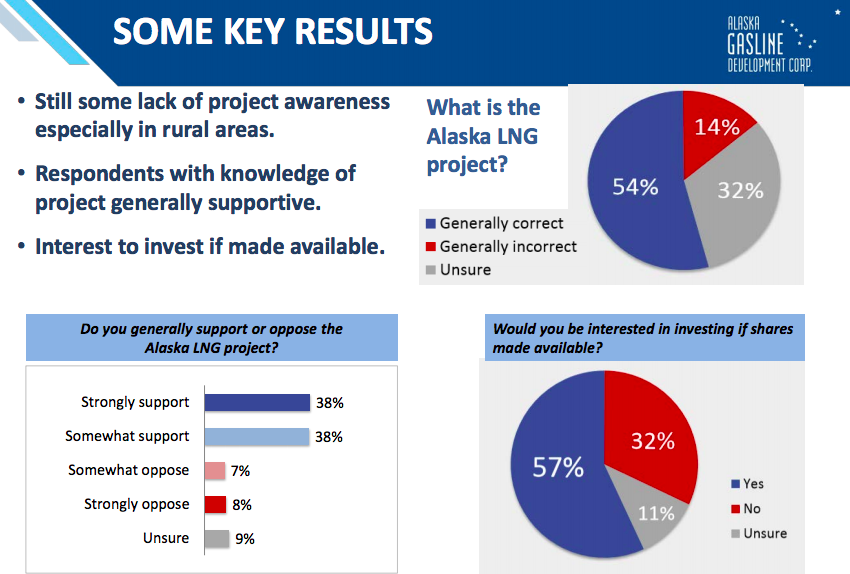
The Alaska Gasline Development Corporation board of directors yesterday learned that the staff of the agency commissioned a poll to determine how the project is faring in the hearts and minds of the voting public. And how to make it fare better in those hearts and minds.

It wasn’t exactly a push poll. The agency is message testing: trying to figure out how to convince the public to have some confidence in the project, and to determine which messages work on Alaskans.

According to the poll, 78 percent of Alaskans would favor the gasline once they are told it will bring jobs, a strong economy, cheaper energy for Alaskans, and will provide cleaner energy in general.

The poll is not being done in a vacuum, but is being used to develop an advertising campaign directed at Alaskans.


POLL IS PARALLEL TO CAMPAIGNING

The ad campaign to shore up support for the gasline will occur during the same cycle as Gov. Bill Walker’s re-election campaign. The gasline is the governor’s signature project that he ran on in 2014, but it has met with strong marketplace headwinds. The world is increasingly awash in natural gas and buyers are no longer engaging in the long-term contracts needed to build the AK-LNG project.

A year ago, a Dittman Research poll of 700 Alaskans showed that 44 percent of Alaskans said a gas line “will never happen,” and 42 percent said they thought the project was “getting closer.” The remaining respondents were undecided.

But public perception of the project’s future has darkened dramatically: Today, according to the most recent Dittman poll, 69 percent of Alaskans believe the gasline isn’t going to happen — at least not in the foreseeable future.


The public is very likely right about the project’s dim outlook. Yet, the AGDC is contemplating an expensive statewide ad campaign to promote the project, the timing for which just happens to coincide neatly with the Walker-Mallott re-election campaign.

Last week, AGDC Board President Dave Cruz scolded members of the Alaska Legislature and the media for expressing skepticism about the project, saying, “The world is watching us. This is not just some little project in Alaska that the world doesn’t know about. And every local news story that is picked up by our industry and world press it places a great challenge on our team when they have to first defend the project against the negative comments before being able to sell it on its merits.”

AGDC spokesperson Rosetta Alcantra in May said that the Senate’s attempts to cut the budget of AGDC and use the funds for public safety and education was unhelpful to the project.

“You know, there’s a lot of positive movement out there and from the perspective of potential customers, I don’t think that helps the message,” she said.

AGDC President Keith Meyer is in Asia, where he has spent much of the year looking for a buyer for Alaska’s gas. He missed the legislative update meeting last week and the AGDC board meeting on Monday.

The agency is burning through $3 million a month in State money.

[Read: ADGC to go it alone on gasline]


Murkowski, Sullivan dine with Trump

2

THE PROTESTORS HAVE INFILTRATED THE MEDIA

Sen. Lisa Murkowski, Sen. Dan Sullivan and other Senate leaders are having their weekly policy luncheon today, and President Donald Trump is attending. Usually Vice President Mike Pence attends.

Before the “Unity” lunch, as it’s billed, Trump and Sen. Bob Corker of Tennessee traded indignities and insults over tax reform, in a battle of words that swamped the news cycle.

The lunch, in the historic Mansfield Room of the Capitol is intended to demonstrate unity on the Republican agenda of tax reform, health care reform, and energy dominance.

A protestor, posing as a journalist, threw papers with the image of the Puerto Rico flag on them at Trump as he arrived at the luncheon with Sen. Majority Leader Mitch McConnell, as seen in this screen shot of a video shot by NBC’s Frank Thorpe V. The protestor was removed in handcuffs by Capitol security.

Trump last attended a Senate Republican lunch in 2016, when he was the party’s nominee for president.