Friday, December 12, 2025
Home Blog Page 1628

Westward focus: Murkowski wins seat on conference committee

2

Senate Majority Leader Mitch McConnell named Sen. Lisa Murkowski as one of the eight Senate Republicans who will serve on the tax reform conference committee, which will work to hammer out differences between the House and Senate versions of the bill. Of the eight, most are from Western States: Orin Hatch of Utah, Mike Enzi of Wyoming, John Cornyn of Texas, and John Thune of South Dakota.

They are are joined on the conference committee by Eastern state senators Rob Portman of Ohio, Tim Scott of South Carolina and Pat Toomey of Pennsylvania.

Earlier this week, Congressman Don Young was named to the House side of the conference committee by Speaker Paul Ryan.

Other Republicans on the conference committee from the House are Devin Nunes of California, Peter Roskam of Illinois, Diane Black of Tennessee, Kristi Noem of South Dakota, Fred Upton of Michigan, John Shimkus of Illinois, Rob Bishop of Utah and House Ways and Means Chairman Rep. Kevin Brady, of Texas, who is the chair of the conference committee.

Only Alaska, Utah, South Dakota and Texas have conference committee members on both sides of the table.

In addition to reducing taxes for Americans at almost all income levels, the bill authorizes oil and gas drilling in the 1002 Area of the Arctic National Wildlife Refuge, a priority for Alaska’s delegation in Washington.

Murkowski shepherded that part of the legislation through her Senate Natural Resources Committee last month. Rep. Young serves on the House Natural Resources Committee and is past chair of the committee. With representation on both sides of the conference committee, Alaska is well positioned to protect the ANWR-opening language in the Senate version.

Breaking: Speaker Edgmon breaks silence on harassment

1

DAMAGE CONTROL

House Speaker Bryce Edgmon issued the following statement on Dec. 6 following allegations of sexual harassment in the Alaska Legislature:

“This is a confidential personnel issue and I am not able to comment on details of the incident or the complaint. The incident illustrates the need for concrete and clear reporting policies and mandatory sexual harassment training for every legislator and staff member,” said House Speaker Bryce Edgmon (D-Dillingham). “Unwanted sexual advances and other forms of harassment are unacceptable and hinder the work of the Alaska Legislature to do the people’s business. Any victim who comes forward must be respected and should know their concerns will be heard, investigated, and addressed with fairness and transparency. Our priority is to ensure a safe and respectful work environment where no one feels threatened. We strongly encourage anyone who has been subjected to sexual harassment, assault, or aggravation in or related to their place of work to come forward. We want them to feel confident that their personnel matters will remain confidential and private, and that the Legislature will listen and follow through.”

Six members of the Alaska House of Representatives and the Alaska State Senate have been appointed to a special subcommittee that will review the legislature’s harassment policies and make recommendations to the joint Alaska Legislative Council before the start of the Second Session of the 30th Alaska State Legislature in January.

In addition to a new policy on sexual and other forms of harassment, the Alaska Legislature is imposing required sexual harassment training for all lawmakers and staff. The training will be conducted by expert trainers with the Alaska Human Rights Commission during the first week of the legislative session that begins on January 16th. The training is mandatory for all members of the House and Senate and their staff.

Edgmon’s statement came following this Must Read Alaska story earlier in the day:

From George Jacko to Dean Westlake

POLICY IS ALREADY ON THE BOOKS

Sending the matter to a subcommittee is a predictable move, as legislators send all their work through committees. But suggesting that the Legislature needs a harassment policy, as mentioned by Edgmon in his statement, is a case of misdirection since there is already a harassment policy on the books.

In fact, Alaska statute covers harassment as a criminal matter:

AS 11.61.120. Harassment in the Second Degree.

(a) A person commits the crime of harassment in the second degree if, with intent to harass or annoy another person, that person

(1) insults, taunts, or challenges another person in a manner likely to provoke an immediate violent response;

(2) telephones another and fails to terminate the connection with intent to impair the ability of that person to place or receive telephone calls;

(3) makes repeated telephone calls at extremely inconvenient hours;

(4) makes an anonymous or obscene telephone call, an obscene electronic communication, or a telephone call or electronic communication that threatens physical injury or sexual contact; or

(5) subjects another person to offensive physical contact.

(6) publishes or distributes electronic or printed photographs, pictures, or films that show the genitals, anus, or female breast of the other person or show that person engaged in a sexual act.

(b) Harassment in the second degree is a class B misdemeanor.

It’s a matter of enforcement of the existing policy, and the actual existing laws on harassment.

Who is the chief enforcer on policy in the House? The Speaker of the House.

The subcommittee needs to determine what Edgmon knew and when he knew it. Will the subcommittee have the courage to bring the House Speaker in for questioning?

CONFIDENTIAL MATTER TO BE HANDLED WITH TRANSPARENCY

Edgmon describes the complaint as confidential, personnel-related, and says it will be “heard, investigated, and addressed with fairness and transparency.” However, the complainant has already gone public with her complaint and is no longer an employee of the Alaska Legislature. It is unclear how it can be handled confidentially and transparently, when the Speaker’s actions and the House Majority Leader’s actions or lack of action are a critical component of the incident.

As the incidents described in the legislative aide’s complaints occurred on city property and on private property in Juneau, the matter should be referred to law enforcement, not just a subcommittee of the Legislature.

From George Jacko to Dean Westlake

6

SPEAKER BRYCE EDGMON IN THE MIDDLE — AND SILENT — AGAIN

Back in 1993, when Sen. George Jacko of Pedro Bay was censured by the Alaska Senate for harassment of female staffers, Bryce Edgmon was Jacko’s up-and-coming legislative aide, and he likely saw it all go down from his front-row seat.

Jacko harassed and allegedly stalked the aide of Sen. Suzanne Little in February of 1993. His world unraveled because he called the Juneau Police Department one night and said he needed police help getting into the hotel room of the aide, because “It has to do with state government … It’s kind of an urgent situation.”

Jacko banged on the door of the hotel room where the woman was living, and the legislator also tried to cajole the clerk into giving him the key. He reeked of alcohol, the clerk later pointed out when authorities opened a case.

The whole incident blew up into a scandal that got ugly with accusations back and forth between lawmakers, and with calls for Jacko’s resignation. There was a censure by the Senate. He eventually apologized, said he thought maybe he had a drinking problem, and disappeared for treatment in Seattle.

Except that particular woman wasn’t the only one. Other women came forward and said he had put undue pressure on them to date him. One turned over notes she had received from Jacko, which showed him offering to change his votes on a bill in exchange for a date. Another said he forcibly entered her house and would not leave. He tried to have a sexual relationship with a 17-year-old page, the Senate Ethics Committee found.

Jacko was married with three children.

His legislative career ended in 1994. But his aide, young Bryce Edgmon of Dillingham, filed quickly for Jacko’s seat, and although he lost that election, he eventually won a place in the House of Representatives in 2006, and he rose through the ranks by caucusing with Republicans until this year, when he rolled his colleagues and became Speaker of a Democrat-controlled body.

A woman named Olivia tells fellow Democrats last week that Rep. Dean Westlake sexually harassed her, grabbed her butt, and that nothing was done about it by legislative leaders whom she told in March, 2017.


FAST FORWARD TO BAD-BOY II

In March of 2017, an aide to Rep. Scott Kawasaki of Fairbanks wrote a letter to now-Speaker Edgmon and Majority Leader Chris Tuck, telling them of specific instances where Rep. Dean Westlake of Kotzebue had been harassing or sexually aggressive. The letter was released originally by KTVA news:

Dear Speaker Edgmon and Representative Tuck,

I am writing to address two separate instances of unwelcome physical contact from Representative Westlake, both of which happened at work-related functions.

The first occurred on January 16th at the Juneau-Douglas City Museum. While walking through a narrow hallway towards the back of the building, I walked by Rep. Westlake. He grabbed me and made a comment about my hair, saying that it “turned him on”. This incident was obviously unexpected and sudden, so I kept walking before I could think of a response.

The second happened this Saturday, March 11th, at the downtown art studio Canvas. We were in a dark, crowded room and I didn’t see him until he was right next to me. He grabbed my butt as he walked by. I pushed his shoulder, but not with enough force for him to move or probably even notice since he kept moving. A nearby staffer saw the incident.

I did not expect a second incident because I thought I had made it clear that I wouldn’t welcome it again. Although I hope that nothing similar does happen again, I want to be very clear that this kind of conduct is unwelcome. Hopefully Rep. Westlake and I can both move forward in a professional manner.

I am making both of you aware so that you can share this with Rep. Westlake privately so no one is embarrassed or damaged.

Let me know if you have further questions.

Thank you for your time.

Olivia 

THE SILENT TREATMENT

In March, Speaker Edgmon took no action on the complaint, and neither did he take action in the following months. Finally, the matter was aired in public last week during a meeting of disgruntled Democrats who gathered in an Anchorage IBEW hall. The whole story was spilled.

The complainant, Olivia, said the party knew Westlake was a harasser when it put the full force of its campaign efforts into his candidacy against another Democrat, Ben Nageak of Barrow.

They knew because locals from District 40 had told them he was a bad egg, but the party was desperate to replace Nageak, who had caucused with the Republicans. Westlake was their best bet and they hired John-Henry Heckendorn to run the campaign. He is now the governor’s campaign manager and constant shadow, on staff in the Office of the Governor.

DEAN WESTLAKE, FROM HIS CAMPAIGN WEB SITE

WESTLAKE, EDGMON VOTED TO CENSURE REP. EASTMAN

During floor debates in May of 2017 over whether to censure a fellow lawmaker, David Eastman of Wasilla, Rep. Westlake joined others in condemning Eastman for saying that rural women used pregnancies to get a free trip to the city for abortions.

“It’s not about parties. It’s about your values. Is this the kind of representation the people of Alaska deserve? It’s not a minority thing. It’s not a majority thing. It’s a standards thing for the representatives of the state of Alaska.” – Rep. Dean Westlake, condemning Rep. David Eastman, May, 2017.

His fellow Democrat Rep. Ivy Spohnholz, who led the charge to censure Eastman, piled on:

“The time for tolerating and allowing racism and sexism to continue in our state is past. … If we don’t do something, that is tacit approval,” – Rep. Ivy Spohnholz, speaking about Rep. David Eastman, May, 2017

Speaker Edgmon also chimed in about Eastman’s statement, saying, “We gave Representative Eastman many opportunities to apologize and reconsider his conduct. Unfortunately he chose to repeat his unfounded claims, which have no basis in truth and malign the motives of some of our most vulnerable citizens. Regardless of your position on abortion, all Alaskans deserve our compassion and respect. Representative Eastman’s statements on the floor of the House and in interviews with the press have shown a blatant disregard for the truth. Today’s action to censure Representative Eastman sends a strong message that such offensive, insulting, and false statements are unacceptable for a sitting lawmaker.”

“It’s incumbent upon the Legislature to set the bar. This is the 21st century. We don’t make statements like that any more.” – House Speaker Bryce Edgmon, condemning Rep. David Eastman, May, 2017

But with specific allegations of harassment against Rep. Westlake surfacing in March and again in December, the Democrat-led House Majority leadership, with Edgmon setting the standard, has remained silent — for nine months and counting.  We are wondering what became of that “bar” that Speaker Edgmon mentioned last May.

State Government 101: A review of Executive branch

1

STUDY HALL IS OPEN AT CHANCE U. 

By ART CHANCE
SENIOR CONTRIBUTOR

There are three branches of State government: Executive, Legislative, and Judicial. For this discussion we will focus on the Executive Branch, but pay some attention to the authorities the other two branches have over the Executive branch.

The judicial branch, in addition to its criminal justice role, has the power to determine whether an action by the other two branches is in compliance with the regulations, statutes, and the Constitution.

Suits against the executive or legislative branches go to one of the four superior courts in the state and can be appealed to the Alaska Supreme Court.

Criminal matters go to either a district or superior court depending on the nature of the alleged crime and may be appealed to the court of appeals. Criminal appeals to the Alaska Supreme Court are at the discretion of the supreme court.

The Founders intended that Alaska would have a small, part-time legislature that could enact taxes and make appropriations and enact statutes to be carried out by the executive branch.

All appropriations must originate in the 40-member House of Representatives. The 20-member Senate must concur. Both bodies can pass most legislation with a simple majority vote.

A veto override and tapping the Constitutional Budget Reserve requires a three quarters vote.

If you’re interested in legislation, the important numbers are 21 and II, the votes required to pass legislation and 27 and 14, the votes required to override a veto or tap the Constitutional Budget Reserve, and if you need that six extra votes in the House and three extra votes in the Senate to get to the CBR, each vote will cost millions of dollars.

Because of the limited role of the Legislature in day-to-day governance, Alaska has a very powerful governor. The Office of the Governor is one of the few places in State government that has a view of and authority over all of the Executive Branch and has some authority over quasi-governmental organizations, corporations, and other State agencies not subordinate to one of the 14 statutorily established State departments.

The Office of the Governor includes the Office of Management and Budget (OMB), the keepers of the purse, and Boards and Commissions, the dispensary of patronage.

In addition to the governor, the Office of the Governor has a chief of staff and in some administrations a deputy chief of staff or two, several special assistants to the governor who are assigned various departments or subject matter areas, a director of Boards and Commissions and his/her support staff, the director of OMB and his/her support staff, and an administrative support staff for the Office of the Governor, as well as security staff.

The governor is statutorily the appointing authority for all employees of the Executive branch, though outside the office, that authority is largely delegated, which is not to say the governor doesn’t have say over who gets appointed.

For quasi-governmentals and other agencies that have an appointed board, the board is the appointing authority. All employees of the Office of the Governor are exempt from the State Personnel Act, the State Pay Plan, and most other legislation and regulation concerning State employees.

Likewise, employees of quasi-governmentals and other agencies outside the statutory departments are exempt from these rules and laws. As a general matter employees exempt from the State Personnel Act serve at the pleasure of the governor or the head of the agency and may be paid whatever they can get. They can be fired for any reason, no reason, but not for an illegal reason. That said, the courts have arrogated to themselves some power over Executive branch dismissals and there have been some successful wrongful discharge suits by exempt and partially exempt employees (and yes I know I haven’t really defined those terms, but I’ll get to it).

Better people than I can be the judge of how much the courts were motivated by politics in some of the wrongful discharge claims.

The Executive branch is organized into 14 statutorily established departments. The executive head of each department is the commissioner, who is appointed by the governor and subject to confirmation by the Legislature. If s/he wants to be, these are very powerful people.  Most prefer to bask in the glory but some try to do something; some even have a clue what they’re doing, but the only qualification for being a commissioner is being friends with the governor and being able to get 21 and 11 to vote to confirm you. That isn’t hard; only one nominee for commissioner has ever been rejected since Statehood.

I’ve worked for a couple of truly competent commissioners and a couple who were smart enough to know what they didn’t know and were secure enough to let the directors and other subject matter experts do their jobs; the rest were wastes of oxygen. Commissioners have a deputy commissioner, who, like the commissioner, have only the qualification of being friends with the governor.

Depending on the size of the department and the administration, a commissioner can have one or two special assistants, again a political appointment that is essentially a patronage hire. Technically a special assistant is in the partially exempt service of State employment and is supposed to have some minimum qualification for the job, but a qualification other than friend of the commissioner is the exception, not the rule.

So, let me define those terms I’ve been throwing around:

The Constitution requires a “merit system of employment,” and the merit system employees are called the Classified Service.

The Division of Personnel has to publish a classification plan for all the jobs in State government and it arranges those job classifications into salary ranges.

Job classifications set out the duties and qualifications expected of a particular position and assigns a wage/salary range to that classification. Theoretically appointment to a classified position is based solely on the merit of the applicant, with some allowance for affirmative action and veterans’ preference. That is more or less true at the entry level but above the entry level, getting in the right bed or knowing the right people goes a long way.

All classified employees of the Executive Branch are unionized except for the four employees of the Alaska Labor Relations Agency.  I won the case before the Alaska Labor Relations Agency that held that job classification was outside the scope of things unions could bargain and the Supreme Court upheld the decision, so while I can’t say the unions can’t play in the job classification game, they can’t if the administration doesn’t want to let them.

Next is the partially exempt service: These are division directors, assistant attorneys general, special assistants and the like — true political appointees. Alaska’s Founders wanted to have an ever so modern and progressive government, so they wanted to make sure the policy making level of State government had some semblance of qualification for their job. Partially exempt employees theoretically have to have a job classification and a job description, and have to meet minimum qualifications for their job; some do, most don’t. Friends of the commissioner or governor work to get these jobs.

The big distinction between partially exempt and classified jobs is if you get dismissed from a partially exempt job, you have no administrative appeal of your dismissal. If you have the money, time, and don’t care to ever work for the State again, you can sue; you might even win if you get fired by a Republican governor and get a Democrat judge.

And finally, there are the exempt service employees.  This is a cohort of State employees to whom employment rules and laws do not apply.

The theoretical basis for the exempt service is that there are certain jobs that are either within the governor’s discretion or which cannot be recruited by normal merit system methods or because of their unique qualification cannot be recruited and paid on the States statutory State Pay Plan or under a union contract.

I knew and liked the late Dan Fauske and I like Dianne Behrends and, sorta’ like Craig Campbell, but I’ll guaran – damn – tee you that I could hire somebody who could have done their job as well as they do for a director or certainly a commissioner’s salary. Out in the quasi-governmentals, the executive head keeps the board of directors happy with travel and perks, and the board pays the executive head hundreds of thousands of dollars a years.

And then there is the worst abuse of the exempt service, the AS 39.25.110(9) temporary exempt.
This is supposed to be someone with special expertise who is engaged in a “temporary and special inquiry” into some issue on behalf of the governor.

It was intended to be a way for governors to hire “dollar a year” people to look into something for the governor. Today it is a way for people with friends in high places to get their friend or bedmate into a $100K job without regard to their qualifications or the need to have the job done.

I raised Hell with the Division of Personnel about 110(9) exempts when I was doing some work on retirement entitlements for the Correctional Officers’ Union.  The DOP’s response was to stop documenting the statutory authorization for exempt appointments so they could answer a Public Records Act request by saying “no such record exists.”

Next time, we’ll get into some of the really ugly stuff.

Art Chance is a retired Director of Labor Relations for the State of Alaska, formerly of Juneau and now living in Anchorage. He is the author of the book, “Red on Blue, Establishing a Republican Governance,” available at Amazon. He only writes for Must Read Alaska when he’s banned from posting on Facebook. Chance coined the phrase “hermaphrodite Administration” to describe a governor who is simultaneously a Republican and a Democrat. This was a grave insult to hermaphrodites, but he has not apologized.

 

New Anchorage airport manager runs silkscreen factory?

Chicagoan James Sczcesniak is said to be Gov. Bill Walker’s choice for manager of the Ted Stevens International Airport, the third busiest cargo airport in the world.

Sczcesniak is the chief operating officer for Windy City Silkscreening, where he manages a silkscreen and embroidery business that provides products for the automobile industry. He’s worked there since 2008 and it appears to be a family company. Marybeth Sczcesniak is the chief executive officer.

Before that, he was at O’Hare and Midway International Airports, a subdivision of the City of Chicago, where he rose through the ranks from running the snowplow operation to becoming deputy commissioner of aviation planning, policy environment, real estate and commercial development, a senior-level management job he held from 2006-2008.

The Anchorage airport job is at the state’s pay grade of 25. If someone is exceptionally qualified, he could get step or two in additional salary, but likely Sczcesniak would be in the $110,000 to $115,000 range. The governor has found it difficult to attract candidates because most airport management jobs pay significantly more, as they are run by port authorities, rather than being state jobs.


In his most recent aviation job, which was nearly 10 years ago, Sczcesniak’s resume says he conceived and implemented “projects and policies that are critical to the airport system’s future growth. Spearheaded the planning, environmental approval, bid process, and lease development for a $200M, 920,000 Sq. Ft. air cargo complex on O’Hare’s former military base. This project is projected to provide the airport with over $400M in rent revenue over the life of the lease, produce 1,200 construction jobs, 1,200 permanent on-site and 10,000 regional jobs. The project achieved LEED Silver certification.”

He was also responsible for O’Hare’s $4.1 billion, 20-year capital improvement plan.

For the two years prior to that, he was director of aviation planning at O’Hare and Midway International Airports.


He has an MBA from University of Chicago Booth School of Business and a BS in Aviation Management from Southern Illinois University at Carbondale. He also earned certificates as a professional pilot and in aviation maintenance.

The most recent Ted Stevens International Airport manager, John Parrott, had been in charge of airport operations for 10 years, but was dismissed in early October by Gov. Walker through his Commissioner of Transportation Marc Luiken and Deputy Commissioner John Binder.

Binder has been filling in as interim airport manager since mid-October.

Walker gave no reason for firing Parrott other than to say through his deputy press secretary that he wanted to go in a different direction, continuing the “progression of his administration.”

The job is a politically sensitive one, and the next governor could appoint his own choice. That would indicate that Sczcesniak may want to keep one foot firmly planted back in the family embroidery and silkscreen business.

The governor’s choice has not yet been reviewed by the state Airport Advisory Board, which by statute is supposed to sign off on any airport manager hires.

Quote of the day: Official public radio opinion?

7

ABANDONING THE ‘UNBIASED’ MYTH, ONE TWEET AT A TIME

“It is insulting that as the most massive transfer of wealth in decades is happening through scribbled notes in the dark of a Friday night this is what @lisamurkowski’s public affairs account is tweets out.”  – Alaska Public Media radio reporter Zachariah Hughes to the world of Twitter on Dec. 1, criticizing Sen. Lisa Murkowski because she had sent a Twitter message celebrating an agreement that prevents unregulated high seas fisheries in the central Arctic Ocean.

To be fair to the senator, Murkowski also sent these Twitter messages on Dec. 1:

“Today marks World AIDS Day – a day to honor and remember all of those who have lost their lives fighting this terrible disease. Over 1 million people die every year from AIDS related causes; I look forward to a day when that number is zero.

And this…

“Tonight I cast my in favor of the Tax Cuts and Jobs Act, comprehensive tax reform that aims to encourage the economic growth needed create jobs and generate wealth, while reducing taxes.

Hughes picked up on just the one, however, for a left hook:

It was not the first time in a week that he’d found fault with the senator over the tax reform package. On Nov. 30, he argued with her about who would get the most benefit, rich or poor:

And a day earlier, Hughes brought sarcasm to bear in making fun of the senator over her stance on opening up the Arctic National Wildlife Refuge at any cost (tl;dr means “too long, didn’t read.”):

In his defense, Hughes’ beat doesn’t cover the Senate routinely, and he generally keeps his bias in check on the city and state issues he does cover. Whether his opinions and observations on national tax policy and Sen. Lisa Murkowski will hurt his credibility with public radio listeners is doubtful, as the “likes” and “retweet” record reflects broad support from his followers on Twitter.

Southern Poverty Law Center targets Alaska Family Council

4

SPLC POURS ON HATE IN THE NAME OF GENDER-NEUTRAL BATHROOMS

The Southern Poverty Law Center has singled out the Alaska Family Council for special condemnation in an accusatory screed published this week, describing the history of an initiative that will appear in April on the Anchorage municipal election ballot.

Protect Our Privacy initiative would allow businesses, nonprofits and churches to keep men’s and women’s bathrooms, changing rooms, and bathing facilities separate. If the businesses so choose, and as they have always done.

The Protect Our Privacy initiative would require municipally owned facilities like the Loussac Library to segregate their bathrooms based on biological sex as determined at birth, so that people using the facilities have a right to physical privacy that includes the right to not be seen in various states of undress by members of the opposite sex.

Voters will decide this matter in Anchorage on April 3, 2018, and the battle of ideas has begun with a particularly ugly salvo by the Southern Poverty Law Center.

The Alaska Family Council’s explanation of the initiative can be found here.

The SPLC story on Alaska Family Council’s efforts can be found here.

In the opinion, the SPLC calls the council an extreme right-wing group that has partnered with the Alliance Defending Freedom, a group that the SPLC lists as a hate group.

Jim Minnery, the head of Alaska Family Council, was not aware that the Southern Poverty Law Center had singled him out, but he wasn’t surprised. He’s been targeted by hateful rhetoric before because he defends religious liberty.

THE ‘HATE GROUP’ IS AT THE SUPREME COURT TODAY

The SPLC’s story was published one day before the SPLC-labeled hate group Alliance Defending Freedom is appearing in front of the U.S. Supreme Court.

The case began today, and ADF is defending the right of a Colorado baker to refuse to bake wedding cakes for gay weddings, because he is a traditionalist Christian who believes marriage is between men and women.

Alliance Defending Freedom attorney Kristen Waggoner is representing cake artist Jack Phillips and is asking the judges to uphold Phillips’ artistic freedom. Evidently in these times artistic freedom is easier to defend than religious freedom.

[Read Amy Howe’s account of the Supreme Court hearing today]

Five years ago, Phillips turned down an offer to design a wedding cake for a same-sex couple. The couple sued. He offered to sell them anything else in his store, Masterpiece Cakeshop, and even to create a cake for them for a different event.

Phillips said his faith is primary in his life. He became a Christian later in life, but there’s been no going back for him.

Justice Anthony Kennedy, the Supreme Court’s most gay-rights-sympathetic judge, said, “Tolerance is essential in a free society. Tolerance is most meaningful when it’s mutual. It seems to me the state [of Colorado] in its position has been neither tolerant nor respectful of Mr. Phillips’ religious beliefs.”

LICENSE TO KILL?

SPLC has targeted other conservative groups as “hate groups,” and the group’s list has served as a dog whistle for leftists to go after the groups named and create fear and terror among those who disagree with the SPLC.

In 2012, Floyd Lee Corkins, a 28-year-old gay rights volunteer walked into the Washington headquarters of the Family Research Council with a 9-millimeter handgun and a bag with 15 Chick-fil-A sandwiches. He planned to shoot everyone in range and stuff the sandwiches in their dead mouths, but a security guard was able to stop him. Later, Corkins said he had gotten the “hate group” map from the Southern Poverty Law Center’s web site and found FRC on the list.

SPLC says that groups like Family Research Council and Alliance Defending Freedom use “incendiary name-calling and demonizing lies” that define “hate” groups — just like the Ku Klux Klan and Aryan Nation groups.

But the story posted on the Southern Poverty Law Center’s website is arguably incendiary, enough so that a reasonable person might ask, “Has the Southern Poverty Law Center become a hate group? Is SPLC inciting violence with name-calling and by demonizing conservative Christians? And how long will it be before it puts Alaska Family Council in the crosshairs for extremists by adding AFC to its list of hate groups?”

[Editor’s note: Alaska Family Council is an advertiser on Must Read Alaska but had no input into this story other than MRAK asking Jim Minnery if he was aware of the Southern Poverty Law Center’s story.]

Breaking: Conyers resignation, Don Young now the Dean of the House

2

Congressman Don Young became Dean of the U.S. House of Representatives today, upon the announced resignation of Rep. John Conyers, D-Michigan, who had been the longest serving member.

Conyers had been pressured to resign for harassing women, including former staff aides. Conyers told a Detroit radio station that he “retiring today,” and is endorsing his son, John Conyers III, for his seat. Conyers was the first African-American Dean of the House, but only held the position for two years. Before him, it was Democrat John Dingell, also of Michigan.

The Dean of the House is largely honorary, and the primary duty is swearing the Speaker of the House.

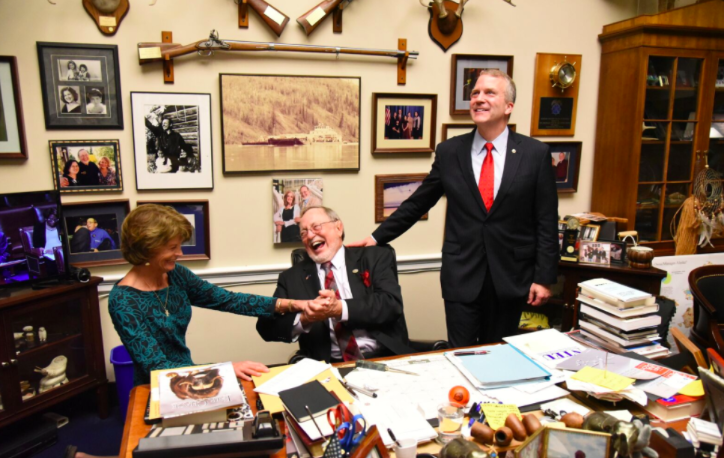
Seniority often has other privileges, such as desirable office space and membership on important committees. But it’s hard to imagine Young giving up his current office, which is filled with Alaskana, memorabilia, and mounted heads of animal. His is the most iconic of any of the offices in the Rayburn Office Building.

Democrats have held the post for generations. The last Republican to be Dean of the House was Gilbert N. Haugen of Iowa, who left office in 1933.

It has been a big week for Rep. Young. On Monday, he was named to the powerful conference committee that will iron out the details on the tax reform bill that includes provisions for opening the Arctic National Wildlife Refuge for oil and gas.

That story is here.

By 6:20 a.m. Alaska time, the Wikipedia entry on Dean of the House was already updated with Young’s name added to the list of Deans of the House throughout history.

Young issued the following statement:

“I have worked with Rep. Conyers on a wide variety of issues over the years and his service to the state of Michigan and this country will always be remembered. I wish him all the best. The Dean of the House is a respected position which carries a responsibility to uphold the traditions and institutional knowledge of this body. My time in the House has been marked by my work on behalf of Alaskans, lifelong friendships with my colleagues and my commitment to serve this nation. I am incredibly blessed to have the opportunity to step into this time honored role and I look forward to continuing to serve this body and the people of Alaska.”

To defend ANWR vote, Don Young chosen for conference committee

0

Every election cycle in recent years, Congressman Don Young’s opponents say he’s run out of political clout. They just keep saying it, but evidently that’s not the case.

Young was just chosen as one of nine House members to serve on the conference committee for the tax reform package that has passed both House and Senate in somewhat different forms. Conference committee is where the differences are ironed out in private meetings between chosen representatives from the House and Senate.

Alaska has a huge dog in the fight, with the provision in the tax bill that contains the authority to open the Arctic National Wildlife Refuge 1002 Area of the coastal plain to oil and gas development.

House Speaker Paul Ryan made the appointment and it was affirmed by the House on a vote of 222-192.

“This has always been a team effort, one that required our delegation to fire on all cylinders at each and every turn. Now that we head to a Conference Committee – the group responsible for negotiating a pathway to the president’s desk – I will do everything in my power to ensure this important moment to unlock ANWR’s energy resources does not pass us by,” Young said.

“It’s been over 40 years since this battle began – a generation’s long battle that is finally coming to a head. I thank Speaker Ryan and the House Leadership for recognizing my role in this important debate and for entrusting me to be part of the effort to craft an agreement that will positively improve the lives of Alaskans and Americans for generations to come. I commend the work of both Senator Murkowski and Senator Sullivan, the dedicated staff on the Energy Natural Resources Committee, and the countless Alaskans who have stood by our side to make this a reality. It’s a remarkable place to be, especially given the dire straits we were in as an energy producing state only two years ago.

“There is still a long way to go in our unified effort to unleash Alaska’s true energy potential, but I am committed to getting this across the finish line. ” – Congressman Don Young

Speaker Ryan named Republican Reps. Kevin Brady of Texas, Devin Nunes of California, Peter Roskam of Illinois, Diane Black of Tennessee, Kristi Noem of South Dakota, Rob Bishop of Utah, Don Young of Alaska, Greg Walden of Oregon, and John Shimkus of Illinois.
House Minority Leader Nancy Pelosi named Democrat Reps. Richard Neal of Massachusetts, Sander Levin of Michigan, Lloyd Doggett of Texas, Raúl Grijalva of Arizona, and Kathy Castor of Florida.
In addition to defending the long-sought ANWR authority, the Republicans will be hammering out differences that include the Senate’s repeal of the individual mandate in Obamacare, forcing Americans to purchase health insurance or pay a penalty to the IRS. The House bill does not include the repeal. The Senate bill preserved the alternative minimum tax, which was repealed by the House. The House made tax cuts for individuals permanent, while the Senate have a sunset date.

Rep. Young is the longest serving Republican in the House. In 1973, his first year in office, he also served on the conference committee that negotiated the final terms of the Trans Alaska Pipeline Act. He has attempted to pass ANWR legislation 12 times over the course of his 23 two-year terms.