Thursday, December 25, 2025
Home Blog Page 1479

Transcript: Fields says he was asking about homosexuality

WANTED TO KNOW IF COMMISSIONER WOULD DISCRIMINATE

Here is the exact transcript of the testimony of Commissioner Designee Kelly Tshibaka, Dept. of Administration, on March 5, 2019, at 3:44 pm in the House Senate Affairs Committee:

“In preparing for these confirmation hearings, I’ve had the opportunity to meet with members of the committees ahead of time. And these meetings have given me the chance to learn about issues of interest to the members, and answer questions on a wide range of topics.

The majority of these meetings have been enjoyable and productive; however, in my meeting with Chairman Fields, he asked me questions related to my religious beliefs, like how I would express my Christian faith at work, how my Christian faith would affect my implementation of laws and policies, and if I would separate my faith-life from my work-life.

He told me to be prepared to answer these questions at the hearing today. So, I want to take a few moments to address these issues openly and publicly.

[Read: The education of Zack Fields: Religious discrimination 101]

I have a strong and established 16-year federal career of cultivating diverse teams, and of faithfully implementing federal laws, regulations and policies. I would not have been entrusted with multiple senior level positions, nor maintained my top-secret SCI security clearance, if I’d engaged in religious expression that was inappropriate, if I’d forced my religious beliefs on others, or if I’d contravened laws and policies with which I disagree.

As further testament to my leadership, the committees have received several letters of endorsement from inspectors general who’ve supervised me throughout my career, as well as from some of my direct reports, many of whom do not share my religious views.
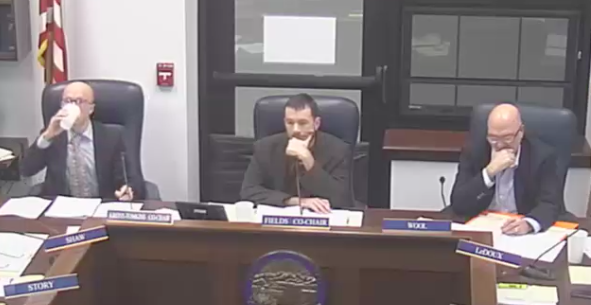
Rep. Jonathan Kreiss-Tomkins sips coffee, while Reps. Zack Fields and Adam Wool stroke their beards during Commissioner Tshibaka’s recitation of the Constitutional protections of her religious beliefs.

You’ve received letters from the former Inspector General from the Department of Justice, the former Inspector General of the Federal Trade Commission, the Inspector General of the U.S. Postal Service, and the Inspector General of the Department of Labor, all of whom have endorsed my nomination, and none of whom would have done so if I was a leader who used my position or authority to violate other people’s civil rights. In short, throughout my professional career, I have lived out my faith and values in a manner that is true to myself, respectful of others, and consistent with the law.

[Watch Kelly Tshibaka’s testimony on akleg.tv starting at minute 42.10]

In my last two confirmations hearings before the Senate, I was asked if I would have the courage to speak up if I believed that our state leaders were heading in the wrong direction. I said I would. And today, I am. This is one of those times.

The questions I’ve been asked about my faith are unconstitutional lines of inquiry that violate my civil liberties.

Religious liberty is enshrined in the text of our United States Constitution.

The First Amendment protects freedom of religious expression. And Article VI of the Constitution provides that no religious test shall ever be required as a qualification to any office or public trust under the United States. The United States Supreme Court has explicitly warned against the danger of presuming that a person’s faith might present a danger in the context of holding public office. In McDaniel v. Paty, Justices Brennan and Marshall wrote that the American experience provides no persuasive support for the fear that clergymen in public office will be less careful of anti-establishment interests or less faithful to their oaths of public office than their un-ordained counterparts.

Article I Section III of our own Alaska State Constitution also provides that no person is to be denied the enjoyment of any civil or political right because of creed. Furthermore, the questions I’ve been asked violate the spirit of Alaska Statute 18.80.200 and 18.80.210 which explicitly prohibit discrimination on the basis of religion, including religious discrimination in employment. Those laws say that this Legislature has declared it a legislative finding that discrimination against an inhabitant of the state because of religion is a matter of public concern, and not only threatens the rights and privileges of the inhabitant of the state, but also threatens the peace, order, health, safety and general welfare of the state and its inhabitants.

Finally, I’d like to direct your attention to guidelines President Bill Clinton issued on August 17, 1997 relating to religious expression in the federal workplace. These guidelines have the force of an executive order, and they’ve been affirmed by every presidential administration since then, including President Barack Obama. The guidelines state that a supervisor is free to engage in religious expression, when it is understood as the personal view of the supervisor and not perceived as coercion of religious or nonreligious behavior.

For example, a supervisor can invite co-workers to church events, talk about religion, and hold or attend a bible study during lunch. He or she cannot, however, order co-workers to attend a religious service, or a coerced agreement with their views. I’d like to submit for the legislative record both President Clinton’s guidelines and a recent legal memorandum that was issued by the Department of Justice on October 6, 2017 regarding federal law protections for religious liberty. I trust that these will be helpful and informative.

My rights, under both our federal and state constitutions, were violated during my pre-hearing meeting with Chairman Fields.

While I harbor absolutely no ill-will against the chairman, my hope is that I am the last nominee before the Legislature to be subjected to such unconstitutional lines of inquiry. All employees of Alaska – from supervisors to staff, from commissioners to interns – have a protected freedom to express their religion or nonreligion. Alaskans’ rights of free exercise are not limited to their doors of their churches, their synagogues, their mosques, or their temples. They carry those rights with them wherever they go, and wherever they are, including in the halls of our state legislature or at their desks at the State of Alaska agencies. Their rights of free exercise of religion have to be honored and protected and observed.

I have found that the greatest diversity in the workforce is created when people are fully free to be their true selves. And it’s in the richness of that diversity that trust is formed, and community is fostered, and unity is forged. It’s along those lines that some Democratic legislators have asked if I will discriminate against people on the basis of their sexual orientation.

So let me be absolutely clear: I will not engage in such discrimination, nor have I ever engaged in such discrimination. I have a long career as a senior leader in the federal government, in which I’ve consistently celebrated, embraced and respected diversity. I will continue to live by that standard as the Commissioner of the Department of Administration…”

Chairman Zack Fields, D-Anchorage: Thanks Ms. Tshibaka. I think before going to other committee members, since I’ve been the subject of part of that statement, I’ll start off.

I did ask the commissioner about her views on homosexuality and her ability to be a manager of a diverse workforce. And I actually thought your answer was entirely appropriate and I appreciated it. I was simply looking for you to repeat it on the record to reassure people. I certainly did not apply a religious test or intend to apply a religious test. I respect that there’s a wide variety of people who are in our workforce. I guess I am just disappointed that you’ve made that accusation because that was not my intent, nor is that what I did. With that I think I’ll go to other committee members’ questions.
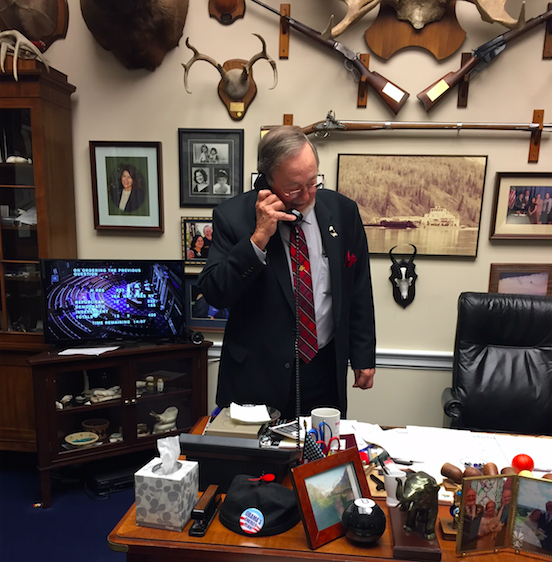

It’s official: Don Young is longest serving Republican in Congress

2

SETS RECORD FOR BOTH SENATE AND HOUSE

Congressman Don Young is officially the longest-serving Republican House or Senate member in history.

Before Tuesday, that title went to former Speaker Joe Cannon, who retired in 1923 after serving 16,800 days. Young is serving his 24th term, since 1973.

As the oldest current member of the U.S. House of Representatives, he became the Dean of the House on Dec. 5, 2017, and he works with 75 House members who were not even born when Young first came to Washington. Young is the last remaining member of Congress who has been in office since the Nixon Administration.

A veteran of the U.S. Army, he moved to Alaska in 1959, around the time of statehood. He settled in Fort Yukon, where he worked in construction, fishing, trapping, and mining. He captained a tugboat on the Yukon River, hauling barges delivering products along the river. He still holds his mariner’s license. In the winter, he taught fifth grade at the local Bureau of Indian Affairs school.

In 1972, he lost his race for the House of Representatives to the incumbent, Rep. Nick Begich. Begich disappeared in a plane crash on Oct. 16, 1972, but won the election anyway. He was declared dead on Dec. 29, 1972, and Young ran in a special election on March 6, 1972, and won against Democrat Emil Notti. He’s won every election since.

Young is the longest serving Republican in both the House and the Senate because the late Sen. Strom Thurmond of South Carolina changed parties in the 1960s from Democrat to Republican.

The education of Zack Fields: Religious discrimination 101

COMMISSIONER OF ADMIN. TAKES COCKY REP. TO SCHOOL ON CONSTITUTION

House State Affairs Committee on Tuesday afternoon took up the confirmation of Commissioner of Administration Designee Kelly Tshibaka. And what seems like it would be the most prosaic of interviews quickly became drama-filled.

The commissioner sat before committee members and faced Committee Co-Chair Rep. Zack Fields, who had already told her to be ready for his questions about her religion.

Tshibaka is a Christian. But this wasn’t her first rodeo. She was ready. After all, not only had Zack Fields asked her about her religious beliefs during private conversations, when she had introduced herself to him during official rounds, other members of the Democratic caucus had also raised concerns about her Christianity.

[Read the full transcript and watch the hearing here.]

Tshibaka started her testimony with her opening statement, telling the committee that she was born and raised in Alaska on moose tongue sandwiches. She is a graduate of Steller Secondary School in Anchorage, and learned the love of numbers and accuracy from her mother, who was an auditor for ConocoPhillips. Her dad was an IBEW electrician, and she learned the importance of teamwork from him, and from him she also learned about standing up for herself when necessary.

She went through her extensive resume: Harvard Law School graduate. Former chief data officer for the United States Postal Service Office of the Inspector General. U.S. Department of Justice counsel. Counsel and chief investigator for the Office of Inspector General.

And then she touched on a subject that made Rep. Fields horrified: She outed him for having questioned her in private about her religious beliefs. Fields, as a former operative for the Alaska Democratic Party, is used to dishing it out, but not used to taking it.

Tshibaka told the committee how incredible it was that this had happened to her when she had spoken to Fields earlier, and how it was unconstitutional and that her religious rights as a citizen working in government had been upheld by many a Supreme Court case.

Fields was visibly shocked. His lip quivered and he denied that he had asked her about her religion, but only wanted to know if she would discriminate against those who were not Christian.

It’s not the kind of question he would have asked a Jew or a Muslim. This is the kind of discrimination that is reserved for Christians, at least in his circle of friends.

In 2015, Tshibaka was appointed chief data officer at the U.S. Postal Service Office of Inspector General, where data analytics has resulted in more than $920 million in financial impact or audit findings in 2016.

Before that she served as the Acting Inspector General of the Federal Trade Commission and in the Office of the Director for National Intelligence, where she conducted civil liberties and privacy oversight and was counsel to the Inspector General. Earlier, she was special assistant to the Department of Justice Inspector General, conducting sensitive investigations; overseeing audits, investigations, and inspections; and assisting in managing employees nationwide.

At the Postal Service, she tracked down fraud, waste, and abuse. Her data analytics team helped auditors recover $121 million in fines and restitution for fraudulent billings to the Postal Service, and avoid making more than $110 million in payments on improper billings.

Tshibaka was tapped to round out the governor’s core team of policy advisors – focusing primarily on areas of management, audit and government efficiency.

But, in spite of her remarkable resume, all that Rep. Fields wanted to know about was: Will she be able to set her religious beliefs aside when performing her duties for the State of Alaska.

In the end, Fields tabled her confirmation interview and did not allow her name to be forwarded out of committee.

Anchorage school board removes social promotion policy

4

The Anchorage School Board on Monday night revised the district’s social promotion policy, which has been in place for the last 20 years.

Now, the policy will be more neutral, acknowledging that every child is different and the school principals and parents should discuss whether holding a child back a grade is in the best interest of the child. The pushing children into the next grade policy is no more.

Last year, among the 3,552 third graders, only five were held back from going on to fourth grade, School Board member Dave Donley told the board. Considering the proficiencies of students, that seems like a low number.

But it is in line with the district’s written preference that students should be moved to the next grade with their classmates; it’s a one-size-fits-all policy and Donley said it’s time to think differently.

[Read the board document here]

Several parents, educators, and interested citizens testified in favor of the change. Retired educator Judy Eledge said she favored the proposal, but only if students who are held back have a plan in place for helping them catch up.

Testifying against changing the policy was the head of the Anchorage teachers union, who called it a “test and punish regime, jamming curriculum down their throat.” Kids don’t have time to play or even eat, union head Tom Klaameyer said. “We take kids where they are and … we nurture them and allow them to go from there. They do catch up.”

Board members debated it for about an hour, with Board member Mark Foster offering some of the most harsh critique of the change:

“I’ll be voting against this destructive policy. It’s not neutral. Look at weight of the evidence — it’s strongly against grade retention at the third grade because it falls disproportionately on uneducated single mothers,” he said. “Delaying an early start is a stronger policy. There’s much stronger research, better results, and it avoids some of the risks.”

But the measure had already passed the Board’s governance committee and had the support of the superintendent, Deena Bishop.

Alaska National Guardsmen head to southern border

4

Alaska Gov. Michael Dunleavy today announced he will deploy close to 10 soldiers from the Alaska Army National Guard’s 1st Battalion, 207th Aviation Regiment to assist U.S. Customs and Border Protection along the U.S. southern border.

The deployment will begin on April 1, in support of aerial patrol operations on the Arizona/Mexico border. The request for National Guard volunteers came through the National Guard Bureau.

“Alaska stands ready in support of the President’s mission to secure the southern border. While this emergency may be thousands of miles away, we must be vigilant in our shared responsibility to address this crisis,” said Dunleavy. “I thank the numerous guardsman, and their families, for answering the call of duty and volunteering to serve in these important support roles.”

“The Alaska guardsmen who volunteered for this mission will provide air, reconnaissance and surveillance support, aviation operations support, maintenance of aircraft, and logistical support in partnership with the U.S. Customs and Border Protection,” said Brigadier Gen. Torrence Saxe.

“We will do our part to ensure all our guardsman  are properly trained to fulfil this mission and that their families are supported in their absence. The Alaska National Guard is Always Ready, Always There, and is proud to support the state and nation when called upon.”

Guard members serving in their regular status fall under their state’s governor as commander-in-chief, which is also the case when they are activated to serve domestically in response to disasters, emergency response and other homeland missions. Alaska’s support for this request is not expected to impact any scheduled local training, deployments or domestic operations commitments, including fire suppression operations. Furthermore, deployment to the U.S. Southern border will be paid for by the federal government.

Helicopter pilots, crew chiefs, aircraft maintainers and support personnel will fill the six-month requirement, and may be swapped out in cycles with other Alaska Army Guard Soldiers. They will fly and maintain aircraft in Arizona that belong to other states’ Guard units.

This is the first deployment of the Alaska National Guard to support the current border security mission.

However, the Alaska Army National Guard previously supported border security operations under other presidential administrations.

Last month, Gov. Dunleavy announced last that he stood ready to support President Trump’s mission to secure the U.S.-Mexico border if Alaska’s National Guard troops were called upon to assist the federal government’s Department of Homeland Security border security mission there.

Royal screw up: Anchorage ballot is inaccurate

CANDIDATE NEVER FILED HIS FINANCIALS, YET IS ON BALLOT

The three-way race for the Anchorage School Board Seat B has candidates David Nees, Ron Stafford, and School Board President Starr Marsett all vying for votes on the upcoming ballot.

But there’s a problem: Ron Stafford never filed his Public Office Financial Disclosure. He is ineligible to be on the ballot, which was already printed and is scheduled to be in the mail to voters next week.

The City Clerk evidently approved his name on the ballot, but has since been made aware of the error. The Alaska Public Offices Commission has also been alerted.

What relief is there to the other two candidates? The Election Office could insert a flyer in every ballot it mails out stating that Stafford is not a candidate. Or it could not count the votes for him, although that would likely hurt Nees more than the incumbent he is trying to replace.

Either way, this is the second time in a row that candidate David Nees has encountered a last-minute surprise. The last time he ran, then board President Tam Agosti-Gisler waited until the last hour of the last day of filing, and then went with Deena Mitchell to the Election Office and withdrew her name, while Mitchell filed hers. Mitchell then was given all of Agosti-Gisler’s campaign funds and went on to win the election.

[Read: The ‘old switcharoo’ in Anchorage elections]

The League of Women Voters mailer has already been released electronically at the Municipality of Anchorage election page, and will be in the mail about the same time as the ballots are mailed. As of now, it contains the error. And the Federation of Community Council’s electronic brochures also contain the error. Those brochures are typically mailed in March.

Anchorage has gone to a mail-only election system, which makes it impossible for election workers to advise people of the mistake as they come through a traditional polling place.

[Read: Must Read Alaska’s final list of Anchorage candidates]

Sec. 39.50.020. of Alaska State Statute requires “Candidates for state elective office other than a candidate who is subject to AS 24.60 shall file the statement with the director of elections at the time of filing a declaration of candidacy or a nominating petition or becoming a candidate by any other means.”

“Candidates for elective municipal office shall file the statement at the time of filing a nominating petition, declaration of candidacy, or other required filing for the elective municipal office. Refusal or failure to file within the time prescribed shall require that the candidate’s filing fees, if any, and filing for office be refused or that a previously accepted filing fee be returned and the candidate’s name removed from the filing records.”

In 2016, Anchorage reading specialist Shirley Nelson withdrew her name from the Assembly race because, as a reading tutor, she refused to disclose the names of her clients, which she felt was a matter of their privacy.

But Ron Stafford, without filing his financial paperwork as required by law, has made it to the mail-in ballot in Anchorage, which will be in the mail on March 12.

An epic weekend with the governor

Gov. Michael Dunleavy had an epic Alaska weekend, which started with a meeting with the president at JBER as he came through on his trip home from Hanoi. The weekend was topped off by Dunleavy participating in the Running of the Reindeer race during Anchorage Fur Rondy, as shown in this quick video:

Juneau artist adds voice to budget discussion — through animation

27

By PAT RACE
GUEST CONTRIBUTOR

I want to thank Must Read Alaska for lending me a few pixels to share this short animation I made about the State of Alaska’s fiscal situation.

I grew up in Juneau and studied computer science at the University of Alaska Fairbanks before moving back home and starting a small business with my college roommate. I’m the third generation of my family to graduate from UAF so I’m naturally a little concerned for the future of the school under the Gov. Michael Dunleavy budget proposal.

My dad is a long-time Republican who grew up in the Nyac mining district, northeast of Bethel, and Juneau. He ran against Rep. Beth Kerttula a few times and I helped with his campaign. My mom is a Democrat who served as a public librarian for 33 years and now she’s a happily retired yoga instructor. Like most Alaskans, I’m somewhere in the middle of that ideological spectrum.

I’m proudly registered nonpartisan and I think Alaska needs conservative fiscal hawks just as much as we need progressives advocating against corporate colonialism. The state’s interests are varied and the best answers are often found through hard questions and earnest compromise.

I’m not a fan of the proposed Dunleavy budget. It’s a tough hit to services like the Marine Highway System and K-12 education in addition to shifting costs to municipal governments. I don’t think Alaskans are going to get behind it.

I like what I’m seeing in the Legislature in response to the Dunleavy budget. Democrats and Republicans are working together in the House, and Senate Republicans haven’t been pitching softballs.

I might be barking up the wrong tree by writing an op-ed for Must Read Alaska, but this fiscal conversation is the biggest question facing our state. And I know Must Read Alaska’s readers ultimately care about Alaska and want what’s best for our future.

Personally, I believe the State provides valuable and essential services that can’t be delivered by the private sector. I believe we have a corresponding obligation to our fellow Alaskans and I think we need to step up and pay for shared services through an income tax.

I know there are other answers and other perspectives and I look forward to reading your comments. Even if you view it critically, I’d appreciate you sharing this video. I hope it can be a good gateway into this discussion.

Full Disclosure

Editor Suzanne Downing asked that I disclose the funding source for this project and I think that’s completely appropriate. This project was funded by Rep. Justin Parish of Juneau before he left office. He allocated $5,000 from his office expense account, which covered about 50 hours of my production time. My crew and I put at least 250 hours into the project.

While they are State funds, office expense accounts are used at the discretion of legislators and frequently cover constituent newsletters and travel to partisan conferences or trainings. Up until 2013 office expenses were also used as extra cash income.

I had help from Rep. Parish’s staff and former Walker Administration Tax Director Ken Alper in collecting the data, most of which came from the Revenue Sources Book.

There were no editorial shackles and this wasn’t a part of a partisan strategy. What you’re hearing in the film is my voice in both a literal and editorial sense.

Pat Race is a Juneau businessman, entrepreneur, and artist.

No National Anthem in school routine, board decides

VETERANS TURN OUT TO SUPPORT MEASURE, BUT IT FAILS TO PASS

For now, the Star Spangled Banner and the Alaska Flag Song won’t be incorporated into the school week in Anchorage public schools. School Board member Dave Donley has been attempting to incorporate it into the curriculum for several months.

Instead, the proposed amendment was sent back to committee for further discussion. It’s spent the last eight months in committee without any sign that the board supports it.

The board, with Donley as the only supporter of his amendment, clearly didn’t want to be on the record against patriotism, and so avoided a simple up or down vote. The death-by-committee was just easier.

A dozen military veterans testified in favor of the Anthem at the Anchorage School Board meeting on Tuesday night, which ran well over the 11 pm hour. Also testifying in favor were school board candidate David Nees, Assembly candidate and former board member Crystal Kennedy, and Alaska Board of Education member Bob Griffin, who is also an Air Force veteran.

Other veterans who spoke included Peter Goldberg, home school parent Thomas Williams, grandfather and martial arts instructor Mike Tavoliero, National Guard Reservist Bethany Marcum, Alaska Veterans Foundation Chairman Ric Davidge, Randy Eledge, Don Jones, Michael Chambers, and Lena Lafferty.

Many of the veterans expressed strong emotion, and said the playing of the National Anthem once a week would help forge a bond, and lead to a sense of unity in Anchorage’s exceedingly diverse school community. Portia Noble, pictured above, spoke about the importance of instilling patriotism and said it was a leading factor when she was searching for a preschool for her daughter.

A couple of teachers disagreed with the importance of the National Anthem as a routine.

The head of the Anchorage teacher’s union, Tom Klaameyer, is a veteran himself, but said he opposed the measure and challenged Board member Donley to recite the third verse of the national anthem. About then, School Board President Starr Marsett interrupted and called him out of order.

Klaamayer apologized but explained he was addressing the maker of the amendment. He then said that playing the anthem was similar to a “forced apology that doesn’t mean anything,” and it was “going down a slippery slope to forced marching. As a veteran and teacher, we get much more in developing our students, and protecting their freedom,” he said.

Donley attempted to recite the third verse but was shushed by fellow board member Alisha Hilde, who sits next to him on the school board and was trying to move the proposal back to the Governance Committee.

A teacher, who identified herself as active in the teacher’s union, also opposed the measure because “to mandate it is nationalistic.”

But the vast majority of those testifying were passionate in their support for playing the Star Spangled Banner regularly in schools. Many expressed dismay that some schools did not even have students recite the Pledge of Allegiance, until the superintendent sent out a recent survey that pointed out that it’s district policy to recite the Pledge.

Donley explained that, after eight months of his proposal languishing in committee, the board could have amended it last night, such as making the musical addition to the curriculum occur once a month or daily, but none was in the mood.

The measure went back to the Governance Committee, where it appears likely to languish until Donley cycles off the school board.