Thursday, December 25, 2025
Home Blog Page 1476

Alaska Native Vietnam vets will finally get their land allotments

TRUMP SPECIFICALLY CALLS OUT THIS ITEM IN MAJOR LANDS BILL SIGNING

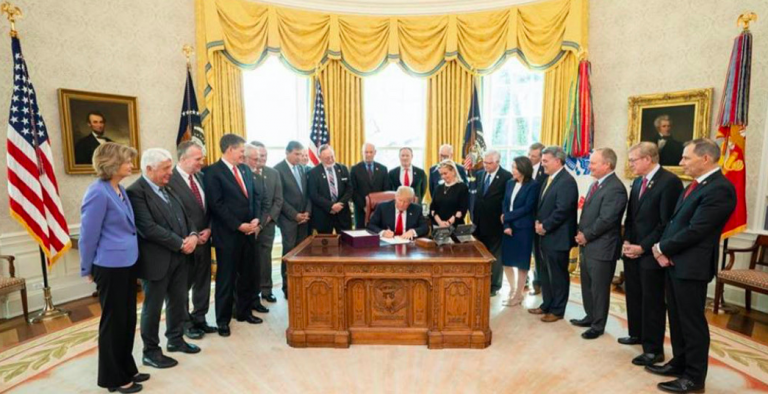
Legislation signed Tuesday by President Donald Trump will give 2,800 Alaska Native veterans — or their heirs, if the veterans are deceased — an opportunity to get the land allotments they were promised before serving in the Vietnam War.

Watch Sen. Dan Sullivan talk about the Alaska Native veterans’ land promise, how Sen. Ted Stevens and Congressman Don Young had fought hard for it, and why it’s so important to him personally:

The John D. Dingell, Jr. Conservation, Management, and Recreation Act has 120 different bills wrapped up in it, several of which apply to Alaska, including a bill that would allow an Alaska gasline to run through Denali National Park.

The omnibuslegislation also requires agencies to maintain more open access to federal land, with an “open unless closed” policy, and allows for construction of more target ranges on Forest Service or BLM lands.

The Alaska delegation was on hand for the signing at the White House of the bill that had been introduced by Sen. Lisa Murkowski and Sen. Maria Cantwell of Washington state, who is the ranking Democrat on the Senate Resources Committee that is chaired by Murkowski.

The package was negotiated with the chairman and ranking member of the House Committee on Natural Resources last year, and the vast majority of bills within it have undergone extensive public review in the House, the Senate, or both.

S. 47 contains provisions sponsored by 50 Senators and cosponsored by nearly 90 Senators in the 115th Congress. The bill includes the following provisions of interest to Alaskans:

  • Denali Improvement Act – Provides routing flexibility for the Alaska gasline project in Denali National Park and Preserve.
  • Alaska Native Veterans Land Allotment Equity Act – Introduced by Sen. Dan Sullivan, R-Alaska, to ensure the federal government fulfills its decades-old promise to provide allotments to Alaska Natives who served in the Vietnam War.
  • National Volcano Early Warning and Monitoring Act – Improves the nation’s volcano-related capabilities to help keep communities and travelers safe.
  • Sportsmen’s Act – Requires federal agencies to expand and enhance sportsmen’s opportunities on federal lands; makes “open unless closed” the standard for Forest Service and BLM lands; facilitates the construction and expansion of public target ranges, including ranges on Forest Service and BLM lands; and clarifies procedures for commercial filming on federal lands.
  • Small Miner Relief Act – Provides relief to four Alaska miners who lost long standing claims due to administrative errors or oversight.
  • Kake Timber Parity ActRepeals a statutory ban preventing the export of unprocessed logs harvested from lands conveyed to the Kake Tribal Corporation.
  • Ukpeagvik Land Conveyance – Requires the Department of the Interior to convey all right, title, and interest in the sand and gravel resources within and contiguous to the Barrow Gas Field to the Ukpeagvik Iñupiat Corporation.
  • Chugach Land Study Act – Requires the Department of the Interior and the U.S. Forest Service to conduct a study to identify the effects that federal land acquisitions have had on Chugach Alaska Corporation’s ability to develop its lands, and to identify options for a possible land exchange with the corporation.
  • National Geologic Mapping Act Reauthorization Act – Renews this program, which is run by the U.S. Geological Survey, for five years.
  • Land and Water Conservation – Permanently reauthorizes the Land and Water Conservation Fund, with key reforms to strengthen and provide parity for its state-side program.

More information on S. 47 is available here.

House members still raising money for campaigns?

9

IT’S A VIOLATION, BUT HEY, THEY’RE IN THE DEMOCRAT MAJORITY

Four members of the House Democrat-led majority are in apparent violation of the law. Reps. Adam Wool, Ivy Spohnholz, Daniel Ortiz, and Tiffany Zulkosky are maintaining fundraising pages on their websites, which is against the law during the legislative session.

AS 24.60.031 says legislators and legislative staff may not solicit or accept contributions for a fundraising event during session for a campaign for state or municipal office. Soliciting includes, but is not limited to: Asking for contributions for the fundraising event; including your name on the fundraising notice; donating items to an auction.

During the legislative session, legislators are also prohibited from soliciting or accepting a contribution or a promise or pledge to make a contribution for their own campaigns, or to influence a state ballot proposition or question, or for a political party.

Adam Wool: http://www.adamwool.com/donate (link live and language asking for contributions by check)
Tiffany Zulkosky: https://www.electtiffanyzulkosky.com/donate (has language asking for donations by check)
Ivy Spohnholz: http://www.ivyforalaska.com/donate (has live link and language asking for donations)
None of the Republican minority members are in violation, per a review of their campaigns websites by Must Read Alaska.

Anchorage voters to decide: 5 percent tax on alcohol?

PROPOSITION 9 WOULD REQUIRE A 50+1 MAJORITY

The ballots are in the mail, and before April 2, Anchorage voters will be deciding whether to levy a 5 percent tax on their drinking habits. The mayor says the $11 million to $15 million he’ll raise with this tax will be used to pay for homeless services.

Proposition 9 states the alcohol tax would be used for health and public safety uses. After the city pays itself for the cost of administration, collection, and auditing, the remainder of the tax would go toward alcohol and substance misuse prevention and treatment, community behavioral health programs, public safety, and homelessness prevention and response, including cleaning up homeless campsites.

Alaska has the highest alcohol tax in the nation, at $12.80 cents per gallon, a result of a tax imposed by the Legislature in 2002, when lawmakers, led by then-House Rep. Lisa Murkowski, sought to abate alcoholism in the state by doubling the tax on hard liquor and tripling the tax on wine. Beer tax went up too, but not as much.

The effort didn’t slow down drinking in Alaska, which increased dramatically in the years after the tax: Hard liquor sales skyrocketed by over 40 percent and wine sales went up 56 percent. The tax is levied at the wholesale level, and is incorporated into the cost of the product consumers buy.

Now, Anchorage Mayor Ethan Berkowitz wants to add another tax, this one to pay for social services for the homeless: Shelters, substance abuse treatment, he cites as examples. But the language of the proposition is broad — any public safety or health issue could qualify to tap into the tax revenues. For example, pay increases for muni police and fire personnel would be considered a public safety expenditure.

HOW WILL THIS AFFECT YOU

If you buy alcohol either at a bar or a liquor store, you’ll end up paying more. A $25 bottle of wine will cost you $1.25 more, on top of the 66 cents per liter you pay to the State for its excise tax.

A $60 bottle of gin has a state tax of between $2.50 (for 750 ml) and $3.38 (liter). You’ll pay another $3 to Anchorage to help the homeless.

Drink at a bar? That’ll be 50 cents more for a $10 cocktail. Dinner out? Add on 45 cents more for a $9 glass of wine.

Normally, taxes in Anchorage must be passed by three-fifths of the voters. But Proposition 9 asks voters to also bypass the charter and approve this tax on a simple 50+1 majority.

Juneau has a 3 percent sales tax on liquor, which is added to the 5 percent local sales tax, for a total of 8 percent. The City of Fairbanks levies a 5 percent sales tax on alcoholic beverages.

WHY DIDN’T THE STATE BOOZE TAX END CHRONIC ALCOHOL ABUSE?

With Rep. Murkowski leading the charge for the state alcohol tax in 2002, she and other tax advocates said the money would be dedicated for alcohol and drug abuse programs. But even while the state collected hundreds of millions of dollars in revenue, it spent less and less on these programs. The Alaska Constitution doesn’t allow tax revenues to be dedicated to special uses, but generally 50 percent of the alcohol tax collected goes for treatment of alcohol abuse, far less than the apparent need.

In 2003, the State of Alaska alcohol tax brought in $10 million in revenue. By 2018, the state collected $39.2 million from alcohol sales.

Mayor Berkowitz plans to collect another $11-15 million starting in January, 2020.

Fairbanks radical fems, transgenders ‘hrrrl insults’ against mayor

 CIVILITY CRUMBLES AS F-BOMBS, THREATS OF VIOLENCE RISE

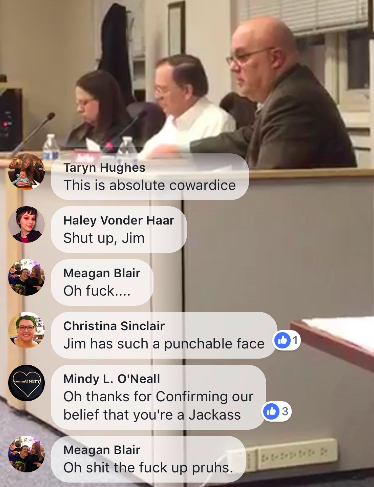
A group of radical feminists and angry transgender individuals hurled insults on Facebook during the group’s live feed of the Fairbanks City Council meeting on Monday night, with one of the members of the “Hrrrl Scouts” saying Mayor Jim Matherly has a “punchable face.”

Last week, the group continued a spew of hate on Facebook against the mayor, who vetoed an ordinance granting specific LGBTQ rights in Fairbanks.

The ordinance, which the city council had adopted by a 4-2 vote, added protections for LGBTQ members in employment, housing and public accommodations. It gave people with gender dysphoria or gender expression an avenue to sue for discrimination.

The veto override failed tonight.

Matherly had originally signed on as a co-sponsor of the ordinance, but then decided to veto it “after much soul searching, research and examination of all facets of the issues,” he wrote in a letter explaining his actions.

Of the angry Facebook group, Christina Sinclair is a Democrat who was endorsed and funded by unions when she ran against Rep. Tammie Wilson in 2016. The group’s live stream responses is a raw look at what Mayor Matherly and council members Dave Pruhs and Jerry Cleworth are facing.


‘Popping and spewing,’ Tarr lectures rural Alaskans

13

URBAN REP. SAYS IT’S A ‘FALSE CHOICE’ BETWEEN SERVICES NEEDED AND REVENUES TO PAY

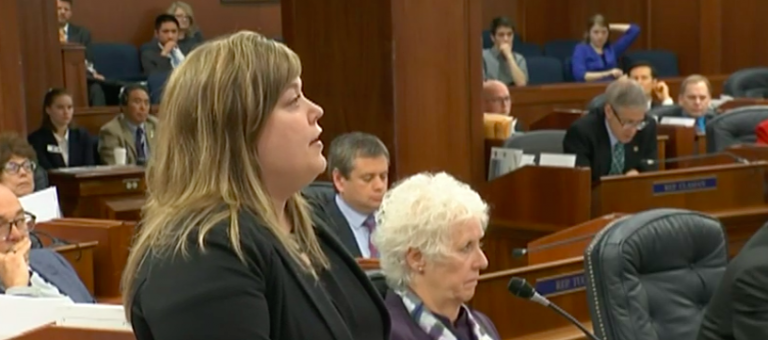
Rep. Geran Tarr, co-chair of House Resources, gave a detailed explanation on the House floor today of why she does not support drilling in the Arctic National Wildlife Refuge’s coastal plain: Melting permafrost is already causing existing wells to “spew” oil everywhere.

“Here we are in 2019 and because of the thawing permafrost, the wells are literally popping out of the ground and spewing oil and gas across the surface of the North Slope,” Tarr said. “I don’t know what will be happening in 2024 (when the North Slope 1002 Area is planned for drilling),  but this is not a comprehensive energy strategy. This is not doing the right thing, in my opinion, for the next generation.”

In fact, a couple of old wells from decades ago have eased out of the thawing permafrost and small amounts of petroleum have come to the surface, mostly gas, but also some oil, all of which was contained in the well housing; none has escaped onto the tundra. Those with that old well design are being capped.

Tarr also objected to the resolution due to climate change, and said she was unhappy that Gov. Michael Dunleavy had shelved Gov. Bill Walker’s climate change task force: “Unfortunately both at our state and federal government, our highest leaders have abandoned the work on climate change.”

She then delivered a lecture directly to rural residents in the state, saying there is a false choice between getting new revenue from the oil fields and providing services to poor areas of the state.

That’s when Speaker Bryce Edgmon interrupted her and cautioned, “Rep. Tarr, I have rural residents in my district. Please continue.” She continued to assert that those services should still be provided to rural residents, who had testified in her committee that they support responsible oil development in their region.

“I would caution any member from making statements that are sweeping in nature. Please continue,” Speaker Edgmon interrupted her again.

“What we heard in committee was that the development was needed because of the services that would come from the revenue,” Tarr argued, evidently taking her disagreement with rural testifiers in her committee to the House floor.

“To me that’s a false choice because I believe the services are needed regardless of whether the revenue comes from the resource development,” she said. However, she was silent on where the revenue would come from in the absence of resource development.

The resolution, which is simply a statement of support, is nearly identical to one that has passed both the House and Senate every two years for decades, but specifically refers to the draft environmental impact statement that is now in the public comment period, which ends March 13.

Senate Joint Resolution 7 says “the Alaska State Legislature requests that the United States Department of the Interior, Bureau of Land Management, implement an oil and gas leasing program in the coastal plain of the Arctic National Wildlife Refuge as outlined in the December 2018 Coastal Plain Oil and Gas Leasing Program Draft Environmental Impact Statement.”

Rep. John Lincoln, who serves the people of District 40 where the 1002 Area is located, had a different perspective than Tarr, who represents urban East Anchorage. As the other co-chair of House Resources, he rose to support the resolution, saying oil wealth has paid for state and local government services for decades. Many of his community leaders had testified in favor of the development.

Rep. Adam Wool, who represents a portion of Fairbanks, voted against the resolution, as did Rep. Sara Hannan, who represents Juneau. Both are Democrats, like Tarr, and both are from communities that benefit greatly from oil revenues.

The only votes against the resolution in the Senate were from Democrat Sen. Elvi Gray-Jackson and Sen. Tom Begich.

What tribal sovereignty is — and isn’t

7

ALASKA NEEDS A PRIMER ON DOING BUSINESS IN AND OUT OF INDIAN COUNTRY

By MARY BISHOP
GUEST CONTRIBUTOR

For the past 30 years I have been an occasional student of Alaska tribal sovereignty.  I am committed to improving the knowledge of this issue among all Alaskans.

To begin with, each of Alaska’s 225 plus tribes are sovereign; each holds sovereign immunity from suit for breach of contract – absent a formal document waiving that sovereignty.

The Alaska Supreme Court affirmed that each tribe has sovereign powers over matters that directly affect their people — such as membership, marriage, adoption, inheritance and divorce. This legal concept is well-explained in the October, 2017 opinion by then-Attorney General Jahna Lindemuth,  linked here.

Tribal sovereignty does not depend on the existence of “Indian Country,” the territory over which a tribe holds governing authority.

Attorney Gabriel Galanda explains in his 2009 American Bar Association  article that “Tribal sovereignty is the single most important element of practicing [law] both because it protects tribal coffers from suit and because of its sacred importance…” In September, 2018  the ABA published a “primer” on doing business with sovereign tribes.

Alaska urgently needs such a primer, one addressing the Alaska situation, where tribes do business within Indian Country and tribes do business outside of Indian Country — and tribal businesses can incorporate under tribal, state, or federal law.

Tribal sovereign immunity complications are likely unknown in the Alaska business community. An ironic Alaska example occurred when on Sept. 8, 2017, the Alaska Supreme Court ruled that a Juneau area tribe could not be sued in state court by the Douglas Indian Association for alleged mismanagement of joint federal tribal transportation funds.

Why? No waiver of immunity had been negotiated between the tribes.

Years ago Alaska required agencies acquire tribal “waivers of sovereign immunity” when interacting with tribes for land and fuel agreements.  I saw no recognition of that need in the state’s 2017 tribal agreements.

Second, Indian Country in Alaska is virtually the same as Lower 48 reservations, asserts the Bureau of Indian Affairs.

In 1971 Congress passed the Alaska Native Claims Settlement Act, which most people thought settled the question of Indian reservations and Indian Country.  So how does Indian Country now come to exist in Alaska?  It is done through the Interior Department’s “fee-to-trust” program, administered by the Bureau of Indian Affairs.  That program allows tribal land which is owned in fee title to be transferred to federal trusteeship. 

Because of an Interior Department 1978 interpretation of ANCSA, the fee-to-trust program was not available to Alaska tribes.  But in 2014, the Bureau of Indian Affairs made a new rule to void this “Alaska exception” to fee-to-trust.

“Yet in no clearer way could Congress’ intent be undermined than by recreating something, through an administrative [BIA] process, that Congress expressly extinguished by law,” asserts State Attorney General Kevin Clarkson in a Jan. 25, 2019, letter to Interior in which he presents arguments against fee-to-trust lands in Alaska.

Following ANCSA, Alaska’s first tract of BIA-approved Indian Country is a parcel in downtown Craig, accepted for trust in 2017.  The Craig Tribal Association’s website notes the tribe’s tax-free Smoke Shop, its mission, and sovereign immunity.

Indian Country in Alaska is free of state and municipal taxation, regulation and zoning. Think marijuana, gaming, tobacco, fuel, fish and game harvest. Consider the effect on competing private business.

Tribal members living within Indian Country have all rights of federal, state and municipal citizenship.  They vote on bonding issues but are exempt from state and municipal taxation.  Their property is generally expected to receive the usual state and municipal services.  Federal courts may attempt a balancing act weighing state interests  against tribal interests.  “And, as with all balancing tests, the result is a crapshoot,” notes the 2017 ABA article.

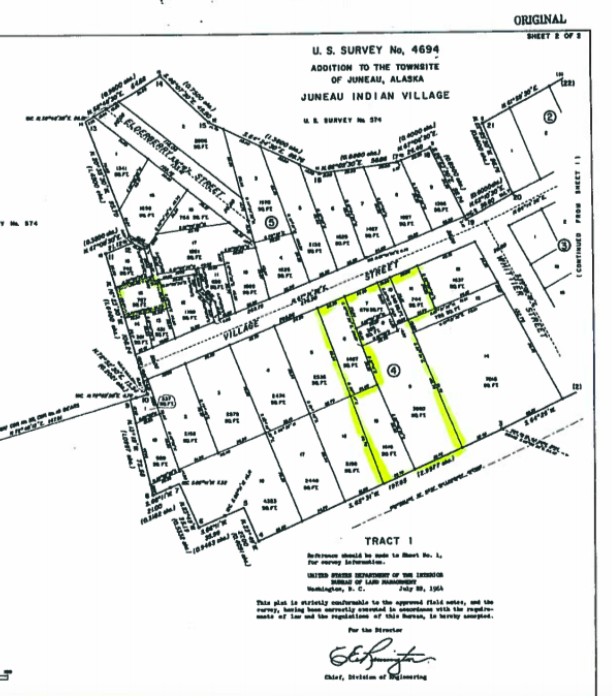
Land in downtown Juneau, Fort Yukon, and Ninilchik has been submitted for trust status.  Native allotments within the Fairbanks City and Borough could be transferred to fee ownership of a tribe, which might then submit it to BIA for fee-to-trust status—tax and regulation free within the city or borough.

Alaska’s one pre-ANCSA reservation is Metlakatla, established by treaty with Canadian Indians.

Through ANCSA, regional and village Native corporations received 11 percent of Alaska lands plus almost $1 billion. Tribes did not receive money or land.  But both money and land have since gone to tribes through grants and for-profit businesses.  Some village corporations have turned over ANCSA lands to tribes.  Tribes can receive land through purchase and gift—and now own millions of acres.

Those who understand Indian law best are those who passionately and patiently advocate for increased tribal authority and financial benefit available through judicious use of this complex body of law.

However, they do not necessarily have the broader interests of all Alaskans in mind. That responsibility lies with the state.

I urge the Dunleavy Administration to move forward by providing an informative primer for the benefit of all Alaskans.

Mary Bishop has lived with her family in Fairbanks and Interior villages since 1961.

With Dunleavy budget, Alaskans are talking about priorities

11

By WIN GRUENING
SENIOR CONTRIBUTOR

As Alaskans take various and mostly predictable positions on Gov. Michael Dunleavy’s proposed budget reductions, a theme seems to be emerging in the Legislature.  Legislators are far from reaching any kind of consensus, yet it’s possible to discern some common elements that presage a possible outcome down the road.

In the face of Alaska’s projected $1.6 billion deficit, to no one’s surprise, some voices demand passage of new revenue measures – a statewide income tax or a sales tax. Others argue steep budget cuts are necessary even while Permanent Fund dividends be enshrined in Alaska’s Constitution and are essentially untouchable.

Win Gruening

Given the current makeup of the Legislature, it’s not likely any of these scenarios will come to pass this year.

The governor’s proposals, while balancing the budget, depend on an array of debatable statutory and policy changes. These are far-reaching and, in some cases, invite lawsuits and leave to the imagination potential consequences down the road.

Nevertheless, Gov. Dunleavy deserves credit for finally forcing Alaskans to discuss the fiscal reality confronting us.

In the Legislature, even conservative voices supporting budget reductions are distancing themselves from the level of cuts being contemplated by the administration.

No doubt they are being influenced by the municipalities they represent.

Many proposed cuts would effectively shift much of the reductions to municipalities across the state. This puts questions of “needs vs wants” squarely in the laps of local taxing authorities where, some would argue, they belong.

But, the wheels of bureaucracy move slowly, and to assume local governments could possibly react in time to absorb these reductions by either raising taxes or canceling projects and services overnight is not reasonable.

Furthermore, proposed cuts to the ferry system, healthcare, and education, for example, require time to analyze for reductions to make sense.

Regardless of one’s feelings about proposed reduction levels, it seems many Alaskans prefer a more realistic approach that phases reductions in over time.

The House Majority is signaling a tax is off the table this year, and to expect budget cuts. “The sheer complexity of taking on the proposed change to the budget itself will consume most our time going forward,” House Speaker Bryce Edgmon, said recently. Edgmon said he’s asked caucus members to “help share the pain.”

Senate Finance Committee Co-Chair Natasha von Imhof explained it this way, “I keep hearing the administration referring to this ‘fiscal crisis.’ We don’t have a fiscal crisis. We have a priority crisis.  We have enough money to pay for a certain level of government services, and a certain level for a dividend. We just don’t have enough money to pay for both at the highest level desired.”

Given the House and Senate public positions, what outcome is possible and reasonable in the session time remaining?

The final date to approve a budget – June 30 – is fast approaching.  With much of the session taken up with organizational changes, legislation supporting the Governor’s budget proposal has yet to be reviewed.

It isn’t hard to see where we are headed and to do the math.

$1.6 billion in suggested cuts cannot be absorbed in the short term and new taxes, even if proposed, would likely be vetoed.

There is only one existing revenue source available large enough to make a difference:

Alaska’s Permanent Fund.

Approved last year under Senate Bill 26, Percent-of-Market-Value (POMV) legislation allows a portion of the Permanent Fund earnings to be split between a permanent fund dividend (PFD) and paying for government services.

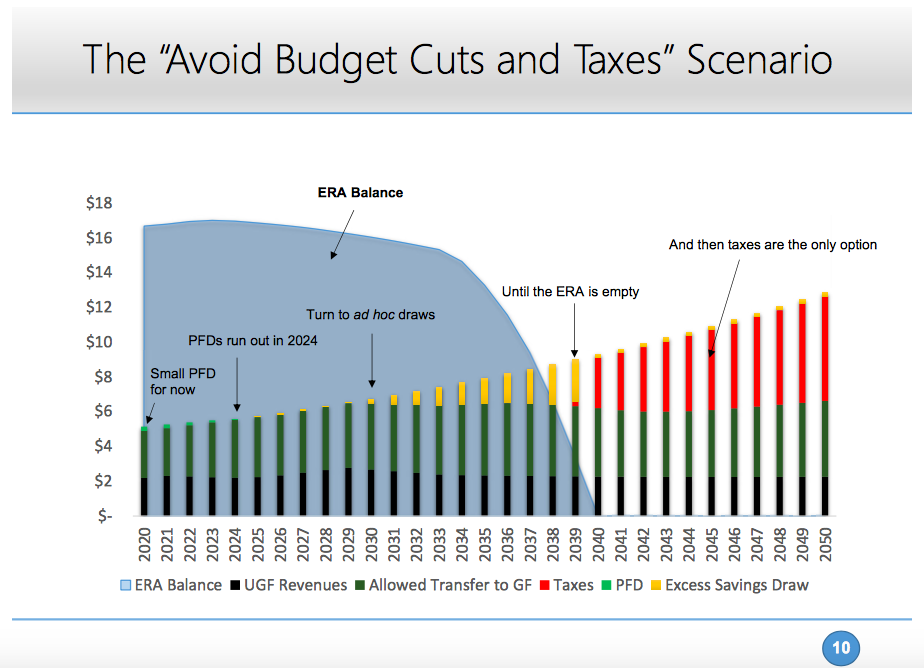
Maintaining PFD’s near last year’s level would make available enough funding to shrink the deficit to a manageable level – in the $350 million range.  A deficit of this size could be handled with targeted expenditure reductions and a minimal draw from the Constitutional Budget Reserve.

When warranted, Gov. Dunleavy would have the option of restoring PFD’s to a higher level in the future, thereby keeping his campaign promise, but it would allow time for any further cuts to be absorbed and Alaska’s economy to continue its recovery.

Equally as important, maintaining curtailment of the PFD during this crisis means every Alaskan would share the pain.

Win Gruening retired as the senior vice president in charge of business banking for Key Bank in 2012. He was born and raised in Juneau and graduated from the U.S. Air Force Academy in 1970. He is active in community affairs as a 30-plus year member of Juneau Downtown Rotary Club and has been involved in various local and statewide organizations.

Fish fight returns to question: What is subsistence?

1

By CRAIG MEDRED
CRAIGMEDRED.NEWS

Before an audience heavy with those who make their living from the sea, commercial fishermen and their supporters paraded before the Alaska Board of Fisheries on Saturday to testify as to where they think personal-use dipnetters belong.

Last in line was the clear answer.

Cordova’s John Whissel might have summarized the thinking best when he observed that the personal-use fisheries “are to be implemented after sport, commercial and subsistence fisheries have met their needs.”

The comments came in response to a Kenai River Sportfishing Association proposal before the Board that would reshuffle salmon allocation priorities in the state’s few, non-subsistence fishing areas.

The proposal seeks to make the food security of 49th State residents the number one issue the Board should consider when deciding who gets which salmon and how many.

Whissel argued the proposal was a scheme to “set up a defacto priority,” giving personal-use fishermen in five “non-subsistence” areas much the same status as subsistence fishermen in most of the rest of the state. Subsistence is a “priority use” in about 80 percent of Alaska.

In the subsistence areas, the number one priority of the Board and fishery managers with the Alaska Department of Fish and Game is to make sure subsistence demands are met.

Dipnetters once had a subsistence priority, but the Alaska Legislature in 1992 passed a law allowing the Boards of Fish and Game to establish non-subsistence areas. The state was at the time jockeying to find a way to bring state law into agreement with the Alaska National Interest Lands Conservation Act, which created more than 100 million areas of new parks and refuges in Alaska and granted “rural residents” a subsistence priority on federal lands.

The state tried to follow suit with a rural priority, but the Alaska Supreme Court ruled that granting Alaskans special hunting and fishing privileges solely on the basis of where they live violated the Alaska Constitution.

As an alternative, the Legislature gave the joint Boards the authority to create non-subsistence areas where there was heavy competition between urban and rural residents for limited resources. The hope was that the feds would buy the plan as tantamount to a rural priority and drop a threat to take over management of fish and game on federal land in the state.

They didn’t. The U.S. government has been involved in managing fish and wildlife on more than 200 million acres of land within the state for almost two decades now.  The state was left in charge of about 150 million acres. The two bureaucracies engage in a constant, joint-management dance in dealing with salmon and other species that move across state-federal boundaries.

Through all this, most of the state’s fisheries have remained largely unchanged. The commercial fishing industry controlled them at statehood, after statehood and to this day.

Read the rest of Medred’s column at this link.