Friday, December 26, 2025
Home Blog Page 1467

MRAK Almanac: Changes ahead at Merrill Field

1

FLYING SEASON IS HERE; NEW RULES FOR MERRILL

The April 5 Alaska Aviators Forum at the Aviator Hotel in downtown Anchorage will focus on air traffic changes at Merrill Field. Caleb Newville and Fred Snyder from Merrill Field Air Traffic Control will outline the new procedures to be implemented soon.

Merrill Field is a general aviation airport east of downtown Anchorage that had over 159,000 operations in 2018. In July it set a record with over 21,000 operations, making it the busiest month in the last 10 years.

Wedged between Joint Base Elmendorf Richardson and Lake Hood, which is the world’s largest seaplane base, with the Federal Aviation Regulation 93 Special Air Traffic rules in place, it’s a complex flying environment, with mountains on one side and Cook Inlet on the other, and numerous rules for altitude and speed. The entire Anchorage bowl sees an enormous volume of air traffic each year.

Merrill has numerous charted VFR arrival and departure procedures to keep traffic organized. The airport recently performed a full review of all of the procedures and made several modifications, which will be published in the April 25 edition of the Chart Supplement.

The pilot outreach team walk through each procedure and the changes, and explain why procedures are designed the way they are, and review numerous ‘best practices’ from the Aeronautical Information Manual to help ensure pilots and air traffic control personnel are working smoothly together.

The forum meets at 7 pm Friday, April 5, at the Aviator Hotel at 4th and C Streets.

Guardian Flight ends two-month search for crew

0

Guardian Flight’s two-month search for its crew members, the company’s aircraft, and its cockpit voice recorder in Frederick Sound has come to an end.

The company says it has exhausted all avenues of exploration and recovery, but plans a shoreline search for any aircraft fragments that may have washed up near Kake, where the medevac plane went down on approach on Jan. 29, where it was picking up a patient.

Pilot Patrick Coyle, flight medic Margaret Langston, and flight nurse Stacie Morse – who was carrying an unborn daughter —  were expected in Kake on the night of Jan. 29, when the twin-engine Beechcraft King Air turboprop plunged into the water.

The search never yielded the remains of the pilot and crew.

“This is very disappointing to their families and our entire Guardian Flight team and extended family of first responders, air medical transporters and health care professionals,” the company said in a statement.

“We were successful in locating and recovering the airplane’s Cockpit Voice Recorder, which has been transported to the National Transportation Safety Board headquarters in Washington, D.C. for further analysis. We are thankful for the assistance rendered over the past two months by the NTSB’s regional office in Anchorage during trying times and despite difficult weather conditions during our search and recovery efforts.

“Guardian Flight has also been able to locate and recover significant portions of the aircraft during this process. We have identified and raised from the ocean depths a number of fragmented major assemblies of the aircraft, including the cockpit, fuselage, tail, engines, propeller blades, wing sections, and landing gears. These will be transported to Juneau for further analysis by the NTSB.

“We thank everyone who has helped in our search following the loss, including many good Samaritans, the U.S. Coast Guard, the NTSB, Alaska State Troopers, local law enforcement, and our dedicated search team. We have searched 7 square miles of ocean and ocean floor and traversed over 700 linear miles by ship to locate our cherished friends, the CVR and aircraft.

“Further, we have engaged Metron Scientific Solutions, experts in underwater search and recovery efforts, to aid us in the evaluation of our search to date. Our search team and the professionals in such efforts have concluded that we have exhausted all our remaining options in our underwater search and recovery efforts.”

The company plans a memorial to recognize and celebrate the lives of the three who lost their lives, all Juneauites.

Passing: Former DOT Commissioner Joe Perkins

6

WORKED ON PROJECTS FROM SNETTISHAM TO HAARP

Joseph “Joe” Perkins passed away on March 25, 2019, from heart and kidney failure at home in Edmond, Oklahoma, where he and his wife moved from Alaska in 2015 as his health deteriorated.

Joe is survived by his wife, Laurie Prentice Perkins, and his children: Lindsay Rico (Joseph) of Edmond; Jack Perkins (Shawnee) of Seattle; Joseph Perkins (Josie) of Maui; and Tom Perkins (Lisa) of Fort Worth. He is also survived by three grandchildren, Grant Rico, Claire Perkins and Chase Perkins, and his brothers, John and Paul Perkins of Missouri. He was preceded in death by his parents.

Joe spent 40 years in Alaska.

Born and raised in Steelville, Missouri, he earned his BS and MS degrees in Civil Engineering from Missouri School of Mines and Metallurgy in Rolla, Mo.

He began his career as an Army engineer. During his first tour in Vietnam he lived with the Montagnards as an advisor to the South Vietnamese Army. During his second tour in Vietnam, he was the operations officer for a combat engineer battalion.

He supervised construction of an anti-aircraft missile site in Korea; roads and bridges in the Dominican Republic; an anti-ballistic missile system in North Dakota; perimeter anti-ballistic sites in remote parts of Alaska; and boat harbors and roads throughout Alaska.

He supervised the construction of the challenging rehabs of the Snettisham Hydroelectric Project in Southeast Alaska and the Chena Flood Control Project in Fairbanks.

He retired in 1982 a lieutenant colonel working as Deputy Commander of the Army Corps of Engineers, Alaska District. He turned down a promotion to Colonel because it meant leaving Alaska. During his Army career, he received two Legion of Merit awards, two Bronze Stars, and numerous other meritorious service medals.

As Alaska was growing in those post-pipeline days, its energy needs increased quickly. Joe joined the Alaska Power Authority and managed an aggressive design and construction program to meet those needs, including the completion of several hydroelectric projects that currently provide about 20 percent of Alaska’s low-cost energy. He then moved on to the private sector as Vice President and President of Frank Moolin and Associates where he led design and construction of numerous Alaska infrastructure projects, including the Anchorage Library, the Anchorage Museum and the Anchorage Landfill along with the construction of 120 post offices throughout the state, the utilidor in Barrow and the several road construction projects in Anchorage.

When the Alaska economy tanked in the late 1980s, Joe joined Moolin’s parent company, Ebasco, as its South American vice president where he completed the construction of the US embassy in Santiago, Chile and led business development efforts in South America.

But Alaska remained in Joe’s heart and mind and he soon found himself suggesting Alaska for an ionospheric research project while working for a defense contractor in Washington, DC. He subsequently developed that project in Gakona, now known as HAARP, the High Frequency Active Auroral Research Program.

It was during this time that Gov. Tony Knowles asked Joe to return to Alaska as the Commissioner of the Alaska Department of Transportation. Joe jumped at the chance to continue developing and improving Alaska’s infrastructure.

As Alaska’s DOT Commissioner for eight years, Joe worked through the challenging budget reduction problems of the time. During those years, the department progressed from a highway department to one that served the unique transportation needs of all Alaska, including rural Alaska.

He helped elevate Alaska DOT to a national and international level when he served as President of the Western Association of State Highway and Transportation Officials, the Vice-President of the American Association of State Highway and Transportation Officials, and as one of two US delegates to the World Road Congress.

In each of those organizations, he was active and instrumental in changing and improving national and international protocols and standards used in highway design and construction. He also served on the Alaska Railroad Board of Directors and the Alaska Industrial Development and Export Authority Board of Directors for eight years.

After Joe retired from Alaska DOT in 2002, he lived in Juneau, but traveled the world helping developing countries plan their fledgling transportation infrastructure systems. He helped identify transportation corridors in Afghanistan, Tajikistan, Kyrgyzstan and Uzbekistan.

He worked with the President of Sao Tome to reroute transportation corridors to enhance economic development. He assisted the President of Gabon in analyzing access and transportation routes to be used in ecotourism development.

When medical issues forced Joe stateside, he focused once again on Alaska infrastructure projects, developing a sniper range at JBER and consulting with utilities, school districts, and the Mat-Su Borough on infrastructure projects. His final professional management project, the Port MacKenzie Rail Project, was still under development at the time of his death.

Other than the myriad of infrastructure projects that Joe championed, Joe’s greatest joy professionally was the hundreds of professionals he befriended and mentored over the course of his career. He loved his work and he loved the people he worked with. He brought a sense of fun and humor to his work, as his Halloween costumes and staff meeting antics often reflected.

He loved fly fishing with his friends, Wilson Hughes, Tony Knowles, Stan Hooley, and Sam Baker. He enjoyed travelling the world with his wife, Laurie. He read and studied history voraciously and often said that he would have loved to have been a history professor in addition to being an engineer.

Most of all, he loved his wife, children, and grandchildren fiercely. He championed Juneau football and served on the JYFL Board of Directors for several years. One of his proudest days was the day he was inducted as a Distinguished Alumnus at his alma mater.

A memorial service will be held on March 31, 2019 at Steelville Presbyterian Church in Steelville, Missouri. Joe will be buried with full military honors in Arlington National Cemetery in Washington, DC.

The family wishes to thank the Alaska Heart Institute in Anchorage, the Integris Advanced Cardiac Care Hospital in Oklahoma City, Dr. Richard Welling of Juneau, and Lindsey Owen of Integris Hospice for their aggressive and caring treatment over the years. Should friends desire, memorial contributions may be sent to the Disabled Veterans of America.

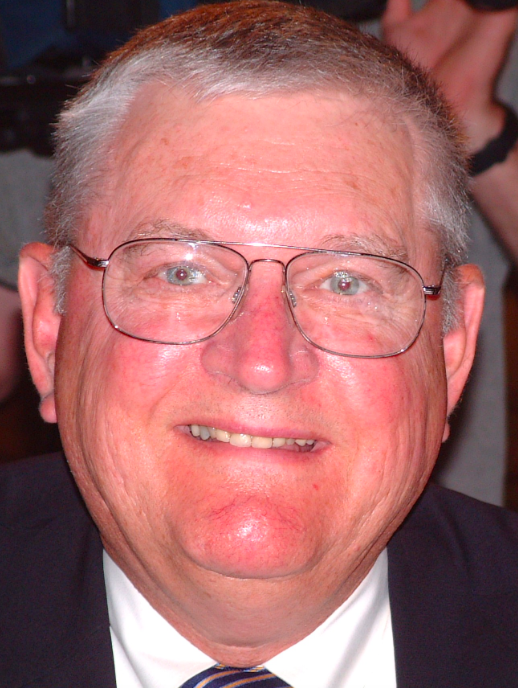
(Photo by Dave Harbour)

Greenpeace swamp thing attends Bernhardt confirmation hearing

3

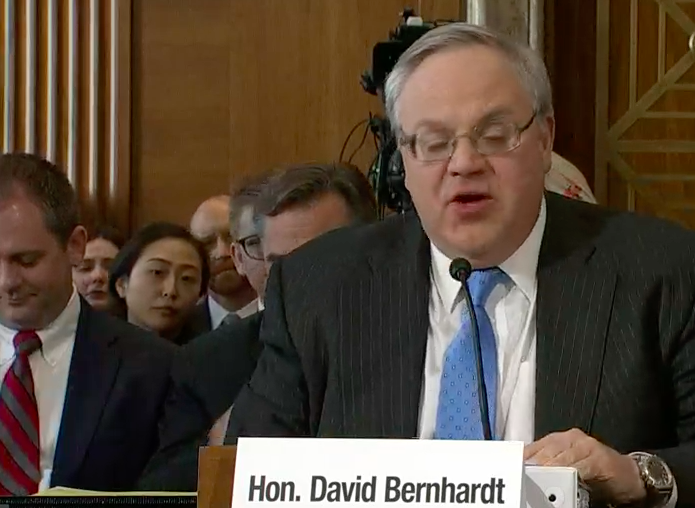
The Senate Energy and Natural Resources Committee’s confirmation hearing for Interior Secretary nominee David Bernhardt went as scheduled on Friday, with Democrats tearing at the nominee relentlessly, according to their playbook.

But one member of the audience took it a step further, donning a green swamp creature mask during much of the hearing, which drew the attention of security guards who then hovered nearby. All of this occurred without the knowledge of Bernhardt, who continued to answer the badgering questions of Democrats on the committee.

Bernhardt was appointed as Secretary of the Interior after the December resignation of Ryan Zinke, who had been hounded out by ethics complaints.

Democrats questioned Bernhardt about his ties to the oil industry and at one point Sen. Ron Wyden of Oregon, basically called Bernhardt a liar.

The Interior Department oversees 500 million acres of federal land, much of it in western states, and has a wide range of land- and resource-management responsibilities, including oil, gas, and mining.

The hearing can be viewed here.

The swamp creature mask appeared about 20 minutes into the hearing. At one point, she taps her fingers on her masked lips, as if to indicate she’s a thoughtful swamp thing, and at another moment, she throws her hands up on the mask’s cheeks to parody her astonishment. After an hour of her antics, the Capitol Police removed her.

Her name is Irene Kim, and she’s a program manager for Greenpeace. Here she is just prior to donning the mask:

Kim later told media “We wanted to bring some absurdity to this event that was happening.”


One-two punch: Judge blocks King Cove Road and Outer Continental Shelf

28

A federal judge in Anchorage on Friday issued two rulings that will disappoint many Alaskans but bring joy to litigating environmentalists:

District Court Judge Sharon Gleason ruled against the King Cove Road to the Cold Bay Airport, and later in the day said that offshore drilling in Alaska’s Arctic is also off the table.

Both rulings preserve actions of the Obama Administration that the Trump Administration was attempting to reverse.

Gleason, who was appointed her judgeship by President Obama in 2011, said that former Secretary of the Interior Ryan Zinke was arbitrary and capricious in his decision to allow a road through a national wildlife refuge. The community of King Cove has fought for a road for years to the nearby all-weather airport; over 100 medevacs have taken place in King Cove since 2014 due to not having road access to the airport.

[Read: Superior Court ruling against King Cove]

Gleason ruled that the land swap of Izembek National Wildlife Refuge land and private Native Corporation land was illegal.

[Read: King Cove land swap is a ‘go’]

Late Friday, Gleason again ruled against the Trump Administration. She wrote that President Trump overstepped his authority when he rescinded orders by former President Obama to withdraw nearly all of the Arctic Outer Continental Shelf from drilling.

Earthjustice had brought the lawsuit on behalf of a group of environmental organizations and Alaska Native interests.

Gleason wrote the president doesn’t have the authority to revoke another president’s withdrawal of the Outer Continental Shelf from leases.

Read: 80-Order-granting-MSJ-1

The two adverse decisions by a U.S. District Court judge will almost certainly be appealed by the Trump Administration.

MRAK Almanac

0
  • It’s National Vietnam War Veterans Day. Thank you to those who served between Nov. 1, 1955 and May 15, 1975.
  • Saturday is the actual date when Seward bought Alaska from Russia in 1867.
  • National Tsunami Warning Center Open House is Saturday, March 30, 1-4 pm at 910 Felton Street in Palmer. The center invites the public and the media to an afternoon of tsunami education at the center responsible for warning both continental coasts of the United States and Canada. Guests will be able to meet the people who stand watch and issue the warnings; learn about tsunamis and how the waves propagate; tour a real-time seismic observatory; talk to staff and emergency managers about the warning process; learn nature’s warning signs and how to prepare. Activities provided for all ages.

Mat-Su event was polite, supportive toward Dunleavy plan

22

THE ONLY OUTBURST FROM THE AUDIENCE WAS CLAPPING

The latest community budget discussion took place in the governor’s hometown.

Gov. Michael Dunleavy, having traveled from Juneau to Nome, Anchorage, and Fairbanks, came to the Mat-Su Valley today and met with about 150 residents, most of whom were friendly to his plan to bring spending down and restore the Permanent Fund dividend to its traditional formula.

At the Mat-Su Resort, Dunleavy and some of his cabinet members laid out Alaska’s fiscal problem (a $1.6 billion deficit) and went through some of the possible solutions: Dipping into savings would drain the Earnings Reserve Account in just a few years. Taxing people would not cover the deficit unless the tax was $11,000 or more per working couple — and that would drive working people out of the state. And taking the Permanent Fund dividend out of the hands of Alaskans isn’t fair to the low-income families and rural Alaska.

The solution, he said, is to bring spending down to what it was before it ballooned after 2006. A growth rate of 15 percent of government spending is what got Alaska in this fix, and cutting spending will help stabilize things, so long as his three constitutional amendments pass to control government growth in the future.

Security was tight at the Mat-Su Resort, with five uniformed Troopers and two of the governor’s security detail keeping a watchful eye, after some protesters in Fairbanks had begun to charge the stage the day before. The venue also provided private security for the event. Protestors — and there was just a handful of them — were kept at the entrance to the property and not allowed within shouting distance of the building itself. A few supporters were also seen at the entrance to provide a message supportive of the governor.

During the evening, a few of the questions submitted by attendees were from opponents to the governor’s plan, or from those with a bone to pick about Americans for Prosperity’s hosting the event. But unlike the events that took place in other communities, there was no angry outbursts in this conservative stronghold.

In fact, as in Fairbanks, the governor and his cabinet received a standing ovation at the end of the evening.

In every community, Dunleavy has been given red pens by citizens, and his visit to Mat-Su was no different in that regard; the very last question of the evening was “Governor do you have a red pen?” The crowd cheered. Dunleavy acquired a few more red pens.

The road show is not over — many more of these discussions are planned and rumor has it the governor will be all over Southeast Alaska next week, and has presentations planned for Anchorage and Wasilla.

Fukushima radiation arrives in Bering Sea

ALASKA SEA GRANT PROGRAM REPORTS

Low levels of cesium-137 from the Fukushima nuclear power plant have been detected near Saint Lawrence Island in the Bering Sea.

Sampling conducted by residents of the island show the reach of the northern edge of Fukushima’s plume. Cesium-137 levels higher than before the 2011 nuclear power plant accident in Japan, Alaska Sea Grant agent Gay Sheffield said.

Cesium-137 is a byproduct of nuclear fission and is traceable in the environment. Measurable amounts of radioactive substances are found in the ocean from both naturally occurring and man-made sources, such as nuclear weapons tests and accidental releases from nuclear reactors. Fukushima failed after the Tōhoku earthquake Japan on March 11, 2011, mostly a result of the tsunami that followed.

The amount of the contamination is extremely low, according to the Alaska Sea Grant report. It’s west of the mainland in the Bering Sea and is actually closer to Russia than to the North American continent.

In March 2011, a tsunami damaged Japan’s Fukushima Dai-ichi nuclear power plant, sending unprecedented levels of radioactive materials into the Pacific Ocean. Saint Lawrence Island residents anticipated that Fukushima-related contamination would eventually reach the Bering Sea based on their knowledge of ocean currents.

“I knew that those Japanese currents would come to our waters and so that’s why I volunteered to do the testing,” said Eddie Ungott, a resident of Gambell.

Ungott has been collecting seawater samples for several years off the coast of Gambell. He sends them to Sheffield in Nome who then ships them to the Woods Hole Oceanographic Institution in Massachusetts for analysis. During 2014, 2015 and 2017, the lab found very low levels of cesium-137, similar to those prior to the Fukushima nuclear accident. No testing was done in 2016 due to lack of funding.

Saint Lawrence Island has about 1,300 residents and is

[Read the rest of the story at Alaska Sea Grant]

Black History Month ignores the real issues

19

LET’S STOP PATRONIZING WITH HOLLOW LEGISLATION

By REP. SHARON JACKSON
GUEST CONTRIBUTOR

This week, after thoughtful consideration, I have withdrawn my support for House Bill 72, a bill that would make Black History Month permanent in Alaska. As the only African-American in the Alaska House of Representatives, I want you to understand why I felt compelled to do this.

February is Black History Month in the U.S. Since 1976, every U.S. president has acknowledged the contributions of African-Americans to the fabric of our nation. Yet, despite the shiny facade of cultural awareness, the black community remains as impoverished, divided and oppressed as ever. Our problems are almost never addressed head-on, yet we continue pledging our loyalty to any politician who happens to say a few nice words about us.

We cannot continue to be blinded by the fact that a legislative body celebrating the existence of black people doesn’t solve any of our problems.

Those who know me best know that I always tell it like it is, so here it goes: I’m not going to support any more empty efforts aimed at appeasing the black community. I don’t want platitudes. I want real policy solutions.

I’m tired of watching politicians – usually of other ethnicities – act like they care about the black community by passing feel-good bills, and then avoid answering the tough, painful, uncomfortable questions that challenge the black community. That isn’t empowerment.

I’m tired of watching programs like affirmative action in schools or businesses that allow in only enough black people to meet a quota and throw away the rest. That isn’t empowerment.

I’m tired of being told that “Black Lives Matter,” only to watch governments spend millions of Medicaid dollars each year to pay for the termination of black lives in the womb. That isn’t empowerment.

Having Black History Month doesn’t change any of these things. In fact, I would argue that it condones them. Our country does need to have a conversation about race, but not the one the mainstream media is force-feeding us.

Let’s answer these questions instead: How can we expect black children to grow up and be successful or empowered when only 45 percent of them have a father in the home to help teach them right from wrong? How can we talk about the disproportionate numbers of black men in prison before we acknowledge that they’ve been left to a life of addiction through drugs and alcohol? Society isn’t corrupted for imprisoning high numbers of black men and women – it’s corrupted for enabling so many disadvantaged people with welfare checks to remain addicted and hopeless for their entire life preceding arrest.

These are real questions that need real answers – not redundant recognitions of black existence. Rather than spending resources to keep people down, we should be investing to lift them up.

I’m not going to stand here and allow anyone else to patronize African-Americans and promote the terrible idea we are all victims. Good intentions pave the way to nowhere. The underlying issues must be addressed, and we, the Legislature, must have the courage and fortitude to face them.

Sharon Jackson is a U.S. armed forces veteran and serves District 13 in the Alaska House of Representatives.