Saturday, December 27, 2025
Home Blog Page 1451

MTA to build fiber optic cable to Canada, link to Lower 48

STATE IS GOING TO BE MORE OPEN FOR BUSINESS WITH HIGHER SPEEDS

Today there’s no terrestrial fiber-optic connection from Alaska to Canada or the Lower 48.

And yet, Matanuska Telephone Association, or MTA, has announced it’s going to build that connection — between North Pole, and the Alaska-Canada border, where it will connect with Canadian carriers and the rest of the continental U.s.

Nick Begich, on the board of MTA, said the project should be completed by the middle of next year. MTA is a cooperative telecommunications company, with 30,0000 customers,

The historic effort caught the attention of Wired Magazine today.

Gov. Michael Dunleavy attended the announcement today and said “This is good for individuals, schools, businesses and all Alaskans.” He said it aligns with his administration’s goals of Alaska being open for business.

The region’s political leaders were ecstatic: “What tremendous news out of Palmer today!” said Sen. Shelley Hughes (R-Palmer).  “I am very grateful for the innovation and forward-thinking that’s been taking place at MTA that’s led to the launch of the all-terrestrial fiber project. It’s exciting that it’s underway now – not years away, that it’s the latest in infrastructure to move us ahead into the future, and that it puts the potential for an information technology hub right in our own backyard.”

“This is a critical step in advancing Alaska’s technological advantages, developing our economy further, and ensuring that Alaska remains competitive with the rest of the world,” said Rep. DeLena Johnson (R-Palmer). “This new project, upon completion, will decrease Alaska’s reliance on vulnerable undersea fiberoptic cables, provide new technological security for our state, and drive down costs on Alaskan families and businesses.”

The cable will be buried along about 270 miles of the Alaska Highway, with the hope being that the high-speed cable will encourage companies to build data centers in Alaska.

 

Breaking: Tammie Wilson walks out on Democrat caucus

15

WILL REPUBLICANS LET HER BACK IN?

[Editor’s note: Rep. Tammie Wilson is back as House Finance co-chair as of 9 am on Wednesday morning. Observers in the Capitol say she made up with the Democratic leadership and she is back in the chair in House Finance.] Three independent sources confirmed Tuesday that Rep. Tammie Wilson, a North Pole Republican, has left the Democrat-led caucus that she joined earlier this year, when they offered her the plum position of co-chair of House Finance. But it’s unclear if her differences with the caucus led her to walk out on her own accord, or if she was pushed to the side.

Speaker Bryce Edgmon is said to be trying to coax her out of her office at this hour. Earlier she was packing boxes, evidently preparing to move out of the spacious Finance co-chair suite.

Wilson got sideways with the Democrats when she was standing in defense of the Gov. Dunleavy crime bills, which roll back the leniencies of SB-91 legislation from two years ago. Rep. Matt Claman, chair of Judiciary, has been trying to kill the bills offered by the governor.

Jennifer Johnston, who was vice chair of House Finance, becomes co-chair with Neal Foster. She is from South Anchorage.

So now the question becomes: Where are Bart LeBon and Steve Thompson, the other Fairbanks Republicans who joined the Democrat-led caucus? Will they stay or will they go? And who will be the new person on Finance to take Wilson’s place?

As far as the Democrats go, they haven’t wanted Wilson to serve on the budget conference committee because she is far too conservative for their tastes. She and Rep. Cathy Tilton could negotiate down the larger budget that the House has offered.

And now that the House budget has passed, the Democrats don’t need Wilson.

At this point, Wilson appears to be a caucus of one. Check back, this a developing story.

MRAK Almanac: May Day! May Day!

1

May 1, 1919: 100 years ago today Cleveland, Ohio witnessed violent demonstrations organized by Socialist leader Charles Ruthenberg, with unionists, socialists, communists, and anarchists to protest against the conviction of Eugene Debs. Brought to you by … Socialists.

May 1, 1919: Anarchists mailed bombs to dozens of prominent leaders across the country, including Ole Hanson, the mayor of Seattle.

May 1, 1999: The Alaska Native Heritage Center opened its doors to the public. It’s the 20th anniversary today.

 * * * *

May 1: If you’re in Seattle today, the 20th Annual May Day March for the Rights of Immigrants and Workers happens in the early afternoon, and then there’s an anarchist rioting event that may overlap it, worth noting and avoiding. Violence could be quite random.

May 2-4: Anchorage is hosting the annual Rotary convention at the Captain Cook Hotel. There will be literally hundreds of do-gooder Rotarians swarming the downtown area, so this is a very good weekend to venture downtown, as in safer than usual.

May 3: Alaska Family Council Spring Banquet, with speaker Jill Stanek, of the Susan B. Anthony List. Cornerstone Church, 10431 Brayton Drive, Anchorage, 7-9 pm. Details

May 4: Alaska Family Council Spring Banquet in Wasilla, with speaker Jill Stanek, of the Susan B. Anthony List. MatSu Resort,1850 E Bogard Rd, Wasilla. Maybe even a guest appearance by the governor. 5 pm. Details

May 4: Kentucky Derby Party at Simon & Seaforts, 420 L Street, Anchorage. 11:10 am. Details.

May 4: Editor’s choice: Alaska Barefoot Mile wine-and-cheese tasting fundraiser at the Megan Room, at Davis Constructors. All proceeds from the event support Human Trafficking organizations Joy International and Priceless, which use the funding to end human trafficking and assist survivors of human trafficking. 6-9 pm. Details.

May 11: The 2019 Alaska Barefoot Mile Walk, to bring awareness to human trafficking around the world. Second annual event in Alaska. Meets at Town Square in Anchorage. Davis Constructors is the event sponsor, 1-4 pm. Details.

Mark Begich’s lucrative port contract

Mark Begich was mayor of Anchorage from 2003 to 2009, when the most critical design and funding decisions were made about the expansion of the Port of Anchorage, now called the Port of Alaska, although essentially a department of the municipality.

It all went horribly wrong in those six Begich years.

Begich blames the previous mayor, George Wuerch, for signing a contract with the Maritime Administration (MARAD), an agency of the U.S. Department of Transportation, to provide oversight of the project. The contract was signed weeks before Begich took office.

But the project went forward and melted down under Begich.

Now, the Anchorage Assembly has given Begich’s consulting company part of a $45,000-$100,000 contract to see what can be done for a project that has been on hold since 2010.

The contract to look into the port expansion disaster and suggest a path forward has been co-awarded to Ascent PGM and Begich’s Northern Compass Group. They were the only two who bid on the study.

Ascent is a project management group, an incarnation of the old “Rise Alaska” group founded by Leif Selkregg, a man with long ties to the Alaska Democratic Party establishment. Roe Sturgulewski is one of the senior executives in the group; he’s married to Carol Murkowski, one of the Gov. Frank and Nancy Murkowski offspring.

If you’re thinking there are a lot of blue-blood political names in the mix, you’re right. Sturgulewski is also the son for former Sen. Arliss Sturgulewski, while Selkregg is the son of a once-well-known civil rights activist, the late Fred Selkregg, who arrived in Anchorage before Statehood. Leif is also the sibling of Sheila Selkregg, who served on the Anchorage Assembly during the Sullivan Administration. The two are registered and reliable Democrats.

That political lineage also includes former Gov. Bill Sheffield, who was the Port director from 2001-2012. He, too, is a loyal Democrat.

Selkregg’s  Rise Alaska has changed hands after it ran out of billable business during the capital project slowdown in Alaska in 2010, when the number of federally funded projects coming to Alaska dried up; Sen. Ted Stevens was gone from office as of January, 2009. Freshman Sen. Mark Begich (2009-2015) was a welter weight senator, unable to steer projects to Alaska, in spite of his friendship with President Obama. Congressional earmarks were out of fashion.

Selkregg is not without expertise, however. His companies have worked on other port projects around Alaska.

Northern Compass is, well, a political arm of Mark Begich. If some famous people are “famous for being famous,” then Begich is politically connected because he’s politically connected. He’s a Democrat, the current mayor of Anchorage (Ethan Berkowitz) is a Democrat, and most of the Anchorage Assembly leans left.

The costs of the port’s 10-year expansion project have skyrocketed from $350 million to close to $2 billion at last count. No one person can figure out why. The work was supposed to be competed in 2013, but was halted in 2010 when the new mayor, Dan Sullivan (not the senator) realized he had inherited a mess. After reviewing the work, Sullivan stuck a fork in the project and declared it “done.” There would be lawsuits. Most have been resolved in the municipality’s favor; the MARAD lawsuit is still pending an outcome.

Maybe Begich and Selkregg can navigate a path forward for the port. The question will then be, how much will tariffs have to go up to support the completion. That’s a question whose answer every consumer and business in Alaska will have an interest.

Archbishop Etienne to succeed as Archbishop of Seattle

1

Anchorage Archbishop Paul Etienne was named the new coadjutor archbishop of the Archdiocese of Seattle. Etienne will eventually succeed Archbishop Peter Sartain as the Archbishop of Seattle.

Pope Francis made the appointment official as it was announced in a press conference in Seattle on Monday.

As coadjutor, Etienne will assist Archbishop J. Peter Sartain in the administration of the Archdiocese of Seattle, and will succeed Sartain upon his retirement or death. Coadjutor bishops are often appointed when a bishop is in ill health; Sartain has serious back issues, according to the Catholic News Agency. Sartain has serious back trouble.

“About eighteen months ago, I began praying for the Lord’s guidance regarding the possibility of asking the Holy Father to appoint a coadjutor archbishop,” Sartain wrote. In September he wrote to the Pope and requested a coadjutor be appointed, so that he could begin to stage into his retirement.

Sartain said a date for his retirement would be determined later this year.

Etienne, 59, was appointed by Pope Francis to head the Archdiocese of Anchorage in 2016. He had served as a priest in Indianapolis and was the Bishop of Cheyenne, Wyoming.

Etienne wrote in a blog post April 29 that he is excited and surprised by the announcement of his new appointment, and noted that his time as head of the Anchorage archdiocese the last two and a half years was “too short.”

“While I am excited and surprised by this announcement, I know it will come as a shock to the People of God in the Archdiocese of Anchorage. Our time together has been too short, but I am mindful of a phrase in Sacred Scripture that refers to God’s timing, known as ‘the fullness of time’.  That time has now come in God’s plan for new leadership in Anchorage,” he wrote.

Go home, Randy, you’re drunk

6

(Editor’s Note: Randy Mann sent Must Read Alaska a note saying he understands what he did was wrong and he has since deleted his comment from Facebook.)

People on social media forget their manners. And some forget that it’s actually a crime to threaten public officials with harm, and that drunkenness would not be a defense.

Randy Mann, whereabouts unknown, is not the first to use Facebook to threaten a governor in Alaska (we delete “tar and feather” comments as we find them on the MRAK comments), but he’s one of the latest, and he’ll very likely get a visit or at least a phone call from a State Troopers who will ask him, “Do you intend to behead the governor or are you just an idiot?”

Randy’s comment came in response to a story at MidnightSunAK, a left-leaning blog that wrote about how unpopular Gov. Michael Dunleavy’s budget is. Randy wanted, it appears, to up the ante and describe just how he really feels.

If it’s a cry for help, be sure to answer the phone, because help could be on the way. And it’s kind of an either/or question, Mr. Mann: Felon or idiot? Be sure to give Trooper Bob the right answer. You don’t want to mess with Trooper Bob.

(Editor’s note: Nikiski and Fairbanks Randy Manns, chill: We’re not talking about you.)

This job will be competitive

0

Looking for a job? Just when you thought the State was out of money comes a bureaucrat position with a boring title (Financial Registration Examiner) but a sweet salary: $616,200 a month.

Obviously a typo, but an eye-catching one.

We checked the PCN from last year and it appears the actual salary is $23.34 an hour.

The Donnybrook ahead: Education funding for coming school year

Are pink slips ahead for teachers this summer? Maybe.

Gov. Michael Dunleavy has put the House and Senate on notice about education funding: He said the current budgets being worked on by the two bodies are missing education money for the coming fiscal year, which starts July 1. If there’s no money appropriated for education, he won’t be able to release funds to school districts without violating the Alaska Constitution (Article 9, Sec. 7, 13).

The attorney general on April 9 gave the Legislature notice too: His letter said that it’s unconstitutional for one Legislature to bind the hands of the next Legislature.

Therefore, according to Clarkson, what the 2018 Legislature did by saying it would forward fund education for 2020, was an exercise in imaginary budgeting: The money was never appropriated because the revenue had not yet even come into the state coffers.

Yes, in 2018, the Legislature theoretically committed future funds, but they still need to appropriate those funds this year, Clarkson said.

AG Clarkson letter on education

But the Legislature’s Budget Director is advising the House and Senate to ignore the warning. David Teal said that an appropriation has indeed been made in 2018 for the 2020 fiscal year, and so lawmakers can ignore the attorney general and proceed to only appropriate for the 2021 fiscal year, to keep the forward funding going.

Not so fast, say other budget experts. If it was appropriated last year, it would have been counted last year, and it was not. Back to the constitutional question of one Legislature binding the hands of the next.

Will the governor veto the education budget? He cannot, because in his opinion there is no budget to veto. He can’t veto a decision made last year that had no line item with it. And in any case, that budget has flown the coop — Walker signed it last year.

What Dunleavy can do, however, is not release funds to school districts. The more likely scenario is that he calls the Legislature back into special session to deal with the education budget. By that time, the rest of the budget will be on his desk for his potential veto consideration.

Or, they can all end up in court this summer, while pink slips go out across the school districts of Alaska.

One thing seems sure: If this governor believes something is unconstitutional, he’s shown that he’s not the kind of governor to just let it ride.

It’s a $1.2 billion question that is hanging out there unresolved as the House and Senate get close to negotiating final passage of the 2020 budget.

Why are legislators not putting the education money into the budget this year?

Teal has told them they don’t have to. And if they do, it becomes subject to the red pen — which is another thing this governor has also signaled he is ready to wield. Dunleavy has proposed in his budget cutting $300 million from the $1.6 billion education budget of this year.

Either the education money missing from the 2020 budget is a constitutional condition, like Teal is claiming, or it’s not, like the Attorney General is claiming.

But the matter is far from resolved as the Legislature heads into its 105th day, with the drop-dead date — May 15 — fast approaching. And the other date to consider is this one: In Anchorage and much of the state, the first day back for teachers is Aug. 15. In the Mat-Su, teachers return on Aug. 12.

Two perish in Napakiak jail fire

6

TRAGEDY HIGHLIGHTS CHALLENGES OF RURAL PUBLIC SAFETY

A fire allegedly set by an inmate in the Napakiak jail has killed two inmates and injured a guard.

The fire was reported about 1:27 am on Sunday. Two guards were able to escape the building, but one was injured attempting to free the inmates. The guard was airlifted for treatment of injuries that were described as serious.

The blaze spread when one inmate lit a mattress on fire and the entire building was engulfed. The bodies of both inmates have been sent to State Medical Examiner’s office and investigators were enroute to the community on Sunday.

It took Troopers 12 hours to get to Napakiak because they didn’t have an aircraft available and could not find a charter with a pilot who had not exceeded his FAA flight time.

The two who died were non-violent offenders who were locked up for some type of alcohol-related incident, likely a DUI situation, Must Read Alaska has learned.

The jail in Napakiak is operated by the village, not the State of Alaska, and is staffed by persons hired by the village. There was likely not an adequate search done on at least one of the men, who probably brought a lighter with him into the cell. In some villages, inmates are routinely allowed to go outside periodically to smoke cigarettes; thus, the possibility of an inmate having snuck a lighter back into the cell has been raised as a source for concern.

2 pm update: Alaska State Troopers identified the prisoner victims as Becca White, 24, and Isaiah Parka, 22. Both were Napakiak residents.

The tragedy highlights some of the challenges for public safety in rural Alaska, where in villages like Napakiak, most people are related to each other in some way and the village does the best it can to create a safe community with the resources and talent it has. Village public officers and tribal officers in Alaska’s small rural communities typically do not have the same training as village public safety officers (VPSOs), who receive training at the Alaska State Troopers Academy. But they also value autonomy and sovereignty.

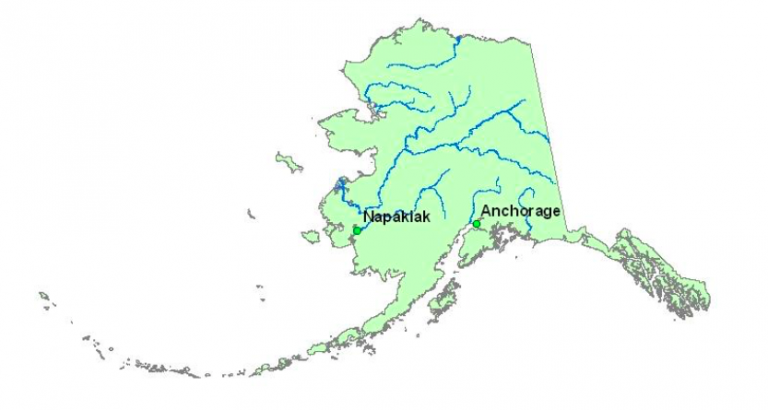
Napakiak, population 367, is on a sandbar on the north bank of the Kuskokwim River,  about 15 miles southwest of Bethel, and about 407 miles west of Anchorage. A dry village, it is populated predominantly by Yup’iks and had first apparent contact with the western world in 1878.

A BIA school began operating in 1939, and by 1946 a Native-owned village cooperative store was opened. The community post office was established in 1951, and the airstrip was completed by 1973.