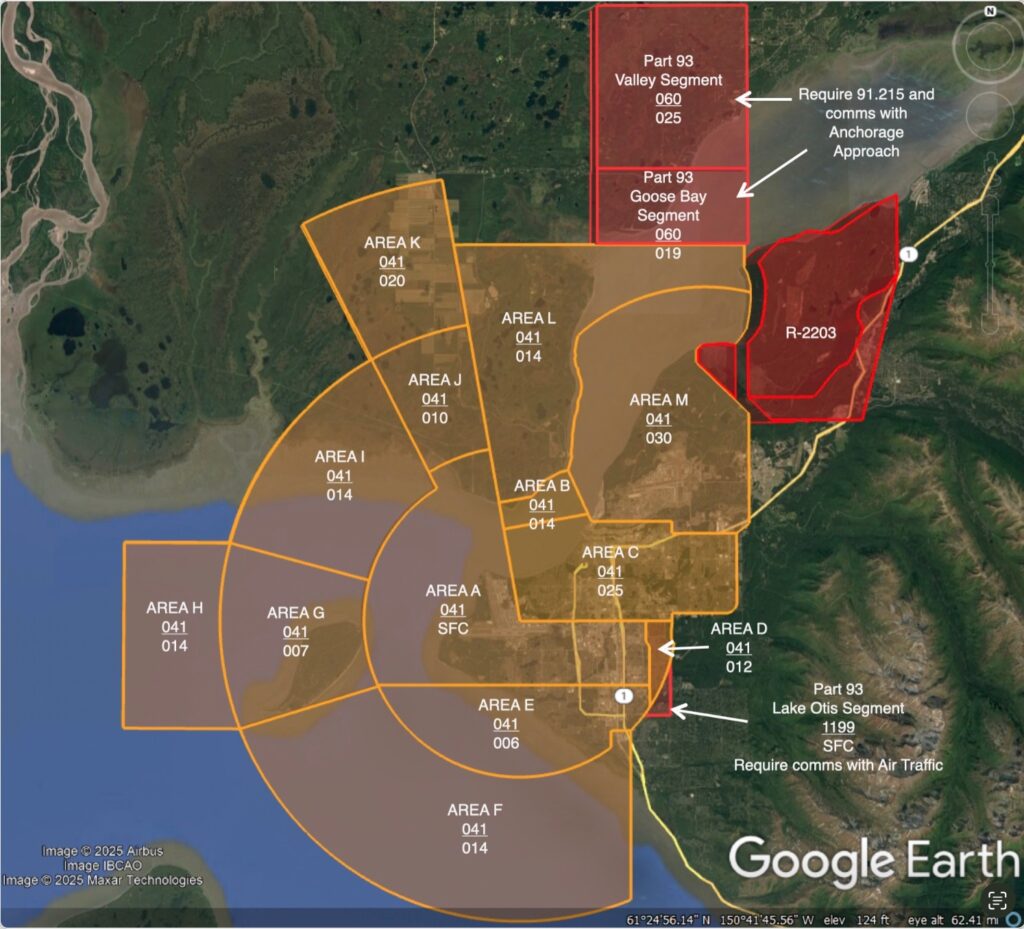
Changes could be on the horizon for pilots flying in and out of Ted Stevens Anchorage International Airport, as the Federal Aviation Administration begins taking public input on a proposal to redraw Class C airspace in the Anchorage area. The changes are expected to be significant in the Anchorage bowl. Pilots will need to do their homework because the patterns will change.
The Federal Aviation Administration will hold two virtual public meetings in September to gather feedback on a proposal to amend Class C airspace at Ted Stevens.
The meetings, set for Sept. 23-24, will air the traffic challenges that may come when the Air Force’s 3rd Wing at Joint Base Elmendorf-Richardson extends runway 16/34 by 2,500 feet and installs an Instrument Landing System, with plans to make it the primary arrival runway.
FAA studies have found that while the upgrades would enhance safety and operational efficiency, they could also cause delays across the region’s airports, including Ted Stevens International, Merrill Field, and Elmendorf.
To mitigate potential impacts, the FAA is reviewing possible redesigns of local airspace and flight procedures. This includes evaluating instrument approaches, air traffic flows, and classifications for Class C and D airspace, as well as special Anchorage Terminal Area flight rules.
Class C airspace is a type of controlled airspace established around airports with moderate traffic levels, such as Ted Stevens Anchorage International Airport, to manage air traffic and ensure safety. It is designed to handle a mix of commercial, general aviation, and sometimes military operations, with specific rules to regulate aircraft movement.
Class D airspace is a type of controlled airspace surrounding airports with an operational control tower but typically lower traffic volume than those with Class B or Class C airspace, such as smaller regional or general aviation airports. It is designed to manage air traffic and ensure safety in the vicinity of these airports. Merrill Field is considered Class D. Lake Hood, the world’s busiest seaplane base, shares a control tower with ANC but operates its own Class D airspace for seaplane and general aviation operations. Its airspace extends from the surface to a similar altitude as Merrill Field’s, with a radius tailored to its operations.
An Ad Hoc Committee led by the Alaska Department of Transportation has helped shape proposed redesigns. Those designs have been shared first through the committee process, with the public’s initial opportunity for feedback coming at the airspace meetings.
Proposed changes to air space in Anchorage.
Meeting attendees will be able to present comments, ask questions, and submit written materials. Both sessions will be recorded and made available on the FAA’s YouTube channel.
Comments can be sent to: Byron G. Chew, FAA Western Service Center, 2200 S. 216th St., Des Moines, WA 98198, or by email to [email protected] (subject line: “ANC Class C”).
A pair of men resembling Secret Service agents were spotted Monday surveying rooftops, cameras, and vantage points in downtown Anchorage, likely scoping out sniper stations and security hazards ahead of this Friday’s historic meeting between President Donald Trump and Russian President Vladimir Putin.
The summit, expected to take place Friday, aims to chart a potential path toward peace in Ukraine. Security preparations are intensifying, with federal teams expected to occupy strategic positions on buildings and parking garages in the days ahead.
But as the security operation ramps up, Mayor Suzanne LaFrance’s administration appears to have made no visible headway in clearing downtown streets of homeless encampments, which present their own hazards.
On Tuesday morning, as on countless mornings before, vagrants could be seen sleeping on sidewalks throughout the city’s core, along the same routes where international journalists, dignitaries, and diplomats will walk this week. Not to mention the Alaska protesters who don’t want peace, as well as protest organizers who will be flown in from out of state.
In advance of a presidential visit, it’s normal for the Secret Service to have meetings with state and municipal officials. Thus, it’s likely that LaFrance has been contacted by the president’s security detail and that requests have been made to secure the downtown area. The Secret Service will also have been working with the Anchorage Police, Alaska State Troopers, and the Governor’s Office.
One particularly stark scene was seen early Tuesday morning by the the Dena’ina Civic and Convention Center, where a man sat on an orange mat beside a charred patch of pavement, evidence of a fire set directly on the sidewalk. Behind him, shopping carts piled with personal belongings stood parked near flower planters. The street people of Anchorage are using the planters for mattresses and toilets.
Must Read Alaska’s Tuesday morning photo tour shows that Anchorage has not figured out where to put all the bodies:
Egan Center entryway.
Visitors center.
Hotels are filling up fast — one night at the Hilton Garden Inn in midtown will set you back $783 on Friday — but there’ just one room left. Friday night at the Home2 Suites by Hilton in midtown is going for $987.
The high-level summit, which is presumed to be in Anchorage and not at some other location in Alaska, is expected to draw global attention, but for now, the most visible reality on the streets is not the arrival of world leaders, it’s the entrenched human crisis that greets visitors at every corner every hour of the day.
A church is facing a $2,500 fine from the City of Montreal for hosting a July 25 worship service without a permit, an event that turned chaotic when anti-Christian protesters threw smoke bombs into the sanctuary.
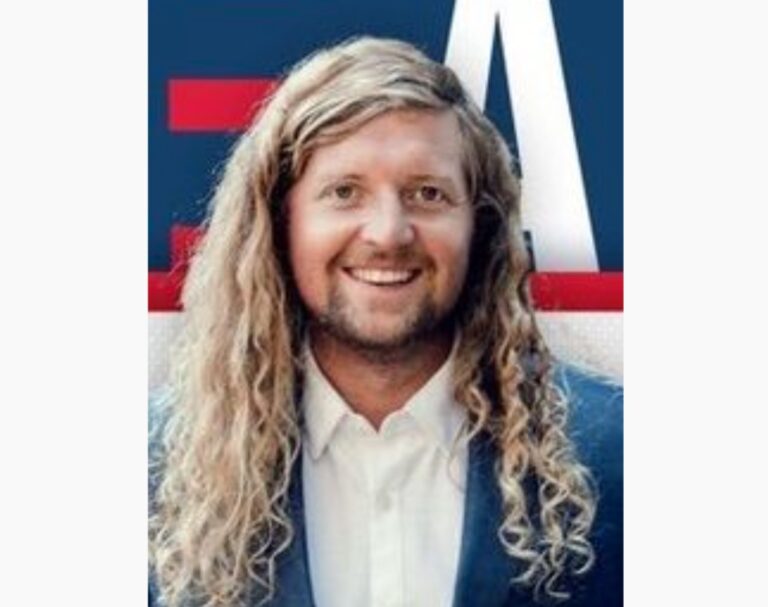
Ministerios Restauración Church had invited American Christian musician and activist Sean Feucht as part of his “Revive in 25” tour. Revival tours are classic Christian events that always include worship music. City officials classified the gathering as a “concert,” requiring a special event permit, which they say the church failed to obtain.
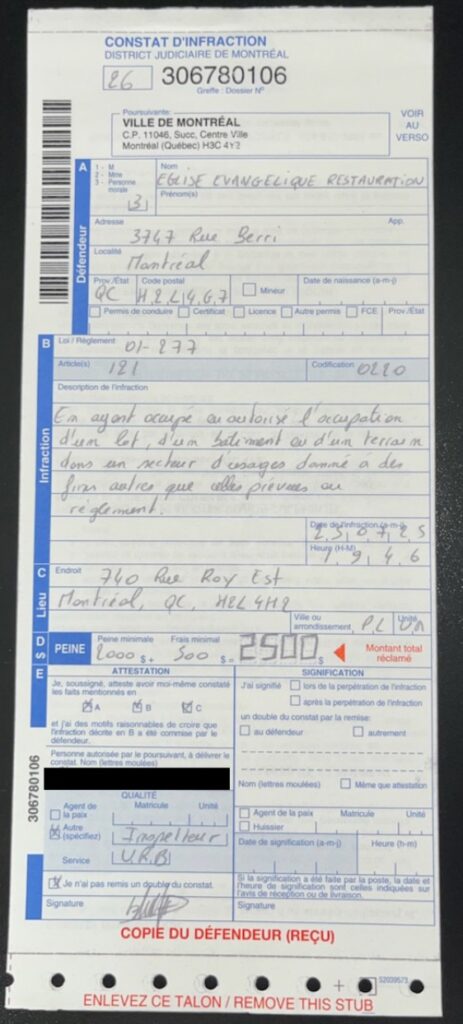
City spokesperson Catherine Cadotte said the fine was issued for violating municipal bylaws regulating use of buildings and land for certain activities. The ticket cites “occupation of a lot, building, or land in a sector of use other than those provided for in the regulations.”
The citation by Montreal police.
While the scene inside the church during the service was peaceful, with a few dozen worshippers singing and praying under the watch of a row of police officers, protests grew outside. According to Rebel News reporter Alexandra Lavoie, Feucht was met by protesters when arriving at the church, and one individual, now identified through video footage as a large man, threw two smoke bombs in at Feucht as he entered. One was detonated inside the building.
“Despite a police presence, the suspect was not detained,” Lavoie reported, adding that security video of the incident has now been made public. There appeared to be little interest in tracking down the suspect, as police seemed more focused on stopping Feucht from speaking.
The Democracy Fund, a Canadian constitutional rights charity, has taken up the church’s legal defense, arguing the fine is an infringement of religious freedom under both the Canadian Charter of Rights and Freedoms and the Quebec Charter of Human Rights and Freedoms.
Mark Joseph, litigation director for the Democracy Fund, accused the city of acting in bad faith. “The state has apparently prejudged this matter, suggesting, improperly and without evidence, that peaceful Christian worshippers were engaged in hate speech. This is highly inappropriate,” Joseph said.
A spokesperson for Montreal’s mayor’s office defended the city’s stance, saying: “This show runs counter to the values of inclusion, solidarity, and respect that are championed in Montreal. Freedom of expression is one of our fundamental values, but hateful and discriminatory speech is not acceptable in Montreal.”
No arrest has been made of the person who threw the smoke bomb inside the church.
Feucht is the founder of the Let Us Worship movement. He ran as a Republican in California’s 3rd congressional district primary in 2020, losing in the primary to Tamika Hamilton.
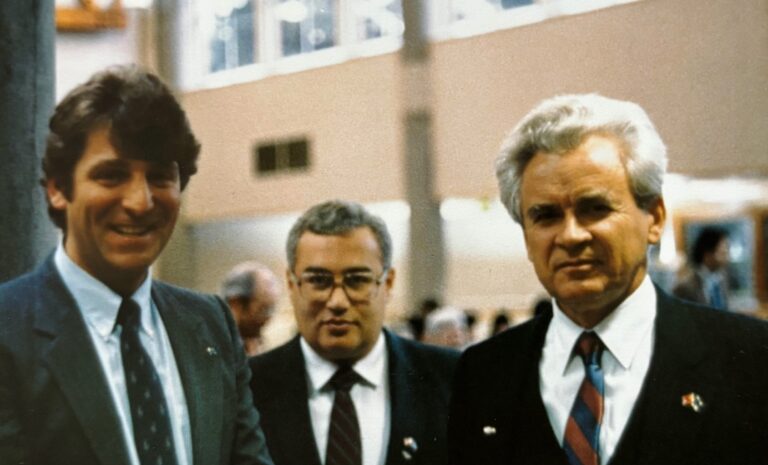
Thirty-five years ago, Mikhail Gorbachev, then president of the Soviet Socialist Republic, was awarded an Honorary Doctorate in Humanities from the University of Alaska Southeast. Then-UAS Chancellor Marshall Lind invited Soviet Ambassador Yuri Dubinin to accept this award on Gorbachev’s behalf.
Dubinin arrived at Juneau with an entourage of six Soviet officials. Back then, I taught Russian Studies and archaeology at UAS and was assigned to accompany the delegation. In fact, Dubinin was the first Soviet ambassador to visit Alaska, post-World War II.
Dubinin was the Soviet ambassador to the United States during much of the turbulent 1980s’ perestroika period. In a Washington post piece, he described himself as a “popularizer of perestroika”— the radical reform efforts of Gorbachev.
In Alaska, the mid-1980s through 1990s was an enthusiastic period of the Soviet/Russian–Alaska relationships in nearly all cultural, educational and governmental spheres. I was a busy person, translating, almost daily, for all involved in the Russian-Alaska affairs; the enrollment in my Russian language classes at UAS was over the limit, with a long waiting list. Indeed, it was a promising hope to end Cold War tensions and begin a new era of mutually productive and friendly relationship between two great nations.
Nevertheless, whether under Soviet/Russian leadership of Khrushchev, Brezhnev, Chernenko, Andropov, Gorbachev, Yeltsin or Putin, the West never stopped its Cold War policies of undermining USSR/Russia. In the late 1970s, President Jimmy Carter provided military and logistical support to the Afghan Mujahideen, the precursor to the Taliban, thereby provoking Soviet invasion of Afghanistan in 1979.
In fact, every successive U.S. president continued covert and overt interference in countries on Russia’s southern borders, including former Soviet Central Asian republics, Georgia and Ukraine.
The ideological architect of the strategy to contain the Soviet Union during Carter presidency was Zbigniew Brzezinski, national security advisor and antagonist of the Soviet regime. Indeed, Ukraine played a pivotal role in the so-called Brzezinski Doctrine, which identifies the country as key to preventing Russian–European economic and political integration. Still today, the U.S. foreign establishment is rife with Brzezinski proteges and anti-Russian Cold War ideology.
With Ukraine, because of Brzezinski’s anti-Russian ideology, the West made a major strategic bet that eventually failed. The crippling sanctions against Russia since 2014 were expected to crater the Russian economy, resulting in a popular uprising and leading to the replacement of Vladimir Putin with a pro-Western leader. The hope was that this wishful dream would lead to a pro-Western globalist taking control of the Kremlin, resulting in a boon for Wall Street, as Russia is the richest country in the world in terms of natural resources.
With the growing demand for natural resources, Russia represents a rich investment opportunity in the unforeseen future. However, these Western sanctions against Russia completely failed. In 2024, European Union’s GDP grew 1.7%, while Russia’s grew 4.2%.
Soon after the dissolution of the Soviet Union—as early as 1993—President Bill Clinton started pushing for NATO expansion in Europe, including Ukraine, to which many strategically thinking American sociologists and historians strongly objected. This is how the slippery road to the current crisis might escalate into potential nuclear conflicts.
After gaining its independence in 1991, Ukraine could expect a bright future. At that time, Ukraine (with exception of Russia) was the largest country (territory) in Europe, with a population of 52 million citizens, and sixth largest GDP in Europe. Today, population of Ukraine is under 30 million citizens, and it is the poorest country in Europe by GDP per capita.
Having vital industrial and agricultural sectors, a favorable climate, and fertile land, the country needed effective anti-corruption reforms, a certain level of autonomy for its regions with large Russian ethnic populations, and, most importantly, neutral status with no membership in any military blocs to become one of the most prosperous European states within its 1991 borders.
Instead, billions of dollars from the Western countries, and George Soros poured into Ukraine—not to boost its economy but to reformat public opinion, which overwhelmingly favored neutral status and opposed joining NATO. This influence from the West helped to instigate the “Orange” revolution regime change in 2004, and then “Maidan” in 2014, which was directly coordinated by then-Vice President Joe Biden with Victoria Nuland from the White House in the Ukrainian capital Kyiv.
The new Ukrainian government, selected by Washington and the West, immediately declared its intention to join NATO. In fact, if not for this 2014 coup, there would be no annexation of the Crimean Peninsula by Russia in 2014, no war today in East Ukraine, and no risk of potential nuclear World War III.
In short, the Western policies of using Ukrainians as cannon fodder to inflict a strategic defeat on Russia denigrates and contradicts the fundamental spirit and soul of America itself. While claiming to adhere to Western/Judeo-Christian values, the West provoked and continues to fund a prolonged war between two nations that have lived together for over three centuries and are bound together by close historical, linguistic, religious, economic, cultural, and family ties.
No one can predict how the Russian-Ukrainian/West conflict will end, but as the drums of World War III keep banging, those who are not among decision-makers or on the battlefields should at least try to clear the smog of this war.
Forthcoming meeting between President Trump and President Putin in Alaska on August 15 is a step in the right direction to achieve peace in the Russian-Ukraine conflict. Certainly, both presidents may have different views on this matter, and they may not succeed to their goal and expectations. However, if they won’t try, then they definitely will not succeed to end this conflict.
Alexander Dolitsky was born and raised in Kiev in the former Soviet Union. He received an M.A. in history from Kiev Pedagogical Institute, Ukraine in 1976; an M.A. in anthropology and archaeology from Brown University in 1983; and enrolled in the Ph.D. program in anthropology at Bryn Mawr College from 1983 to 1985, where he was also lecturer in the Russian Center. In the USSR, he was a social studies teacher for three years and an archaeologist for five years for the Ukrainian Academy of Sciences. In 1978, he settled in the United States. Dolitsky visited Alaska for the first time in 1981, while conducting field research for graduate school at Brown. He then settled first in Sitka in 1985 and then in Juneau in 1986. From 1985 to 1987, he was U.S. Forest Service archaeologist and social scientist. He was an Adjunct Assistant Professor of Russian Studies at the University of Alaska Southeast from 1985 to 1999; Social Studies Instructor at the Alyeska Central School, Alaska Department of Education and Yukon-Koyukuk School District from 1988 to 2006; and Director of the Alaska-Siberia Research Center from 1990 to 2022. From 2006 to 2010, Alexander Dolitsky served as a Delegate of the Russian Federation in the United States for the Russian Compatriots program. He has done 30 field studies in various areas of the former Soviet Union (including Siberia), Central Asia, South America, Eastern Europe and the United States (including Alaska). Dolitsky was a lecturer on the World Discoverer, Spirit of Oceanus, and Clipper Odyssey vessels in the Arctic and Sub-Arctic regions. He was a Project Manager for the WWII Alaska-Siberia Lend Lease Memorial, which was erected in Fairbanks in 2006. Dolitsky has published extensively in the fields of anthropology, history, archaeology and ethnography. His more recent publications include Fairy Tales and Myths of the Bering Strait Chukchi, Ancient Tales of Kamchatka, Tales and Legends of the Yupik Eskimos of Siberia, Old Russia in Modern America: Living Traditions of the Russian Old Believers in Alaska, Allies in Wartime: The Alaska-Siberia Airway During World War II, Spirit of the Siberian Tiger: Folktales of the Russian Far East, Living Wisdom of the Russian Far East: Tales and Legends from Chukotka and Alaska, and Pipeline to Russia: The Alaska-Siberia Air Route in World War II.
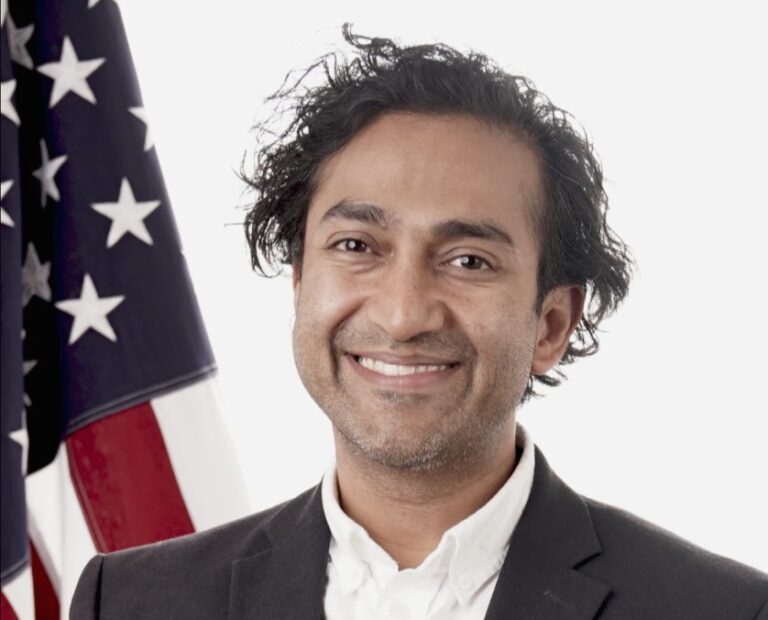
Dr. Vinay Prasad, a nationally known hematologist-oncologist, took the helm of the FDA’s powerful Center for Biologics Evaluation and Research in early May. It was a position with vast influence over vaccines and other biologics.
Just two months later, he abruptly resigned amid a coordinated smear campaign involving Big Pharma, right-wing firebrand Laura Loomer, and critical Wall Street Journal editorials.
Behind the scenes, whispers claimed President Donald Trump wanted him gone, even though Health and Human Services Secretary Robert F. Kennedy Jr. and FDA Commissioner Dr. Marti Makary urged him to stay.
Prasad, unwilling to let political drama eclipse the FDA’s mission, stepped aside “to avoid being a distraction,” saying he planned to return to California and spend more time with his family. In doing so, he put the institution and the nation ahead of himself.
But less than two weeks later, he’s back. At Makary’s urging, the White House reinstated Prasad after reviewing the comments Loomer had branded as “disloyal” to Trump. The verdict? There was no “there” there, as Gertrude Stein might put it.
The official announcement by HHS spokesperson Andrew Nixon was, “Dr. Vinay Prasad is resuming leadership of the Center for Biologics Evaluation and Research. Neither the White House nor HHS will allow the fake news media to distract from the critical work the FDA is carrying out under the Trump Administration.”
Of course, Loomer had to respond with a post on X (formerly Twitter) which said this was an “egregious personnel decision” and then went on to say she plans to “(ramp) up my exposures of officials within HHS and FDA” in the coming weeks.
Big Pharma is watching Prasad’s return closely. It’s uncertain how this will impact Sarepta Therapeutics, which recently had strong disagreements with the FDA over its Duchenne Muscular Dystrophy drug Elevidys before Prasad resigned last month. Interestingly, two days after Prasad resigned, the FDA approved Elevidys for ambulatory DMD patients. Sarepta was allowed to resume shipments, which caused its stock to soar.
And Big Pharma doesn’t know the effect on Pfizer and Moderna, now that the Covid boosters are being restricted to those at risk and those over 65 years old.
Yes, you can still get the jab if you don’t meet those criteria, but will your health insurance company pay for it? You may have to pay in more than one way.
Now let’s get to what’s most important-our children and vaccines. How do we ensure that our children’s vaccines are safe and effective? Why is it we give more vaccines to our children than any other country? Why do we vaccinate our children with vaccines that other countries won’t give due to safety concerns?
It always goes back to follow the money. Somehow the Hippocratic Oath that says “First do no Harm” is not as important as the bottom line.
Linda Boyle, RN, MSN, DM, was formerly the chief nurse for the 3rd Medical Group, JBER, and was the interim director of the Alaska VA. Most recently, she served as Director for Central Alabama VA Healthcare System. She is the director of the Alaska Covid Alliance/Alaskans 4 Personal Freedom.
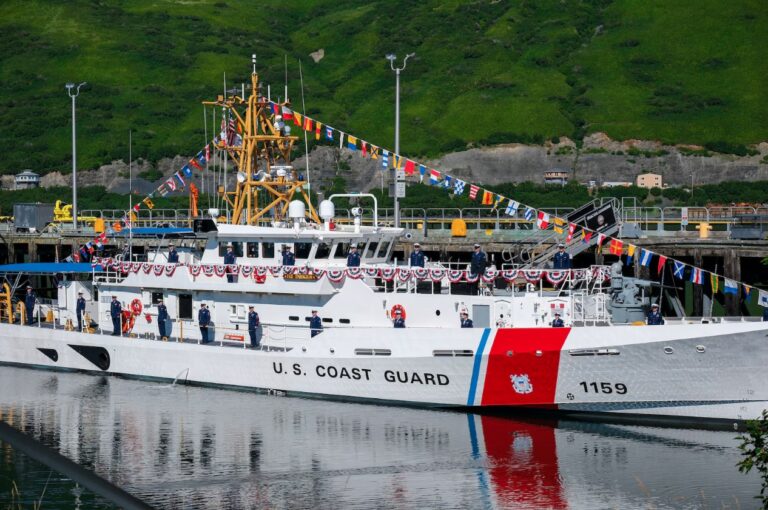
Just one day after the ceremonial commissioning of the icebreaker Storis in Juneau, the US Coast Guard welcomed another vessel into its Alaska fleet, officially commissioning the Coast Guard Cutter Earl Cunningham during a ceremony Monday at Coast Guard Base Kodiak.
Acting Coast Guard Commandant Adm. Kevin Lunday presided over the ceremony, which was attended by members of the Cunningham family, including the ship’s sponsor, Penney Helmer, granddaughter of the cutter’s namesake.
“Commissioning the USCGC Earl Cunningham strengthens our ability to control, secure, and defend Alaska’s U.S. border and maritime approaches, protect resources vital to our economic prosperity, and respond to crises throughout the Aleutian Islands,” Lunday said. “This crew will honor the heroic legacy and selfless devotion to duty exemplified by Petty Officer Cunningham in the years ahead.”
The Earl Cunningham is the 59th Fast Response Cutter in the service and the second of three slated to be home-ported in Kodiak. Its crew will operate primarily in the Aleutian Islands, Bering Sea, Gulf of Alaska, and North Pacific Ocean, carrying out missions such as search and rescue, fishery patrols, drug and migrant interdiction, national defense, and ports, waterways, and coastal security.
The cutter honors Petty Officer 2nd Class Earl Cunningham, who enlisted in the Coast Guard in 1928 after serving in World War I. On Feb. 8, 1936, Cunningham volunteered to rescue two ice fishermen trapped in the frigid waters of Lake Michigan. He reached them in a skiff and pulled them aboard, but severe weather stranded the group on the ice. Three days later, one fisherman made it to shore alive; the other died trying. Cunningham was found frozen in place at the oars of the skiff.
For his sacrifice, Cunningham was posthumously awarded the Gold Lifesaving Medal. He left behind his wife, Helen, and three sons.
The new cutter is part of the Coast Guard’s modernization effort to replace its aging 1980s-era Island-class patrol boats. Backed by the largest single funding commitment in Coast Guard history, nearly $25 billion through President Donald Trump’s One Big Beautiful Bill Act, including $1 billion for additional Fast Response Cutters, the vessels boast advanced communications, surveillance, and over-the-horizon deployment capabilities. They are a key component of Force Design 2028, an initiative launched by Secretary of Homeland Security Kristi Noem to build a more agile and responsive Coast Guard.
The commissioning marks the Earl Cunningham’s joining active service, with a mission ranging from saving lives to defending America’s maritime borders.
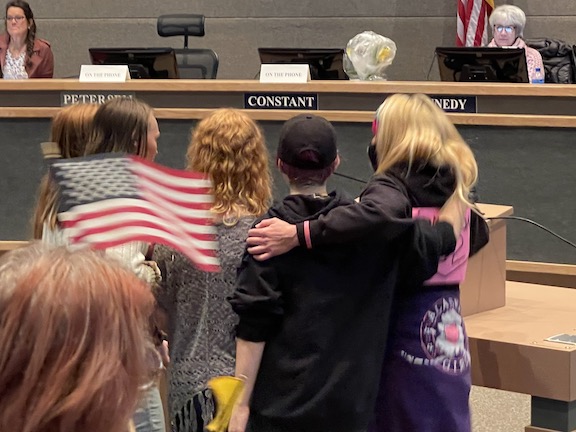
The Anchorage Assembly is set to take up a resolution at Tuesday’s regular meeting that could reshape how the city uses and manages its rapidly expanding network of traffic cameras.
The proposal by Chair Chris Constant, titled “A Resolution of the Anchorage Assembly Regarding the Implementation and Use of Traffic Cameras and Traffic Camera Recordings Throughout the Municipality,” comes from his concerns over pedestrian safety as well as individual privacy.
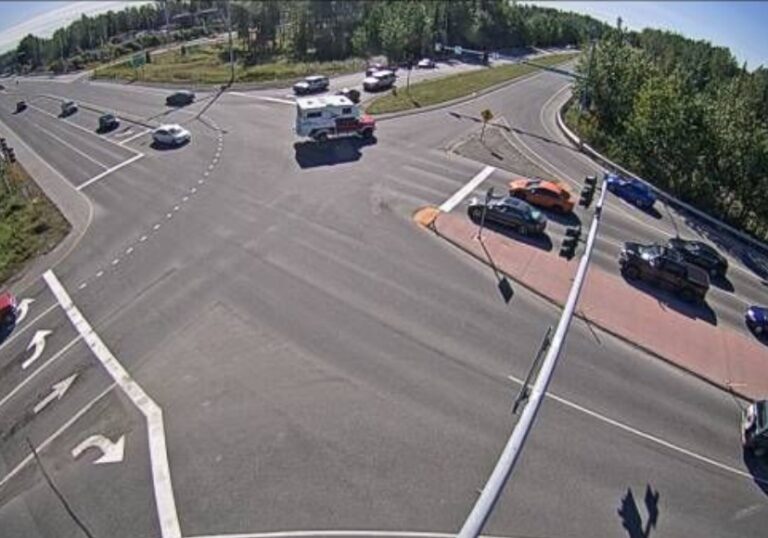
Anchorage recorded a grim milestone in 2024 — 15 pedestrians were struck and killed on city streets, the highest number on record. The pace has continued into 2025. In response to rising fatalities, the municipality has expanded its traffic camera program, installing cameras at 283 traffic signals since 2017 and on track to have them at every intersection by the end of summer, according to the Municipal Traffic Department. That does not include the state cameras installed on state-maintained road.
While city officials have promoted the program as a public safety tool, the resolution notes that the “ubiquitous employment of cameras” raises “serious concern for the privacy rights of the people of Anchorage and the visitors to our hometown.” It cites both the US Constitution and the Alaska Constitution’s unusually strong privacy protections, as well as past allegations of municipal misuse of surveillance footage, including within City Hall.
Currently, the city has no published policy governing how traffic camera footage is stored, accessed, or released. The resolution calls for the mayor’s administration to develop, adopt, and publicly release such a policy by Oct. 15, coinciding with the completion of the citywide installation of the remaining traffic cameras.
The proposal outlines two core principles for the new rules:
Transparency and public accountability for municipal actions.
Protection of individual privacy rights, including for crime suspects.
Among the specific features Constant wants included are:
Explicit limits on which municipal employees may access cameras and review footage.
Clear procedures for storage, release, and eventual destruction of recordings.
Safeguards to prevent misuse of footage for political or personal purposes.
If approved, the resolution would take effect immediately. The meeting begins at 5 pm in the Assembly Chambers at the Loussac Library, 3600 Denali St.
The Anchorage Assembly will hold public hearings on a series of ordinances and resolutions at its regular meeting Tuesday, Aug. 12. The public hearing portion of the meeting begins at 6 pm in the Assembly Chambers at the Z.J. Loussac Library, 3600 Denali St.
Here’s a list of items up for comment:
AO 2025-59 — Updates to the Anchorage Municipal Code on access to public records and procedures for responding to records requests. The new rules would make it more difficult to access public documents. (Assembly Chair Chris Constant, former Vice Chair Meg Zaletel)
AO 2025-83 — Increases the maximum fee that may be charged for processing credit and debit card transactions for taxicab services. (Assembly Member Felix Rivera, Vice Chair Karen Brawley)
AO 2025-85 — Repeals and replaces the bar safety hour program code section, eliminating the application, review, and issuance process, discontinuing annual reports, and adding a bar safety hour registration requirement. (Assembly Chair Chris Constant)
AR 2025-218 — Reappropriates up to $5.6 million from 2024 Port Revenue Bond proceeds for bond issuance costs, transferring funds from the Port of Alaska Capital Improvement Fund to the Port of Alaska Operating Fund. (Public Finance Department)
AO 2025-87 — Modifies, eliminates, and adds fees for entitlements within Title 21 not currently listed in the fee schedule. (Planning Department, Case No. 2022-0016)
AO 2025-89 — Authorizes a three-year lease (below fair market value) with two one-year extensions between the Municipality and the Anchorage Community Development Authority for a parking lot at 225 E St. downtown. (Real Estate Department)
AR 2025-220 — Appropriates up to $2.5 million from the Heritage Land Bank Fund for Holtan Hills offsite improvements. (Real Estate Department)
AR 2025-221 — Appropriates another $1.3 million for homeless shelter and support to the Anchorage Health Department. (Office of Management and Budget)
AR 2025-221(S) — Appropriates $1.3 million for rehabilitating vacant and abandoned properties which would be seized to help transition people out of emergency shelters. (Assembly Chair Chris Constant, Assembly Member Daniel Volland)
AR 2025-229 — States the Assembly’s conditional protest of the renewal of Municipal and State marijuana cultivation license #30782 for Wobbly Moose LLC in Fairview.
AR 2025-230 — States the Assembly’s conditional protest of the renewal of State marijuana cultivation license #12125 and manufacturing license #12471 for Alaska Wild Coyote Inc., dba Alaska Marijuana Gardens and AMG Concentrates, in the Taku/Campbell area.
How to participate The Assembly accepts testimony in person, in writing, or by phone. Written or phone testimony requires submitting the Public Testimony Form by 5 pm the day before the meeting.
The Alaska Legislature’s passage of House Bill 57 reflects a familiar but flawed approach to educational improvement: raise the Base Student Allocation and add targeted programs without confronting the systemic inefficiencies that undermine return on investment.
While the bill addresses class-size caps, reading incentives, and charter school processes, the FY 2024 audited revenue data (found under “Annual Revenue 2024” link at https://education.alaska.gov/schoolfinance/budgetsactual) show that Alaska’s education system is not uniformly underfunded. The real challenge is uneven spending patterns, weak accountability, and the absence of performance-linked incentives.
For major municipal districts, per-pupil operating revenue is already substantial:
Anchorage: $16,662 per ADM at 42,764 Total enrollment (average daily membership, or ADM)
Fairbanks: $17,757 per ADM at 12,452 Total ADM
Kenai Peninsula: $19,778 per ADM at 8,301 Total ADM
These figures represent almost 50% of the state’s ADM and 41.22% of all state education revenue drawn from local, state, and federal sources. These are comparable to or higher than many high-performing U.S. districts. Yet outcome disparities persist, and past BSA increases have not translated into proportional gains in student achievement.
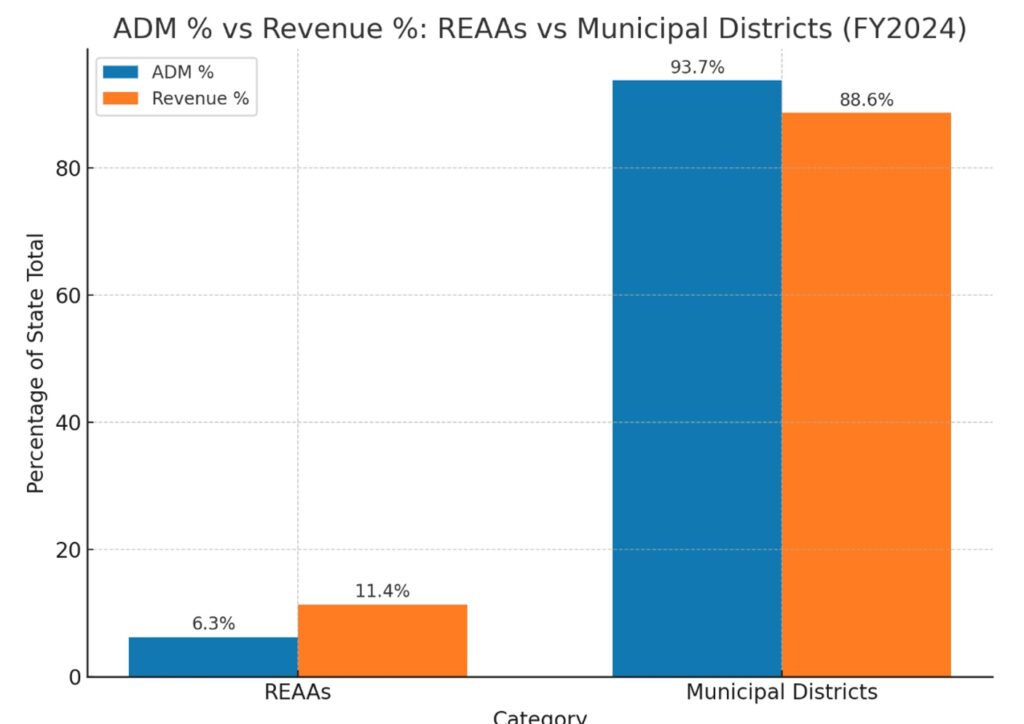
For REAAs, which account for 6.27% of total ADM and 11.39% of total education revenue, per-ADM figures vary widely: small, remote systems can exceed $100,000 per student due to scale penalties and high-cost federal programs; others are closer to urban levels. Unlike municipal districts, REAAs have no local tax base, relying almost entirely on state and federal funding plus Special Revenue Funds.
Why HB 57’s Approach Is Misaligned
While HB 57 creates a “Task Force on Education Funding”, it leans heavily on traditional inputs:
Increased BSA
Expanded vocational/technical funding factor
Reading incentive grants
Transportation formula changes
What it does not do is link these increases to:
Teacher contract flexibility
Outcome-based budgeting
Accountability for professional development spending
Innovation pilots in underperforming schools
For municipal districts, this means perpetuating inefficiencies where local revenue could be leveraged for innovation. For REAAs, this means applying uniform funding increases to non-uniform realities, ignoring scale, remoteness, and staffing constraints.
Paths Forward by Governance Type
1. Negotiate Performance-Linked Incentives (PLIs)
Municipal Districts: As part of collective bargaining agreements, municipal school districts should tie step increases or stipends to gains in reading/math proficiency, attendance, graduation rates, and reduced remedial coursework. Local tax authority can support targeted incentive funds.
REAAs: As part of collective bargaining agreements, the Alaska legislature should use school-wide bonuses tied to K–3 reading gains, attendance, and on-time credit accrual. Include hard-to-staff premiums for SPED, STEM, and secondary math, structured as retention bonuses.
2. Develop Innovation Pilots via Memorandum of Understanding
Municipal Districts: Create “pilot zones” with flexible staffing and compensation models. Test competency-based classrooms or alternative schedules in underperforming schools without full contract renegotiation.
REAAs: Pilot multi-age competency groups, hybrid teacher/para models, extended-year terms, and community-embedded career and technical education. Use short, renewable MOUs with clear metrics to minimize risk.
3. Incentivize Upskilling of Support Staff
Municipal Districts: Integrate para-to-teacher pipelines into collective bargaining agreements, focusing on shortage areas. Use local funding to underwrite coursework and credentialing.
REAAs: Build special education para II/III tiers and offer stipends for lead paraprofessionals. Service-year commitments can stabilize staffing where recruiting externally is costly and slow.
4. Link Professional Development to Outcomes
Municipal Districts: Require professional development vendors to include pre/post instructional measures, tie renewals to demonstrated student gains, and align training with district goals.
REAAs: Adopt a “rule of three” for professional development: pre/post measures, in-class coaching, and a 90-day evidence review. Focus on universal screener growth in reading/math.
5. Engage Legislators for Flexibility
Municipal Districts: Advocate for Public Employment Relations Act (PERA) amendments to allow merit pay pilots and efficiency-linked bargaining exceptions. Seek targeted opt-outs from rigid salary structures.
REAAs: Request waivers for small-cohort scheduling, tele-service credit for special education, and fast-track approvals for micro-school charters or innovation schools.
Financing the Shift Using FY 2024 Data
Municipal Districts: Reallocate a portion of professional development budgets to outcome-linked training. Fund incentives from efficiency gains, reduced turnover, and targeted use of local dollars.
REAAs: Redirect special revenue funds allocations to para-to-teacher pipelines. Use savings from reduced itinerant travel and vacancy churn to underwrite PLIs and retention bonuses.
The Special Revenue Fund Illusion and the False Case for Municipal Property Tax Increases
In FY 2024, municipal school districts, Anchorage, Fairbanks, and Kenai Peninsula, controlled nearly half of the state’s ADM but drew in 38.34% of all state education revenue, before factoring in their substantial local contributions through property taxes and in-kind contributions. Alongside their state and local funds, they also received tens of millions in Special Revenue Funds (SRF):
Anchorage: $95 million SRF
Fairbanks: $26 million SRF
Kenai Peninsula: $23 million SRF
School District
ADM
Total Revenue ($)
Per ADM Revenue ($)
Local Contribution ($)
Special Revenue Funds ($)
Anchorage
42,764
687,656,244
16,080
221,038,822
95,165,535
Fairbanks
12,452
210,732,243
16,924
55,164,201
26,475,110
Kenai Peninsula
8,301
156,904,011
18,902
54,753,114
23,710,637
Special revenue funds include restricted-use federal and state categorical grants (Title I, IDEA, Impact Aid, targeted reading and CTE grants) that, while not fully fungible, still offset costs that would otherwise be paid from general operating funds.
Under AS 14.17.410(b)(2), municipalities are already required to make a “required local contribution” based on taxable property value. HB 57 layers additional state funding on top, through a 12 % BSA increase, expanded vocational/technical allocations, reading proficiency incentives, and adjusted transportation subsidies. This inflow arrives without any mandate for offsetting property tax relief or demonstrable efficiency gains.
The result is local governments can claim “budget gaps” that justify tax increases even as per-ADM revenues, when special revenue funds are included, are on par with or above those in high-performing states. Property tax hikes are thus politically framed as necessary to protect educational quality, when in reality:
Special revenue fund growth reduces the burden on unrestricted local dollars for targeted programs.
HB 57 injects significant new state revenue without requiring reform.
Historic revenue increases have failed to deliver proportional academic improvements.
This creates a false justification for property tax increases: voters are told schools are underfunded, when the data show funding has grown substantially, but without performance-linked reforms to ensure the dollars produce better outcomes.
Conclusion
HB 57’s “fund first, reform later” posture risks reinforcing the same inefficiencies that keep Alaska’s achievement stagnant. The FY 2024 data show that both municipal districts and REAAs need incentive-driven, performance-focused reforms, but the levers differ.
For municipal districts, the narrative that property tax hikes are unavoidable is undermined by the fiscal reality:
Per-ADM revenues are already substantial.
Special Revenue Funds (SRF): Tens of millions in federal and state categorical grants offset targeted costs that would otherwise be borne by unrestricted local funds.
HB 57 injects significant new state revenue without requiring any efficiency benchmarks, outcome-based budgeting, or property tax offsets.
The result is a political framing in which voters are told schools are “underfunded” while, in truth, the total revenue picture, including special revenue funds, places Alaska’s major municipal districts at or above the per-pupil funding levels of many high-performing states. This creates a false justification for property tax increases: the call for more local taxation is driven less by genuine fiscal shortfall and more by a policy choice to preserve inefficient structures without demanding measurable results.
For REAAs, the problem is different. They lack a local tax base, rely heavily on volatile state and federal funds, and face structural cost penalties due to remoteness and scale. Uniform Base Student Allocation (BSA) increases are a blunt tool in this context, failing to address chronic staffing shortages, high turnover, and the logistical burdens of service delivery.
In both cases, the path forward is not simply more money, but better alignment of funding with measurable outcomes:
Performance-linked incentives
Innovation pilots tailored to local realities
Professional development tied to demonstrable classroom impact
Legislative flexibility to escape one-size-fits-all mandates
Only by coupling funding to results, and by rejecting the property tax “necessity” myth where special revenue fund and state increases already close much of the gap, can Alaska ensure that every additional dollar delivers a clear return in student achievement.