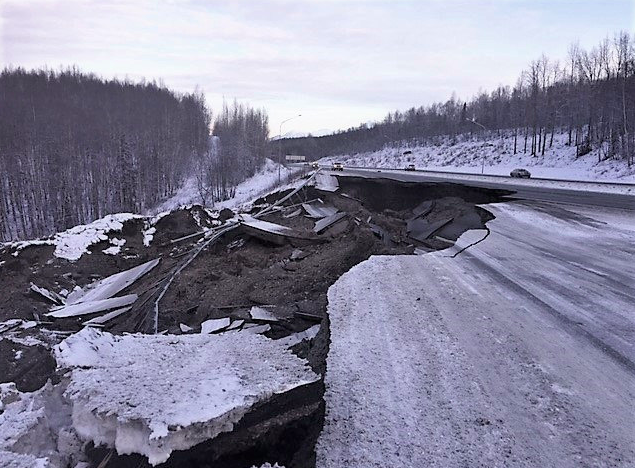
The Alaska Earthquake Center revised the Nov. 30, 2018 Southcentral Alaska earthquake from magnitude 7.0 to 7.1.
In the three months since the earthquake, data was reviewed by numerous agency and academic groups.
“These evaluations are in fairly good agreement and all converge near 7.1,” said Michael West, director of the Alaska Earthquake Center.
There are many ways to calculate the magnitude of an earthquake, he explained. The modern standard for large earthquakes relies on the concept of “seismic moment” — a measure that accounts for the size of a rupture, how far it moves, and the friction.
[Watch this 5-minute explainer video from the IRIS Consortium]
Seismic moment can be estimated by different combinations of seismic waves and analysis techniques, which lead to slight variations in the magnitude estimate.
There are now more estimates of the magnitude available than right after the earthquake, and most of these tilt toward 7.1, due to the convention of rounding the number — and because anything less than a tenth of a unit of magnitude is not meaningful.

At larger magnitudes, such as over 8, the addition of a tenth of a magnitude has more impact.
The 1964 earthquake was for many years considered to be magnitude 8.4-8.5. It wasn’t until the seismic moment technique (described above) was developed that it was revised to 9.2, although that is still debated among those who study these topics.