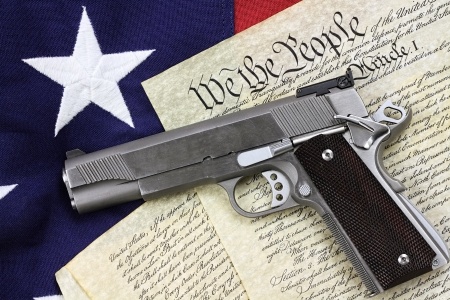
Democrat Colorado Gov. Jared Polis on Friday signed Senate Bill 25-003 into law, enacting a new “permit-to-purchase” system for certain semi-automatic firearms.
The signing ceremony was held behind closed doors with a selected group of gun control advocacy groups in attendance.
The new law establishes a framework that requires Coloradans to obtain a permit before purchasing specific semi-automatic firearm platforms, which are now subject to restrictions.
To qualify for the permit, applicants must complete a 12-hour educational course. The legislation also delegates oversight of the training requirements and permitting process to Colorado Parks and Wildlife, while placing additional permission responsibilities on local sheriff’s departments that now have the authority to sign off on the gun ownership.
The passage of SB 25-003 followed months of heated debate. Tens of thousands of Coloradans have voiced their opposition, but the state has gone Democrat in recent years, and Democrats are generally opposed to private gun ownership.

The first commercially successful semi-automatic rifle has been around since 1885. The Mannlicher Model 1885 was developed and patented by Ferdinand Mannlicher in Austria. Early semi-automatic pistols, like the Schönberger-Laumann, emerged around 1892, followed by designs such as the Borchardt C93 in 1893 and the iconic Luger in 1898. These have been in the hands of American citizens for over 140 years. But over the past few decades, Democrats have sought to take them away from civilians and allow only military and law enforcement to have such firearms.
Semi-automatic firearms are widely used in Alaska by hunters. For example, in subsistence hunting among Alaska Native communities, semi-automatics are useful for their reliability and speed when targeting seals, which often only surface briefly.
The bill is described more fully at this Colorado General Assembly link.
It’s almost certain that the bill, now that it is law, will be challenged on constitutional grounds.