
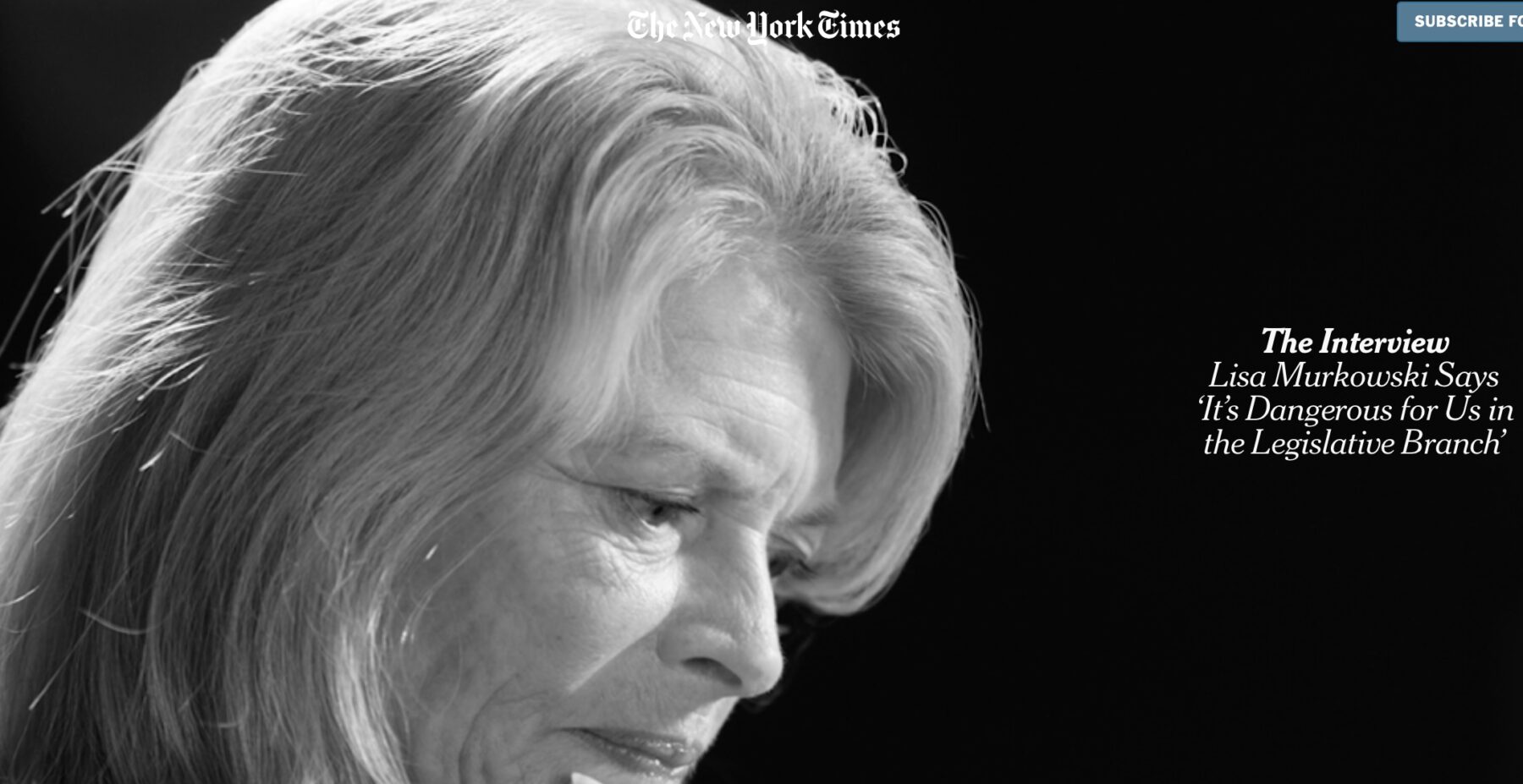
In an hour-long interview with The New York Times Magazine, published on June 14, a fearful-sounding Sen. Lisa Murkowski of Alaska reflected on her decades-long career, her bleak view of the Republican Party, and the challenges facing Alaska.
“I’m oftentimes very anxious myself about using my voice, because retaliation is real,” she said, rephrasing comments she made earlier this year.
In April, during a conference with nonprofit leaders in Anchorage, she drew national headlines when she stated, “we are all afraid” and “retribution is real.”
Now it’s also perceived retaliation, which is an action driven by revenge or “getting even,” while retribution is considered a more formal, state-administered, response that is more proportional.
“It’s dangerous for us in the legislative branch,” she said to the interviewer.
The conversation with the newspaper comes just ahead of the release of her memoir, Far From Home, expected later this month. In recent months, after she announced her book would be published, she has been ever-present in the media, a tactic used by many authors to grow a readership for their books.
Murkowski reiterated that she has never voted for President Donald Trump and that she endorsed Nikki Haley during the 2024 Republican primaries. In the interview, she criticized the GOP’s continued alignment with Trump and pointed to a culture of fear within the party. She recalled moments where Republican lawmakers hesitated to speak out due to concerns about political retaliation.
She highlighted her record of bucking party leadership, including her vote against repealing the Affordable Care Act in 2017 and her opposition to Trump’s nomination of Pete Hegseth for secretary of Defense. She did vote for Biden’s pick for Defense, Lloyd Austin, and Trump’s first-term Defense Sec. James Mattis.
Murkowski used the interview to spotlight Alaska’s vulnerability to changes in federal funding. She said an estimated 37% of the state’s budget tied to federal programs, which makes her concerned about proposed cuts under Trump’s new budget plan, the Big Beautiful Bill, now in front of the US Senate for consideration.
According to Murkowski, those proposals have already resulted in funding freezes and layoffs, triggering protests in Alaska. These are protests she tacitly encouraged in April, when she spoke to the nonprofit conference, telling the audience, “Be affirmative in your protesting to support the programs you want to see preserved. I think it’s important the concerns continue to be raised rather than letting the fatigue of the chaos grind you down.”
Regarding the budget cuts, she told the newspaper, “I come from a state where we have, on a per capita basis, more federal workers than most any other state. So to come in and tell these people that have been helping us with everything from permitting a mine to the visitor’s center at the Mendenhall Glacier and telling them, sorry, your services are no longer warranted. That’s not how we operate here. So it’s been a rocky, rocky five months with dealing with some of what we saw with the DOGE effort,” she said.
Murkowski also discussed her opposition to elements of Trump’s proposed “Big, Beautiful Bill,” including Medicaid cuts and the phaseout of green energy tax credits. The bill attempts to make it harder to scam Medicaid, which is a program that is riddled with fraud, with estimates that the fraud costs taxpayers $22 billion to $73 billion a year.
She expressed alignment with fellow senators Josh Hawley and Susan Collins, who also support Medicaid fraud. Murkowski warned that the proposals could disproportionately impact Alaska, which she noted already face challenges in healthcare access and energy development. She did not explain the prevalence of very suspect invoices submitted to Medicaid by the Native medical providers in the state, nor the need for an overhaul of the Medicaid system.
Her forthcoming memoir, Far From Home, recounts key moments in her career, including her historic 2010 write-in campaign victory after losing the Republican primary to Joe Miller. The book covers her 23 years in the Senate and offers insight into navigating Washington.
The full transcript of her interview can be read here at Apple Podcasts.


