
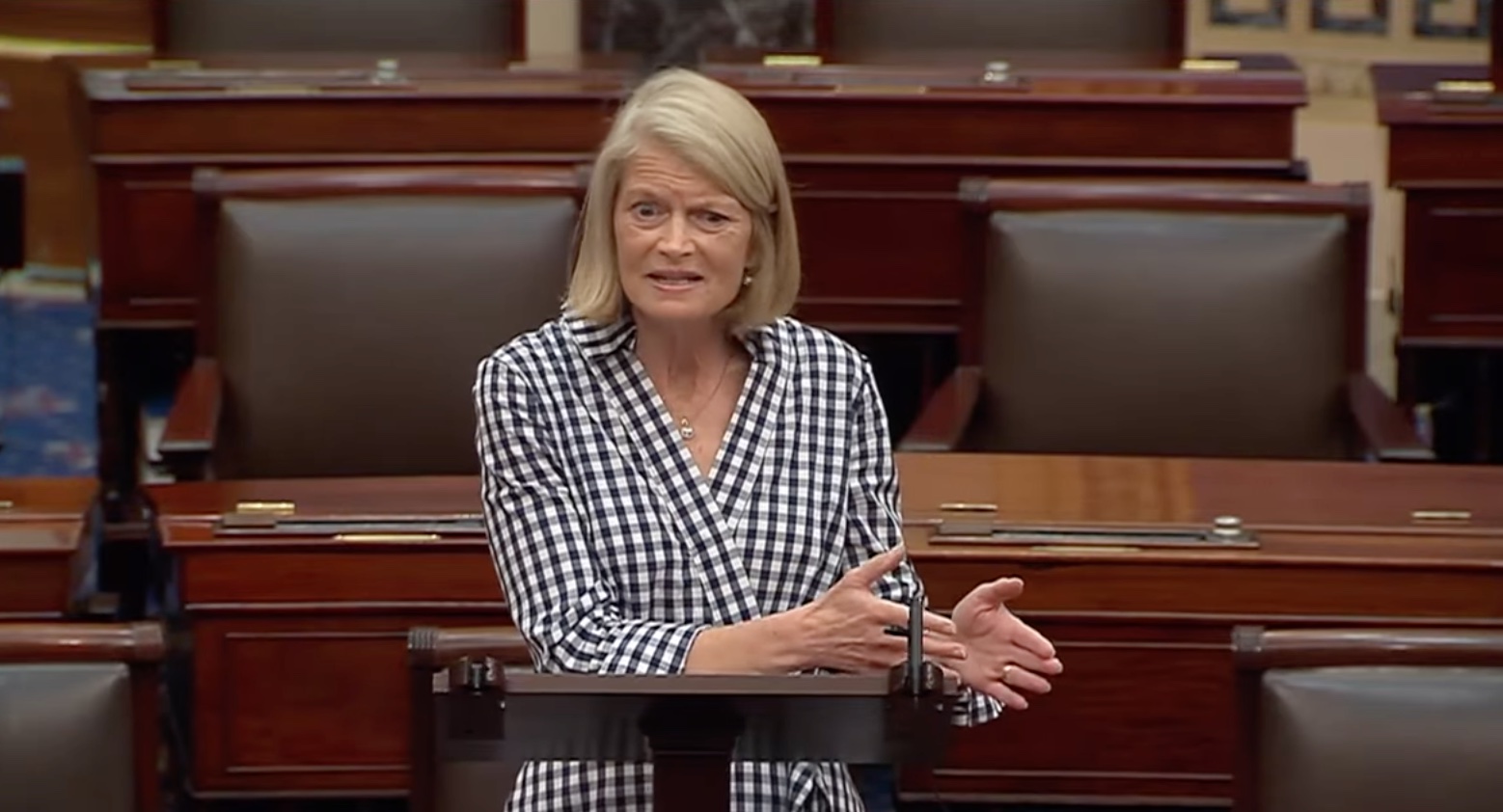
The return of pork earmarks to Congress has reignited a battle inside the Republican Party, raising questions about whether lawmakers can pass government funding bills before the Sept. 30 deadline.
At the center of the fight is Alaska’s senior senator, Lisa Murkowski, who has submitted nearly $345 million in Congressionally Directed Spending requests for Fiscal Year 2026. Her requests, publicly posted on the Senate Appropriations Committee’s website in accordance with transparency rules, span a wide range of projects:
- Agriculture, Rural Development, FDA, and Related Agencies: $10.25 million
- Commerce, Justice, Science, and Related Agencies: $22.23 million
- Energy and Water Development: $74.25 million
- Financial Services and General Government: $11.75 million
- Homeland Security: $13.25 million
- Interior, Environment, and Related Agencies: $48.14 million
- Labor, Health and Human Services, Education, and Related Agencies: $58.35 million
- Military Construction, Veterans Affairs, and Related Agencies: $36 million
- Transportation, Housing and Urban Development, and Related Agencies: $70.75 million
The total — $344,714,000 — reflects projects ranging from infrastructure upgrades to health and Native initiatives. As a senior member of the Senate Appropriations Committee, Murkowski is positioned to shepherd at least some of these projects into law.
Many of the appropriations are for rural areas of the state, including $1 million for the Alaska Native Women’s Resource Center to provide “Alaska Tribes with justice program implementation support,” and $498,000 for Tanana Chiefs Conference to “provide sexual assault response services in rural Alaska.”
There’s also Robert Aqqaluk Newlin Sr Memorial Trust earmark for $241,000 for “The Uqapiaqta Inupiaq Language Year will provide an opportunity for adult Inupiaq learners to acquire conversational Inupiaq language speaking ability, grounded in Inupiaq ways of life. Federal funds will support elder gatherings and staffing to develop needed curricular materials.”
Murkowski has earmarked $300,000 for the Alaska Native Justice Center for “Support the assessment of, and writing a report on, the status of Tribal justice for Congress.”
A $500,000 appropriation to Alaska Native Women’s Resource Center would be to “support the AKNWRC hosting Tribal Community Response Plan (TCRP) gatherings to identify gaps in services and challenges in developing and sustaining supportive and sufficient transitional housing in Alaska’s remote tribal communities for all survivors.” Cook Inlet Tribal Council would get $500,000 for “dissemination of the 2024 Alyce Spotted Bear and Walter Soboleff Commission on Native Children’s report to the President and Congress, ‘The Way Forward,’ and the development of a toolkit to assist with implementation.”
The Alaska Council of School Administrators would get $500,000 “to create an online Alaska Native Civics game.” The International AIDS Association would see $548,000 for “Design and engineering for a new building” in Fairbanks.
Most of the big appropriation requests are for infrastructure projects, however — roads, ports, new buildings and leaky roofs on old buildings, flood mitigation, landslide data collection and more.
Perhaps no community has more Murkowski earmarks per capital than Nome, with at least $63 million for the deepwater Port, and another $14.4 million for other projects.
Not all members of Alaska’s delegation share Murkowksi’s earmark approach.
Sen. Dan Sullivan, who has long opposed earmarks, submitted no requests for FY26. Since first running for office, Sullivan has argued that earmarks contribute to wasteful spending. Instead, he leverages his committee posts to secure federal investment in Alaska through other channels.
The divide in Alaska mirrors a broader rift among Senate Republicans. Fiscal conservatives, led by Sen. Mike Lee of Utah, warn that earmarks are incompatible with the GOP’s brand of fiscal discipline and is incompatible with having $37 trillion in debt. The Senate conference rules, passed in a closed-door vote of 28-12 in 2019, still ban earmarks within the Senate Republican caucus.
That ban has eroded in practice, with appropriators like Murkowski continuing to request projects while others refuse.
Murkowski’s full list of requests is available on the Senate Appropriations Committee’s website here.


