

The 49th State Angel Fund, a function of the Anchorage Mayor’s Office, late last year launched a fund for Alaska businesses in response to the Covid-19 pandemic, and it has carved out half of the fund to dedicate it to people of color.
“The 49SAF Co-investment Fund is a dollar-for-dollar fund: 49SAF will match new cash equity (or equity-like) investment into any Alaska company up to $25,000, near-automatically. Recognizing the lack of racial diversity in our portfolio, 49SAF has carved out half of this effort’s total capital to create the Building Equity Co-investment Fund to prioritize applications from businesses owned by Black, Indigenous and People of Color (‘BIPOC’),” the fund’s website states.
But the race preference being managed by local government puts the municipality at risk for a lawsuit. A federal district Judge in Texas this week found that the Biden administration engaged in systemic gender and race discrimination when it distributed Covid-19 relief for American restaurants — and not just Texas restaurants.
The case was brought by restaurant owner Philip Greer, who sued the Small Business Administration because, even though he is caucasian, he needs the same federal rescue assistance as a minority restaurant owner would under the American Rescue Plan Act. Undoubtably, this case will be sent to the Supreme Court.
Another lawsuit was filed over the $29 billion portion of the American Rescue Plan Act fund, when a Tennessee restaurant owner made similar claims to the Texas restaurant owner in a case still pending.
The Restaurant Revitalization Fund, a $28.6 billion program authorized by the ARPA, requires the SBA to give priority preference to restaurants owned by specific minorities and women, while bumping white males and other minorities to the back of the line.
The Restaurant Revitalization Program defines “socially disadvantaged” as people “subjected to racial or ethnic prejudice or cultural bias because of their identity as a member of a group without regard to their individual qualities.” The list includes Black Americans, Hispanic Americans, Native Americans, including Alaska Natives and Native Hawaiians; Asian Pacific Americans; and Subcontinent Asian Americans.
Restaurant owner Antonio Vitolo, who is the plaintiff, said, “I do not want special treatment. I just want to be treated equally under the law. I am opposed to race and sex discrimination, and I would hope my government lived up to the same principle.”
While the 49th State Angel Fund has not yet been sued for similarly discriminating against non-minority applicants, it is certainly vulnerable. Anyone who applied for funding from the city-managed fund and didn’t receive it might have a case, if they are caucasian. In this case, it would land as a lawsuit against the incoming mayor, even if the prior management of the fund was not a concept he supported.
The management team of the fund will likely be part of the changing administration under Mayor-elect Dave Bronson. The fund, created under the administration of Mayor Dan Sullivan in 2012, is run by Erin Baca.
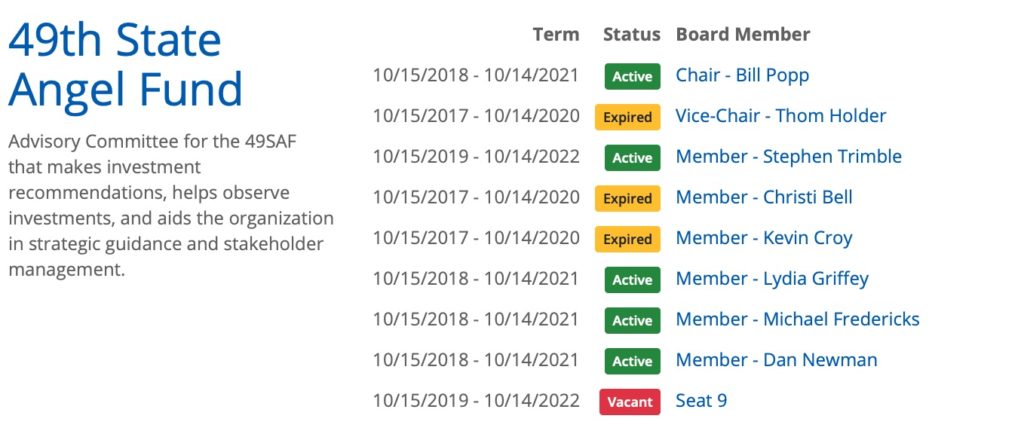
Current advisors include Bill Popp of Anchorage Economic Development Corporation; Christi Bell, University of Alaska; Kevin Croy, Nine Mile Labs; Amy Fredeen, Cook Inlet Tribal Council; Lydia Griffey, STANTEC; Melissa Moody, Google; Dan Newman, AK Premier Auctions; and Stephen Trimble, Arctic Solar Ventures, and recent candidate for House District 22 against Rep. Sara Rasmussen.
There are several seats available for appointment to the 49th State Angel Fund board of advisors, which represents a few of the hundreds of volunteer appointments that may be made by the incoming mayor:
Read: Anchorage start-up fund at Municipality now dedicated to 50 percent minority.


