
By ART CHANCE
SENIOR CONTRIBUTOR
One of my very earliest memories is sitting on my grandfather’s shoulders watching the departure of a Wadley Southern steam locomotive and train from Swainsboro to Wadley, Georgia in 1953 or ’54.
I was only four or five and it was probably the most impressive thing I’d ever seen.
The Wadley Southern was about a 20-mile rail link between Swainsboro and Wadley, which was on the mainline of the Central of Georgia Railroad; it was the link to the world if you lived in rural Southeast Georgia.
The Wadley Southern hauled some general freight, especially fertilizer, cement, livestock, and other bulk commodities from the mainline to the industries and businesses on its route, and it hauled bulk timber, pulp wood and some finished lumber back to the mainline along with a few passengers to catch the Central’s “Nancy Hanks” passenger train to Savannah, Atlanta, and the world.
And, yes, it was the South in the 1950s, and the passenger car on the Wadley Southern was what is known as a Jim Crow car, a combination coach and baggage car that had a front and rear passenger compartment separated by a baggage, and sometimes mail, compartment. The whites had one passenger compartment and the blacks had the other.
Leaving out uniquely Southern things like Jim Crow cars, most shortline railroads ran pretty much like the Wadley Southern in the days of small towns and steam locomotives.
In the days of steam, the Alaska Railroad hauled general freight to individual customers all along its route. I don’t know when the last time that siding that goes to Alaska Mill and Feed was used, but it was the typical operation of a local train; bringing a load of feed or fertilizer to some “feed and seed” store in a small town.
During World War II, the Alaska Railroad became a military railroad in all but name. Military railroads had standard design locomotives for use all over the world; track widths varied, bridge loads varied, tunnel clearances varied, fuel availability varied, but the U.S/ came up with standardized locomotives that could be easily adapted to local conditions.
The most common locomotive was the S-160, a “Consolidation” or “2-8-0” locomotive. The 2-8-0 wheel arrangement for steam freight locomotives was perhaps the most common freight locomotive in the U.S. and gave good power as well as the ability to handle tight curves and poor trackage.
The U.S. sent thousands of them around the world and 12 of them to Alaska. The Alaska Railroad’s S-160s were the mainstay of railroad’s power through the war and thereafter until the diesel revolution began in the late 1940s. The diesel locomotive had been supplanting the steam locomotive even before Word War II, but the production capability was in place to produce and maintain steam locomotives, so the US railway system remained almost entirely steam powered through the war.
With the end of the war and the end of government control, the railroads abandoned their by now largely worn out steam locomotives as quickly as they could.
Even after it dieselized in the early 1950s, the Alaska Railroad kept a few steam locomotives on its roster because of annual flooding between Nenana and Fairbanks. The electric traction motors of diesel-electric locomotives didn’t handle submersion in water very well, so the steam locomotives were kept around to get through the spring floods. By the early 1960s, the steam locomotives were no longer thought necessary and the railroad disposed of them.
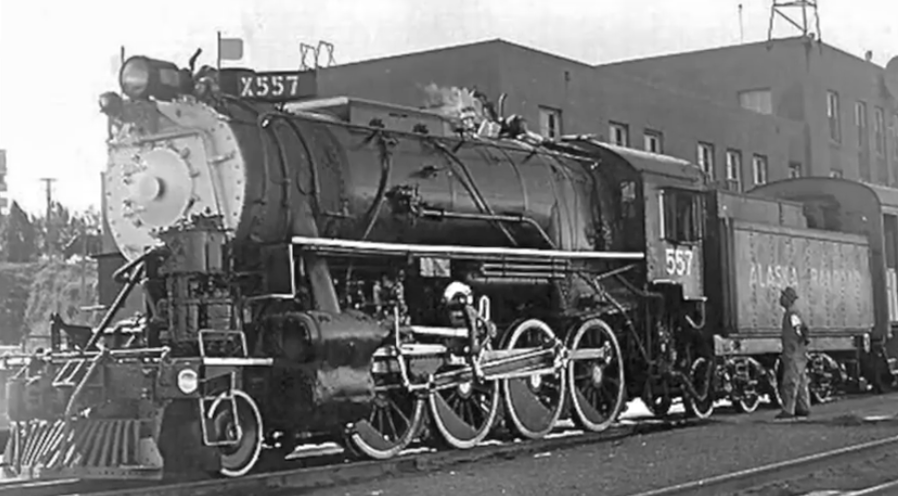
The last was Locomotive 557, which was sold to a collector and museum operator in Washington. While 557 was not kept in operable condition, she was well cared-for and remained in good condition. A few years ago, a group of Alaskans had the opportunity to bring her home.
With the help of the Alaska Railroad and many generous benefactors, the 557 is installed in an “engine house” in Wasilla and is being restored for operation. Almost all work other than certain professional consultation is being done by volunteer labor. Everything on her is being paid for by private or foundation/philanthropic donations — she’s no welfare queen.
The U.S. bought her from the American Locomotive Works in 1943 for $50,000. When she moves under her own power again, some millions will have been invested, even if all the labor is volunteer. I bought the “number 3 flue” in her firebox.
Those of us who don’t change our spark plugs, oil, or tires anymore don’t really have any comprehension of what it takes to work on machines like the 557. The tools to work on them don’t exist anymore, so you have to salvage and repair them or make them from scratch.
Fortunately, there are still some guys around who know how to use a metal lathe and can machine a tapered bolt that can stand 800 foot pounds of torque. For reference, if you’ve ever changed a tire, tightening the lug nuts is about 80-100 foot pounds. The guys restoring the 557 had to make the sockets to attach to the wrench to tighten those bolts.
Everything has to be made using skills that hardly exist in America today and are mostly possessed by guys, yes, guys, who have gray hair and sometimes curmudgeonly attitudes towards people who don’t understand their work and their world.
In a couple of years the last steam locomotive of the Alaska Railroad will be the first to operate again. I can’t wait to ride behind her to Seward; we don’t have the amazing wooden climb anymore but even the switchbacks are pretty impressive.
The modern Alaska Railroad diesels have 5,000 horsepower, and Locomotive 557 has maybe 1,500, but she can lug a decent sized passenger train over that hill even if she has to do it one cylinder stroke at a time.
That is the drama of steam locomotives. Those of us of a certain age remember the “little engine that could,” and “I think I can, I think I can;” those are the rhythms of the cylinders of a steam locomotive; one cylinder stroke at the time as it forces itself up the grade.
Art Chance is a retired Director of Labor Relations for the State of Alaska, formerly of Juneau and now living in Anchorage. He is the author of the book, “Red on Blue, Establishing a Republican Governance,” available at Amazon.


