
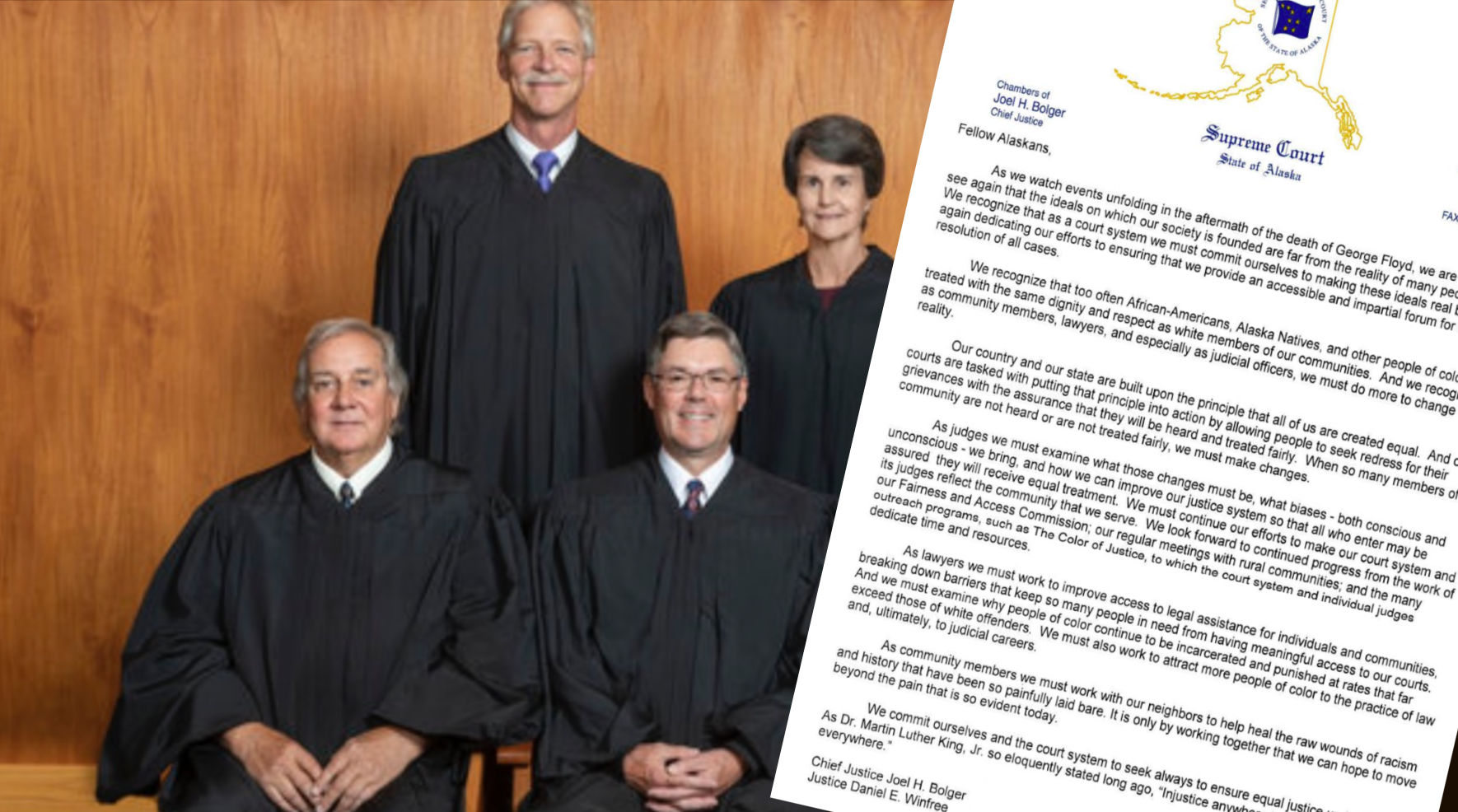
A “systemic racism” letter penned by and signed by the Alaska Supreme Court and posted on its State of Alaska website in early June prompted robust conversation at the commission that deals with complaints about judges in Alaska.
Now, the commissioners would like a conversation with the Supreme Court justices who signed it.
The letter made its way to the commission agenda in August, when long-time member Robert Sheldon raised a concern about the appearance of the Supreme Court justices condemning the justice system in Alaska; the discussion about the letter was tabled until Dec. 11.
Must Read Alaska wrote about the letter in June:
During the Dec. 11 meeting, the commissioners heard more of Sheldon’s concerns. Front and center, he said that the justices had a choice: They could have acknowledged that Alaska has done more for its primary minority population than any place in history with extensive reparations. He also pointed out that the letter the justices signed was eerily similar to the one penned by the Massachusetts Supreme Court, and other courts around the nation in an effort that seemed coordinated.
Ultimately, Sheldon prevailed in his motion to have the Judicial Conduct Commission write a letter to the Supreme Court justices and invite them in for a private conversation about what they meant by the letter, and how it came to be written.
The commission voted 5-3 to make the request of the justices, recognizing that they may, if they choose, simply refuse to talk to the commission.
Background: In June, shortly after the death of George Floyd, a number of courts around the nation signed confessional letters taking responsibility for racism. Alaska’s Supreme Court letter echoed the phrasing of others, indicating there was a coordinated effort, which appears to have been coordinated by the National Center for State Courts.
Few of them were as radical as Washington Supreme Court’s confessional, which states, in part,
“As judges, we must recognize the role we have played in devaluing black lives. This very court once held that a cemetery could lawfully deny grieving black parents the right to bury their infant. We cannot undo this wrong⸺but we can recognize our ability to do better in the future. We can develop a greater awareness of our own conscious and unconscious biases in order to make just decisions in individual cases, and we can administer justice and support court rules in a way that brings greater racial justice to our system as a whole.”
Alaska’s Supreme Court wrote, in part,
“We recognize that too often African-Americans, Alaska Natives, and other people of color are not treated with the same dignity and respect as white members of our communities. And we recognize that as community members, lawyers, and especially as judicial officers, we must do more to change this reality….As judges we must examine what those changes must be, what biases – both conscious and unconscious – we bring, and how we can improve our justice system so that all who enter may be its judges reflect the community that we serve.assured they will receive equal treatment. We must continue our efforts to make our court system and its judges reflect the community that we serve.”
California’s Chief Justice also wrote, in part,
..We must continue to remove barriers to access and fairness, to address conscious and unconscious bias—and yes, racism…
Massachusetts’ chief justices wrote, in part,
As judges, we must look afresh at what we are doing, or failing to do, to root out any conscious and unconscious bias in our courtrooms; to ensure that the justice provided to African-Americans is the same that is provided to white Americans; to create in our courtrooms, our corner of the world, a place where all are truly equal.
The complete list of confessional letters from judges and justices is at this NCSC link.
Sheldon on Friday expounded on the Alaska exceptionalism in the court system, and said the statement by the Alaska justices was in error or at least ill-advised.
Alaska has completed four reparation cycles, he said, including the Alaska Native Claims Settlement Act, two recapitalizations of Native corporations, and land grants for Native Vietnam veterans.
Alaska’s largest corporations are owned by Natives, he pointed out.
Every Alaskan gets a Permanent Fund dividend, which is viewed by many as a form of universal basic income, Sheldon said.
In his 13 years on the Judicial Conduct Commission, the commission has investigated or reviewed each complaint of bias, whether or not it was even jurisdictional, he said.
More of the commission’s discussion of whether to have the justices respond to them on the topic of their letter is at this YouTube link:
Alaska’s Commission on Judicial Conduct oversees the conduct of justices of the Alaska Supreme Court, judges of the state court of appeals, state superior court judges, and state district court judges.


