
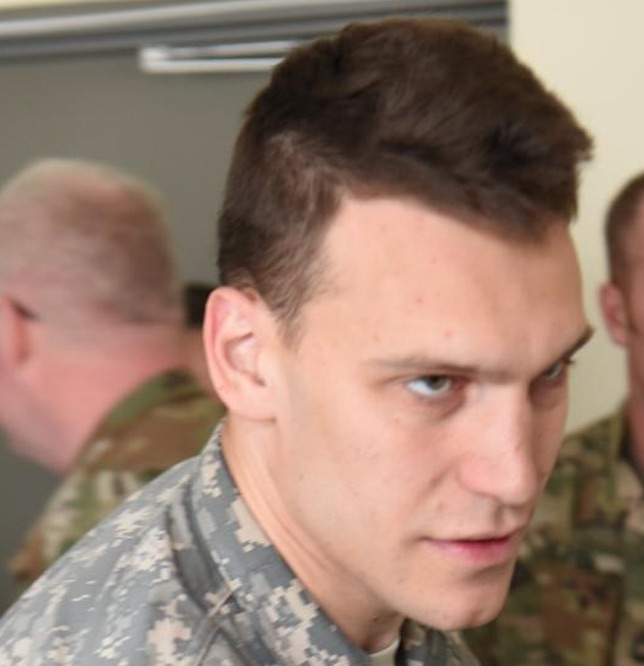
Alaska State Sen. Forrest Dunbar, currently deployed to Poland on active duty with the Alaska Army National Guard, is drawing scrutiny for a politically charged letter issued to constituents while serving in uniform — a move that may violate military conduct standards and federal law.
In a letter circulated on social media under his official Alaska State Legislature letterhead, Dunbar confirmed that he would return to the state for the August special session and vote to override Gov. Mike Dunleavy’s partial veto of a massive increase to education funding that was passed by a deeply split legislature.
“I will be voting yes to override,” Dunbar wrote, citing what he called “catastrophic cuts” to school budgets.
However, the message may have crossed a line drawn by multiple federal regulations prohibiting active-duty service members from engaging in partisan political activity.
Dunbar’s statement appears to run afoul of Department of Defense Directive 1344.10, which strictly limits active-duty military personnel from making partisan political statements or taking public positions on pending legislation.
The directive bars service members from participating in political activity that may imply military endorsement or blur the lines between official military capacity and political advocacy.
While Dunbar said he sought an “Exception to Policy” to take leave and pay for his own return to Alaska for the vote, the statement itself was issued while he remains mobilized, and it was made using his official legislative platform. That fact alone may violate the principle that political commentary must be done in a purely personal capacity and without use of official titles or platforms.
Under Article 88 of the Uniform Code of Military Justice, commissioned officers are prohibited from using contemptuous or disrespectful language against senior government officials. Dunbar’s letter stops short of overt disrespect, but his partisan and inaccurate framing of the governor’s action while on active duty adds to the case that can be made that he is engaging in partisan political activity.
In addition to the legal and ethical concerns, Dunbar’s letter also contains a misleading characterization of the governor’s action. Gov. Mike Dunleavy vetoed only a portion of an increase to education funding, not cutting funding. Dunleavy only cut out some of the additional funds that were awarded to Education. Calling it a “catastrophic cut” oversimplifies and exaggerates the scope of the veto, which makes Dunbar’s statement highly political, rather than factual information for his constituents.
Then there’s the Hatch Act. Although it primarily applies to civilian federal employees, the same types of restrictions extend to members of the armed forces.
The combination: Military status, state office, and partisan advocacy, is a messy mix that his higher-ups at the Pentagon may find interesting, at the very least.
Violations of DoD Directive 1344.10 or UCMJ provisions can result in administrative or disciplinary action, ranging from a formal reprimand to more serious consequences, depending on the severity and whether the statement is judged to harm good order and discipline.
As of this writing, no official investigation into Dunbar’s conduct has been announced. However, the incident is likely to be elevated to Department of Defense leadership by those who take umbrage with his use of his uniform for political business.


