
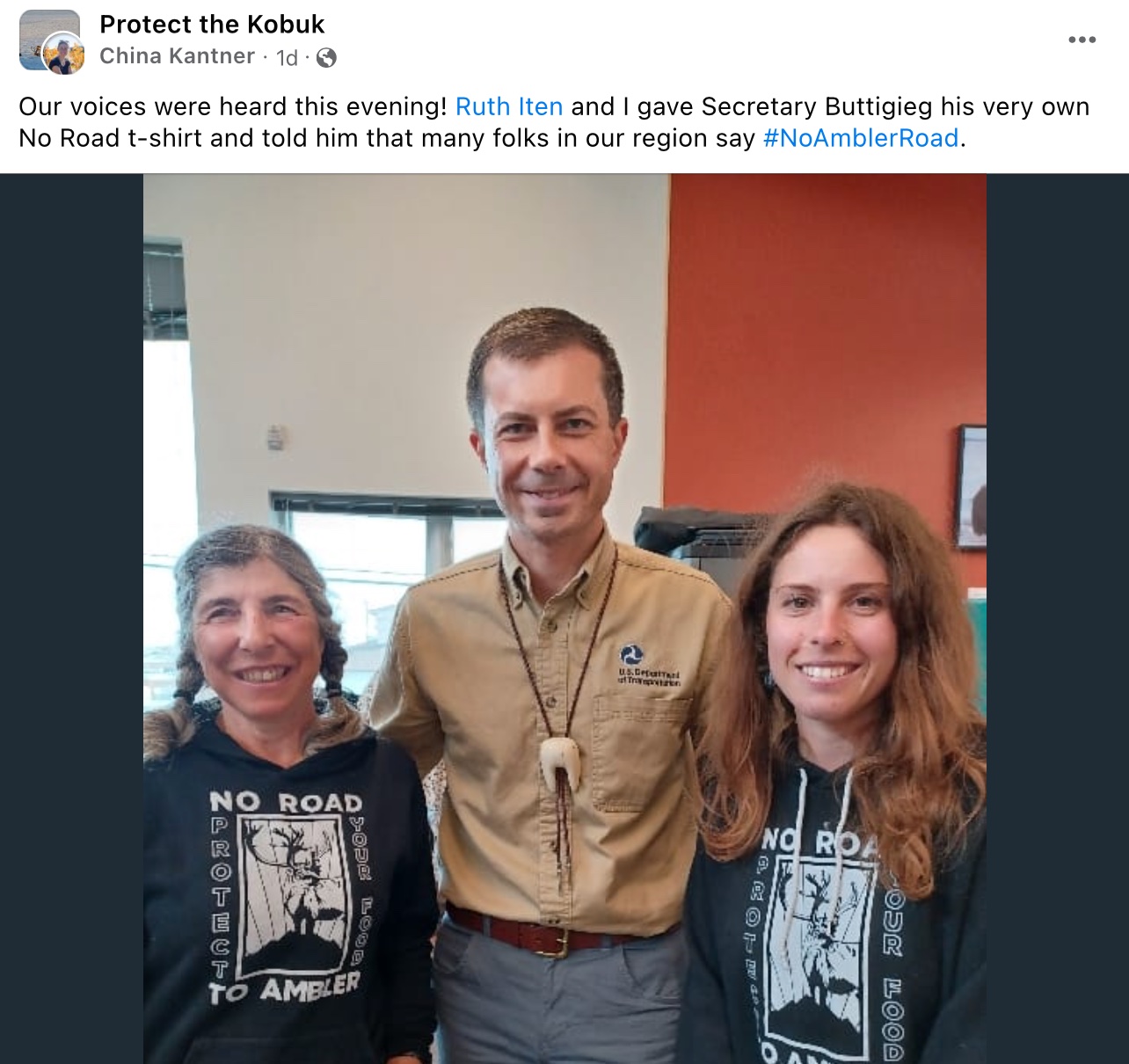
Protect the Kobuk, a group whose Facebook account’s administrator’s name is “China,” gave Transportation Secretary Pete Buttigieg a “No Road” t-shirt this week, while the secretary was traveling in the Interior this week.
The shirt’s message? No road from the Dalton Highway to the state’s Ambler Mining District.
China Kantner went on Facebook and wrote, “Our voices were heard this evening. Ruth Iten and I gave Secretary Buttigieg his very own No Road t-shirt and told him that many folks in our region say #NoAmblerRoad.”
What is this all about? The Alaska Industrial Development and Export Authority has proposed to construct a 211-mile private industrial access road to the state mining district, but it would have to cross federal land.
The Biden Administration has been on record saying that minerals for the new Biden green economy should come from national sources, but currently, most of the needed minerals for electronics and national security come from China, which is, according to most Americans, an enemy of the U.S.

Meanwhile, Alaska has not seen a new road built in the state since the 8-mile gravel road from Kivalina to its new school site.
The issue of the top member of the Biden Administration in charge of roads accepting a “no-road” t shirt raised the eyebrows of those watching his every move in Alaska. Does this mean Buttigieg is opposed to the Ambler Road, which would be exclusively used by the mining area and not open to the general public?
The supplemental environmental impact statement will come out in a month, givng the public a chance to weigh in on the project.
The history of the Ambler Mining District goes back generations.
In 1980, President Jimmy Carter enacted the Alaska National Interest Lands Conservation Act, sometimes called, “The Great Compromise.” This law aimed to balance Alaska’s natural resource economy with environmental preservation and the protection of Alaskan lifestyles. It created 10 new federal parks, preserves, and monuments in Alaska and guaranteed specific rights, including access to the Ambler Mining District for resource development.
By 2009, the Alaska Department of Transportation and Public Facilities started assessing potential road and railway routes to the Ambler Mining District, identifying a possible corridor through the Gates of the Arctic National Preserve. In 2013, the project’s responsibility shifted to the Alaska Industrial Development and Export Authority, a state-owned corporation created to bolster Alaska’s economic prosperity.
AIDEA aimed to establish a public-private collaboration to fund, build, and manage the controlled access road, mirroring their previous successful project, the DeLong Mountain Transportation System. This involved partnering with the private sector for road development, where the construction expenses were recouped via tolls.
In March 2020, the Department of Interior, Bureau of Land Management issued the Final Environmental Impact Statement for the Ambler Road. A few months later in July, the BLM and the U.S. Army Corps of Engineers issued the Joint Record of Decision under the National Environmental Policy Act.
Throughout 2021, the Ambler Access Project made progress including establishing rights-of-way understandings between AIDEA, the National Park Service, and BLM as well as an AIDEA-Doyon land access agreement and an AIDEA-NANA land access permit.
The agreement and permit with Doyon and NANA, respectively, are effective until Dec. 31, 2024. These are not yet rights-of-way actual agreements. Project resources were added to advance the project through Final Feasibility and Permitting, including a dedicated program manager, external communications manager, and a team of contractors to complete nine critical scopes of work.
In 2021 and 2022, the Northwest Arctic Borough, Native Village of Shungnak, Alaska’s Congressional Delegation, the Alaska Chamber, Alaska Miners Association, Alaska Support Industry Alliance, Council of Alaska Producers, and the Resource Development Council for Alaska, Inc., among others, expressed their support for the AAP through published letters and resolutions.


