
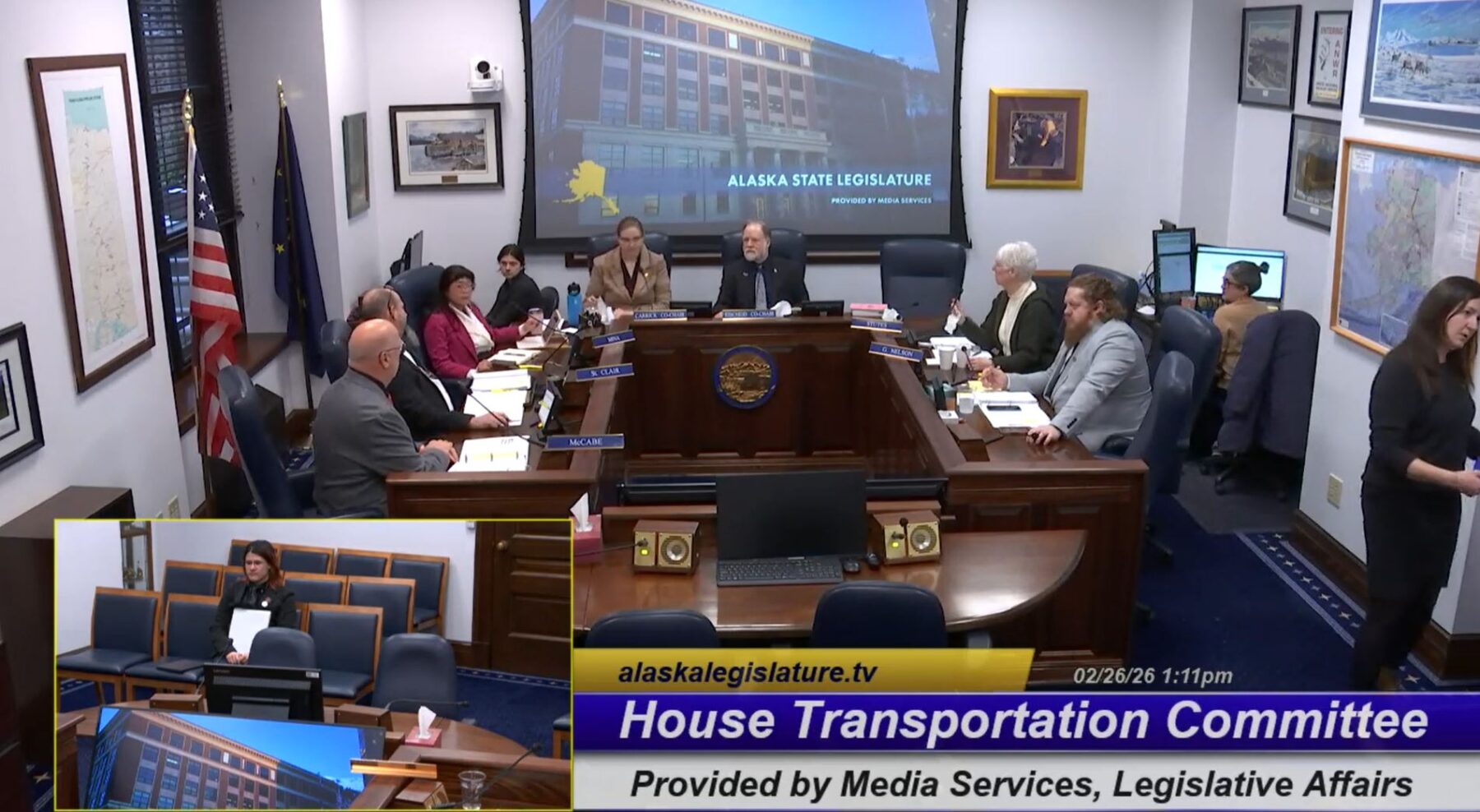
The Alaska House Transportation Committee convened yesterday to refine legislation shaping the state’s future mobility landscape. Lawmakers adopted targeted amendments to House Bill 217 on autonomous vehicles before holding it for further review, then moved to discuss House Bill 303 on motor vehicle registration. The session underscored the need to balance innovation with practical enforcement and alignment with federal standards.
HB 217 – Clarifying Commercial Autonomous Vehicles Amid Enforcement Questions
The committee opened with HB 217, which seeks to establish a regulatory framework for autonomous vehicles, particularly commercial applications. Two amendments were adopted without objection. Representative Mina’s (D – Anchorage) Amendment A2 defined “personal delivery devices” (small sidewalk robots) to exclude them from the broader autonomous vehicle definition, preventing municipal regulatory confusion. “The defines those little robots, which are actually called personal delivery devices in statute,” Mina explained.
Representative Nelson’s (R – Sutton) Amendment A1 narrowed the bill’s scope to commercial vehicles such as big rigs and large passenger carriers. “This really dials it into commercial vehicles, saying exactly what it’ll be applied to, which is what our discussion all revolved around,” Nelson stated.
Discussion intensified when Representative McCabe (R – Big Lake) raised enforcement challenges, questioning fault determination, human operator verification, and ethical decision-making in crash scenarios. Emerging Technologies Coordinator Benjamin Glenn from the Department of Transportation provided key context: the bill targets SAE levels 3-5 automation, but verification relies on operator statements or post-incident data since capabilities are software-based. “The bill just defines capability, not any external markers,” Glenn noted.
Co-Chair Carrick (D – Fairbanks) emphasized keeping the bill narrowly focused on commercial vehicles rather than opening a broader autonomy debate. After Glenn’s input on federal preemption risks (HR 7390) and the need for ongoing stakeholder work, the committee held HB 217 and reopened the amendment deadline.
HB 303 – Updating Vehicle Title Requirements for Modern Standards
The committee then turned to HB 303, sponsored by Representative St. Clair (R – Wasilla), which aligns Alaska with federal and most state standards by establishing a 25-year rolling average for vehicle title requirements. No amendments were offered. St. Clair described it as straightforward modernization: “This is simple common-sense legislation. It’s just bringing us on par with the feds and most other states with a 25-year rolling average.”
With no discussion, Representative Stutes (R – Kodiak) moved the bill, which advanced unanimously with a “do pass” recommendation and zero fiscal note.
Next week’s “Tech Week” agenda includes presentations on drone innovation and Department of Transportation technology initiatives. The actions signal legislative intent to modernize transportation rules while addressing practical implementation hurdles for emerging technologies.


