
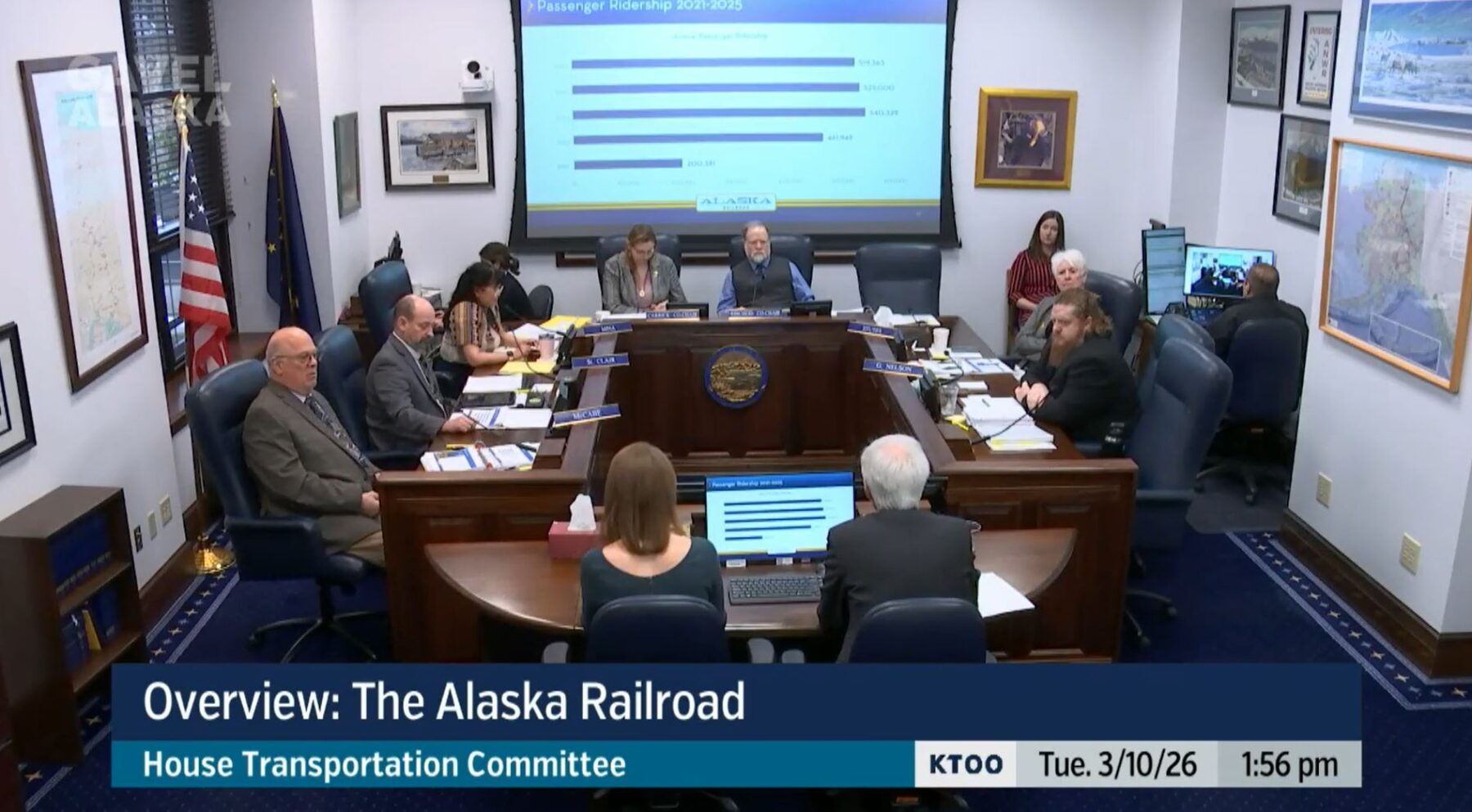
The Alaska House Transportation Committee received a detailed briefing today from Alaska Railroad Corporation (ARRC) leadership on the railroad’s unique public-corporation structure, operational performance, capital investments, and preparedness for the Alaska LNG project. The session also featured the introduction of House Joint Resolution 42 (HJR 42), which expresses legislative support for the Northern Continental Corridor (NCC) rail link to the Lower 48. The meeting underscored the ARRC’s role as a self-sustaining economic engine while spotlighting opportunities for expanded rail infrastructure amid federal defense priorities.
ARRC President and CEO Bill O’Leary and External Affairs Director Megan Clemens opened the presentation by outlining the railroad’s history and governance. Established as a public corporation in 1985 after the federal government transferred the aging 700-mile system, the ARRC operates independently from the state general fund. All net income is reinvested into infrastructure, preventing reliance on legislative appropriations. O’Leary described the model as “ingenious,” noting that the railroad’s obligations cannot become state liabilities by statute (AS 42.40). The seven-member board is appointed by the governor, with staggered five-year terms; all current members were appointed or reappointed by Governor Dunleavy.
Operational highlights included nearly 4 million tons of freight moved in 2025 (up 300,000 tons year-over-year) and approximately 500,000 passengers annually. Freight revenue remains the largest business line at roughly 44 percent, bolstered by interline growth with Lynden barges supporting North Slope activity. The ARRC manages 36,000 acres of land—half leased at fair market value—providing stable revenue that buffers market volatility. Strategic goals adopted in 2024 emphasize safety, revenue growth, expense control, capital execution, and rail/real estate expansion.
Clemens detailed ongoing capital projects funded internally and through federal grants. The $137 million Seward Passenger Dock, supported by a 30-year usage agreement with Royal Caribbean Group, is on track for completion in May 2026 and will operate as an open double-berth facility. A companion $50 million shore-power project is advancing. Other initiatives include freight dock lengthening in Seward, Whittier Tunnel expansion for double-stack service, an annual $25 million track rehabilitation program replacing 40,000–50,000 ties, and a half-billion-dollar bridge program targeting more than 100 structures to reach the Lower 48’s 286,000-pound standard.
On the Alaska LNG project, O’Leary expressed full readiness to transport pipe, citing decades of experience including recent moves through Seward. The ARRC plans to deploy roughly $10 million in spur and terminal upgrades upon the developer’s Final Investment Decision. A major financial tool emerged from a January 15, 2026, IRS revenue ruling affirming the railroad’s authority under the Alaska Railroad Transfer Act to issue tax-exempt debt as a conduit issuer for the pipeline and related facilities—potentially saving hundreds of millions without liability to the state or ARRC. Legislative authorization would still be required for any issuance.
“We can do this,” O’Leary stated confidently, referring to the railroad’s logistics and financing capabilities for the LNG project.
Committee members raised questions on freight growth beyond LNG, passenger affordability for Alaskans (noting federal grant restrictions on resident discounts), and the Healy Airport runway on ARRC land. Action items include providing statutory references from AS 42.40, the full strategic plan, and detailed passenger-count breakdowns separating public riders from cruise-line charter cars.
The committee then took up HJR 42, sponsored by Rep. Garrett Nelson (R-Sutton). Invited testifiers Kevin Thompson and Greg Madalena of E4M, along with Hillary Palmer of Dewberry Engineers, described the NCC as a 1,200-plus-mile corridor offering supply-chain redundancy, national defense logistics, and economic impact projected at 420,000 job years. Palmer referenced her 2023 FEMA supply-chain assessment highlighting Alaska’s single-point vulnerabilities at the Port of Alaska and Alaska Highway. The resolution frames the project around unprecedented federal defense spending and an expiring 2030 presidential permit. No state construction funding is required; proponents envision initial Department of Defense validation to attract private capital. An amendment deadline was set for Friday, March 13, 2026, at 5 p.m.
Co-Chair Rep. Eischeid (D-Anchorage) praised the resolution as “forward-thinking” and timely. The committee will continue its hearing on HJR 42 at the next meeting, scheduled for Thursday, March 12.
The ARRC presentation and HJR 42 discussion reflect growing momentum for rail expansion in Alaska, balancing near-term infrastructure upgrades with long-term connectivity goals.


