HOUSE DIRECTION ON BUDGET: LESS THAN $500 PER DIVIDEND
Gov. Michael Dunleavy has proposed a $3,000 Permanent Fund dividend for all eligible Alaskans, and a budget for State government that is about a 21 percent lower than the one offered by Gov. Bill Walker, which was about $4.8 billion in undesignated general funds. Walker’s budget increased spending over this fiscal year by hundreds of millions of dollars.
Dunleavy said the Walker budget didn’t balance, and his lower number has left people all over the state in shock as they realize how much of a shell game the former budget was, and how much communities are going to lose in State services.
But the House Majority’s budget strategy is now beginning to gel and it looks like it will offer the Walker budget, with just a few trims around the ears. Right now, there are no big cuts planned.
House Finance co-chair Rep. Neal Foster is on record saying the budget will likely be static: About $4.8 billion, give or take.
In House Rules Chairman Chuck Kopp’s newsletter, he gives a sense of how that would be paid for: “With the right kind of management, and without new taxes, I believe that our state can afford the core services upon which Alaskans rely. If we prioritize keeping our communities healthy, safe, and prosperous over paying ourselves unprecedented dividends, we can run our state responsibly. This year the House Majority has committed to not spending money we do not have – we will not be advocating for new or raised taxes, we will not spend down our savings, and we will not over-draw from the earnings reserve account. Future generations are counting on us to be good stewards of our funds, and we’re not interested in jeopardizing the health of our state’s assets or our current economic recovery efforts.”
If these two things are true — what Rep. Foster said and what Rep. Kopp said — it means the Permanent Fund dividend will not be $3,000, as proposed by Dunleavy.
To pay for the Walker budget without new taxes and without digging deeper into the Permanent Fund Earnings Reserve Account, Alaskans would take an 84 percent haircut on their dividend.
The math shows that Permanent Fund dividends would be about $480, because State government would require the other $2,520 from every man, woman, and child. In other words, a family of four would lose over $10,000.
CHOICES FOR LAWMAKERS
These are choices that lawmakers are facing. No one yet knows what the Senate has in mind, but the two different visions from the Democrat-led majority in the House and the fiscally conservative governor are coming into focus.
What is likely to happen is that both the House and Senate will find cuts, but also tap the dividend to make up the difference. This is where things are very elastic — so far, neither the House nor Senate have produced their own budgets, and Democrats are trying to get Dunleavy to start bargaining his own budget away.
The veto pen is powerful. But the governor can only veto spending, not add money back, once the House and Senate decide what their spending levels will be. If the dividend amount that reaches his desk is $500 or $1,000, Dunleavy will not be able to increase it.
APOCALYPTIC HOUSE PLAN?
Last Wednesday in House Finance, the Dunleavy Administration’s chief economist presented a scenario that actually was what that House plan would look like.
[View the slides from economist Ed King’s presentation here]
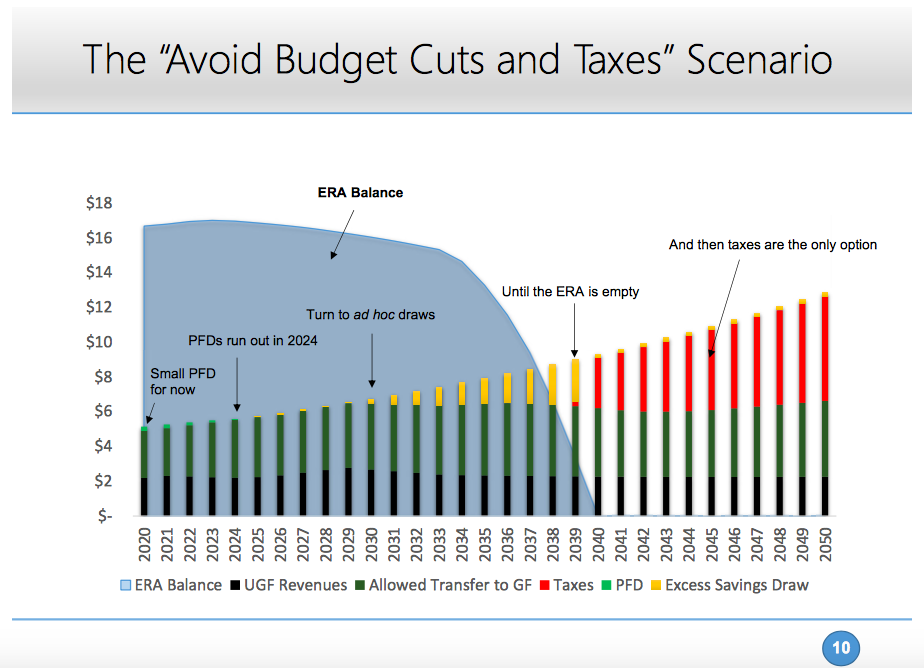
With no cuts to spending, and using the “Percent of Market Value” method to fund the existing state budget and a dividend of under $500, after two years, the entire draw from the Permanent will be consumed by the growing budget, which increases naturally due to increasing step-and-merit wages, and other cost increases.
(A percent of market value draw from the Earnings Reserve Account, as opposed to a fixed draw, is based on a multi-year average of the Permanent Fund value.)
Perhaps not knowing he was actually presenting the House Majority’s current direction on the budget, King’s slides revealed the problem the House Majority faces.
The Majority members on House Finance looked visibly unnerved at Slide 10 of the presentation, which shows that the Permanent Fund dividends will go away in five years if the budget is not cut down to match revenues.
By then, dividends would be so small as to barely be an important part of a family’s budget. When the Earnings Reserve Account is gone, taxes would follow to feed government. But that’s years down the road at least.
Here’s the slide that had the committee squirming last Wednesday: