
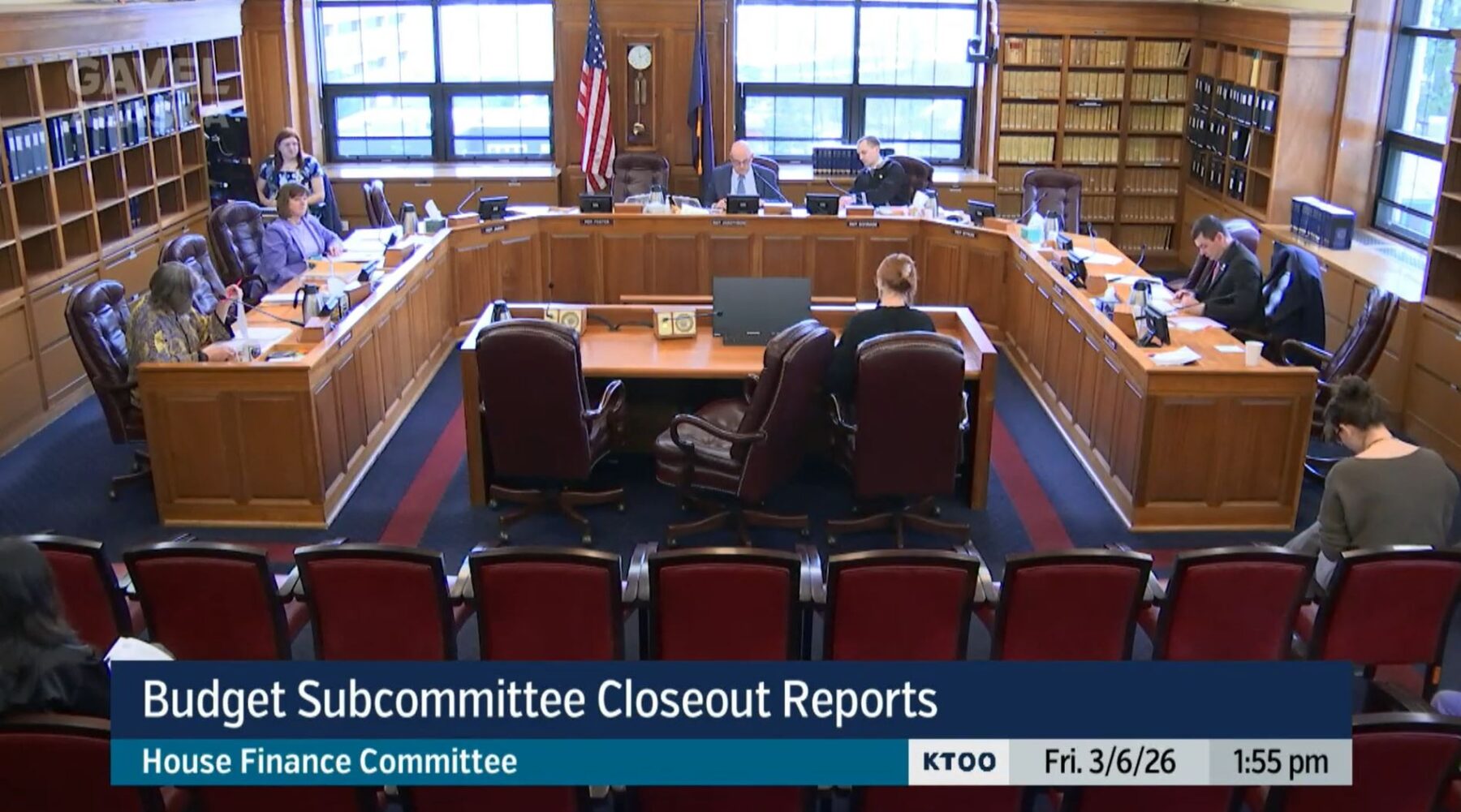
The Alaska House Finance Committee reviewed and advanced closeout reports for six state agencies on Friday, marking the first tranche of deliberations on the FY27 operating budget. The reports, covering the Departments of Law (DOL), Health, Family and Community Services (DFCS), Administration (DOA), Corrections (DOC), and Transportation and Public Facilities (DOT&PF), largely adopted Governor’s proposals with targeted adjustments, reflecting a focus on fiscal alignment, infrastructure investments, and vulnerable populations.
Alexander Schroeder, staff to Rep. Josephson (D-Anchorage), explained the budget action (BA) reports, highlighting comparisons between FY26 Management Plan, House Committee Substitute 1 (HCS1), Governor’s requests, and subcommittee recommendations. “If you see blue text across a row, it means there was a change from the Governor’s request,” he noted, emphasizing modifications or additions.
Starting with the Department of Law, Schroeder presented a closeout that adopted all five Governor-proposed items without subcommittee additions. Key changes included a $500,000 decrement in interagency receipts for uncollectible funds in Civil Division litigation, and increments totaling $33,400 all funds ($6,100 UGF and $27,300 interagency) for IT classification study implementation in Administrative Services and Legal Support. Net: +$6,100 UGF and -$462,100 other funds from adjusted base.
Dr. Erin Page, staff to Josephson, handled Health and DFCS. For Health, the overall budget rose $460 million (12.1%) from FY26 adjusted base, with $78 million UGF increase (7.3%), driven by Medicaid. Governor items included a $10 million UGF decrement for behavioral health rates (offset by FY26 supplemental carryover), $43 million UGF for Medicaid provider payments, $11.3 million UGF for eligibility systems upgrades, and $3.7 million UGF for a virtual contact center to cut backlogs. Subcommittee added $625,000 UGF for private duty nurse (PDN) rates, projecting $30 million annual Medicaid savings. “We should see it almost immediately,” Page said of PDN impacts, estimating $84,000 daily savings for eight patients.
DFCS saw a $5 million overall decrease (1%) from adjusted base, mainly federal receipts alignment, with $3.2 million UGF increase (1.1%). Governor actions: $474,000 UGF grants transfer from Health for youth residential services, plus small classification adjustments. Subcommittee added $1.5 million UGF to Children’s Advocacy Centers (CACs) offsetting Victims of Crime Act cuts, and OCS workforce stabilization for HB 151 compliance, plus intent on kinship placements.
Caroline Hamp, staff to Rep. Calvin Schrage (NA-Anchorage), outlined DOA: $349.1 million total, <1% all-funds increase from HCS1, driven by IT classification. Relative to Governor, -$567,700 interagency via deleting vacant Deputy Commissioner and Chief of Operations positions. Adopted Governor proposals like Shared Services deconsolidation. Narrative flagged DOA’s partial noncompliance with FY26 intent on AlaskaCare health plan rates, projecting $18.5-$26.3 million lapsed funding reliance despite a “stair-stepped conservative approach.” Also emphasized public broadcasting neutrality and deconsolidation data collection.
Hunter Meacham, staff to Rep. Hannan (D-Juneau), presented DOC: $523.4 million total, accepting Governor requests fully. Highlights: $20 million UGF for personal services/inmate transport, $3.1 million UGF for medical staff, $1.7 million for community residential centers. Intent to quantify community/regional jails costs for FY28 discussions. “It articulates what we haven’t had—what the total cost is,” said Rep. Hannon. $29.7 million UGF change from CS1.
Tim Clark, staff to Hannan, closed with DOT&PF: $678 million total, 0% change from Governor amended. Accepted all items: ~$400,000 across funds for IT classification, $7.9 million UGF restorations for maintenance (offset by $3.5 million deleted positions from reorganization). Key: Alaska Marine Highway System (AMHS) to multi-year language funding for federal grant flexibility. “At first glance, it may appear the agency is being cut, but it is only being moved,” Clark cautioned. $156 million difference from CS1; Stapp noted apparent 33% slash due to AMHS shift, seeking UGF breakouts.
Fiscal Stability Assessment: These closeouts signal cautious stability amid rising demands. UGF increases (e.g., Health’s 7.3%, DFCS’s 1.1%) target Medicaid growth and vulnerabilities, offset by savings like PDN’s $30 million potential and federal alignments avoiding “hollow authority.” Decrements (Law’s -$462,100 other funds, DOA’s -$567,700) and efficiencies (DOT&PF reorganizations) curb excesses, while intent language ensures accountability (e.g., DOC jails costing, DOA health plan compliance). Overall, balanced adoption of Governor items with minimal additions suggests fiscal prudence, though unresolved metrics (e.g., kinship rates, deconsolidation data) warrant monitoring. A late PFD query by Stapp equated $118 million (DOT-like) to ~$160 per person, highlighting trade-offs in a resource-constrained budget.


