
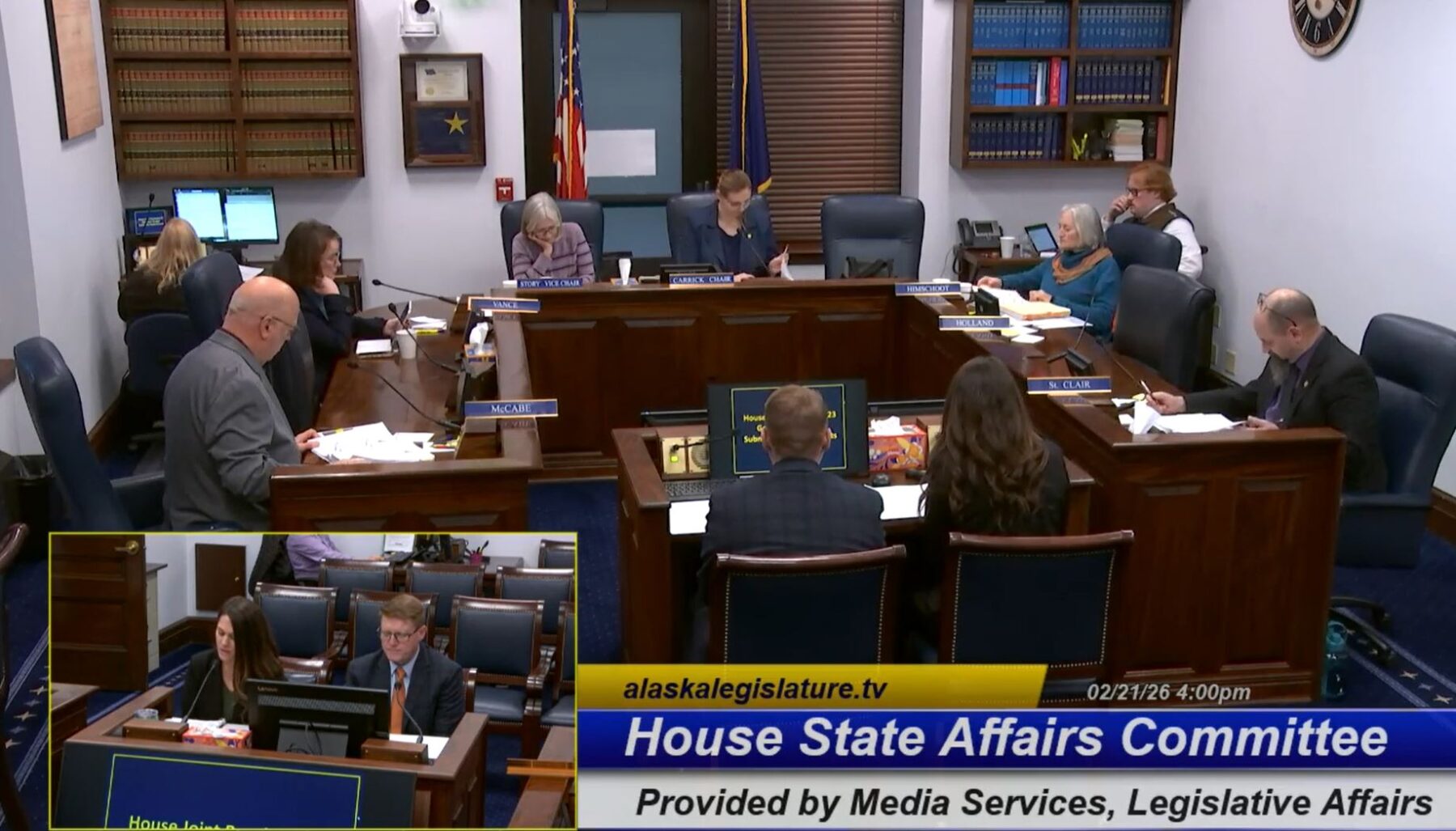
JUNEAU, Alaska — On February 21, 2026, the Alaska House State Affairs Committee delved into House Joint Resolution 23 (HJR 23), a proposed constitutional amendment aimed at reshaping how the governor initiates the state’s annual budget process. Sponsored by Representative Jubilee Underwood, the measure seeks to mandate that the governor submit a balanced operating budget without relying on draws from the Constitutional Budget Reserve (CBR) as anticipated revenue, elevating existing statutory requirements to constitutional status.
The discussion highlighted ongoing fiscal challenges in Alaska, where volatile oil revenues have long strained state finances. Underwood introduced the resolution by emphasizing its focus on procedural clarity rather than dictating spending levels. “At its core, HJR 23 is about institutional design and long-term stability,” she asserted, arguing that it would provide voters with a structured framework to ensure fiscal discipline from the outset.
Staff member Buddy Witt elaborated on the proposal’s mechanics. He noted that current statutes already require a balanced budget submission, but HJR 23 would constitutionally prohibit including CBR funds in revenue projections for the initial budget. “What HJR 23 does is it basically says, yes, the governor must submit a balance sheet,” Witt explained. “And those expenditures in that budget may not exceed the anticipated revenue. But the big thing that it does, it says that anticipated revenue cannot include the CBR.”
This constraint addresses a historical reliance on the CBR, established in 1990 by voter approval of Article IX, Section 17 of the Alaska Constitution. The fund, which collects revenues from resolved mineral disputes post-July 1990, serves as a rainy-day account for state operations during deficits. With a current balance of approximately $2.9 billion, the CBR has been tapped repeatedly, including recent controversies over a $50 million investment in private equity, which critics argue undermines its liquidity for emergencies. Since its inception, the fund has received about $5.6 billion in deposits and earned $1.9 billion in revenues, but draws totaling $5.1 billion have highlighted Alaska’s structural deficits amid fluctuating oil prices.
Committee members probed potential loopholes and implications. Representative St. Clair questioned revenue projection sources, with Witt clarifying that the executive branch retains discretion. Representative Vance raised concerns about governors sidestepping the rule via supplemental budgets, which Witt acknowledged could complicate the amendment’s legal classification. Representative McCabe inquired about timelines, prompting Underwood to express hope for a November 2026 ballot appearance. “That would be the hope. Yes. If it gets through on time, this would be on 2026 ballot for our next go around,” Underwood stated.
Vice Chair Story asked if the governor’s required 10-year fiscal plan must also balance, with Witt confirming the amendment targets only the initial submission. He committed to researching other states’ practices, where 45 states constitutionally or statutorily require governors to submit balanced budgets, often with stricter provisions than Alaska’s current setup. For instance, most states prohibit deficit carryovers, a flexibility Alaska maintains under statute. Chair Carrick sought historical precedents of deficit budgets paired with revenue measures, leading to an action item for Underwood’s office to investigate past administrations.
Representative Himschoot drew parallels to local governance, citing her assembly experience with mandatory balanced budgets. Underwood echoed this from her school board tenure: “At the end of the day, though, it still had to be balanced.”
Public testimony revealed mixed sentiments. Larissa Fonov from Wasilla strongly supported the measure for fiscal stability. “I believe a constitutional requirement to start the annual budget process with a budget that balances without draining our savings will ensure a more stable fiscal future,” she stated, urging swift passage. “And ask you to pass it out of your committee as quickly as possible.”
In opposition, Ed Martin Jr. from Kenai argued the resolution misplaces focus amid a structural deficit. “We’re becoming dependent on additional money out of the CBR,” he asserted. “But the plain and simple fact is what you really should be focusing on is what I just provided to you and what happened with our past revenue commissioner and the $50 million. That has been taken out of the CBR. That’s the focus you should be making right now. Where is the money going and where is it coming from? I gave you a solution that will help Alaska into the future,” Martin said.
Ryan Sheldon from Talkeetna endorsed HJR 23 as practical. “I won’t belabor my point, but as a businessman, at least, seems like a pretty common-sense thing to operate within the margins of what your expected income is going to be for a fiscal year as opposed to planning on, you know, using any other maybe, savings or any ad accounts would be it,” he testified.
Alaska’s budget process, governed by statute rather than strict constitutional mandates, requires the governor to submit a balanced proposal by December 15 for the fiscal year starting July 1. Unlike 44 states where legislatures must pass balanced budgets, Alaska allows deficits to be addressed via reserves like the CBR. Recent budgets have drawn heavily on savings, with Governor Mike Dunleavy’s FY2027 plan projecting $1.5 billion from reserves amid calls for new revenue measures like a seasonal sales tax.
If advanced, HJR 23 could mark a significant step toward curbing CBR dependency, aligning Alaska more closely with national norms for fiscal restraint. As debates continue, the resolution underscores broader tensions in managing the state’s oil-dependent economy.


