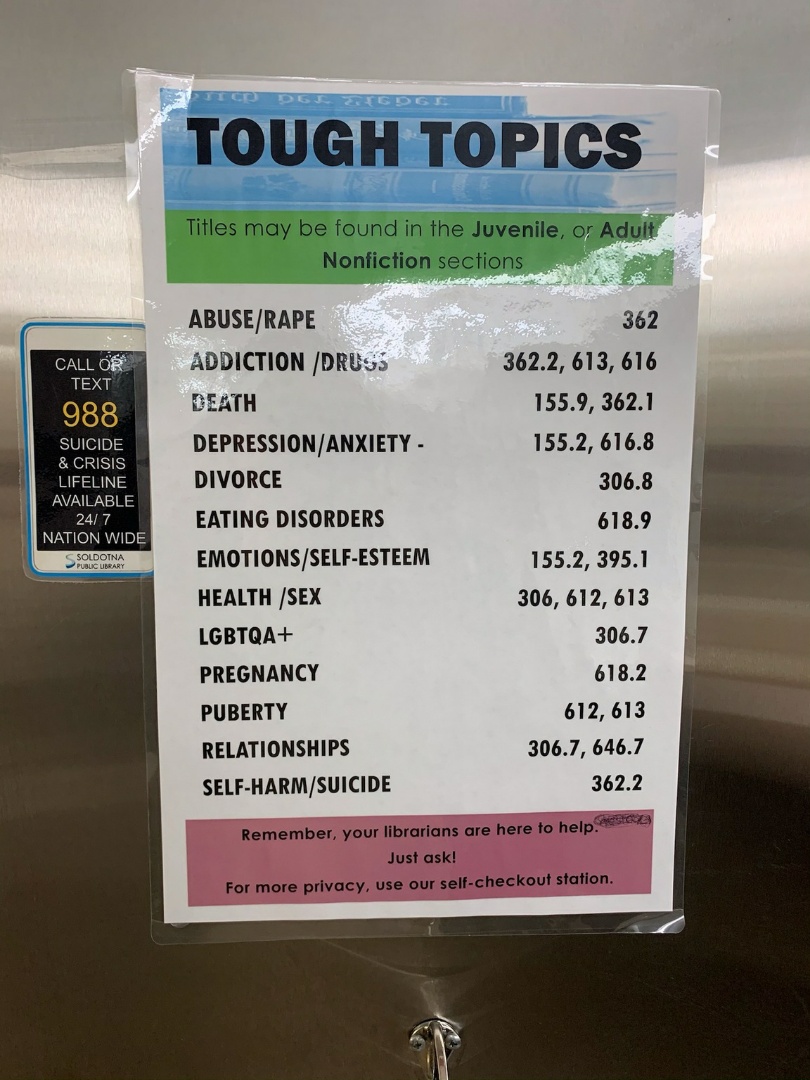
On the insides of the bathroom stalls in the Soldotna Public Library, city librarians have posted some “helpful tips” for books, in a place where children can see them without a parent observing or interpreting: They can find books on rape, abuse, depression, sex, alternative lifestyles, and suicide, and more in either the juvenile or adult nonfiction sections of the library. The Dewey Decimal section numbers are included in the recommendations.
The list doesn’t include where to find books on historical fiction, how-to, or adventure nonfiction, but where to find books that perhaps people don’t want to ask librarians about.
It’s a tip noted in a 2017 edition of School Library Journal, where one librarian published a report about how she used “Bathroom Book Blurbs” to entice students into reading books.
“In every stall and above every urinal, I’ve placed a Bathroom Book Blurb. People read anything when using the restroom—so why not advertise books?” Jamie Leroy wrote in her article about the technique for enticing kids to read certain books.

“When I started my Bathroom Book Blurbs, I saw immediate results. The next day, students asked for the ‘book they saw in the bathroom.’ Kids who’d never come to the library were showing up. I had to buy more copies to meet the demand,” said LeRoy, who was a librarian at Northwest High School in Justin, Texas that year.
Soldotna librarians have taken the Bathroom Book Blurbs to a whole new level, encouraging the reading of social and moral topics that some parents might find sensitive — if they knew what was behind that bathroom door.
The poster is one example of librarians who do not see themselves as neutral agents, but as radical change agents for society and ideological and social entrepreneurs. A 2021 academic paper explores this concept, and how librarians can advance the United Nations’ “sustainability agenda” and “Sustainable Development Goals”:
“Recently, visions of librarians as radical positive change agents (Lankes 2016) have influenced and shaped this debate, raising new questions about neutrality or ‘post-neutrality,’ professional agency and personal and political ideologies. However, what does it mean to be a radical positive change agent? To expand our understanding of the librarian as a radical positive change agent, this paper introduces the concepts of activism and social entrepreneurship. By highlighting similarities and differences between the concepts of the change agent, the activist and the social entrepreneur, this paper aims to inform future discussions about the proactive role of librarians working for change. The current focus on how librarians should act as agents for change in relation to the UN sustainability agenda and the Sustainable Development Goals (SDGs) serves as an example throughout. The paper concludes by posing questions for further discussions of how the concepts of the change agent, the activist and the social entrepreneur might expand our understanding of the proactive librarian and how they might translate to the practice of librarianship in the era of ‘post-neutrality.'”
The paper goes on to explain that “Today, there seems to be widespread recognition that librarians should be proactive change agents and drivers of change” and should “initiate the change that is urgently needed facing global challenges like climate change, poverty, hunger, gender equality etc.”