
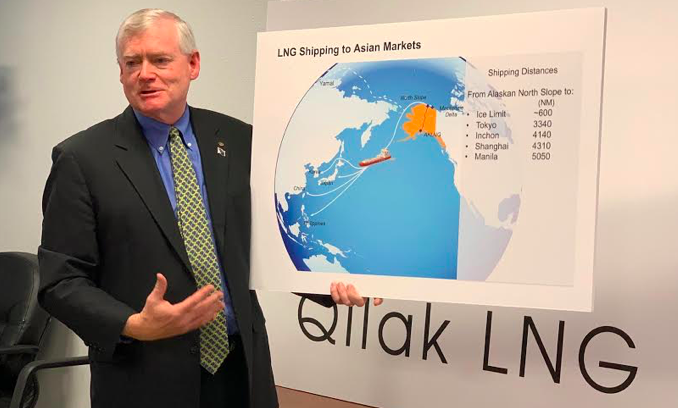
A company led by former Lt. Gov. Mead Treadwell plans to ship Alaska natural gas from the Point Thomson field on the North Slope across the Arctic Ocean and to markets in Asia, including Japan, Korea, and the Philippines.
Qilak LNG has signed a “heads of agreement” with Exxon, which could provide 560 million standard cubic feet per day to an off-shore liquefaction plant, which would also be a loading terminal for icebreaking tankers.
A similar project is now in full production in Yamal, Russia, with a second such project on the way.
For years, Alaska has been stuck with stranded gas, and the AK-LNG project, an 800-mile pipeline to Nikiski, has been seen as not financially feasible with the prices of natural gas expected to remain low for some time. But shipping natural gas by tanker rather than across land has advantages — some environmental, and some simply market forces that any project must “rock and roll with,” said Treadwell today.
[Read: Elizabeth Warren has a plan to kill Alaska LNG ports]
Shipping natural gas from the Beaufort Sea is also nearly as close to Asia as the Nikiski terminus of the Alaska LNG project, which is only 40 miles closer to some north Asian customers.
The project would require as many as 15 specially built icebreaking tankers, which themselves would be run on LNG. The tankers have heavy propellers that help the vessel crunch through the ice, stern first. When the vessel reaches open water, it can then proceed bow first to its destination.
Treadwell said he had a conversation with Gov. Michael Dunleavy today and said the governor is interested in monetizing Alaska’s gas. By making the gas commercially viable, it would also put more petroleum condensate into the Trans Alaska Pipeline System, which generates royalties and taxes for the state, the North Slope Borough, and Valdez.
[Read: Former Gov. Walker trying to point gasline to Valdez again]
Treadwell and other company executives made the announcement today to a gaggle of reporters in downtown Anchorage, where they are opening an office to complete a feasibility study, environmental impact statement, and export permits that will lead to a final investment decision by 2021. Financing could come form the Bank of Japan; Japan has shown an interest in helping the U.S. balance its trade, and LNG exports could do a lot to correct the imbalance.
Treadwell said the project would not necessarily negate the existing AK-LNG concept. But, he said, “To quote Wally Hickel, I’ll buy the champagne and pop the cork,” if AK-LNG can get off the drawing board. The final environmental impact statement on AK-LNG is due next year from the Federal Energy Regulatory Commission.
Qilak LNG is a subsidiary of Lloyds Energy of Dubai. Lloyds would buy the gas itself from Exxon and bring it to projects that it owns in Asia, such as floating regassification plants or power plants, or to utilities owned by other entities.
The company views natural gas as a bridge fuel, and can help countries in Asia move from less environmentally friendly energy sources such as coal-fired power plants, said David Clarke, former BP executive who is Qilak’s COO and president.


