BUDGET VETOES HAVE THIS TOWN IN A TWIST
Fairbanks is a town divided. Some residents support state budget cuts — which are coming in at 12.5 percent of the entire state budget.
Others, including the daily newspaper of the Golden Heart City, do not support the $400 million in cuts, and want a legislative override.
Former Rep. Al Vezey of the greater Fairbanks Borough may or may not be in either camp, but one thing he is clear on is that the legislative meetings in Juneau do not qualify as the second Special Session. They are simply meetings. Vezey filed a lawsuit Wednesday to ask the court for an injunction against those proceedings.
The Vezey complaint, which names House Speaker Bryce Edgmon and Sen. President Cathy Giessel, says that the two presiding officers acted in contempt of the constitutionally ordained mandate to comply with Gov. Michael Dunleavy’s executive proclamation, which set the venue for the second Special Session in Wasilla.
“The assembling of legislators in Juneau, Alaska is nothing more than a gathering of members of the legislature,” his complaint reads. “This gathering is and was instigated through the President of the Alaska State Senate and the Speaker of the Alaska State House of Representatives by virtue of their ex officio authority.”

The complaint asks the court for a declaratory judgment that the currently convened meetings in Juneau do not constitute an actual meeting of the Special Session, and that anything coming out of those meetings does not have the force of law. And it asks for an injunction, compelling Giessel and Edgmon to convene the Special Session in Wasilla, where the governor called it.
It’s an argument that judges will be loathe to involve themselves because both sides are politically motivated and have much at stake.
NEWSPAPER REVEALS ITS CARDS
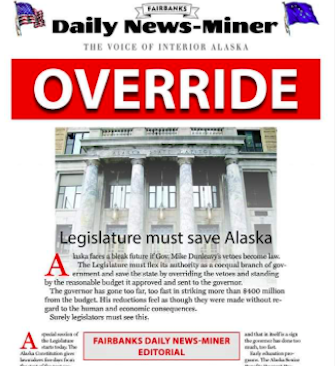
Two days earlier, the Fairbanks NewsMiner published a full-page, front-page editorial titled “override.”
Conservatives in Fairbanks say that the newspaper, circulation about 9,000, has all but destroyed its credibility over this decision to turn completely political and will likely lose hundreds of subscribers with its breathless declaration: “Legislature must save Alaska.”

In fact, it is extremely rare for a newspaper to use its front page real estate to express the owner’s opinion. It would have been done only with a robust discussion of the editorial board.
But the newspaper is now owned by the nonprofit Snedden Foundation, which bought the newspaper in 2015. The Snedden Foundation’s top employees are all NewsMiner staffers, and the newspaper is the foundation’s sole business line. The Snedden Foundation will have some explaining to do to the IRS this year for its clear attempt to influence legislation by becoming a propaganda organ.
[View the Snedden Foundation’s tax filings from 2017]

Front page editorials are an oddity, but not without precedent. In the rare occasions they are used, they stir controversy in their communities about the appropriateness of dedicating what is considered to be “neutral space” to the newspaper’s opinion. Some examples of other newspapers that have dabbled in the practice include:
1951: President Harry Truman fired Gen. Douglas MacArthur for insubordination. The New York Journal American condemned the action on the front page.
1953: With fighting ending in Korea, William Randolph Hearst Jr. wrote “The Korean Truce” editorial on the front page of the Albany, N.Y. Times Union.
But rarely do frontage editorials take up the entire page, as the NewsMiner chose to do. It’s a huge risk for the newspaper, and harms the credibility of reporters covering the issues.
REPUBLICANS SPLIT
At a meeting of Fairbanks Republicans a week and a half ago, Rep. Steve Thompson, a Republican who now caucuses with the Democrats, took a barrage of polite but pointed criticism from his fellow Republicans for not standing with Republicans in support of the governor. His appearance at the Friday Republican luncheon was nothing short of disastrous for him and few in Fairbanks political circles think he will have the stomach to run for re-election.
Steve Lundgren, president and CEO of Denali State Bank and another Republican, testified to the House Finance Committee this week that his bank wanted veto overrides because, well, the bank is a holder of several University of Alaska bonds, and he’s worried about the value of those bonds. Unfortunately, Lundgren demonstrated that his invited expert testimony about the state budget was motivated.
Fairbanks is, in many ways a university town, and the $135 million haircut to the university budget will hit many families hard. There will be consolidation, job losses, and degree programs scrapped. Hundreds of jobs could be eliminated, and that’s of no small concern to a town that takes pride in the Fairbanks campus and has fought for it year after year, battling for supremacy over the growing Anchorage campus.
As elsewhere in the state, Fairbanks residents are taking sides, and it’s not only Democrats nicking Republicans over the budget, but someRepublicans also attempting to convince legislators to override the vetoes.
They have until Friday; after that, the budget that is signed is the budget that sticks for Fiscal Year 2020, and the university — in Fairbanks and at all the other 16 campus locations in Alaska — will need to adapt to a new reality.