
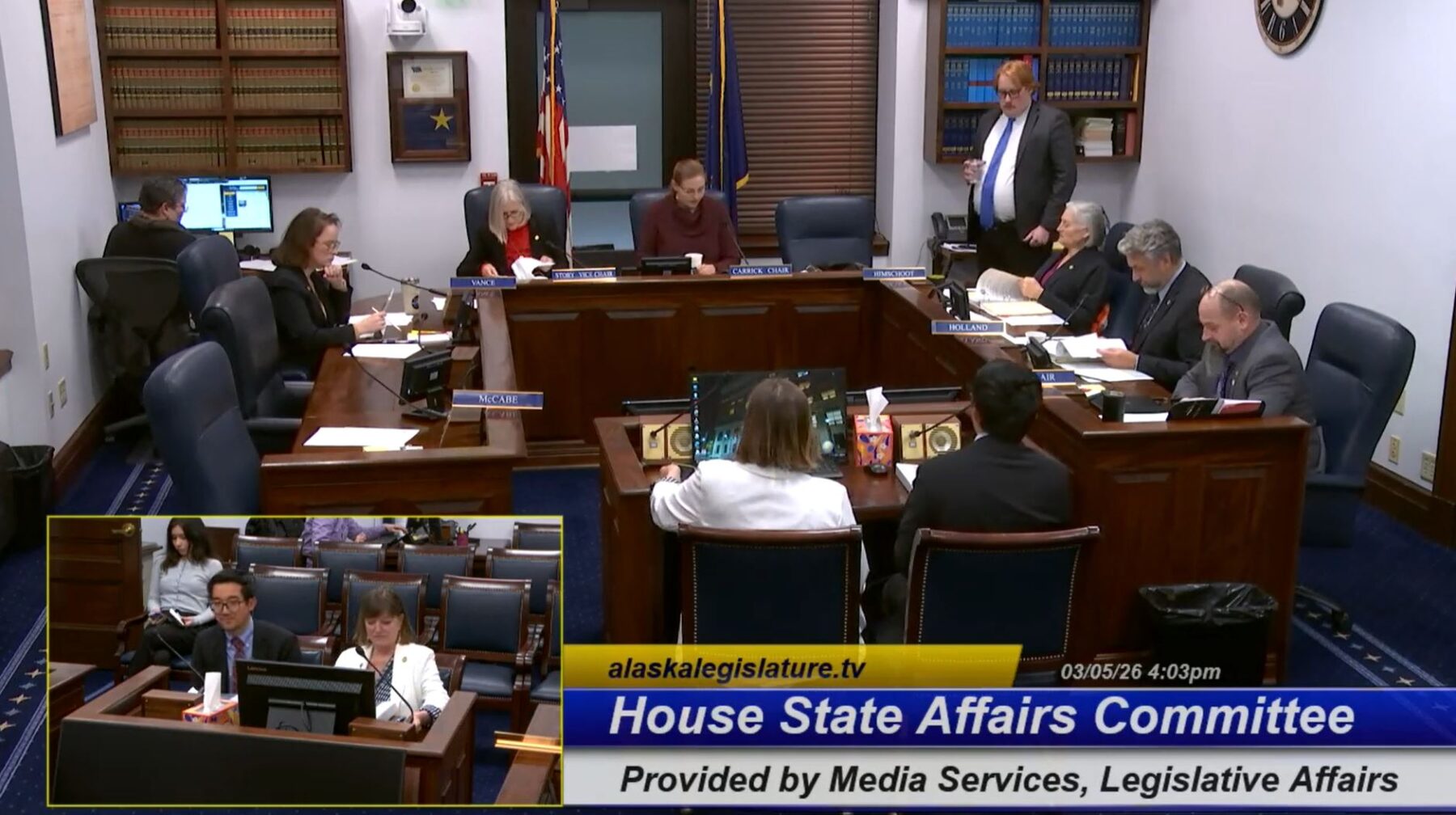
The House State Affairs Committee revisited HB 152, sponsored by Rep. Alyse Galvin (NA-Anchorage), which proposes an “education head tax” to address Alaska’s persistent structural fiscal deficit. The bill, in its fifth hearing, combines a flat $150 annual head tax on wage earners with a tiered 4% income tax on earnings above $150,000 for single filers or $300,000 for joint filers. Amid discussions on amendments and fiscal modeling, committee members weighed the measure’s potential to generate $300-350 million annually against the state’s high cost of living and local tax burdens.
Rep. Galvin opened by contextualizing Alaska’s revenue challenges: oil now contributes only about 30% of state funds, down from 90%, with Permanent Fund earnings at around 40%. “We need broad-based revenue,” she asserted, highlighting equity for nonresident workers in high-wage sectors like oil and gas. The bill closes the “S Corporation loophole,” ensuring pass-through owners pay the 4% on excess income.
Staffer David Jiang estimated the bulk of revenue from the tiered component, with the head tax adding a smaller share. Rep. St. Clair (R-Wasilla) questioned the “education tax” label, prompting Galvin to explain its intent to fund public education transparently. “And I just want us to be mindful that sometimes it’s helpful for folks to understand why we have a bill in place, especially like this. And I thought that the language of education tax would help people understand. The reason that I am having the nerve, the courage, Or the crazy head to come forward with a tax. Is that I know? We’ve got a problem. And gosh darn it, we haven’t had another solution yet to fix it. We should have by now, but we haven’t. And so here I am,” Galvin stated, referencing a planned $500 million draw from the Constitutional Budget Reserve (CBR) amid higher returns elsewhere.
Chair Carrick noted that pairing HB 152 with her royalty dividend bill could eliminate next year’s deficit, potentially creating a surplus, but emphasized the need for deeper analysis. She requested modeling for a $100,000 threshold, which Jiang suggested could yield over $600 million if lowered to $75,000, factoring in projects like Pikka and Willow.
Rep. Holland (NA-Anchorage) advocated a virtuous cycle linking taxation to education investment, proposing phased implementation and a digital wallet to minimize federal tax leakage on Permanent Fund Dividends (PFDs). Jiang clarified constructive receipt doctrine: “The federal government treats income as taxable when it’s under taxpayer control. The distinction is if the head tax or the four percent flat tax were automatically applied to whatever the tax amount is without any choices to pay DMV fees, hunting fishing license fees. That amount that is going towards state taxes wouldn’t be taxed federally… the remaining balance as it is current day would be taxed federally… if you had a $1,000 PFD, paying that $150 head tax, is not going to be taxed additionally on the federal level, but $850 would go on to be taxed federally. If that option were to be expanded to include hunting and fishing license fees, DMV fees, then that whole amount would go under federal taxes… there’s no state taxes that are levied on the PFD. It’s just federal.”
Equity and burden concerns dominated. Rep. Vance (R-Homer) highlighted Alaska’s 5% total tax burden versus the 11% U.S. average, but stressed 25-30% higher costs—utilities 57% above national, food 27%, transportation 17%. “A tax of any form is going to be a burden,” she said, citing her district’s high taxes in Homer and Seldovia with perceived fewer services. She opposed statewide income tax per her mandate but urged ROI analysis and in-state modeling, criticizing ISER’s lack of local data.
Vice Chair Story (D-Juneau) addressed purchasing power disparities: “$150 buys more in Juneau than Skagway or Haines,” and warned of inaction’s costs—lost services, recruitment woes, economic deterrence. Galvin reiterated federal bars on nonresident-only taxes and tied stability to workforce retention, noting $127 million in public employee recruiting/training.
Rep. Himschoot (NA-Sitka) praised Galvin’s courage, noting 13 of her 21 communities self-tax, resisting added burdens for unserved areas. She floated a 25% summer sales tax with winter rebates via PFD, emphasizing quality-of-life intangibles amid rising costs pushing “breaking points.”
Chair Carrick sought local tax comparisons—e.g., a $152,000 family in Bethel (10% sales tax) versus Fairbanks or Anchorage—and queried state offsets for high local rates. Galvin cautioned legal complexities: “A broad-based tax is a broad-based tax,” avoiding jurisdictional entanglements. She stressed constitutional mandates for education and roads, plus improved bond ratings from stable revenue.
Vance scrutinized the DOR fiscal note’s 70 new positions and FY 2030 cost spike, urging updates for 7-10,000 new workers in North Slope/LNG projects and seasonal seafood declines (81-82% nonresident, low-wage). Jiang cited Labor Department data: oil/gas 40.5% nonresident, wages hitting the 4% threshold; seafood below.
Carrick affirmed HB 152’s substantive dent in deficits but noted it doesn’t guarantee local relief or upfront investments. Amendments are due Monday, with potential action Thursday.
This hearing underscores Alaska’s fiscal crossroads: balancing revenue needs against affordability in a high-cost state.


