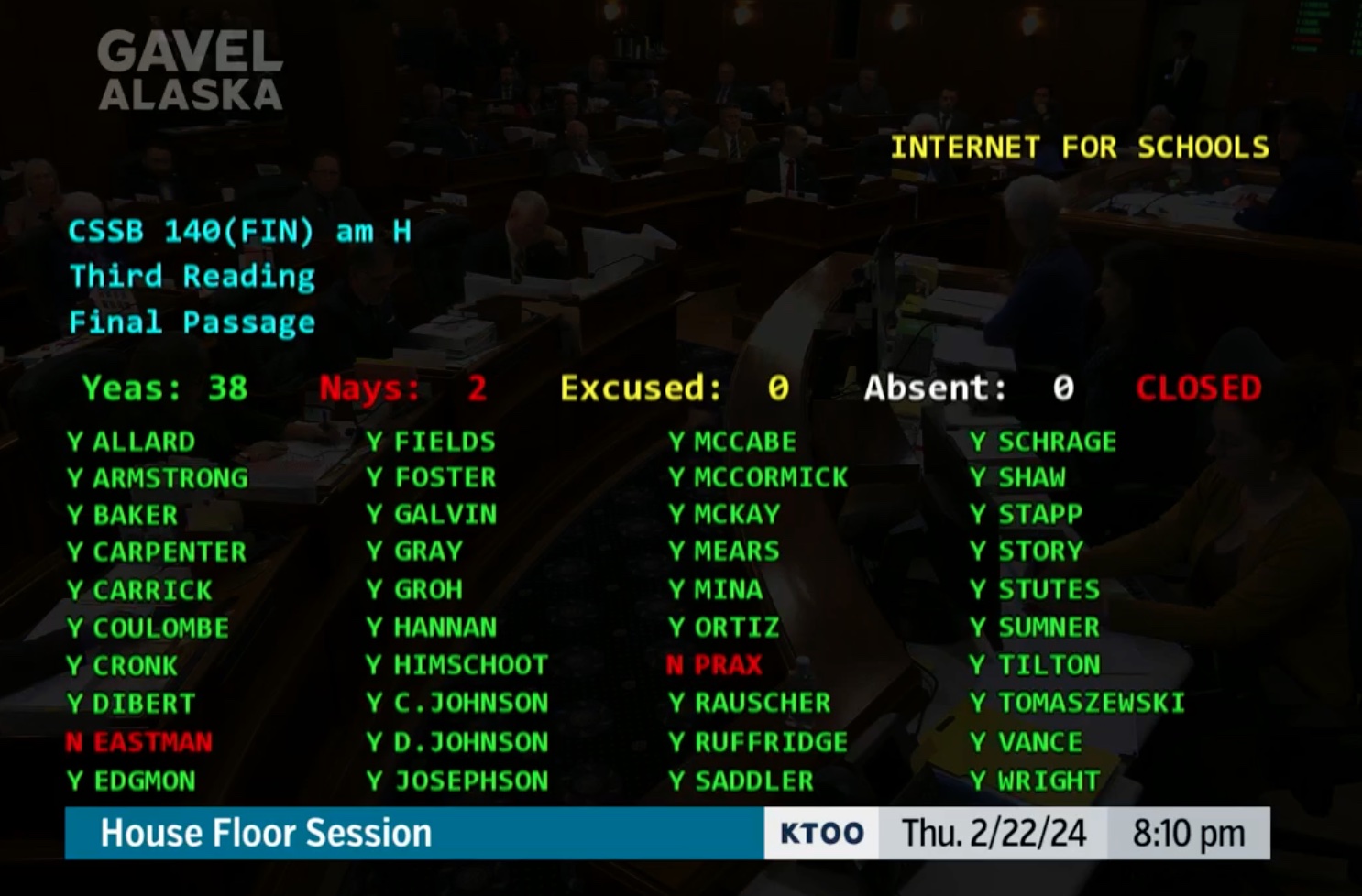
After days of caucusing and partisan bickering, the Alaska House of Representatives passed a major committee substitute for Senate Bill 140, as an omnibus education package that includes a hike to the base student allocation (BSA) that adds $175 million to school districts in the fiscal years going forward. The bill has money for the Reads Act, student transportation, and support for correspondence and charter schools, and grants for rural school internet.
Rules Chair Rep. Craig Johnson reminded legislators that in the Legislature no one ever gets everything he or she wants. That became the theme of the night, with many legislators standing to agree that the bill isn’t perfect, but it allows schools to plan for next year.
“The best thing we did we today for student retention is to give them [schools] some certainty,” Johnson said, adding that he hopes he does not regret his vote in favor of the bill and that schools spend the money wisely.

The base student allocation, as the bill now stands, will increase by $680 per student, the first increase to the permanent formula in many years. This means in future years, the cost will be added into school funding’s baseline formula. The Democrat minority had sought amounts of up to $1,400.
The final compromise was not as comprehensive as the Republican-led House Majority had initially hoped; however, caucus members consider the final product a “path forward that has the possibility of surviving a conference committee with Senate colleagues,” the majority wrote in a statement.
“Major wins for the House Majority include additional support for Alaska families who choose correspondence programs by improving parity with brick-and-mortar schools; support and protections for Alaska’s charter schools; increased funding for pupil transportation and additional support for ongoing implementation of the READS act designed to ensure all Alaska students are reading proficient by the 3rd grade,” the majority said.
“The House has been having some difficult but necessary conversations during the last few days. As we said at the beginning of session, education was going to be one of our top priorities and we delivered on that promise. While the final bill fell short of what we’d proposed earlier, I’d still call it a ‘qualified’ success. Given what was at stake, failure was not an option,” said House Speaker Cathy Tilton.
Rep. Tom McKay of Anchorage expressed hope that the ability to work together to pass education funding would bode well for working together on other priorities, such as the need to ensure lower-cost energy in the future.
“This BSA increase will otherwise be consumed by energy costs,” he said.
Rep. Frank Tomaszewski of Fairbanks said that support for the schools at Eielson Air Force Base outside of Fairbanks is a state duty and he was happy the two sides of the political aisle could work together to meet that commitment, since school closures are pending in Fairbanks.
Rep. Bryce Edgmon of Dillingham reminded colleagues that the underlying purpose of the bill was for internet in rural schools, but the House has done something historic, which is to not wait until the final days of session to resolve education funding. And this would be a major help to school districts, he said.
The bill contains the $40 million in Broadband Access Grant funds for better internet access and speeds for schools in rural Alaska. The BAG provision was time-sensitive because those monies must be appropriated by Feb. 27.
“Twenty-four hours ago I was doubtful we could get where we are tonight and I hope it sets the tone to get the budget out … on time,” Edgmon said. Edgmon represents districts that will benefit from the BAG grants.
Rep. Mike Cronk of Tok said he was frustrated that the education lobby had used children as pawns to get votes, and admonished them to not do that in the future.
Others described the past few days as a “tough” and “ugly” process, and said the final bill was a compromise and it was good that lawmakers persevered. The mood was hopeful that the progress would mean the razor-thin majority and minority would be able to continue to work on other major issues.
The bill will return back to the Senate, where it may be changed and will be hammered out in a conference committee between the two bodies.