
Editor’s Note: This story was updated on 2/5/2026 to clarify that the State’s spending growth was at approximately 6% each year before Dunleavy took office. Dunleavy has kept budget growth at 1% during his tenure.
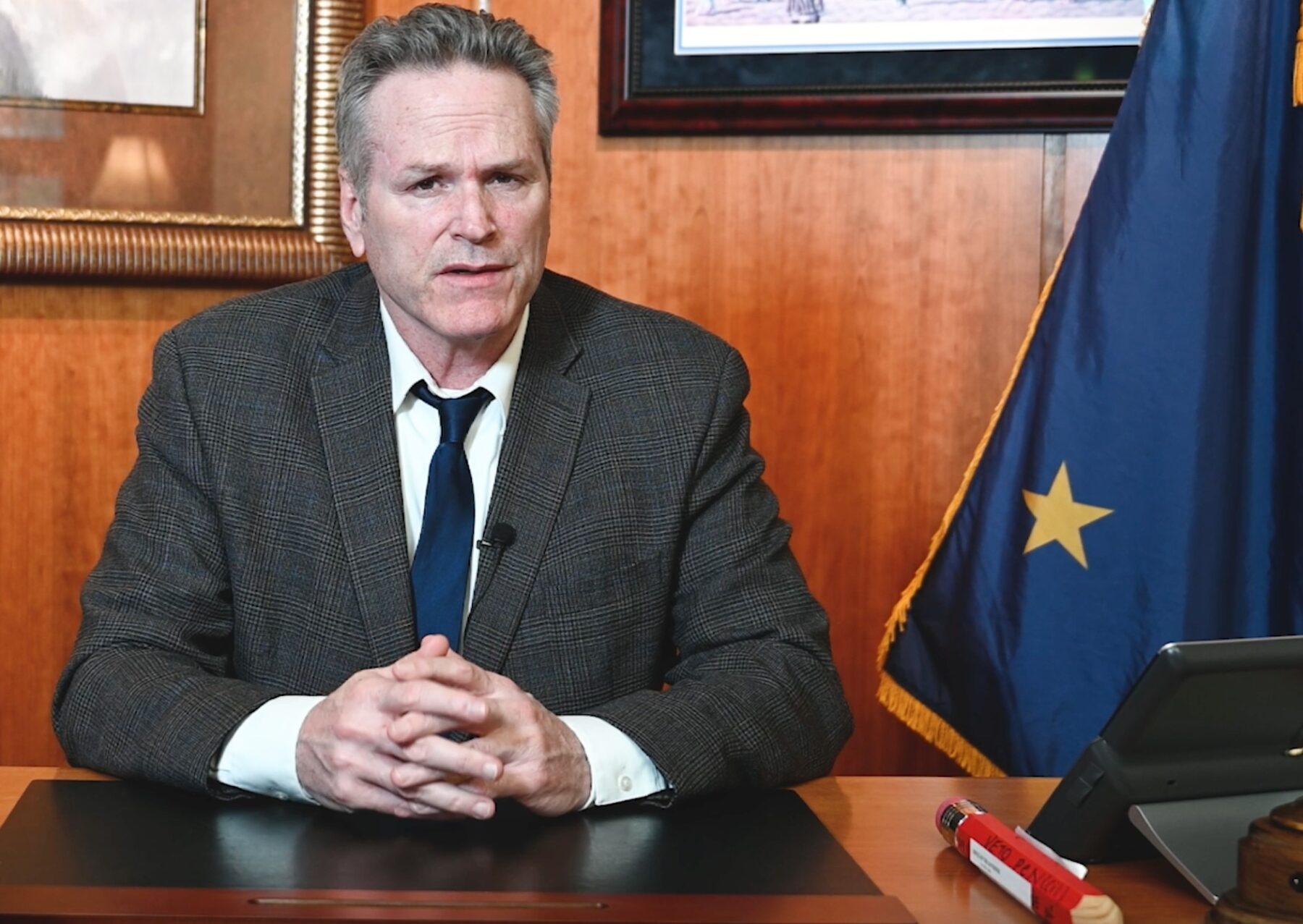
Yesterday, February 3, Commonwealth North invited Governor Dunleavy to speak to members and guests at former Lieutenant Governor Mead Treadwell’s house. Governors Bill Egan and Walter Hickel founded Commonwealth North in 1979 with the mission to “educate Alaskans on significant public policy issues and assist in identifying effective solutions.” Seats left over after members registered were available to the public for $50. Dunleavy shared key insights about his fiscal plan with attendees.
The Spending Problem
According to Dunleavy, Alaska has never had a fiscal plan in its history. Currently, Alaska analyzes oil and gas prices to set the budget, and the Legislature tells the Governor how much they expect will be available for the budget depending on oil and gas. Dunleavy stated that this strategy leads to high volatility with oil and gas prices rising and falling unpredictably. The Legislature often raises the budget when oil and gas go up but often fails to lower the budget when oil and gas falls. This had led to spending growth of approximately 6% each year before Dunleavy took office. Dunleavy has been able to keep the budget growth at 1% during his tenure.
Alaska’s Unique Economy
Dunleavy highlighted two unique facts about Alaska’s economy that play critical roles in his approach to the fiscal plan. First, he said that Alaska “excepts as normal what is not normal in the rest of the states, or even in the world.” According to Dunleavy, this unique Alaska “normal” is the absence of a sales tax. Other states and countries that rely on resource-based revenue have a sales tax to act as a stabilizer. The absence of this stabilizer and Alaska’s high economic volatility turns off potential investors.
The second unique fact is that Alaska experiences an “economic bubble” in the summer due to tourist season. No other state experiences a seasonal tourism impact to the extent that Alaska does. Dunleavy proposed a seasonal sales tax that would capture tourist activity as revenue for the state.
Protecting the PFD
Although acknowledging the State’s need to change its spending habits, Dunleavy affirmed the Permanent Fund Dividend as belonging to the people and as an important expense that should not be diminished for the Legislature’s convenience. According to Dunleavy, the PFD should serve as brakes for the Legislature. Dunleavy argued that requiring a full PFD puts “brakes” and “guardrails” on the Legislature because taking from the PFD eliminates the voice of the people, but considering a new tax involves discussion and includes the people’s voice.
Furthering his argument for a full PFD, Dunleavy stated that diminishing the PFD pushes some families into poverty. Those families then seek out State welfare, which costs the State money. He indicated that this may cause an unintended expense that may outweigh the expense of issuing the full PFD.
When asked why seek a sales tax rather than cut the PFD or levy an income tax, Dunleavy responded by referencing the recent study from the Institute of Social and Economic Research (ISER). The study analyzed several fiscal options for Alaska and found that a sales tax would cause the least impact to Alaskans compared to other options such as an income tax or a diminished PFD.
Summary of Dunleavy’s Fiscal Plan
Dunleavy provided attendees with a handout containing a summary of his fiscal plan. The plan proposes 10 rules “that give structure to the budgeting and revenue process.”
- Limit spending growth to 1%. The current spending growth rate of approximately 6% each year is out of control. The Legislature must limit its spending growth.
- Establish a revenue cap. Currently, when revenue increases, government spending increases. Dunleavy proposes the Legislature set a revenue cap, meaning a maximum amount of revenue that can be included in the budget. Any additional revenue would then be invested.
- Additional revenue not used in the budget will be split 50/50 between the Permanent Fund and the Constitutional Budget Reserve.
- Preserve the Permanent Fund by combining the Earnings Reserve Account with the Permanent Fund Corpus, set a maximum 5% Percent of Market Value draw, and maintain a 50/50 split between government spending and the PFD. The plan estimates a $3,600 annual dividend for Alaskans over the next 10 years.
- Establish a government sunset and reauthorization process. This process would require the State to regularly “review the efficacy of state agencies and determine if those agencies should be terminated, continued, or reorganized to better serve the public.”
- Institute a seasonal sales tax of 4% from April to September and then 2% from October to March. The sales tax is to expire in January 2034. Estimated revenue is $730 million.
- Eliminate the corporate income tax. Although this change would result in an estimated $602 million loss of revenue, it would encourage more investment in Alaska. According to Dunleavy, investors are highly disincentivized to invest in Alaska because of its remote location away from the market, absence of interstate connection, and harsh climate. The corporate income tax only disincentivizes investors more.
- Market Based Sourcing. Estimated revenue is $25-65 million.
- Increase the minimum production tax floor for oil and gas from 4% to 6% until January 2032 when it will revert back to 4%. Estimated revenue is $130 million.
- Institute a $0.15 per barrel fee for Alyeska Pipeline. Estimated revenue is $25 million yearly.
Dunleavy admitted the plan as is will likely not pass the Legislature. He said that although he would like to see everything pass, he would be happy if at least some of the plan passed the Legislature this session. As always, the State’s fiscals are a key focus in the Legislative session. Must Read Alaska will continue to provide readers updates regarding the budget.


