
HAS COURTS NOW PAYING FOR ABORTIONS THEY DEMAND
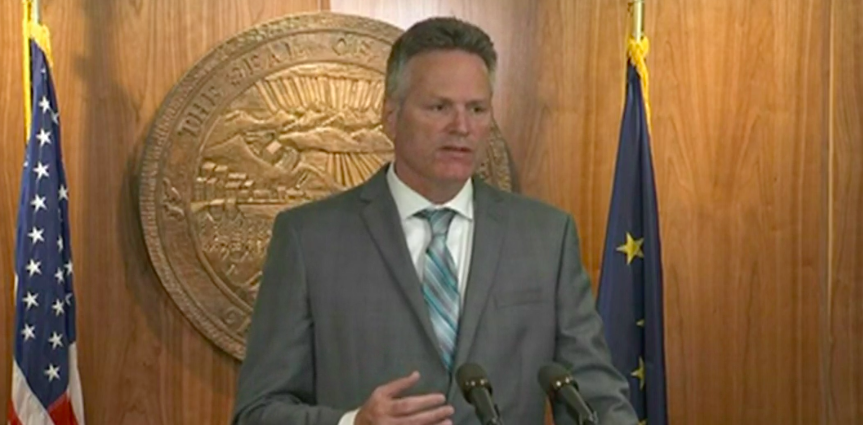
Gov. Michael Dunleavy, without getting some of his key legislation passed by the Legislature, is balancing the State budget with savings.
Even then, he said today, the budget is only halfway to being in line with revenues, with $444 million in additional cuts made for a total of about $700 million, which includes the cuts made by the Legislature. The budget excludes a Permanent Fund dividend appropriation.
The deficit remaining is about $850 million, and that money will come out of the Earnings Reserve Account of the Alaska Permanent Fund.
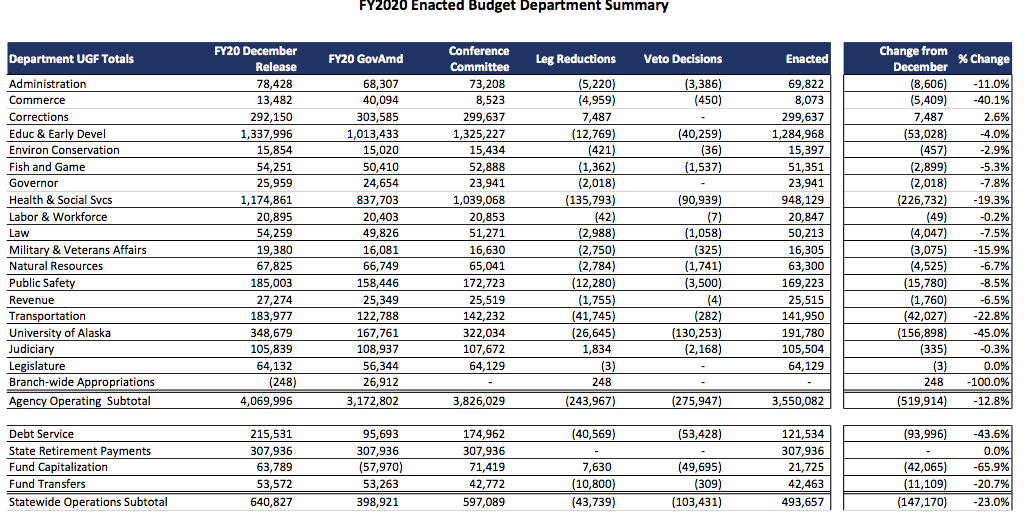
The budget for 2020 is $4.9 billion in general fund spending, a 12.8 percent reduction from the Gov. Bill Walker budget, and the lowest spending level since 2005.
The original budget proposed by Dunleavy would have trimmed 21 percent from the Walker budget, which had grown from the previous year.
Here are some of the highlights of the cuts to state spending:
ITEMS OF INTEREST
MEDICAID ELECTIVE ABORTIONS
The governor vetoed $335,000 from the administrative costs of the court system. It was his way of saying that if the state’s judges insist on standing by their ruling that the State of Alaska must pay for elective abortions with State funds, they’ll have to pony up the money out of their own budget. It’s a small cut to the Judiciary of less than one percent.
$334,000 is the amount the State spend last year on elective abortions. Both the House and Senate passed a budget with intent language that said no state funds may be used to pay for abortions, but an existing State Supreme Court ruling says otherwise.
The federal government prohibits paying for elective abortions with federal funds, due to what is called the Hyde Amendment. And the governor is also opposed to the public treasury being used for elective abortions.

MEDICAID (IN THE DEPARTMENT OF HEALTH & SOCIAL SERVICES)
The legislature reduced the State Medicaid program by $75 million, and the governor added another $50 million in cuts, for a total of $125 million. This leaves $2 billion for Medicaid spending in Alaska.
UNIVERSITY OF ALASKA
As expected, the entire cut to the University of Alaska system is $130.2 million, which includes the $5 million that was cut by the Legislature. This is a huge haircut that will require structural changes in how the university operates, and is something the Board of Regents has begun to tackle, as their funds become scarce July 1. The university system currently has 17 campuses.
SENIOR BENEFITS / WWAMI / PUBLIC BROADCASTING
The entire senior longevity bonus is vetoed. The Senior Benefits Program was established in 2007 and pays cash benefits to Alaskan seniors who are age 65 or older and have low to moderate income. Cash payments are $76, $175, or $250 each month depending on income. Already the State had suspended some of the April and May payments for the higher-income recipients because of a shortfall in funds.
WWAMI survived the veto pen. The University of Washington School of Medicine’s multi-state medical education program for Washington, Wyoming, Alaska, Montana and Idaho (WWAMI) gives medical students access to training, and is used to recruit doctors to Alaska.
PUBLIC BROADCASTING: The only portion of public broadcasting money not vetoed is for the emergency broadcasting provided primarily to rural areas. Vetoed: $2,036,600 for Radio, $633,300 for TV, and $46,700 for the Alaska Public Broadcasting Commission.
SCHOOL BOND DEBT REIMBURSEMENT
Half of the debt service the State has been paying on local school bonds was vetoed. That means school districts will have to rely upon local taxpayers to pay the full debt service for the schools they built or renovated. The veto totals $48,910,250. Future debt incurred by districts won’t be paid off by the State.
EDUCATION
The Legislature’s attempt to forward fund education for 2021 was vetoed. The governor doesn’t believe it is constitutional to encumber future legislatures or future governors with spending promises unless the money is actually set aside for the purpose, which it is not under forward funding schemes. This is an issue that will likely go to court next month.
ALASKA MARINE HIGHWAYS
The State Ferry System was spared. The governor accepted the plan by Sen. Bert Stedman, co-chair of Senate Finance, to only fund the ferries at $46 million. Stedman has been working to reform the system. This allows the ferry system to continue through the fall, winter, and spring.
POWER COST EQUALIZATION
All funds like the Power Cost Equalization Fund will be swept into the General Fund. From there, the Legislature can reissue those funds to rural communities to help with their power costs when it works on the capital budget in a special session.
EARNINGS RESERVE ACCOUNT
The governor is putting $1 billion into the corpus of the Permanent Fund to help with inflation proofing and an additional $4 billion, for a total of $5 billion. The Legislature had put $9 billion into the corpus. The veto amount is $5,579,800.
PERMANENT FUND DIVIDEND
The budget presumes a full statutory Permanent Fund dividend, but it’s not in this operating budget. It will need to be a stand alone budget bill or a component of the yet-to-be-enacted capital budget.
POSITIONS REDUCED
Through vetoes, 62 full time, 2 part time, and 4 non-permanent positions have been eliminated, for nearly $12 million in reduced payroll costs.
VILLAGE PUBLIC SAFETY OFFICERS
$3 million in vetoes to the program, which is already in excess of what they can spend. There are 25 vacancies in the VPSO program and they have struggled to fill those for a long time.
OCEAN RANGERS PROGRAM
The Ocean Rangers program is vetoed, for $3,409,100 in savings.


