
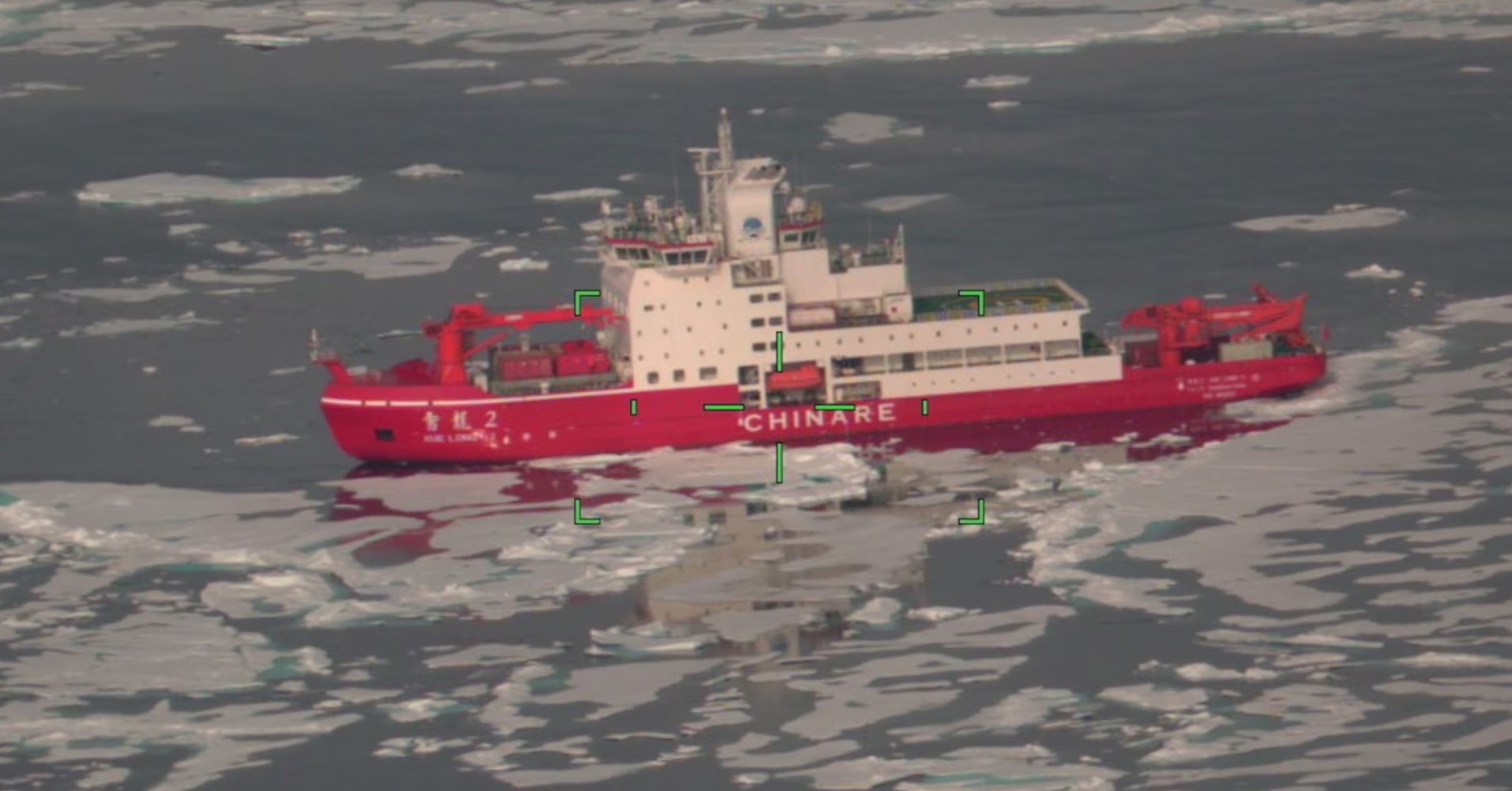
A Chinese government icebreaker was intercepted by the US Coast Guard on Friday after being detected deep within the US Extended Continental Shelf in the Arctic.
The vessel, a Chinese-flagged polar research ship operated by the Polar Research Institute of China, was discovered approximately 130 nautical miles inside the US Extended Continental Shelf boundary, about 290 nautical miles north of Utqiagvik, also known as Barrow. Research by Chinese may include testing the US military security of the area or engaging in other spy activities.
In response, a US Coast Guard C-130J Hercules aircraft from Air Station Kodiak was deployed to investigate under Operation Frontier Sentinel, the Arctic District’s strategic initiative designed to “meet presence with presence” amid rising foreign interest in the region.
“The U.S. Coast Guard, alongside partners and other agencies, vigilantly monitors and responds to foreign government vessel activity in and near U.S. waters to secure territorial integrity and defend sovereign interests against malign state activity,” said Rear Adm. Bob Little, Commander of the Coast Guard Arctic District.
While the Extended Continental Shelf is not considered US territorial waters, the United States holds exclusive rights to manage and conserve the living and non-living resources within the shelf under international law. The incident highlights growing strategic tensions and increased activity by non-Arctic nations, particularly China, in the region.
In recent years, China has steadily expanded its Arctic footprint, describing itself as a “near-Arctic state” despite being geographically distant from the region. It obtained official observer status on the Arctic Council in 2013, giving it access to key discussions about the region’s governance. The Chinese government has invested heavily in polar research, icebreaker fleets, and infrastructure projects as part of its broader “Polar Silk Road” strategy, which aims to establish trade routes and scientific influence in the rapidly changing Arctic.
The presence of the ship in the Extended Continental Shelf reflects this increasing activity, adding to growing geopolitical competition in a region that is becoming more accessible due to technology.
The Coast Guard did not report any violations of international law, but emphasized its continued commitment to safeguarding US maritime interests in the Arctic.


