
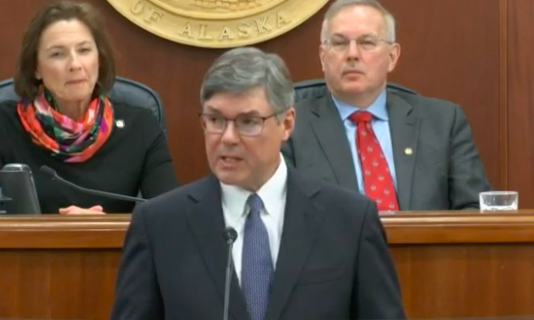
Chief Justice Joel Bolger has told the lawyers in the Recall Dunleavy case that if they think he should recuse himself from the matter, they should move for him to be disqualified.
But if they don’t move to do so, he’ll consider himself qualified to judge the case coming before him and the other Supreme Court judges on March 25, because he doesn’t think his impartiality is compromised.
In a letter to the counsel on each side of State vs. Recall Dunleavy, the court has said that either side could file a motion to disqualify Chief Justice Joel Bolger by Feb. 26.
And yet, there’s another sticky problem: The only lawyer left defending the State against the recall is Margaret Paton-Walsh, who has applied to become a Supreme Court appointee.
Her candidacy for the Supreme Court will have to go through Judge Bolger, who happens to also be the head of the Alaska Judicial Council.
Paton-Walsh is the only lawyer who would ask the Chief Justice to disqualify himself, and would have to do so at her own career peril.
The other lawyers — Jahna Lindemuth, Jeff Feldman, and Susan Orlansky — are working on behalf of the Recall Dunleavy Committee, and Bolger has already signaled that he’s “their guy.”
The legal team that joined the case to fight for the governor has withdrawn, after it became apparent the court was biased.
In the letter signed by Meredith Montgomery, clerk of the appeals court, the court has attached a volume of written material that shows Bolger has spoken out — sometimes directly and sometimes opaquely — against the governor’s policies, and that he met with the governor regarding a matter that is now at the heart of the recall campaign that he will be deciding: The two met last year to discuss the process for appointing judges.
[Read: Refuse to recuse? Chief Justice Bolger was material witness at heart of recall case]
Bolger has, in his letter through Clerk Montgomery, flipped the meaning of Canon 3E of the Code of Judicial Conduct, according to legal observers.
That section reads, “a judge shall disqualify himself or herself in a proceeding in which a judges impartiality might reasonably be questioned.”
In other words, it’s the judge’s duty to recuse himself or herself. He “shall,” if there’s a reasonable question.
But Bolger is playing chicken in a relationship with a state attorney, because he knows he has her at a serious disadvantage, as though to say, “Move to disqualify me if you dare, Ms. Paton-Walsh.”
The letter from the court to the attorneys contains background material, including remarks Bolger has made of a political nature regarding the governor over the past year. Check out the file below:


